Monthly Archives: August 2021

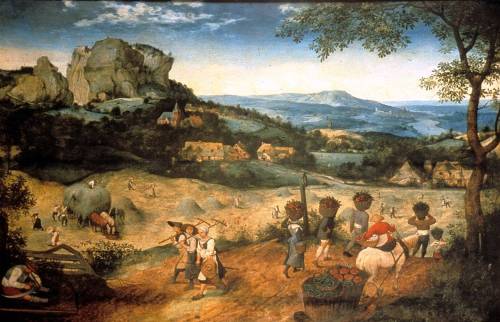
#FineArtFriday: The Hay Harvest by Pieter Bruegel the Elder, 1565

Haymaking,_Pieter_Brueghel_the_Elder (1)Artist: Pieter Bruegel the Elder (1526/1530–1569)

Title: The Hay Harvest

Genre: genre art

Date: 1565

Medium: oil on panel

Dimensions: Height: 117 cm (46 in) Width: 161 cm (63.3 in)

According to the Web Gallery of Art, Haymaking, also known as The Hay Harvest, belongs to the Series of the Months. All the other panels in this series are dated 1565. July and August are the months when most summer crops are harvested. This painting and the August panel (The Corn Harvest) show the bringing-in of the harvest.

Workers scythe grain in the large field toward the center of the painting. In the foreground, other laborers harvest vegetables and pick berries. Everyone works to bring in the food, men, women, and children, as winter isn’t that far away, and the hay will sustain the draft animals in the long cold months ahead.

While each painting in the series shows the traditional occupation of that month, Bruegel’s real subject is the landscape itself, its ever-changing appearance.

I have always loved Bruegel the Elder’s work because he portrays the gathering of food as a fundamental human activity. He shows us that the quantity of food we have on our tables is determined by the knowledge and labor of others.

The variety of foods we have available to us is dictated by the form of the landscape. To carve a living from the earth a farmer must understand and care for the land that sustains them. They must know what areas of soil will be best for each crop and use that knowledge when laying out how the fields will be planted, as each crop has different nutrient requirements. Within one valley, many types of soils will exist, so what serves to grow hay may not work for more delicate vegetables.

In the lush bounty of this painting, Bruegel the Elder shows us the wisdom of farmers, knowledge that sustains us to this day. He illustrates the way all people who grow and gather our food are bound to the land.

In this regard, we who grow food in our back gardens understand and respect the labors of those small farmers who grow produce for our local markets.

About the series, Months of the Year, via Wikipedia:

(Bruegel’s) famous set of landscapes with genre figures depicting the seasons are the culmination of his landscape style; the five surviving paintings use the basic elements of the world landscape (only one lacks craggy mountains) but transform them into his own style. They are larger than most previous works, with a genre scene with several figures in the foreground, and the panoramic view seen past or through trees. Bruegel was also aware of the Danube School‘s landscape style through prints.

The series on the months of the year includes several of Bruegel’s best-known works. In 1565, a wealthy patron in Antwerp, Niclaes Jonghelinck, commissioned him to paint a series of paintings of each month of the year. There has been disagreement among art historians as to whether the series originally included six or twelve works. Today, only five of these paintings survive and some of the months are paired to form a general season. Traditional Flemish luxury books of hours (e.g., the Très Riches Heures du Duc de Berry; 1416) had calendar pages that included the Labours of the Months, depictions set in landscapes of the agricultural tasks, weather, and social life typical for that month.

Bruegel’s paintings were on a far larger scale than a typical calendar page painting, each one approximately three feet by five feet. For Bruegel, this was a large commission (the size of a commission was based on how large the painting was) and an important one. In 1565, the Calvinist riots began and it was only two years before the Eighty Years’ War broke out. Bruegel may have felt safer with a secular commission so as to not offend Calvinist or Catholic. Some of the most famous paintings from this series included The Hunters in the Snow (December–January) and The Harvesters (August). [1]

About the Artist, Via Wikipedia:

Pieter Bruegel (also Brueghel or Breughelthe Elder c. 1525–1530 – 9 September 1569) was the most significant artist of Dutch and Flemish Renaissance painting, a painter and printmaker, known for his landscapes and peasant scenes (so-called genre painting); he was a pioneer in making both types of subject the focus in large paintings.

He was a formative influence on Dutch Golden Age painting and later painting in general in his innovative choices of subject matter, as one of the first generation of artists to grow up when religious subjects had ceased to be the natural subject matter of painting. He also painted no portraits, the other mainstay of Netherlandish art. After his training and travels to Italy, he returned in 1555 to settle in Antwerp, where he worked mainly as a prolific designer of prints for the leading publisher of the day. Only towards the end of the decade did he switch to make painting his main medium, and all his famous paintings come from the following period of little more than a decade before his early death, when he was probably in his early forties, and at the height of his powers.

As well as looking forwards, his art reinvigorates medieval subjects such as marginal drolleries of ordinary life in illuminated manuscripts, and the calendar scenes of agricultural labours set in landscape backgrounds, and puts these on a much larger scale than before, and in the expensive medium of oil painting. He does the same with the fantastic and anarchic world developed in Renaissance prints and book illustrations.

He is sometimes referred to as “Peasant Bruegel”, to distinguish him from the many later painters in his family, including his son Pieter Brueghel the Younger (1564–1638). From 1559, he dropped the ‘h’ from his name and signed his paintings as Bruegel; his relatives continued to use “Brueghel” or “Breughel”. [2]


Credits and Attributions:

Wikimedia Commons contributors, “File:Haymaking, Pieter Brueghel the Elder.jpg,” Wikimedia Commons, the free media repository, https://commons.wikimedia.org/w/index.php?title=File:Haymaking,_Pieter_Brueghel_the_Elder.jpg&oldid=431869636 (accessed August 5, 2021).

[1] Wikipedia contributors, “Pieter Bruegel the Elder,” Wikipedia, The Free Encyclopedia, https://en.wikipedia.org/w/index.php?title=Pieter_Bruegel_the_Elder&oldid=1028859234 (accessed August 5, 2021).
[2] Wikipedia contributors, “Pieter Bruegel the Elder,” Wikipedia, The Free Encyclopedia, https://en.wikipedia.org/w/index.php?title=Pieter_Bruegel_the_Elder&oldid=1028859234 (accessed August 5, 2021).

Comments Off on #FineArtFriday: The Hay Harvest by Pieter Bruegel the Elder, 1565

Filed under #FineArtFriday

Character Development: Showing Emotions

Most authors who have been in writing groups for any length of time become adept at writing emotions on a surface level. We bandage our wounded egos and work at showing our characters’ inner demons. We spend hours writing and rewriting, forcing words into facial expressions.

depth-of-characterHappiness, anger, spite – all the emotions get a description. Eyebrows raise or draw together; foreheads crease and eyes twinkle; shoulders slump and hands tremble. Lips turn up, lips curve down, and eyes spark – and so on and so on.
Using facial expressions as dialogue tags can work when done sparingly and combined with a conversation.

But that solution can easily become a crutch that keeps us from delving deeper into our characters.

Also, it’s aggravating when it becomes repetitive.

And this brings me to the core of this post. In the early drafts of my most recent work in progress, I struggled to give my characters balanced personalities. During NaNoWriMo, when I was writing new words as quickly as I could, I leaned too heavily on the external, with a LOT of smiling and shrugging.

Those facial expressions were code words for the second draft, places where more work would be required to flesh out the scene.

Nothing is more ordinary than a story where a person’s facial expressions take center stage, hollow displays of emotion with no substance. Lips stretch into smiles, but the musculature of the face is only a small part of the signals that reveal the character’s interior emotions.

Then, there are the stories where the author leans too heavily on the internal. Creased foreheads are replaced with stomach-churning, gut-wrenching shock, or wide-eyed trembling of hands.

And don’t forget the recurring moments of weak-kneed nausea.

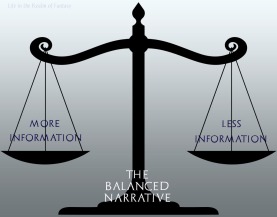
the balanced narrativeFor me, the most challenging part of writing the final draft of any novel is balancing the visual indicators of emotion with the more profound, internal clues.
It takes effort to write a narrative so that we aren’t telling the reader what to experience. We allow the reader to infer what to feel (remember we are still in the inferential layer of the Word-Pond). We must make the emotion feel as if it is the reader’s idea.

If you haven’t seen this before, here is my list of surface emotions:

  • Admiration
  • Affection
  • Anger
  • Anguish
  • Anticipation
  • Anxiety
  • Awe
  • Confidence
  • Contempt
  • Defeat
  • Defensiveness
  • Denial
  • Depression
  • Desire
  • Desperation
  • Determination
  • Disappointment
  • Disbelief
  • Disgust
  • Elation
  • Embarrassment
  • Ethical Quandary
  • Fear
  • Friendship
  • Grief
  • Happiness
  • Hate
  • Inadequacy
  • Indecision
  • Interest
  • Jealousy
  • Love
  • Lust
  • Powerlessness
  • Pride
  • Regret
  • Resistance
  • Revulsion
  • Sadness
  • Shock
  • Surprise
  • Temptation
  • Trust
  • Unease
  • Weakness

These are emotions you can show with either a facial expression or a physical reaction, combined with internal dialogue or conversations.

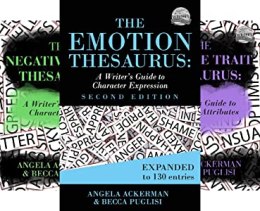
emotion-thesaurus-et-alI have mentioned The Emotion Thesaurus by Angela Ackerman and Becca Puglisi. Sometimes all we need is a hint of how to show what a character is feeling, someone to point the way when we’re suffering from a blank mind.

Just don’t go overboard when describing emotions, as it can turn into mawkishness, maudlin caricatures of emotions, and over-the-top melodrama.

Readers form mental visions of the scenes you describe, and you don’t want them to find your protagonist’s reactions repulsive.

A few subtle physical hints and some internal dialogue laced into the narrative show a rounded character, one who is not mentally unhinged.

Each of us experiences emotional highs and lows in our daily lives. We have deep-rooted, personal reasons for our emotions.  Our characters must have credible reasons, too. A flash of memory or a sensory prompt can inspire emotions that a reader can empathize with.

Why does a blind alley or a vacant lot make a character nervous?

Why does a grandmother hoard food?

Why does the sight of daisies make an old woman smile?

Writing genuine emotions requires practice and thought. Motivation is the foundation of emotion in a narrative. If a character’s eyes light up at the sight of daisies, WHY does she react with that emotion?

Emotions that are undermotivated have no base for existence, no foundation. They lack credibility and leave us, the reader, feeling as if the story is shallow, a lot of noise about nothing.

Timing and pacing are essential. Let’s say the sight of a river sparks a memory.

The emotion hits, and the character processes it, experiencing a physical reaction.

If something sparks a memory that advances the plot or explains something about the character, simply mention it in passing. That way, you avoid dumping backstory, and the reader can extrapolate the needed information.

ozford-american-writers-thesaurusOpen the thesaurus and find words that carry visual impact in your narrative, and you won’t have to resort to a great deal of description.
Weak word choices separate the reader from the experience of the narrative, dulling the emotional impact of what could be a highly charged scene.

Balancing the internal and external reactions our characters experience is necessary. Otherwise, all we have is a bunch of drama queens on a quest for sanity instead of heroes looking to rid the world of evil.

The books I love are written with bold, strong words and phrasing. The emotional lives of their characters are real and immediate to me. Those are the kind of characters that have depth and are memorable.

Homework assignment: A good exercise for writing deep emotions is to create scenes involving characters you currently have no use for.

  1. My Coffee Cup © cjjasp 2013The setting is a coffee shop.
  2. You must create two to four characters.
  3. One of them is hiding a gun.
  4. One of them is angry.
  5. Give them conversations and mental dialogue and practice using their body language instead of dialogue tags.

Mixing body language into paragraphs in place of dialogue tags to show who is speaking serves several purposes:

  • It describes what they are thinking and feeling in fewer words.
  • It keeps the “he said, they said” problem down to a dull roar.

Again, common sense is required, or the scene becomes nothing but words followed by grimaces, foot shuffling, and paper rattling.

Remember, just as in all the many other skills necessary to the craft of writing a balanced narrative, practice is required.

PREVIOUS POSTS IN THIS SERIES:

Storyboarding character development 

Character Development: Motivation drives the story 

Character Development: Emotions

14 Comments

Filed under writing

Character Development: Emotions

Severe emotional shock strikes us with a one-two-three punch. When you dissect them, you will see that all emotions, from the mildest to the strongest, affect us both physically and mentally in a 1-2-3 order:

  1. Initial gut reaction
  2. Flash of mental processing
  3. Body language, expression, etc.

WritingCraftSeries_character-arcWhen we write mild reactions, it’s unnecessary to offer too many emotional descriptions because mild is boring.
But if you want to emphasize the chemistry between two characters, good or bad, strong gut reactions on the part of your protagonist are a good way to do so.

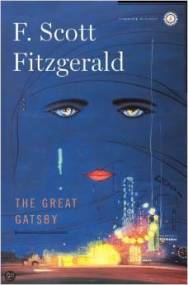
I often use examples of simple emotions from F. Scott Fitzgerald’s The Great Gatsby. The prose has power despite the fact it was written a century ago.

About The Great Gatsby, via Wikipedia:

The Great Gatsby is a 1925 novel by American writer F. Scott Fitzgerald. Set in the Jazz Age on Long Island, near New York City, the novel depicts first-person narrator Nick Carraway‘s interactions with mysterious millionaire Jay Gatsby and Gatsby’s obsession to reunite with his former lover, Daisy Buchanan.

The novel was inspired by a youthful romance Fitzgerald had with socialite Ginevra King and the riotous parties he attended on Long Island’s North Shore in 1922. Following a move to the French Riviera, Fitzgerald completed a rough draft of the novel in 1924. He submitted it to editor Maxwell Perkins, who persuaded Fitzgerald to revise the work over the following winter. After making revisions, Fitzgerald was satisfied with the text, but remained ambivalent about the book’s title and considered several alternatives. Painter Francis Cugat‘s cover art greatly impressed Fitzgerald, and he incorporated aspects of it into the novel. [1]

The following passages show us what is going on inside Nick Carraway, the protagonist. Every word is placed intentionally, put in that place for a reason, meant to evoke a strong reaction in the reader.

Here, Fitzgerald describes a feeling of hopefulness:

And so with the sunshine and the great bursts of leaves growing on the trees—just as things grow in fast movies—I had that familiar conviction that life was beginning over again with the summer.

Next, he describes shock:

It never occurred to me that one man could start to play with the faith of fifty million people—with the single-mindedness of a burglar blowing a safe.

Jealousy:

Her expression was curiously familiar—it was an expression I had often seen on women’s faces but on Myrtle Wilson’s face it seemed purposeless and inexplicable until I realized that her eyes, wide with jealous terror, were fixed not on Tom, but on Jordan Baker, whom she took to be his wife.

f scott fitzgerald The Great GatsbyThe discomfort of witnessing a marital squabble:

The prolonged and tumultuous argument that ended by herding us into that room eludes me, though I have a sharp physical memory that, in the course of it, my underwear kept climbing like a damp snake around my legs and intermittent beads of sweat raced cool across my back.

We not only see Nick’s emotions – we see his view of everyone else’s emotions, shown by his view of their physical reactions. We are never told what people feel but are shown through visual cues and conversations.

Choose a narrative POV and stick with it. Whether we are writing in the first-person or close third-person point of view, seeing the reactions of others is a key to conveying the sometimes-tumultuous dynamics of any group.

Writing emotions with depth is a balancing act. The internal indicator of a particular emotion is only half the story. We see those reactions in the characters’ body language.

This is where we write from real life. When someone is happy, what do you see on the outside? Bright eyes, laughter, and smiles.

When a friend looks happy, you assume you know what they feel on the inside. You presume they feel energized, confident.

So now you need to combine the surface of the emotion (physical) with the deeper aspect of the emotion (internal). Not only that, but we want to write it so that we aren’t telling the reader what to experience.

We allow the reader to decide what to feel. We must make the emotion seem as if it is the reader’s feeling.

If you have no idea how to begin showing the basic emotions of your characters, a good handbook that offers a jumping-off point is The Emotion Thesaurus by Angela Ackerman and Becca Puglisi.

Their entire series of Writers Helping Writers books is quite affordable and full of hints that you can use to give depth to your characters.

emotion-thesaurus-et-alJust don’t go overboard. They will offer nine or ten hints that are physical indications for a wide range of surface emotions. You can usually avoid dragging the reader through numerous small facial changes in a scene simply by giving their internal reactions a little thought.

I usually reread The Great Gatsby every summer, along with several other classic novels in various genres.

Fitzgerald’s prose is written in the literary style of the 1920s. It was a time in which we still liked words and the many ways they could be used and abused, hence the massive amount of Jazz Age slang that seems incomprehensible to us only a century later.

Students taking college-level classes in literature and English are often required to read The Great Gatsby and other classic novels from that era, such as James Joyce’s Ulysses.

While these novels are too complex for most people’s casual reading, there is a reason why these books are still required.

We twenty-first-century writers can learn something important from studying how Fitzgerald showed his characters’ thoughts and internal reactions. We can convey a wide range of emotions without resorting to cliché descriptions.

Next in this series, we’ll explore some of the trickier aspects of showing a character’s physical reaction.

Previous posts in this series:

Storyboarding character development 

Character Development: Motivation drives the story 


Credits and Attributions:

[1] Wikipedia contributors, “The Great Gatsby,” Wikipedia, The Free Encyclopedia, https://en.wikipedia.org/w/index.php?title=The_Great_Gatsby&oldid=1036037007 (accessed July 31, 2021).

Quotes from The Great Gatsby by F. Scott Fitzgerald, © 1925 Charles Scribner’s Sons. PD|75 Fair Use.

Original Cover of The Great Gatsby by F. Scott Fitzgerald, © 1925 Charles Scribner’s Sons. Cover artist: Francis Cugat. PD|75 Fair Use.

6 Comments

Filed under writing