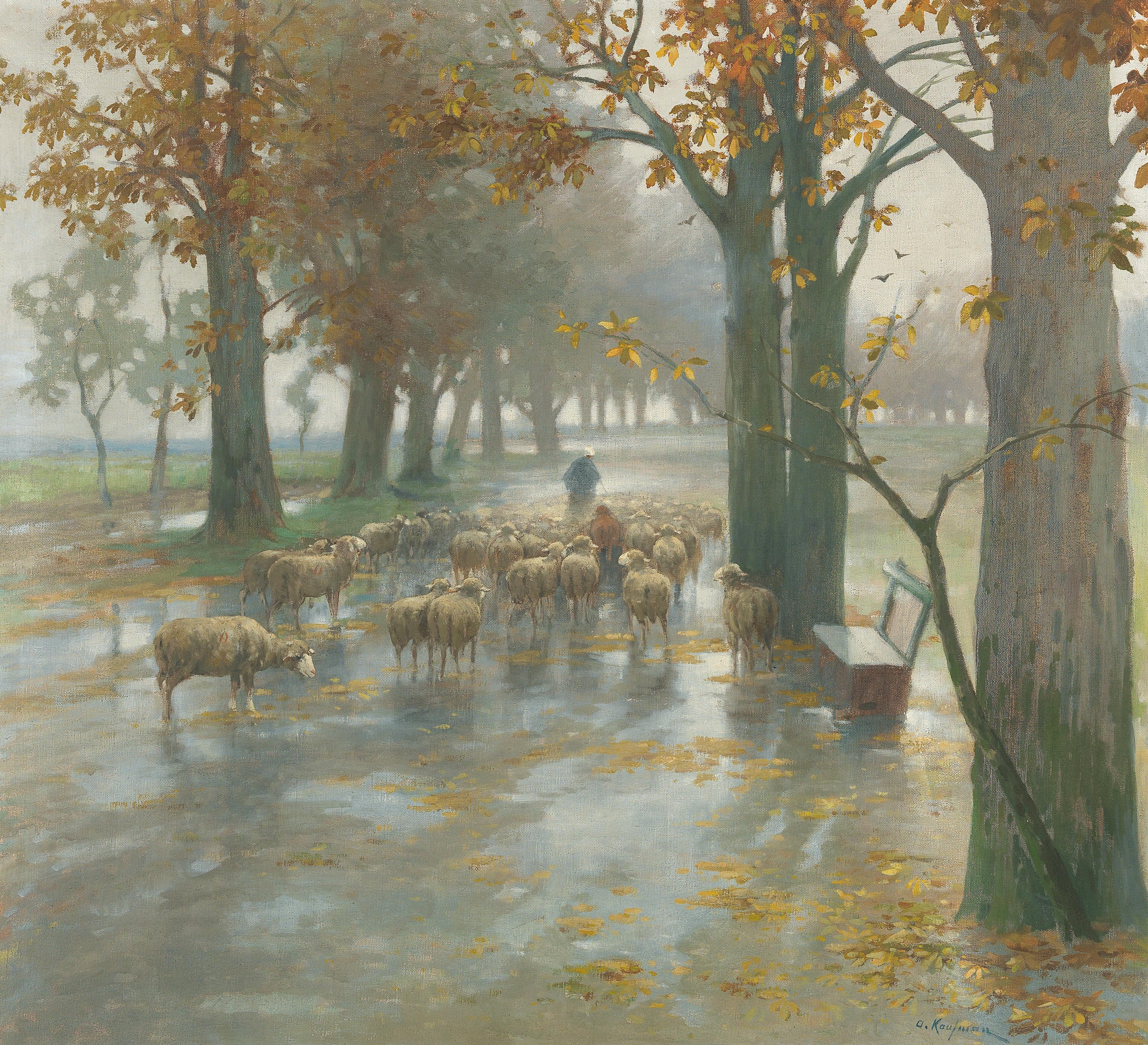
#FineArtFriday: Flock of Sheep with Shepherdess on a Rainy Day by Adloph Kaufmann

Artist: Adolf Kaufmann (1848–1916)

Title: Flock of Sheep with Shepherdess on a Rainy Day

Date: by 1916

Medium: oil on canvas

Dimensions: 102 × 113 cm (40.1 × 44.4 in)

What I love about this painting:

Oh those poor miserable sheep. Sure, they’re wearing wool coats, but it’s autumn, and the rain is cold. The shepherdess isn’t really enjoying the day either, but a girl’s gotta do what a girl’s gotta do, and this girl’s job is shepherding the sheep.

Seriously, this is a wonderful painting. Kaufmann shows us an exceedingly realistic rainy day in a wooded meadow, with water pooling in muddy places and bedraggled sheep getting their feet wet. Somehow he has managed to convey the sullen mood of the flock, which I can relate to. Fortunately for them, the shepherdess is most likely taking them to higher ground where they can graze without standing in water.

I feel their misery. The rains have returned in force here, and I am glad I no longer have sheep to shepherd, rain or shine. Still, I must leave my cozy apartment and drive to the grocery store, etc., grateful that I am in my warm, dry car and not walking the muddy path Kaufmann shows us in this painting.

About the Artist, via Wikipedia:

Adolf Kaufmann (15 May 1848, in Troppau – 25 November 1916, in Vienna) was a landscape and marine artist from Austria-Hungary.

He was initially self-taught, but completed his studies with the animal painter, Émile van Marcke, in Paris and undertook several study trips, throughout Europe and the Middle East. His residence alternated between Paris, Berlin, Düsseldorf and Munich.

In 1890, he decided to settle in Vienna and opened a studio in the Wieden district. In 1900, together with Carl von Merode [de] and Heinrich Lefler, he opened an “Art School for Ladies”. He continued to visit Paris frequently and, when he painted there, signed his works with the pseudonym “A. Guyot”. Other names he signed with include “A. Papouschek”, “G. Salvi”, “A. Jarptmann”, “R. Neiber”, “J. Rollin” and “M. Bandouch”. Why he did this is unclear, although his choice of signature often reflects stylistic differences. [1]


Credits and Attributions

IMAGE: Wikimedia Commons contributors, “File:Adolf Kaufmann – Flock of Sheep with Shepherdess on a Rainy Day.jpg,” Wikimedia Commons, https://commons.wikimedia.org/w/index.php?title=File:Adolf_Kaufmann_-_Flock_of_Sheep_with_Shepherdess_on_a_Rainy_Day.jpg&oldid=1114083148 (accessed January 29, 2026).

[1] Wikipedia contributors, “Adolf Kaufmann,” Wikipedia, The Free Encyclopedia, https://en.wikipedia.org/w/index.php?title=Adolf_Kaufmann&oldid=1332903934 (accessed January 29, 2026).


1 Comment

Filed under #FineArtFriday

Bringing emotions to life #writing

To create characters with emotional depth, you must swim with the sharks of show-and-tell. Most authors who have been in writing groups for any length of time become adept at writing emotions on a surface level.

We work to show our characters’ facial expressions, whether happiness, anger, or spite, etc. We show their eyebrows raise or draw together. Their foreheads crease and eyes twinkle; shoulders slump and hands tremble; lips turn up and dimples pop; lips curve down and eyes spark … and so on and so on.

When done sparingly and combined with conversation, this can work. But no more than one facial change per interaction, please. Nothing is more off-putting than reading a story where each character’s facial expressions take center stage.

Writing emotions with depth is a balancing act. Expressions and body language can only hint at the internal thoughts and feelings of a character, as showing the outward physical indicators of a particular emotion is only half the story.

This is where we write from real life. When someone is happy, what do you see? Bright eyes, laughter, and smiles. When you are happy, how do you feel? Energized, confident.

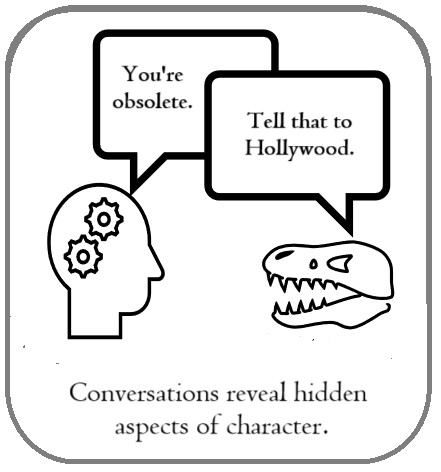
Conversation is about something we didn't know and offers us clues.How do we show it? Through the observations, both spoken and unspoken, of the main characters and those close to them.

In revisions, I look at each scene and try to combine the physical evidence of personal mood with the deeper aspect of the emotion. I combine spoken dialogue and internal dialogue with physical cues to offer hints as to why a character is feeling a certain way.

The hard part is to write it so I don’t tell the reader what to experience. I love it when an author makes the emotion feel as if it is the reader’s idea.

Here is a short list of simple, commonly used, easy to describe, surface emotions. These are easy to show through conversations and physical cues.

  • Anger
  • Anticipation
  • Awe
  • Confidence
  • Contempt
  • Defensiveness
  • Denial
  • Desire
  • Desperation
  • Determination
  • Disappointment
  • Disbelief
  • Disgust
  • Elation
  • Embarrassment
  • Fear
  • Friendship
  • Grief
  • Happiness
  • Hate
  • Interest
  • Love
  • Pride
  • Revulsion
  • Sadness
  • Shock
  • Surprise

Other emotions are tricky because they are more difficult to show physically unless some background information is included. They are complicated and deeply personal, but these are the gut-wrenching emotions that make our work speak to the reader.

So, here is an even shorter list of complex emotions:

  • Anguish
  • Anxiety
  • Defeat
  • Depression
  • Indecision
  • Jealousy
  • Ethical Quandary
  • Inadequacy
  • Lust
  • Powerlessness
  • Regret
  • Resistance
  • Temptation
  • Trust
  • Unease
  • Weakness

When I began writing seriously in the 1990s, I had no idea how to convey the basic emotions of my characters other than through dialogue, a form of telling. Other writers have the opposite problem, and their characters smile, and smile, and grin, and smile. It is showing … but not showing very much other than a lack of inspiration on the writer’s part.

I had good mentors and editors in those days, and through their kind suggestions, I have learned ways to combine the showing and telling. The key is to think of them as salt and garlic powder: a little of each makes the soup delicious but too much ruins it.

Book Cover, Emotion thesaurus.If you are just starting out, and don’t know how to include physical cues in a scene, a good handbook that offers a jumping off point is The Emotion Thesaurus by Angela Ackerman and Becca Puglisi. This book is affordable and full of hints that you can use to give depth to your characters, which makes the story deeper as a whole.

Just don’t go overboard. They will offer nine or ten hints that are physical indications for each of a wide range of surface emotions. Do your readers a favor and only choose one physical indicator per emotion, per scene.

I say this because it is easy to make a mockery of your characters, turning them into melodramatic cartoons.

  • Subtle physical hints, along with some internal dialogue laced into the narrative show a rounded character, one who is not mentally unhinged.

Each of us experiences emotional highs and lows in our daily lives. We have deep-rooted, personal reasons for our emotions.  Our characters must have credible reasons too, inspired by a flash of memory or a sensory prompt that a reader can empathize with.

Why does a blind alley or a vacant lot make a character nervous?

  • Perhaps they were attacked and robbed in such a place.

Why does a grandmother hoard food?

  • Perhaps her baby sister died of starvation.

Why does the sight of daisies make an old man smile?

  • He might be remembering the best day of his life, sixty years before.

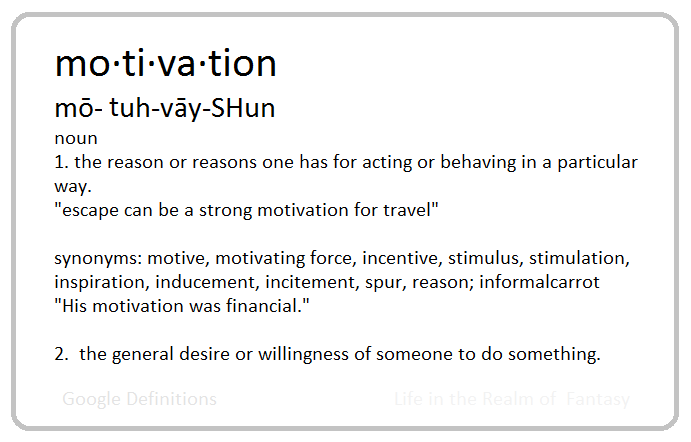
motivation definition: the reason one has for behaving a certain way.Writing genuine emotions requires practice and thought. I’ve mentioned this before, but motivation is key. WHY does the character react with that emotion? Emotions that are undermotivated have no base for existence, no foundation.

The story feels shallow, a lot of noise about nothing. Hints of backstory offered through dialogue, either internal or spoken, can resolve this.

Another thing to consider is timing. The moment to mention the character’s memory is when the physical response to the emotion hits and the character is processing it. That way, there is a reason for their sudden nausea. With small hints, you avoid the dreaded info dump, and the reader begins to see the needed backstory. They want to keep reading to discover the whole truth.

Phrasing and word choices can convey emotional impact in your narrative. If you use powerful words, you won’t have to resort to a great deal of description.

  • I don’t worry about this in the first draft. The second draft is where I check for weak word choices.

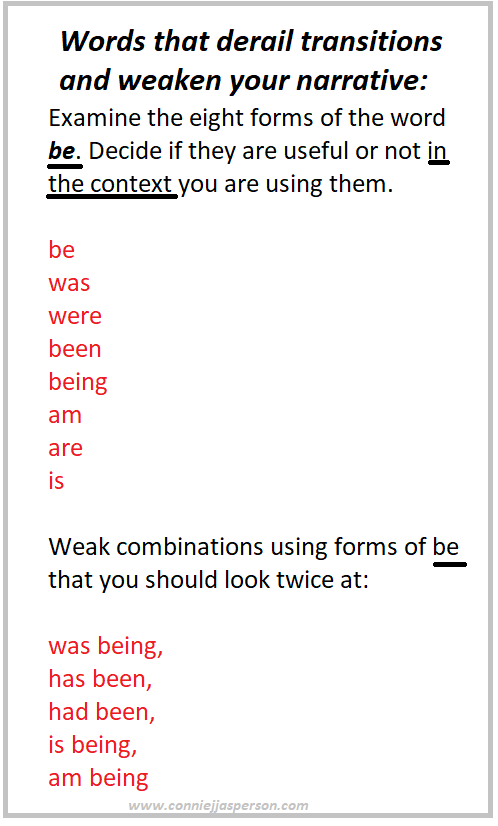
weak words - all forms of the word be. Look for their context and decide to keep or toss them.Passive phrasings are first draft clues, places where I was just trying to get the story on paper. If they are left in the final draft, they separate the reader from the experience, negating the emotional impact of what could be a powerful scene.

The trick is to avoid writing maudlin caricatures of emotions, and over-the-top melodrama.

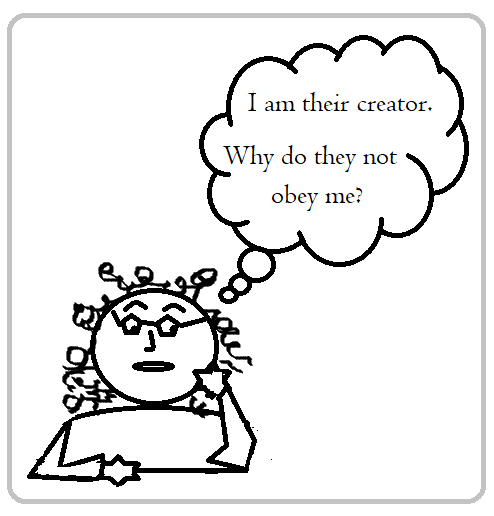
Cartoon: I am their creator. Why do they not obey me?The books I love are written with bold, strong words and phrasing. The emotional lives of their characters are real and immediate to me. Those are the kind of characters that have depth and are memorable.

A good exercise for writing deep emotions is to create character sketches for characters you currently have no use for. I say this because just as in all the many other skills necessary to the craft of writing a balanced narrative, practice is required.

Practice really does make the imperfections in our writing less noticeable, and you may find a later use for these practice characters. They may be the seeds of a marketable short story.

1 Comment

Filed under writing

#FineArtFriday: Spring Landscape by Ellen Favorin ca 1900

Artist: Ellen Favorin (1853–1919)

Title: English: Spring Landscape (Suomi: Kevätmaisema)

Genre: landscape painting

Date: circa 1900

Dimensions: height: 20.7 cm (8.1 in)

Collection: HAM Helsinki Art Museum

What I love about this painting:

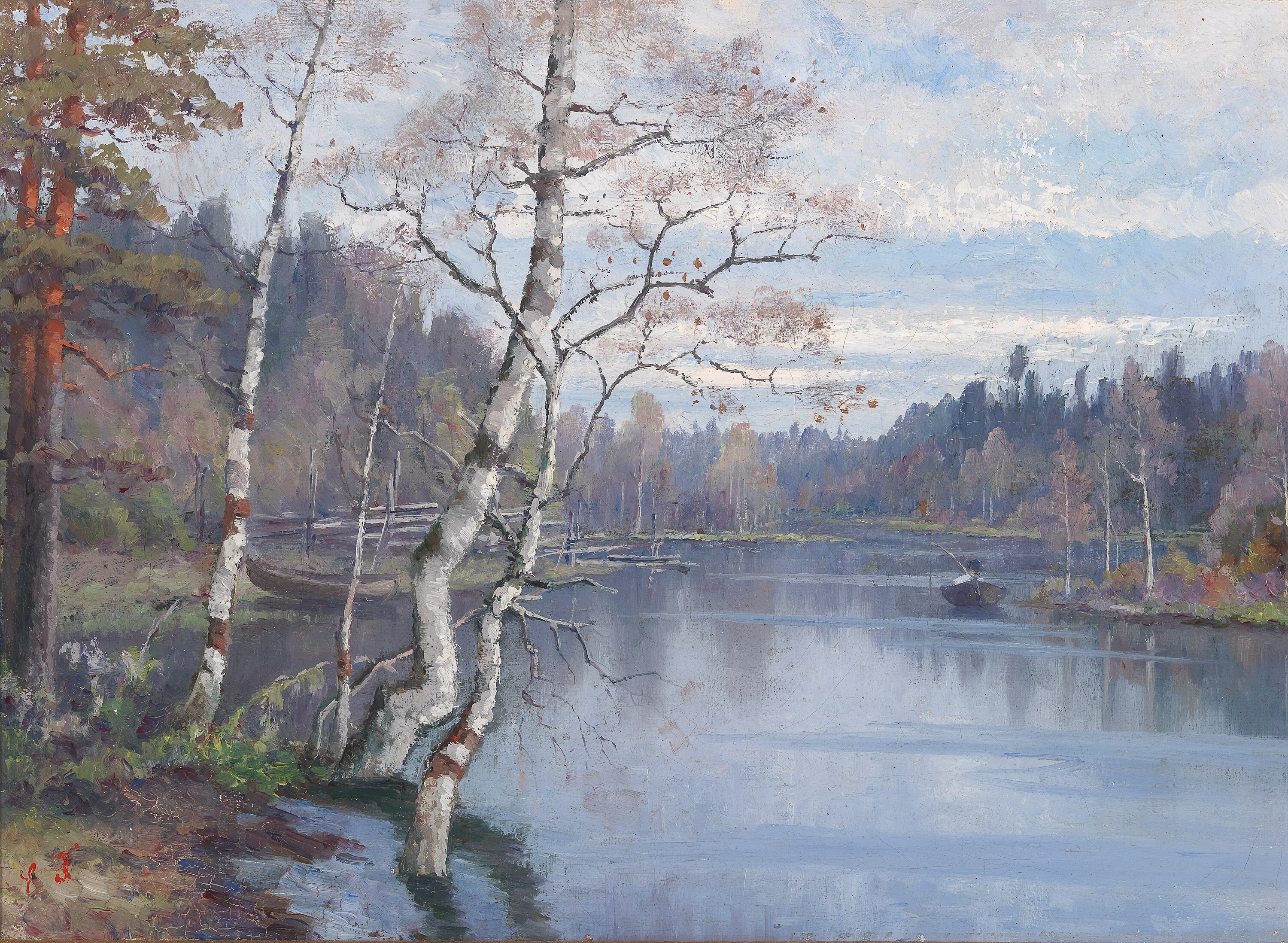
Ellen Favorin shows us a pleasant spring day beside a calm lake, with leaves on the birch trees just beginning to bud out. I especially like how she has portrayed the foliage and shrubbery along the lake shore, with the water high from the spring snowmelt, and the birch trees standing with their feet submerged.

Someone is enjoying a quiet day of fishing, and I would love to be them! What a perfect day.

I will find more paintings by this artist and feature them in the future.


About the artist, via Wikipedia:

Elsa “Ellen” Favorin (31 December 1853– 27 November 1919 was a Swedish-speaking Finnish painter.

Her parents were Anders Abraham Favorin and Lovisa Ingman. After attending the painting schools in Helsinki and Stockholm, she continued her studies in Munich, Düsseldorf and at the Académie Julian in Paris. She often painted landscapes and was one of the artists who joined Victor Westerholm in the artists’ colony at Önningeby on the island of Åland. She died together with her sister in a fire at their home in Lohja in 1919. [1]

As you can see, Wikipedia had little to say about her. However, you can find an excellent and comprehensive biography of Ellen Favorin at NiceArtGallery.com.


Credits and Attributions:

IMAGE: Wikimedia Commons contributors, “File:Ellen Favorin – Spring Landscape.jpg,” Wikimedia Commons, https://commons.wikimedia.org/w/index.php?title=File:Ellen_Favorin_-_Spring_Landscape.jpg&oldid=864051225 (accessed January 22, 2026).

[1] Wikipedia contributors, “Ellen Favorin,” Wikipedia, The Free Encyclopedia, https://en.wikipedia.org/w/index.php?title=Ellen_Favorin&oldid=1333359650 (accessed January 22, 2026).

2 Comments

Filed under #FineArtFriday

A few ideas for a Zen #writing life

We may all write novels or short stories or poetry, but every writer is different. We each have our own approach to getting our work on paper.

I’m like everyone else. I have difficulty thinking creatively when life is too stressful. However, blog posts are more like technical writing, which is how I keep my writing mind working.

Over the years, I have developed a few tools for my writer’s toolbox. These are exercises that jar things loose, help me feel like writing when my well of creative energy is running low.

When the blender of life kicks into gear here at Casa del Jasperson, my ability to write goes out the window.

Nowadays, I stop forcing it.

I’m an indie and my deadlines are self-imposed. My timelines aren’t as finite as a writer who is under contract. I write every day no matter what, but rather than beating myself up over something I can’t deal with, I work on a different project. It might be a blog post or a short story. Sometimes, I take on an editing job.

I can always come back to the novel when inspiration returns.

Sometimes a project begins well but despite that great beginning, it goes unfinished.

Maybe I have run out of ideas for that story, which led to me loosing enthusiasm. No matter what the intended length is, an unfinished project is something I can work on later.

As an indie, my goals are for me, not for anyone else. I choose to embrace a Zen writing life

One manuscript has sat unfinished for several years for a variety of reasons. The story was stalled at the halfway point, and I had only a vague idea of how it must end. This year I managed to write a synopsis of the final half of the story arc and that has become invaluable as an outline. Writing is now moving ahead as I had hoped.

Despite how much I love the stories that fall out of my head, my work doesn’t appeal to readers of action adventure. My stories are internal. The characters and the arc of their personal journeys are the central elements of their stories. While I love the action and the setting, those elements are only the frame within which the characters live and grow.

In the old days, I didn’t understand that. I marketed it to the wrong audience. Readers of action and adventure aren’t interested in slower-paced work. Even worse, I rushed to publish my work when it wasn’t ready.

So, the first hard-earned snippet of wisdom I have to share today is this: Write your stories for yourself and don’t stop trying. We have to know our target market. One important thing I have come to accept is this: my work is written for a niche market of those few readers who seek out the kind of work that I do. I write what I want to read, and I am an odd duck when it comes to literature. So, I am writing for a smaller subset of readers and that will have to guide how I market my books.

The second piece of wisdom is a little more challenging but is a continuation of the first point: Write something new every day, even if it is only one line. Do it whether you are inspired or not because it is exercise. Just like yoga or martial arts, your aptitude for writing grows in strength and skill when you exercise it daily. Writing a blog post is my daily exercise. If you only have ten minutes free, use them to write whatever enters your head, stream-of-consciousness.

The third thought is a fun thing: learn the meaning of a new word every day. You don’t have to use every word you know, but it never hurts to learn new things. Authors should have broad vocabularies. Today’s word was bumptious which means offensively self-assertive.

The fourth thing: is don’t worry about self-editing when you are laying down the first draft. I know it’s a cliché, but it is also a truism. Let the words fall out of your head, passive phrasing and all, because the important thing is to finish the story.

The fifth thing to remember is thisevery author begins as someone who wants to write but feels like an imposterThe authors who succeed in finishing a poem, a short story, or a novel are those who are brave enough to just do it. They find the time to sit down and put their ideas on paper. And ninety times out of a hundred, they still feel like an imposter.

Finally, authors must overcome roadblocks in their personal life. My husband has late-stage Parkinson’s which makes life a little too interesting at times. Writing enables me to make sense of the twists and turns of our human experience.

It helps me process life’s complications in a non-threatening way.

In real life, nothing is certain. Adversity happens. Dealing with troubles forges strength and if you are a person blessed with empathy, it creates an understanding of other people’s challenges.

I am blessed. I can write whatever I am in the mood for. Having the time and opportunity to write is a luxury, one I didn’t have as a younger person raising children and holding down two jobs. I have a group of fellow writers that I can depend on for good advice, and for support when life is hard.

I don’t write to win awards, and I don’t earn a lot from my work. but I love what I do and don’t feel guilty about any arbitrary goals I don’t achieve.

I can relax and enjoy the act of creating something from idea to completion, but in my own time and at my own pace.

In this new year, I hope you find the time and inspiration to write whatever your dreams lead you to. I hope you have success at whatever your creative mind dreams up.

And I hope you have a Zen creative experience.

5 Comments

Filed under writing

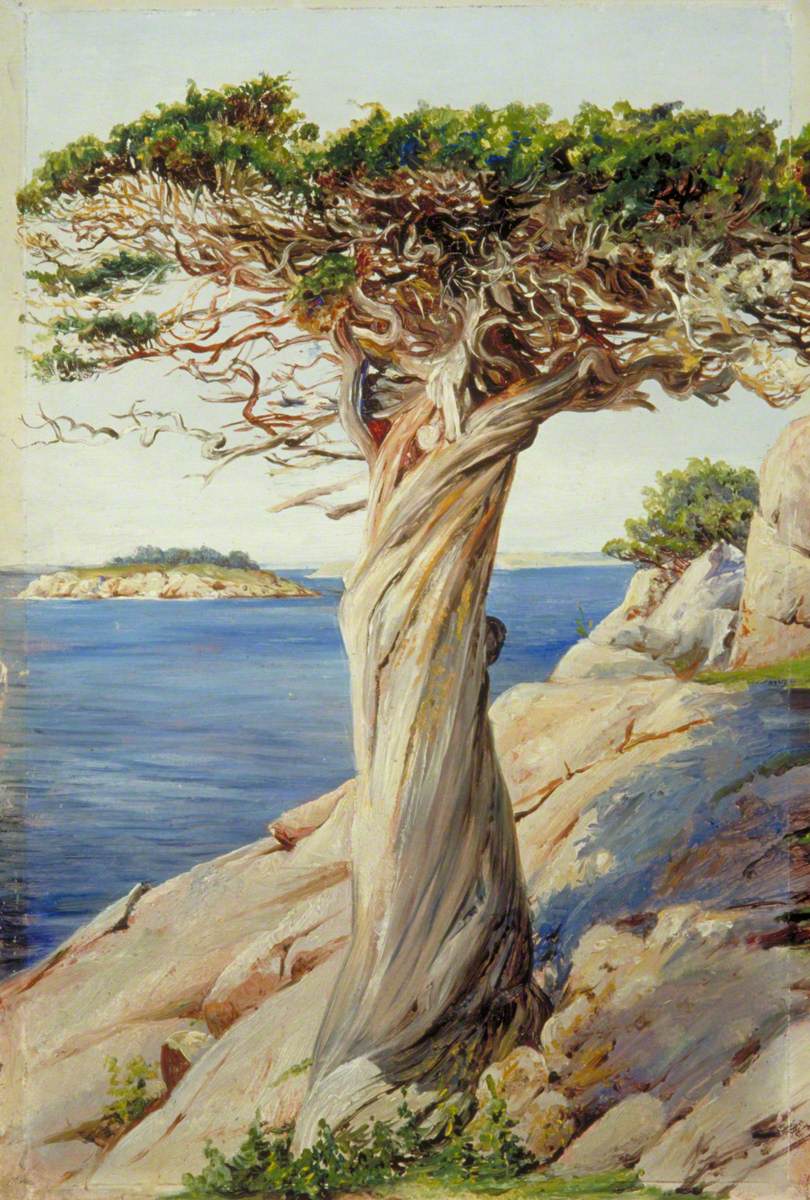
#FineArtFriday: An Old Red Cedar on the Rocks near West Manchester, Massachusetts by Marianne North 1871

Artist: Marianne North (–1890)

Title: An Old Red Cedar on the Rocks near West Manchester, Massachusetts

Date: 1871

Dimensions: height: 35 cm (13.7 in)

Collection: Marianne North Gallery

What I love about this painting:

Marianne North gives us a sunny day and the portrait of a tree whose life was written in its twisted trunk and tangled branches. This tree has seen some stuff!

I can relate to that tree. This staunch old lady is perched on a promontory overlooking the sea, a perfect view of all the world. However, this tree has carved its living from a harsh environment.

Trees must grow where their seeds fall, and seed that sprouted this cedar fell into a tiny crack on the cliffs, finding just enough soil to nourish the seedling. No gentle forest loam for this hardy monarch; salty air and violent storms are her companions.

I love the sunny day and the strength of this tree. Marianne North is a new artist to me, and I will post some of her other paintings as I come across them.

About the artist, via Wikipedia:

Marianne North (24 October 1830 – 30 August 1890) was an English biologist and botanical artist, known for her plant and landscape paintings, her extensive foreign travels, her writings, her plant discoveries and the creation of her gallery at the Royal Botanic Gardens, Kew.

North trained as a vocalist under Charlotte Helen Sainton-Dolby, but her voice failed, and she then devoted herself to painting flowers. After the death of her mother in 1855, she constantly travelled with her father, who was then member of parliament for Hastings; and on his death in 1869 she decided to pursue her early ambition of painting the flora of distant countries.

The scientific accuracy with which she documented plant life in all parts of the world, before photography became a practical option, gives her work a permanent value. Plant species named in her honour include Areca northianaChassalia northiana, Crinum northianumKniphofia northiaeNepenthes northiana, and the genus name Northia.

Kew Gardens claims that the North Gallery (situated in the east section of the gardens) is “the only permanent solo exhibition by a female artist in Britain”. In 2008 Kew obtained a substantial grant from the National Lottery, which enabled it to mount a major restoration of both the gallery and the paintings inside.

On 26 September 2016, the television channel BBC Four broadcast Kew’s Forgotten Queen. The documentary told the story of North’s life. [1]

For a great video biography of the artist, go to YouTube:  The Remarkable Miss North


Credits and Attributions:

IMAGE: Wikimedia Commons contributors, “File:Marianne North (1830-1890) – An Old Red Cedar on the Rocks near West Manchester, Massachusetts – MN207 – Marianne North Gallery.jpg,” Wikimedia Commons, https://commons.wikimedia.org/w/index.php?title=File:Marianne_North_(1830-1890)_-_An_Old_Red_Cedar_on_the_Rocks_near_West_Manchester,_Massachusetts_-_MN207_-_Marianne_North_Gallery.jpg&oldid=1030484784 (accessed January 15, 2026).

[1] Wikipedia contributors, “Marianne North,” Wikipedia, The Free Encyclopedia, https://en.wikipedia.org/w/index.php?title=Marianne_North&oldid=1330628765 (accessed January 15, 2026).

5 Comments

Filed under writing

Plot Armor, Objective, and Risk #writing

My weekend got derailed due to life cluttering it up with huge chunks of reality. I hate it when reality ruins my carefully plotted existence. So, instead of a new post, I am revisiting a post from 2023, a short story about a writer wrestling with her characters, objectives, and inventing risks with a dash of plot armor thrown in. I hope you enjoy it!


Sometimes I lose the plot. I know that character plus objective plus risk equals a story, but sometimes I can’t figure out the risk part.

Or the objective.

Characters can be tricky too. I have the plot armor part down well, but that’s just for the protagonist. Everyone else’s safety is fair game.
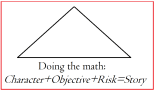
StoryMemeLIRF10052021Sometimes I can’t find the plot even when I have an outline. I get to a place where I don’t know what to write, and the characters stand around doing nothing. I repeat the same old crisis with slight variations, which is tedious.

I thought I was writing a medieval fantasy, but according to a reddit thread I saw last week, dragons are overdone. Apparently, every fantasy features dragons.
Version 1.0.0

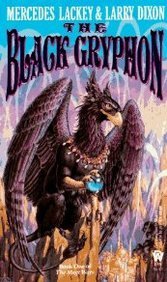
So now what? Griffons and manticores are prominent in medieval heraldry. There must be a reason for that. Mecedes Lackey did griffons, and I don’t want to copy her, so what is left? Unicorns?

My imagination is stuck on manticores, but even in fantasy they’re a rare beast. My hero just killed the last one so I’m unsure what to do now. Readers don’t like it when you milk a plot twist over and over, no matter how you change the scenery around it.

Sometimes I hate this job.

So, let’s look at the plot outline again. I’m all about giving my characters agency, but they have to work with me, give me a bit of help. Sometimes it takes divine intervention to get the plot moving again.

Today I have barely gotten started when I feel someone staring at me. Of course, it’s Sir Percival, looking over my shoulder. “Ahem.” He glares at me.

My characters no longer surprise me when they intrude, but being polite when I am disturbed is impossible. “What do you want? I’m a little busy.”

Bodleian_Library-MS_Bodl_764-fol_025r-manticoreSir Percival the Pointless says, “I rescued Lady Adeline, and the manticore is dead. Did you notice?”

“Yes. I wrote that scene, and if I do say so myself, you were magnificent.” One problem with heroes is their desire for obscene amounts of praise.

“Thank you,” he replies, attempting to appear modest and failing. “Well, the thing is, Lady Adeline has thrown herself into wedding preparations.”

“I know.” I force myself to reply politely. “I’m designing the dress.”

“Well, you’ve been doing that for the last twenty pages, but who’s counting. Anyway, I’ve been booted outside because no one needs the groom until the big day. I need something to do.”

I never noticed it before, but Percy isn’t handsome when he scowls. Is there some way I can make him look like an adult? I don’t like beards, but he needs something to disguise his serious lack of a chin.

Percy the Pointless presses his attack. “You know, you’re really good at telling folks how to plot a book, but you suck at it yourself. We’re 25,000 words into your novel, and you’ve already wasted the big scene.”

What? He’s cruisin’ fer a bruisin’, as they say in my part of the world. “Watch it buddy. I wrote you, and I can easily delete you.” See? I can give a dirty look too.

He just shrugs. “I doubt you’re going to do that. You’ve spent two months on this epic. However, if you intend this to be a novel, you have at least 50,000 or so more words to write. I have nothing to do.”

I just realized that he has a slightly nasal whine. Oh, lord. I’ve written a whiney hero. However, the idiot has a point. I mistimed the big finale, so now I need a new objective for him, something entailing risk.

This could take a while. I gaze at Sir Percival the Prim, wondering what I was thinking when I made an idiot nobleman like him the star of this charade. “I can’t work with you staring over my shoulder. Look, why don’t you watch TV for a while?” I park him in front of the TV and give him the clicker.

He looks first at me and then at the clicker. “What is this?”

Sighing, I show him how to turn the TV on and help him find something he’ll enjoy.

That takes an hour. Nine hundred channels and nothing interests him. Eventually we settle on old Star Trek reruns.

Finally, I am back at the keyboard and scraping the bottom of the barrel for a few more terrifying plot twists, hoping to keep this bad boy busy. All I can think of is manticores, but he’s already killed the only one that was left in the world.

Readers hate it when authors milk the same old plot twists.

“Ahem.”

I look up, only to see Duchess Letitia, Percy’s future stepmother-in-law standing at my elbow. “Yes?”

Book- onstruction-sign copy“I’m sorry to bother you, but we desperately need a certain magical ingredient for my special anti-aging cream.” She looks at me expectantly. “My stepdaughter’s wedding is a big deal. But the outline says Percival and Adeline will assume the throne upon their marriage. It’s canon now, so I’m done, kicked to the curb in the prime of my life.” She dabs the corner of her squinty eyes with a silken handkerchief. “You set this story in an era where women have few career options. I simply must have my beauty cream, or I won’t be able to snare a new hubby.”

She has a point. “And that ingredient is…?” I hope it’s not a complicated thing because now I have two bored characters nagging the hell out of me.

A sharklike smile crosses her features. “Manticore’s milk.”

How odd. I never realized until this moment is how evil Adeline’s stepmother looks when she smiles like that. I love this woman.

She says, “I’m sure Sir Percival can get some since he’s just sitting around watching a magic box filled with other people having adventures.”

Duchess Letitia’s malicious smirk offers me no end of possibilities. I consider this for a moment. I could rewrite the original battle scene and subtract the dead manticore part.

He could get killed milking the manticore.

Or perhaps only maimed. After all, he does wear highly polished (but heavy-duty) plot armor.

Lady Adeline would have to rescue herself and then him. But what the hell?

He’s a hero, right? Bad days at the office come with the territory. A few dents in his plot armor should deflate his ego a bit.

I hoist myself out of my chair and walk to the living room.

There he is, sitting with his dirty boots propped on my coffee table.

Oh, yes. there will be mutilation in his future. I am going to stretch his plot armor to the limit. Rather than deleting his character from the story and starting anew, this jackass will live.

Percy the Prim and Proper will beg me to kill him off.

I can still change things up. The manticore that the idiot fought in chapter ten was only feigning death. Yes …. the nice, persecuted manticore lives, and now manticores are an endangered species.

Lady Adeline won’t approve of Percy attempting to murder the last one so there will be trouble in paradise. The noble idiot will have misadventure after misadventure until my new coffee table is paid for.

I feel invigorated. My plot is back on track, and I am inspired to write like the wind! “Percy, I have a task for you. Take this bucket and get some manticore’s milk. It’s a matter of life and death.”

He looks up. “I will in a minute, but I must see how this story ends. Captain Kirk might die if Spock can’t get the medicine!”

That’s another good plot twist. Note to self: have Duchess Letitia supervise stocking the medical supplies in Percy’s kit.

You know, now that I think about it, the duchess was wrong about one crucial thing. Nothing is canon until the book is published. I think the duchess deserves a much larger role in this story.

Excalibur London_Film_Museum_ via Wikipedia

Excalibur London Film Museum via Wikipedia

So does my new protagonist, Lady Adeline.

A lady hero who needs armor and a sword.

And a horse.

A horse that’s a unicorn.

I love this job.

And the reddit trolls are wrong. Dragons are NOT overdone. In fact, I need a big, angry one now.

4 Comments

Filed under writing

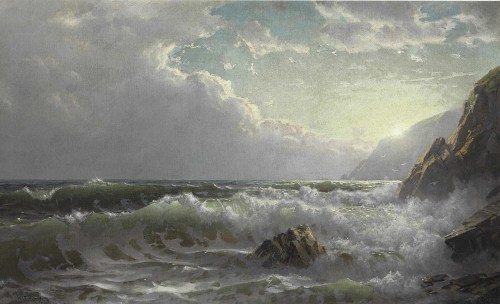
#FineArtFriday: a closer look at “Off the Coast of Cornwall” by William Trost Richards 1904

Artist: William Trost Richards  (1833–1905)

Title: Off the Coast of Cornwall

  • Genre: landscape art
  • Date: 1904
  • Medium: oil on canvas
  • Dimensions : Height: 55.9 cm (22 in); Width: 91.4 cm (35.9 in)
  • Collection   Private collection
  • Inscriptions: Signature and date bottom left: W.T. Richards.04.

What I love about this painting:

I first featured this painting in June of 2020. This is one of my favorite seascapes, as it captures the cold sense of danger that is a storm at seashore. The waves crash against the rocks, and only a fool goes wading along this stretch of the beach.

But after the sea calms, the shore will be littered with rare unbroken shells and driftwood, a picker’s paradise.

William Trost Richards shows us a blustery day along the rugged coast of Cornwall. Intermittent rain squalls blow through, and when one passes the sun peeps out, the bright lull between storms. The sea is that dark greenish color reflecting the sky, a quality stormy waters here in the North Pacific coast often have. It is of a shore half a world away from me (in England), but it feels as familiar as if it were the coast of my home, Washington State.

What I love most about how Richards depicted the water is the milk-glass opaqueness of the green water and the way the light seems to shine through the waves. Luminist landscapes emphasize tranquility, and often depict calm, reflective water and a soft, hazy sky.

About the Artist via Wikipedia:

William Trost Richards  rejected the romanticized and stylized approach of other Hudson River painters and instead insisted on meticulous factual renderings. His views of the White Mountains are almost photographic in their realism. In later years, Richards painted almost exclusively marine watercolors.

In the summer of 1874 Richards visited Newport, Rhode Island, and became enthralled with the area’s sublime coastline. He purchased his first of several Newport area homes in 1875 and continued to paint there for the rest of his life, dividing time between Newport and Chester County, Pennsylvania, where he purchased a farm near the Brandywine in 1884. Richards made many excursions to Europe, especially Britain and Ireland, where he produced an important body of work. [1]

Richards was one of the few 19th century American landscape artists who was equally skilled as a watercolorist and a painter in oils. His drawings are considered among the finest of his generation. Many of his drawing still survive.

Today, Richards is best known for his luminist seascapes. Paintings such as the one featured here today demonstrate his mastery of light and atmosphere. His favorite subjects were the Rhode Island, New Jersey and British coasts.


Credits and Attributions:

IMAGE: Off the Coast of Cornwall, by William Trost Richards Wikimedia Commons contributors, “File:William Trost Richards – Off the Coast of Cornwall.jpg,” Wikimedia Commons, https://commons.wikimedia.org/w/index.php?title=File:William_Trost_Richards_-_Off_the_Coast_of_Cornwall.jpg&oldid=1127134702 (accessed January 8, 2026).

[1] Wikipedia contributors, “William Trost Richards,” Wikipedia, The Free Encyclopedia, https://en.wikipedia.org/w/index.php?title=William_Trost_Richards&oldid=1324003703 (accessed January 8, 2026).

2 Comments

Filed under #FineArtFriday

What is an archetype and how does it fit into my work? #writing

If you write fiction, you are making use of an archetype, whether you know it or not. In literature, the word archetype describes the kinds of characters and plots featured in stories across all cultures and eras of human history.

Even in our ancient past, when we had little communication with other cultures, our myths and legends shared common, recognizable characters we call archetypes.

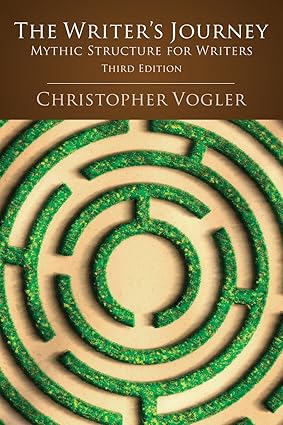
The Writer’s Journey, Mythic Structure for Writers, by Christopher Vogler, details the various traditional types of characters that are featured in mythology and our modern literary canon. His work is based on Joseph Campbell‘s book, The Hero With a Thousand Faces,

The following is Christopher Vogler’s list of character types [1] who are the heroes and villains in every story:

  1. Hero: someone who is willing to sacrifice his own needs on behalf of others.
  2. Mentor: all the characters who teach and protect heroes and give them gifts.
  3. Threshold Guardian: a menacing face to the hero, but if understood, they can be overcome.
  4. Herald: a force that brings a new challenge to the hero.
  5. Shapeshifter: characters who constantly change from the hero’s point of view.
  6. Shadow: a character who represents the energy of the dark side.
  7. Ally: someone who travels with the hero through the journey, serving a variety of functions.
  8. Trickster: embodies the energies of mischief and desire for change.

So, there we have the characters. Now we need a story. Christopher Booker, author of The Seven Basic Plots: Why We Tell Stories [2], tells us that the following basic archetypes underpin the plots of all stories:

  1. Overcoming the Monster

  2. Rags to Riches

  3. The Quest

  4. Voyage and Return

  5. Comedy

  6. Tragedy

  7. Rebirth

  8. I would add an eighth: Romance

We feel comfortable with these basic recognizable storylines, no matter how differently they are presented to us. No matter the story, if it is fiction, we have characters in familiar roles, acting out familiar plots.

Yet, despite the basic similarity of these characters and plots and their ancient origins, they are the basis of our modern literary canon. Every author has a story to tell, and it is their imagination, style, and voice that make it new and unique.

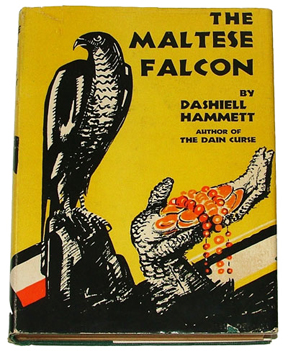
Let’s consider two famous novels. First, we’ll look at The Maltese Falcon, by Dashiell Hammett.

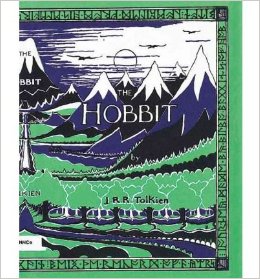
This is a detective novel, a thriller, nothing at all like our other novel, J.R.R. Tolkien’s The Hobbit, which is an epic fantasy quest tale.

However different it looks on the surface, The Maltese Falcon is definitely a quest tale.

The genre of this tale is classic thriller with a film noir flavor. Yes, it’s a quest featuring a hero and a villain, but delivered with a twist.

Sam Spade is a hardboiled, cynical private eye. He is hired to retrieve a jeweled statue, the Maltese Falcon. However, the statue itself is a MacGuffin. The MacGuffin’s importance to the plot is not the object or goal itself, but rather the effect it has on the characters and their motivations. In this case, the quest changes Sam’s life. The sole purpose of the MacGuffin is to move the plot forward.

In The Hobbit, home-loving Bilbo Baggins is a comfortable, upper-middle-class hobbit who is tricked into hosting a group of strangers for a dinner. Overcome by a moment of rashness, he joins the wizard Gandalf and the thirteen dwarves of Thorin’s Company. The obvious quest is for Bilbo to break into a dragon’s lair, acting as a burglar to reclaim the dwarves’ home and treasure from the dragon Smaug.

Through the process of fulfilling his burglar tasks, Bilbo finds the Arkenstone, an heirloom jewel prized above all else by the leader of the dwarves, Thorin Oakenshield.

It is a MacGuffin.

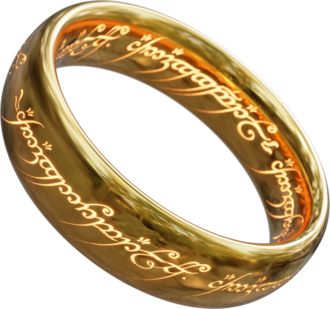
the one ringIn fact, the entire quest, from the moment he leaves home until the day he returns, is a MacGuffin. This is because its sole purpose is to force Bilbo’s personal growth and place him where he will find the One Ring, which will be featured as a core quest in later stories.

By the end of The Maltese Falcon, we learn that the object of the quest was not the purported “Maltese Falcon” after all, despite the lengths they go to acquire it and the efforts the characters expend in the process. The true core of the story is the internal journey of both Sam Spade (the hero) and Brigid O’Shaunessy (the ally/shapeshifter/trickster), two people brought together by the quest, and whose lives are changed by it.

Similarly, the true object of The Hobbit’s quest is not the reclamation of the dwarves’ heritage and treasure. It is how Bilbo Baggins is changed by his experiences and the people he meets on the journey.

So, The Hobbit and The Maltese Falcon begin with the same character archetype of the hero.

  • Bilbo (the hero) is hired to steal the Arkenstone for Thorin and the dwarves.
  • Sam Spade (the hero) is hired to obtain the Maltese Falcon for Brigid O’Shaunessy.

In both tales, another archetypal role that appears is that of the mentor: Bilbo has Gandalf the Wizard, and Sam Spade has Caspar Gutman. Despite their very different personalities and reasons for offering wisdom, both are mentors. Both offer advice that advances the plot.

Both Brigid O’Shaunessy and Thorin Oakenshield begin as allies but prove to be tricksters, shapeshifting and becoming the shadow.

In each tale, the hero endures hardship to acquire an object (the Maltese Falcon or the Arkenstone), only to find that it is no longer as important as he thought. In the process of their journeys, both find joy and sorrow.

Sam Spade never acquires the true Maltese Falcon but finds out who really killed his business partner. He loses much in the process and emerges a different man.

Bilbo Baggins loses his naïveté, and after all the work of finally finding it, he hides the treasured Arkenstone. He does this because of Thorin’s greed and uncharitable actions toward the Wood-elves and the Lake-men who have suffered from the Dragon’s depredations.

And as anyone can tell you, despite their being written in the same era, and the similarities of their archetypal plots and characters, they are radically different novels.

And that is the beauty of the deeper level of the story.

Something so fundamentally similar as plot archetypes and character archetypes emerges completely unique and (on the surface) wildly dissimilar from others when told by different storytellers.

So, while there may be no “new” stories, your voice, your originality and imaginative twists make the story new and memorable.


Credits and attributions:

IMAGE: The One Ring, Wikimedia Commons contributors, “File:One Ring Blender Render.png,” Wikimedia Commons, https://commons.wikimedia.org/w/index.php?title=File:One_Ring_Blender_Render.png&oldid=1051100432 (accessed January 3, 2026).

[1] Wikipedia contributors, “Archetype,”Wikipedia, The Free Encyclopedia ,https://en.wikipedia.org/w/index.php?title=Archetype&oldid=1321105373 (accessed January 3, 2026).

[2] Christopher Booker (2004). The seven basic plots: why we tell stories. London: Continuum. ISBN 978-0826452092. OCLC 57131450.

Wikipedia contributors, “The Writer’s Journey: Mythic Structure for Writers,”Wikipedia, The Free Encyclopedia,https://en.wikipedia.org/w/index.php?title=The_Writer%27s_Journey:_Mythic_Structure_for_Writers&oldid=1324459018 (accessed January 3, 2026)

2 Comments

Filed under writing

#FineArtFriday: Rembrandt and Saskia in the Parable of the Prodigal Son by Rembrandt van Rijn 1635

Rembrandt and Saskia as the Prodigal Son.

Artist: Rembrandt (1606–1669)

Title: Rembrandt and Saskia in the parable of the Prodigal Son

Depicted people: Rembrandt and his wife, Saskia van Uylenburgh

Date: 1635

Medium: oil on canvas

Dimensions: height: 161 cm (63.3 in) width: 131 cm (51.5 in)

Current location: Staatliche Kunstsammlungen Dresden

What I love about this painting:

This was done during the best years of Rembrandt’s life, the years when he was a popular young artist, a time when he was financially secure. He was deeply in love with his wife and at the time of this painting, the future looked bright.

In many ways, Rembrandt was the embodiment of the traditional view of the parable of the prodigal son. He was fond of luxuries that he couldn’t quite afford, sure of his talents, and determined to have his own way in life regardless of the accepted morality of his society.

The two people shown in this painting were happy and knew how to celebrate life, which is clearly shown in this self-portrait.

About this painting via Wikipedia:

It portrays two people who had been identified as Rembrandt himself and his wife Saskia. In the Protestant contemporary world, the theme of the prodigal son was a frequent subject for works of art due to its moral background. Rembrandt himself painted a Return of the Prodigal Son in 1669.

The left side of the canvas was cut, perhaps by the artist himself, to remove secondary characters and focus the observer’s attention on the main theme. [1]

About the Artist, via Wikipedia:

Rembrandt Harmenszoon van Rijn; 15 July 1606 – 4 October 1669), known as Rembrandt, was a Dutch Golden Age painterprintmaker, and draughtsman. He is generally considered one of the greatest visual artists in the history of Western art. It is estimated that Rembrandt’s surviving works amount to about three hundred paintings, three hundred etchings, and several hundred drawings.

Unlike most Dutch painters of the 17th century, Rembrandt’s works depict a wide range of styles and subject matter, from portraits and self-portraits to landscapes, genre scenes, allegorical and historical scenes, biblical and mythological subjects and animal studies. His contributions to art came in a period that historians call the Dutch Golden Age. [2]

To learn more about this artist and his remarkable (and often sad) life, go to Rembrandt – Wikipedia.

For an excellent biography on the life and works of Rembrandt van Rijn via YouTube, go to: Rembrandt van Rijn: Tragedy, Genius and the Art of Light | Full Documentary


Credits and Attributions:

IMAGE: Wikipedia contributors, “The Prodigal Son in the Brothel,” Wikipedia, The Free Encyclopedia, https://en.wikipedia.org/w/index.php?title=The_Prodigal_Son_in_the_Brothel&oldid=1292671149 (accessed January 1, 2026). [1]

Wikipedia contributors, “Rembrandt,” Wikipedia, The Free Encyclopedia, https://en.wikipedia.org/w/index.php?title=Rembrandt&oldid=1329139620 (accessed January 1, 2026). [2]

1 Comment

Filed under #FineArtFriday

Character development: #writing the mentor

No matter the genre, from sci-fi to romance, a mentor shows up to offer needed information that helps the protagonist succeed in their quest. I write fantasy, so certain themes figure prominently in my work. Often, the theme that shapes the main character’s arc is the hero’s journey or, possibly, coming-of-age. These are strong themes, and in stories where the character arc is shaped by them, one of the side characters can serve as a mentor.

Writing Craft Series: the mentorThe mentor can take many forms. Creating a mentor with depth and a sense of history without going off on a tangent is tricky. This is where my writing group is so helpful. Their thoughts and opinions enable me to narrow the focus, helping me create a character who empowers my intended plot arc, but doesn’t take over the story.

I often think about the people who guided me when I was young. In my case, my father encouraged me to never stop learning. But the person who had the most influence on my view of family was my maternal grandmother. She was an amazing woman, and I aspire to be the kind of person she was.

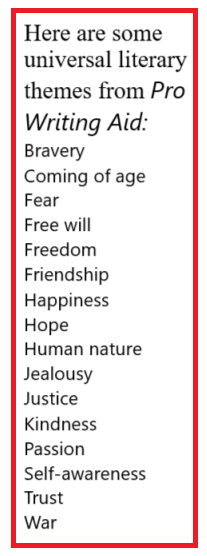
Some universal literary themes, such as bravery, fear, hope, etc.She never lectured or preached, but she knew things, and I learned by observing her. She had an Edwardian childhood and a Roaring Twenties adulthood. Family was the most important thing to her.

She understood that life is a series of learning from our mistakes but expected us to do what was right. Watching her taught me that true wisdom is not about having all the answers. It is about doing the best you can with what you have and finding joy in the small things.

Wisdom is a word that symbolizes a myriad of ideas. In a mentor, it can signify knowledge of fundamental human truths. Perhaps their naïve enjoyment of life has long gone, but in its place is the ability to enjoy the now, to be truly present in life.

The story will tell you what sort of mentor it requires. Some mentors can provide food and shelter, momentary comfort, and an opportunity to heal and regroup. Through their actions and conversation, these mentors can dispense needed wisdom.

Others are more formal: a leader who trains the protagonist in a craft, such as weaponry or magic, something needed to fulfil the quest.

Experience makes a person wiser and can change the personalities of our characters. Perhaps one becomes hardened as a form of self-preservation. That person can become the Han Solo kind of mentor.

Conversely, life experiences can make a mentor more understanding of human frailty.

Let’s look at Aragorn, from the Lord of the Rings Trilogy.

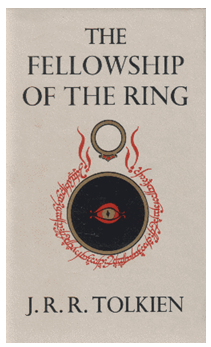
Cover image for The Fellowship of the Ring by JRR TolkienTolkien was crafty. The scene where Aragorn is first introduced makes us wary. The man we meet is mysterious and seems a little dangerous. Yet there is more to him than we see in the dark, smoky taproom of the Prancing Pony, and we wonder about him. At that point, he is only known as Strider, and in that role, he offers them the information they need.

In the chapter titled “Strider,” Frodo reads Gandalf’s letter. Having read it, Frodo says, “I think one of his (Sauron’s) spies would – well, seem fairer and feel fouler, if you understand.”

“I see,” laughed Strider. “I look foul and feel fair. Is that it? All that is gold does not glitter, not all those who wander are lost.” [1]

In the scene, Aragorn is quoting a poem that is later revealed to reference him and his birthright. These are wise words from a poem-within-the-story, a signature literary device Tolkien used regularly.

“All that is gold does not glitter,

Not all those who wander are lost;

The old that is strong does not wither,

Deep roots are not reached by the frost.”

With that quote, he cautions Frodo to look beyond the surface and see the strength that lies beneath. He suggests that the converse can be true, that beauty can disguise what is evil.

In Aragorn, we have a mentor who is wise from life experience and somewhat hardened to the discomforts of his exile. But he is also kind, a person who cares about even the smallest people. He is later revealed to be the heir of Isildur, the sole remaining scion of the fabled last King of Gondor.

Yet, at this stage, he is approaching middle age and may as well be heir of nothing. The respectable landlord of the Prancing Pony looks down on him, seeing Aragorn as little more than a vagrant. Here, he is only known as Strider, leader of the Rangers. These soldiers are not merely mercenaries; they are the Dúnedain of the North, the descendants of his ancestor’s knights.

In the guise of Strider, Aragorn is a good mentor from the first moment we meet him. The reader understands this because he is shown to have a history. Tolkien does this perfectly as the backstory is only hinted at.

Frodo knows nothing about him, other than he is a friend of Gandalf. But Frodo has a good sense about people, and something tells him Strider can be trusted. Our protagonist listens to his counsel even when he disagrees with it.

When we create a mentor character, we must give the reader reasons to believe they have the wisdom our protagonist needs.

At the outset, when we find Strider in the Prancing Pony observing Frodo making the worst possible blunder, we know instantly that there is more to this man than is seen on the surface.

“Well? Why did you do that? Worse than anything your friends could have said! You have put your foot in it! Or should I say your finger?” ~ Strider, The Fellowship of the Ring. [1]

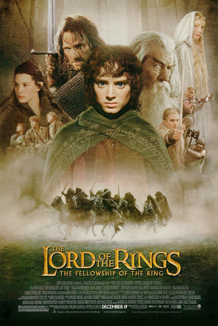
Movie poster for the Fellowship of the RingIn that scene, we meet a person who knows about the secret Frodo carries. Despite Frodo’s error, Tolkien’s portrayal of him makes us believe that he won’t try to steal it, that he is honorable. Here is a person who genuinely wants to help Frodo escape the Black Riders.

We hope that Frodo will listen to him despite his (justifiable) paranoia and Sam’s misgivings.

When I create a mentor in a story, I hope to convey a sense of history without beating the reader over the head with it. I want to evoke a feeling of rightness, that this person knows things we don’t, that this person has knowledge our protagonist must gain.

Hopefully, the insights of my own mentors (my writing group) will guide me to write memorable narratives filled with characters who leave an impact.


Credits and Attributions:

[1] Quote from The Fellowship of the Ring, by J.R.R. Tolkien, Publisher: Houghton Mifflin Harcourt; Illustrated edition, published 29 July 1954. (accessed December 28, 2025) Fair Use.

The Lord of the Rings: The Fellowship of the Ring theatrical release poster. Wikipedia contributors, “The Lord of the Rings: The Fellowship of the Ring,”Wikipedia, The Free Encyclopedia,https://en.wikipedia.org/w/index.php?title=The_Lord_of_the_Rings:_The_Fellowship_of_the_Ring&oldid=1329784385(accessed December 28, 2025).

Wikipedia contributors, “The Fellowship of the Ring,”Wikipedia, The Free Encyclopedia,https://en.wikipedia.org/w/index.php?title=The_Fellowship_of_the_Ring&oldid=1329646864(accessed December 28, 2025).

1 Comment

Filed under writing