Monthly Archives: May 2023

Layers of depth: The use and abuse of modifiers #amwriting

Depth in a narrative is created by many layers. One layer we must look at involves prose, words we use, and how we phrase things. The way we use modifiers and descriptors plays a significant role in how our work is received by a reader.
depthPart1revisionsLIRF05252021In writing, we add depth and contour to our prose by how we choose and use our words. We “paint” a scene using words to show what the point-of-view character is seeing or experiencing. Yes, we do need to use some modifiers and descriptors.

Modifiers are like any other medicine: a small dose can cure illnesses. A large dose will kill the patient. The best use of them is to find words that convey the most information with the most force.

When we refer to modifiers, what do we mean?

Any word that modifies (alters, changes, transforms) the meaning and intent of another word is a modifier. Modifiers change, clarify, qualify, or limit a particular word in a sentence to add emphasis, explanation, or detail.

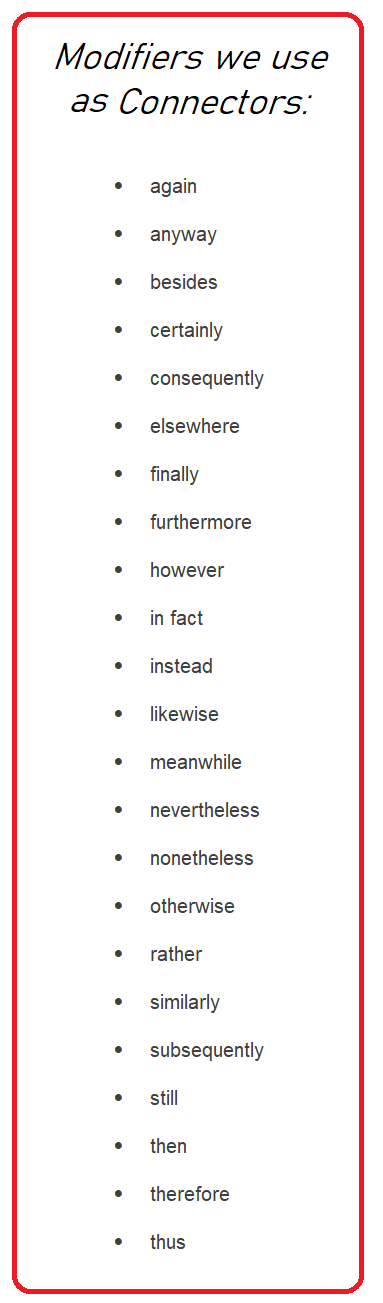
We also use them as conjunctions to connect thoughts: “otherwise,” “then,” and “besides.”

What are descriptors? Adverbs and adjectives, known as descriptors, are helper nouns or verbs—words that help describe other words. They are easily overused, so these words are often reviled by authors armed with a little dangerous knowledge.

What is a quantifier? They are nouns (or noun phrases) meant to convey a vague number or an abstract impression, such as: very, a great deal ofa good deal ofa lot, many, much. The important word there is abstract, which I think of as a thought or idea describing something without physical or concrete existence.
modifying-conjunctions-04262022One of the cautions those of us new to the craft frequently hear are criticisms about the number of modifiers (adjectives and adverbs) we habitually use. This can hurt, especially if we don’t understand what the members of our writing group are trying to tell us.

Perhaps the number of modifiers isn’t the problem, but the forms we use fluff up our narrative.

Perhaps you have been told you use too many “ly” words or descriptors. Examine the context. Have you used the word “actually” in a conversation? You may want to keep it, as dialogue must sound natural, and people use that word when speaking.

However, if you have used “actually” to describe an object, check to see if it is necessary. Is the sentence stronger without it?

  • The tree was actually covered in red leaves.
  • Red leaves covered the tree.

Many descriptors are easy to spot, often ending with “ly.” When I begin revising a first draft, I do a global search for the letters “ly.” A list will pop up in my lefthand margin. My manuscript will become a mass of yellow highlighted words.

  • “ly” words are code words – a kind of mental shorthand in a first draft. In the revision process, they tell us what we need to expand on to fully explore the scene as we originally envisioned.

It’s a daunting task, but I look at each instance and see how they fit into that context. If a word or phrase weakens the narrative, I change it to a simpler form or remove it and rewrite the sentence.

Think about it – bare is an adjective, as is barely.

Context is everything. Take the time to look at each example of the offending words and change them individually. You have already spent months writing that novel. Why not take a few days to do the job well?

Sentence structure matters. Where you place an adjective relative to the noun they are describing affects a reader’s perception. Adjectives work best when showing us what the point-of-view characters see, hear, smell, touch, and taste.

Sunlight glared over the ice, a cold fire in the sky that cast no warmth but burned the eyes.
Timid WordsIn the above sentence, the essential parts are structured this way: noun – verb (sunlight glared), adjective – noun (cold fire), verb – adjective – noun (cast no warmth), and finally, verb-article-noun (burned the eyes). Lead with the action or noun, follow with a strong modifier, and the sentence conveys what is intended but isn’t weakened by the modifiers.

The above scene could be shown in many ways, but a paragraph’s worth of world-building is pared down to 19 words, three of which are action words. This is an area I struggle with, and it occupies most of my attention during revisions.

Shakespeare understood the beauty and the power that contrasting modifiers can add to ordinary prose without making it artificial. Consider this line from his play, As You Like It, written in 1599:

It strikes a man more dead than a great reckoning in a little room. As You Like It, Wm. Shakespeare, 1599.

What brilliant imagery Shakespeare handed us—strong words with powerful meaning: dead, great, reckoning, little. His prose moves us as we read or hear it spoken because he uses words with visual impact.

Most writers know that participating in a critique group requires delicacy and dedication. They know it involves restraint and the ability to allow other authors to write their own work. Most groups don’t micromanage a manuscript because they know how too much input and direction can remove the author’s unique voice from a piece.

These are dedicated people who love reading and want your work to succeed.

As writers, we all want to be accepted and have others like our work, but we must write from the heart. That means using modifiers, descriptors, or quantifiers when they are needed. It’s a balancing act. We must be mindful of the form and the context of how a modifier fits into our phrasing.

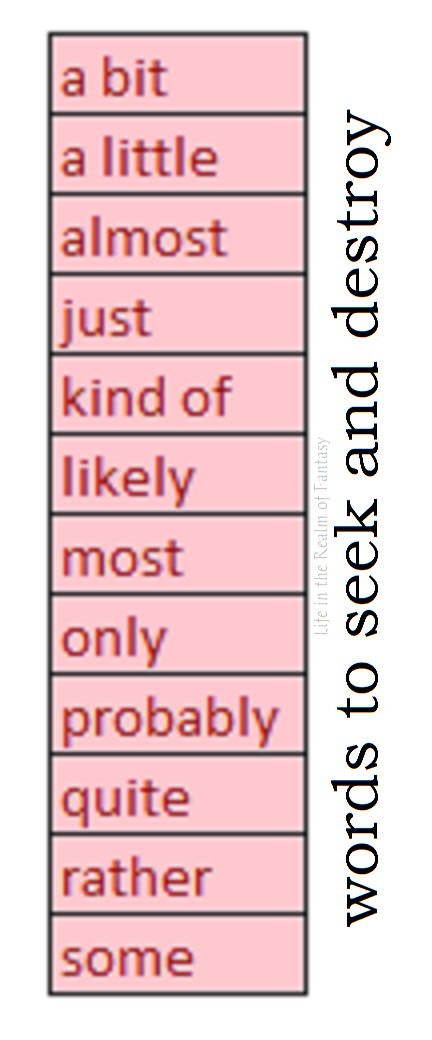
The following image is a list of code-words I seek out and re-examine when I begin revising a first draft. Each word points me in the right direction. All I have to do is rephrase that sentence with stronger forms of the “ly” word.
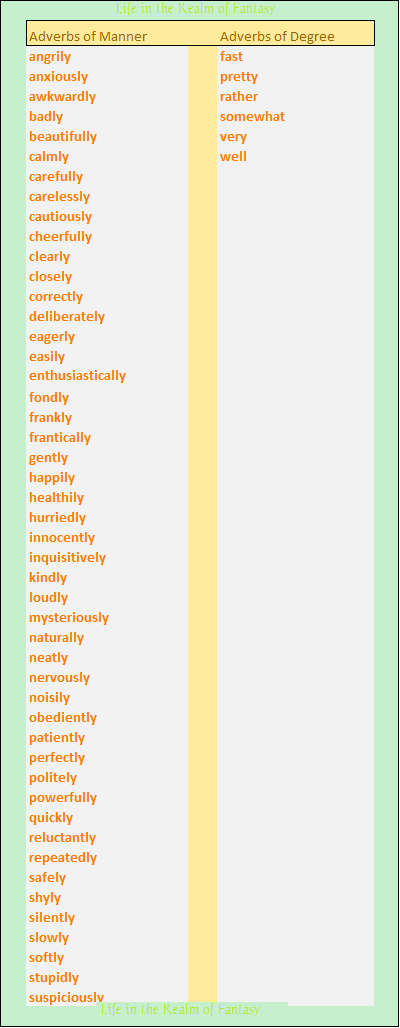
List of common adverbs

12 Comments

Filed under writing

#FineArtFriday: the Song of Love by Georgio de Chirico

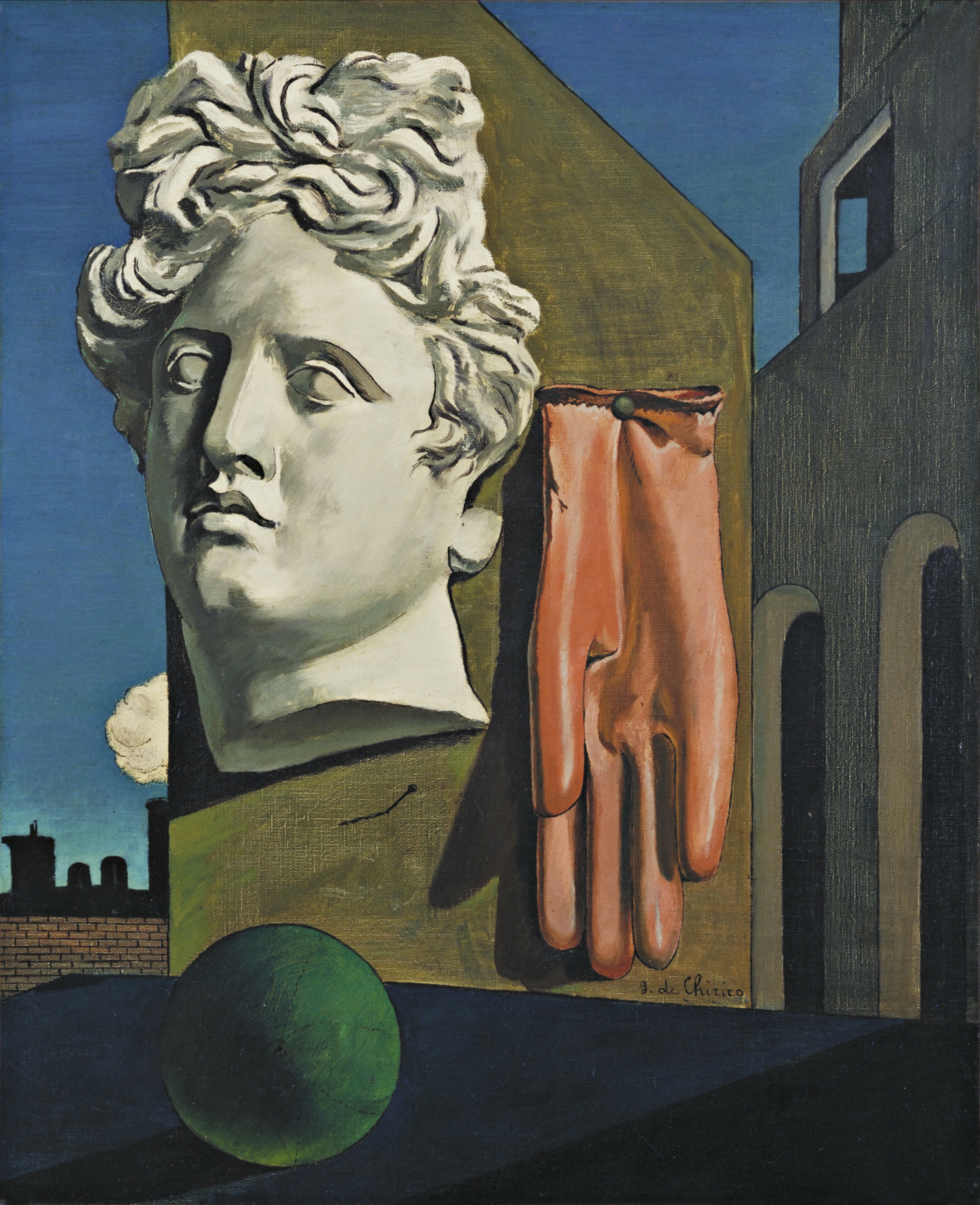
De_Chirico's_Love_SongArtist: Giorgio de Chirico, 1914,

Title: The Song of Love,

Genre: Metaphysical Art

Medium: oil on canvas, 73 x 59.1 cm,

Location: Museum of Modern Art, New York

About this painting, via Wikipedia:

Chirico presents a bust of a classical sculpture, a rubber ball, and a rubber glove on a canvas in between some buildings with a train passing by in a scene that spurs a sense of confusion. The bust could be a representation of Chirico’s love of classical art and a disappearing age. Chirico uses the rubber glove as a mold of a hand that implies the void of human presence. The buildings set up a scene that is reminiscent of the cityscapes of Chirico’s past. [1]

About the Artist,  via Wikipedia:

Giuseppe Maria Alberto Giorgio de Chirico; 10 July 1888 – 20 November 1978) was an Italian artist and writer born in Greece. In the years before World War I, he founded the scuola metafisica art movement, which profoundly influenced the surrealists. His best-known works often feature Roman arcades, long shadows, mannequins, trains, and illogical perspective. His imagery reflects his affinity for the philosophy of Arthur Schopenhauer and of Friedrich Nietzsche, and for the mythology of his birthplace.

After 1919, he became a critic of modern art, studied traditional painting techniques, and worked in a neoclassical or neo-Baroque style, while frequently revisiting the metaphysical themes of his earlier work.

The paintings de Chirico produced between 1909 and 1919, his metaphysical period, are characterized by haunted, brooding moods evoked by their images. At the start of this period, his subjects were motionless cityscapes inspired by the bright daylight of Mediterranean cities, but gradually he turned his attention to studies of cluttered storerooms, sometimes inhabited by mannequin-like hybrid figures. [2]

For more on the life and art of Georgio de Chirico, check out this video: Is This £1 Thrift Shop Painting By 20th Century Italian Master? | Fake Or Fortune | Perspective – YouTube


Credits and Attributions:

Image: Love Song by Georgio de Chirico, PD|100, courtesy Wikipedia Contributors, Wikipedia, The Free Encyclopedia https://en.wikipedia.org/wiki/File:De_Chirico%27s_Love_Song.jpg. (Accessed April 30, 2023.)

[1] Wikipedia contributors, “The Song of Love,” Wikipedia, The Free Encyclopedia, https://en.wikipedia.org/w/index.php?title=The_Song_of_Love&oldid=1146489854 (accessed April 30, 2023).

[2] Wikipedia contributors, “Giorgio de Chirico,” Wikipedia, The Free Encyclopedia, https://en.wikipedia.org/w/index.php?title=Giorgio_de_Chirico&oldid=1152305674 (accessed May 4, 2023).

2 Comments

Filed under #FineArtFriday

Layers of Depth – using atmosphere to emphasize emotion #amwriting

Writing emotions with depth is a balancing act, and simply showing the outward physical indicators of a particular emotion is only half the story. Every idea for a novel comes to me with an idea for the overall mood. That mood will underscore and emphasize the characters’ personal mood and changing emotions.

depth-of-characterIn his book, Story, Robert McKee tells us that emotion is the experience of transition, of the characters moving between a positive and negative. Beneath and behind the emotions that our characters experience is the atmosphere of the story, going unnoticed on the surface.

Atmosphere is the aspect of mood that setting conveys. It is only an ambiance, but it is a powerful tool for helping us show our characters’ emotional state.

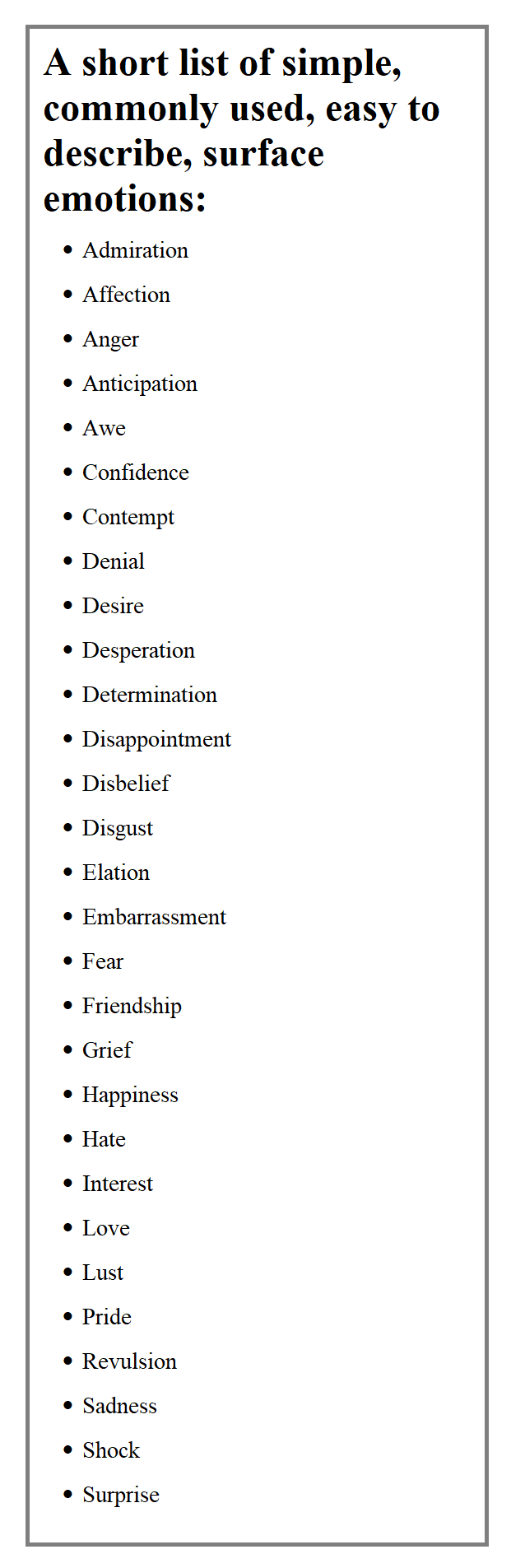
When creating our characters, we find it easy to connect with vivid emotions, such as hate, anger, desire, and passion. These are loud emotions.

Volume control is a crucial part of the overall pacing of our story. “Loud” deafens us and loses its power when it’s the only sound. So, like the opening movement of Beethoven’s 5th Symphony, we must contrast loud against quiet to create the texture of our story.

When we first begin as writers, we find it difficult to convey our characters’ emotions without telling the reader what to feel. After receiving our share of abuse from other writers, we swing toward showing their every mood in minuscule detail.

emotionwordslist01LIRF06232020Truthfully, I find detailed descriptions of facial expressions to be boring and sometimes off-putting. Every author armed with a little knowledge writes characters with curving lips, stretching lips, and lips doing many things over, and over, and over … with little variation.
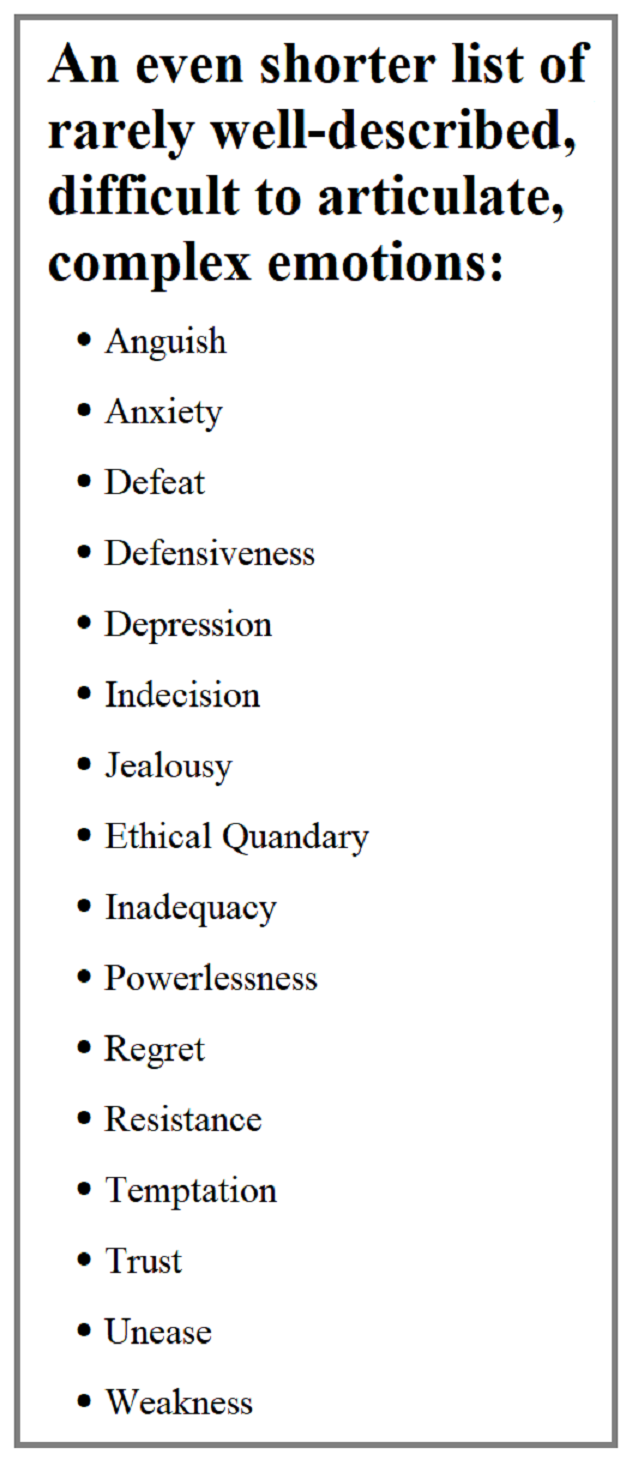
A happy medium between telling and showing can be achieved, but it takes work. We must choose words that show what we mean and use the environment to convey subtle feelings wherever possible. I say wherever possible because it is not practicable to always employ the setting in a narrative. We need to get inside the characters’ heads.

Severe emotional shock strikes us, and we have an immediate physical reaction.

Visceral reactions are involuntary—out of our control. We can’t stop our faces from flushing or our hearts from pounding. Visceral feelings are emotions we feel deeply. We find it difficult to control or ignore them because they are instinctive and not the result of thought.

We can pretend it didn’t happen or hide it, but we can’t stop it. An internal physical gut reaction is difficult to convey without offering the reader some information, a framework to hang the image on.

There will be an instant reaction. How does a “gut reaction” feel? We might experience nausea, gut punch, or a feeling of butterflies in our stomach. Think about how you respond to internal surprises, and write those feelings down.

I experience severe shocks this way:

  • disbelief—the OMG moment
  • a sinking feeling in the pit of my stomach, freezing in place, or a shout of “No!”
  • Years ago, on witnessing a horrific accident, I experienced disassociation or a feeling of viewing the scene from outside myself. This involuntary coping or defense mechanism is meant to minimize or help a person tolerate stress.

When we write mild reactions, offering a lot of emotional descriptions is unnecessary because mild is boring. A raised eyebrow, a sideways glance—small gestures show the attitude and mood of the character.

But good pacing requires balance. Quiet scenes enable us (and our characters) to process the events detailed in the louder scenes.

However, strong emotions are compelling. Highly charged situations are strengthened by the way we write the emotional experience. The way we show the setting reinforces each physical response.

The following is an excerpt from a work in progress:

Knowledge lay in Ivan’s belly, a cold ball of disaster. He had already failed as a shaman, and he wasn’t even a true seeker. But he couldn’t let Cai down, had to prove he could resolve it. He forced a smile, projecting confidence. “Look at that view. I’d heard the lake is so large one can’t see the southern shore from Neville, but I didn’t realize its truth. It seems as vast as the sky.”

As you can see, I struggle with these concepts as much as any other writer does. This scene is set on an early spring morning with cold winds shuttling heavy clouds across a blue sky. Rain moves in later in the day, underscoring Ivan’s dark mood. Sometimes I do well at conveying atmosphere and emotion; other times, I don’t. But I keep trying because it takes effort to succeed in anything.

When I write a scene, I ask myself why this character is reacting this way. Emotions without cause have no basis for existence, no foundation. They’re a lot of noise about nothing.

The emotion hits, and the character processes it. From a different work in progress:

It would have been the first battle spell John had cast in years, but no. His battle abilities were still gone, as if the inferno he’d unleashed in the culvert had burned them away.

Timing is crucial, and this is the moment to slip in a brief mention of the backstory. That way, we avoid an info dump, but the reader has the information needed to make the emotion tangible.

On the heels of that thought, John was overcome by the remembered sounds, the roar of flames, the shrieks of the enemy …. he sagged to the curb, gagging and gasping, unable to breathe properly, panicking under the weight of it.

emotionwordslist02LIRF06232020Simplicity has an impact, but I struggle to achieve balance. When looking for words with visceral and emotional power, consonants are your friend. Verbs that begin with consonants are powerful.
Use forceful words, and you won’t have to resort to a great deal of description. Weak word choices separate the reader from the experience, dulling the emotional impact of what could be an intense scene.

If you are between projects and don’t know what to write, a good exercise is to create an intense and dramatic scene for characters you currently have no story for. Give them a setting, and use it to emphasize how they feel.

The key to writing a good scene is to practice. You may find a later use for these characters, and that scene could be the seed of a longer story. The more we practice this aspect of the craft, the better we get at it.

And the more we write, the more individual and recognizable our writing voice becomes.

17 Comments

Filed under writing

Layers of Depth: Mood and Emotion #amwriting

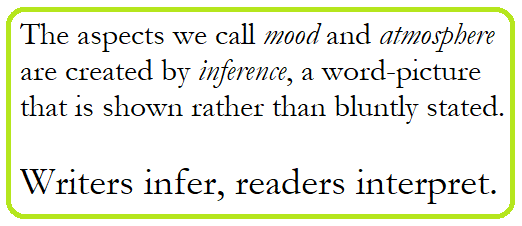
Readers and authors often use the word mood interchangeably with atmosphere when describing a scene or passage. Like conjoined twins, mood and atmosphere march along together—separate but intertwined so closely that they seem as one.

mood-emotions-2-LIRF09152020Mood is long-term, a feeling residing in the background, going almost unnoticed. Mood affects (and is affected by) the emotions evoked within the story.
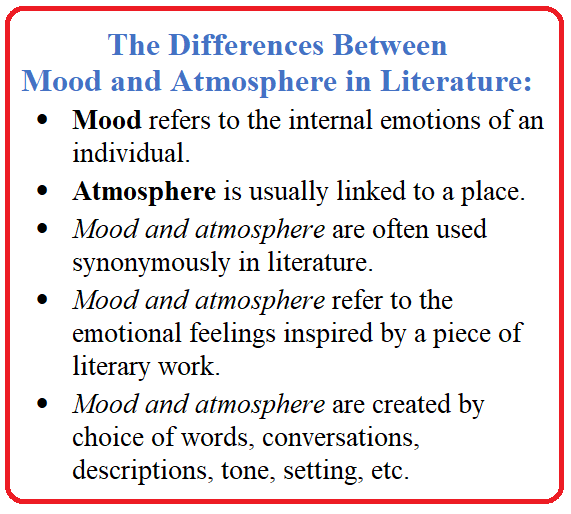
Atmosphere is also long-term but is sometimes more noticeable as it is a worldbuilding component. Atmosphere is the aspect of mood that setting conveys.

Emotion is immediate and short-term. It exists in the foreground but contributes to the overall atmosphere and mood.

In his book, Story, Robert McKee tells us that emotion is the experience of transition, of the characters moving between a positive and negative. “Story” by Robert McKee,

Much of my information comes from seminar videos on the craft of writing found on YouTube and posted by Robert McKee. He is an excellent teacher, and his textbook is a core component of my personal library. A wonderful 6-minute lesson on the difference between mood and emotion can be found at:

Robert McKee, Q&A: What Is the Difference Between Mood and Emotion?

While emotions are immediate, they can be subtle. I look for books where emotions are dynamic, because that is when the character’s internal struggle becomes personal to me.

Mood is a large word serving several purposes. It is created by the setting (atmosphere), the exchanges of dialogue (conversation), and the tone of the narrative (word choices, descriptions). It is also affected by (and refers to) the emotional state of the characters—their personal mood.

Mood-and-atmosphere-LIRF04302023Undermotivated emotions lack credibility and leave the reader feeling as if the story is flat. In real life, we have deep, personal reasons for our feelings, and so must our characters.

A woman shoots another woman. Why? Add in the factor of her child having been accidentally killed by the woman she murders, and you have high emotion and high drama. Therefore, just as in real life, the root cause for a character’s emotions is a fundamental motivation for their actions.

Which is more important, mood or emotion? Both and neither. Characters’ emotions affect the overall mood of a story. In turn, the atmosphere of a particular environment may affect the characters’ personal mood. Their individual attitudes affect the emotional state of the group.

Because emotion is the experience of transition from the negative to the positive and back again, emotion changes a character’s values, and they either grow or stagnate. This is part of the inferential layer, as the audience must infer (deduce) the experience. You can’t tell a reader how to feel. They must experience and understand (infer) what drives the character on a human level.

What is mood? Wikipedia says:

In literature, mood is the atmosphere of the narrative. Mood is created by means of setting (locale and surroundings in which the narrative takes place), attitude (of the narrator and of the characters in the narrative), and descriptions. Though atmosphere and setting are connected, they may be considered separately to a degree. Atmosphere is the aura of mood that surrounds the story. It is to fiction what the sensory level is to poetry.[1] Mood is established in order to affect the reader emotionally and psychologically and to provide a feeling for the narrative.

What is atmosphere? It is created by our word choices and is intangible, but it affects how the reader perceives the story. The setting contributes to the atmosphere, so it is a component of worldbuilding. But we should note that the setting is only a place; it is not atmosphere. Atmosphere comes into play when we place certain visual elements into the scenery with the intention of creating a mood in the reader.

  • Tumbleweeds rolling across a barren desert.
  • Waves crashing against cliffs.
  • Dirty dishes resting beside the sink.
  • A chill breeze wafting through a broken window.

Atmosphere is created as much by odors, scents, ambient sounds, and visuals as by the characters’ moods and emotions. It is a component of the environment but is also an ambiance because it is intentional.

We build atmosphere into a setting with the aim of creating a specific frame of mind or emotion in the reader.

I love it when an author drops me into an atmosphere that colors their world and shapes the characters’ moods.

So, now we know that atmosphere is environmental, separate but connected to the general emotional mood of a piece. From the story’s first paragraph, we want to establish a feeling of atmosphere, the general mood that will hint at what is to come.

storybyrobertmckeeRobert McKee tells us that the mood/dynamic of any story is there to make the emotional experience of our characters specific. It makes their emotions feel natural. After all, the mood and atmosphere Emily Brontë instilled into the setting of Wuthering Heights make the depictions of mental and physical cruelty seem like they would happen there.

Happy, sad, neutral—atmosphere and mood lend a flavor to the emotions our characters experience, giving them emphasis and making them real to the reader.

For me, as a writer, the inferential layer of a story is complicated. Creating a world-on-paper requires thought even when we live in that world. We know how the atmosphere and mood of our neighborhood feel when we walk to the store. But try conveying that mood and atmosphere in a letter to a friend – it’s harder than it looks.

Next up: a closer examination of emotions and why showing is so much more difficult (and sometimes dangerous) than telling.


Credits and Attributions:

Wikipedia contributors, “Mood (literature),” Wikipedia, The Free Encyclopedia, https://en.wikipedia.org/w/index.php?title=Mood_(literature)&oldid=1147399122 (accessed April 30, 2023).

13 Comments

Filed under writing