
Maybe you’re a “pantser,” not a “plotter.” Unlike me, you like to wing it when you write; just let the ideas flow freely.
 I have “pantsed it” occasionally, which can be liberating but for me, there always comes a point where I realize my manuscript has gone way off track and is no longer fun to write. Then I must return to the point where the story stopped working and make an outline.
This year, I finally published Bleakbourne on Heath, a novel that began as a serial published in 2015 – 2016 on Edgewise Words Inn. That experience was how I discovered that writing and publishing a chapter a week is not my forte. I hit a dead spot at the ¾ mark, and the book was on hold for several years because of other writing commitments, but finally, it was finished, and now it is out the door.
Another bit of unfinished business is book two of a duology. I’ve committed to writing the second book in this set before publishing the first because I know from experience it will be years between installments, and readers don’t like that. This ensures the wait time for the second book’s release is reasonable. Even though the entire story will span two books, this first half must have a finite ending, and I think I have finally achieved that goal.
It’s at what would be considered the midpoint of the 2-book story arc. The problem has been deciding where in the overall story arc of the duology the ending of book one occurs and how it leads into the action of the opening chapters in the second half.
I have stopped floundering and (literally) cut my losses. I trimmed book two back to where the narrative dissolved into chaos. Now I must figure out how to bring the story to its intended conclusion.
This isn’t unusual. Fortunately, my years of doing NaNoWriMo have given me some tools for just such an emergency.
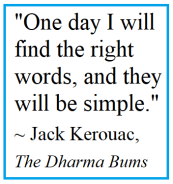 The first tool is a sense of balance. Every published novel has entire sections that were cut or rewritten at least once before it got to the editing stage.
Much of what you cut out can be recycled, reshaped, and reused, so never delete weeks of work. Save everything you cut to a new document, labeled and dated something like “Outtakes_AF_rewrite2_06-19-2023.” (For me, that stands for Outtakes, Aelfrid Firesword, rewrite 2, June-19-2023)
Now, we must consider what will be the most logical way to end this mess.
What is the core conflict? For me, a good way to pull the ending out of my subconscious is to revisit the outline I made of the story arc. Fortunately, I have been on top of things, so deviations from the original plans have been noted on my outline.
The problem I am experiencing now is that I didn’t know precisely where this duology would end when I began writing it so that part never got plotted. Now I can see how the internal growth of the characters has caused two of them to fundamentally change from what was originally planned. Their personal goals have radically deviated from what I had initially thought, and they have a lesser part to play.
By visualizing the whole picture of the story to this point, I usually find the inspiration to put together the final scenes that I know must happen. I know what must be achieved in the last chapters – I just can’t get it onto paper. This is where I stop and drag out a notebook and pen. I sit outside or in a coffee shop and write down those loose ideas for an hour or so. I find an outline is crucial, especially when trying to write a solid ending. The list of events helps me get the story out of my head in a logical sequence.
What must occur between the place where the plot was derailed and the end? I write a list of chapters with the keywords for each scene noted.
Once I have made a few notes as ideas occur to me, I start a new document and save it with a name indicating that it’s a worksheet for that novel: AF_Final_Chpts_Worksheet_06-19-2023 (Aelfrid Firesword, final chapters worksheet, and the date)
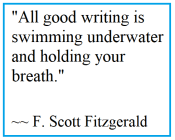 At first, the page is only a list of headings that detail the events I must write for each chapter. I know what end I have to arrive at. But the chapter headings are pulled out of the ether, accompanied by the howling of demons as I force my plot to take shape:
- Chapter – Sunhammer revealed/Alf swears the vows of protection
- (and so on until the last event)
You’ll note that there are no numbers, but the word “chapter” and a rudimentary title are there. I don’t number my chapters until the final draft is complete, although I do head each section with the word “chapter” written out, so it is easy to find with a global search. The titles will disappear, or be changed, depending on which series it is.
This is because, in my world, first drafts are not written linearly. Things change structurally with each rewrite. So the numbers are only put in when the manuscript is finalized.
- I begin writing details that pertain to the section beneath each chapter heading as they occur to me.
- Once that list is complete, those sketchy details get expanded on and grow into complete chapters,
- Which I then copy and paste into the manuscript.
When I begin designing the ending, it’s as challenging as plotting the opening scenes. I go back to the basics and ask myself the same questions I asked in the beginning.
It’s a good idea to have a separate worksheet that lists each character and contains notes detailing what they wanted initially. That way, you can see how they’ve been changed by the events they have experienced.
- What do the characters want now that they have achieved a significant milestone?
- What will they have to sacrifice next?
- What stands in the way of their achieving the goal?
- Do they get what they initially wanted, or do their desires evolve away from that goal when new information is presented?
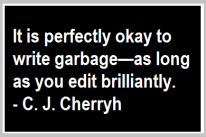 Don’t be afraid to rewrite what isn’t working. Save everything you cut because I guarantee you will want to reuse some of that prose later at a place where it makes more sense.
Not having to reinvent those useful sections will significantly speed things up, so I urge you to save them with a file name that clearly labels them as background or outtakes.
We all suffer from the irrational notion that if we wrote it, we have to keep it, even though it no longer fits. No amount of rewriting and adjusting will make a scene or chapter work if it’s no longer needed to advance the story. When the story is stronger without that great episode, cut it.
Outtakes are fodder for a short story or novella set in that world. This is how prolific authors end up with so many short stories to make into compilations. Every side quest not used in the final manuscript can quickly become a short story featuring characters you already know well.
What you have written but not used in the finished novel is a form of world-building. It contributes to the established canon of that world and makes it more real in your mind.


 Life in the Realm of Fantasy
Reblogged this on Kim's Musings.
LikeLiked by 1 person
❤ Kim, thank you for the reblog! You made my day!
LikeLiked by 1 person
My pleasure!
LikeLike