
September is in full swing, and with it comes writers’ conferences. This last weekend, I attended the Southwest Washington Writers’ Conference in Centralia, Washington. I sat in on presentations by Lindsay Schopfer, Mellissa Hart, Elizabeth Goddard, and many other writers, all discussing the craft of writing. I also gave a small presentation on adding depth to our heroes and villains.
 Conferences are excellent places to make good connections with other writers. You meet people you can talk to about every aspect of the experience of writing as well as craft. No one’s eyes glaze over when you try to explain your main character’s inner demons and you find people with struggles similar to your own.
You also meet industry professionals who will help you on your road to a finished project.
I have another conference in two weeks, this one in Seattle. After PNWA’s 2023 conference, I will plow through my notes for new info, as conferences always give me plenty of fodder for several blog posts.
September is also the time of year when I begin pulling together the characters and plot of my next novel. I’m a Municipal Liaison for NaNoWriMo (National Novel Writing Month).
If you haven’t heard of this, it’s a worldwide event taking place in November. Each year, thousands of people in all parts of the world dedicate themselves to writing a 50,000-word narrative in only thirty days.
NaNoWriMo is a contest in that you have achieved your goal if you write 50,000 words and have your word count validated through the national website. But it is not a contest in any other way as there are no monetary prizes or fame for those winners, only a PDF winner’s certificate that you can fill out and print to hang on your wall.
Depending on your intended audience, a manuscript of only 50,000 words is a short novel. It’s a good length for YA or romance but is only half a novel for epic fantasy or literary fiction.
November’s Goal
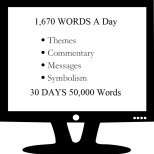
Regardless of the planned length of their finished novel, a dedicated author can get a book’s basic structure and storyline down in those thirty days. They sit for an hour or two each day and write at least 1667 words.
That’s all you need to do. At the end of 30 days, you will have written 50,000 words.
Author Lee French and I are co-MLs for the Olympia Region for NaNoWriMo. Every year, many writers in our area create profiles at www.nanowrimo.org and embark on the writer’s journey. Lee and I work together to ensure they have all the necessary tools and support to achieve their goals.
We’ve been doing this for a while and have seen a pattern among our writers. The first roadblock happens when reality sets in, and the writers realize that writing is work. This usually occurs within the first few days. A small percentage will never get more than 2,000 words written.
They discover writing isn’t their jam, after all.
The majority of new NaNo writers are people who “always wanted to write a book.” Often, they don’t know what they want to write and have no clue how to be disciplined enough to write any words, much less the number it takes to make a novel.
They start, get 30 to 1,000 words in, and realize they have nothing to say. But in our region, many people will reach the 10,000-word mark before they stop writing. That’s an achievement—it’s almost a novella.
 Some new writers are completely fired up for their novels, obsessed. They go at it full tilt for a week or even two, and then, at the 20,000-word mark, they take a day off. Somehow, they never get back to it. These writers will continue to write off and on and may participate in NaNoWriMo again.
Even seasoned writers who have crossed the finish line at NaNoWriMo in previous years may find that the commitment to sit and write 1,667 words daily is not doable. Things come up—life happens, and it’s okay to set the writing aside. You can always come back to it later.
But by November 30th, a third of the writers in our region will make it to the 50,000-word mark. Some will reach above 80,000, and a few will exceed 100,000.
Some of these novels have complete story arcs and are ready for revisions. Most are not, but more work could make these proto-novels publishable.
It takes commitment and discipline to write 1,667 new words every day. You are not revising old work. Instead, you’re writing something new and not looking at what you wrote yesterday.
To do this, you must sit at the keyboard, open the document to where you left off, and begin writing forward. I have some tips and tricks to simplify this process, and we will discuss them later.
I’m not a good typist. The words that fall out of my head during NaNoWriMo are not all golden, just so you know. When writing stream-of-consciousness, many words will be garbled and miss-keyed.
This means that the revision process is a long and winding road for me.
I began writing Ruins of Abeyon, my forthcoming novel in November 2017, on the spur of the moment when I had a sudden flash of “what if.” I started with no outline, so the story arc evolved as I wrote the book. I listed the events in a separate document as I went. Later, when revising, it was easy to see the arc and make an outline. I could see when it was best to move certain events to more logical places and even when things needed to be cut.
Still, it has taken five years to get this book to where it is ready to be published.
Succeeding in writing even a short story gives one the confidence to continue.
If you have a novel in your soul and it’s bursting to get out, this might be your chance. However, planning for a successful NaNoWriMo is like preparing for a marathon.
We let our families know what we are planning well in advance and share how vital reaching our goal is to us. That way, we have their emotional support. We also plan ahead for meals and family time so the essential people in our lives aren’t neglected. In the US, this means fixing a Thanksgiving dinner on the last Thursday of November and enjoying the things that matter most.
 Cooking is my love language. I have many tips and ideas for getting word count and having a proper family feast. As a dedicated writer, I know how to plan for all aspects of life.
In many ways, we’re physically and mentally preparing for a marathon. We build our strength and get our families behind us by ensuring we have prepared well in advance.
Over the next few weeks, we will focus on laying the groundwork for our novels so that we will be ready and able to write when November comes.
Much of what I will discuss has emerged from my 13 years of experience and my co-ML Lee’s ideas for prep work.
I have made life-long friends through participating in my local NaNoWriMo group. The emphasis is on having fun and meeting personal goals, commiserating when goals can’t be met, and just enjoying the experience of creating something that is ours. We have the support and encouragement of the worldwide community of writers and people of all nations and walks of life.
Everyone has a story. Some people will write those stories, and I will be first in line at the eBook store, eager to read them.


 Life in the Realm of Fantasy
Thank you for this info! I’m very intrigued and might use this opportunity to push my novel forward!
LikeLiked by 1 person
Hello Samantha! It’s a great chance to finish a project. There are so many ways to “do” NaNoWriMo–that is what keeps it interesting for me.
LikeLike
Pingback: #NaNoPrep: What do I want to write? #nanowrimo | Life in the Realm of Fantasy