
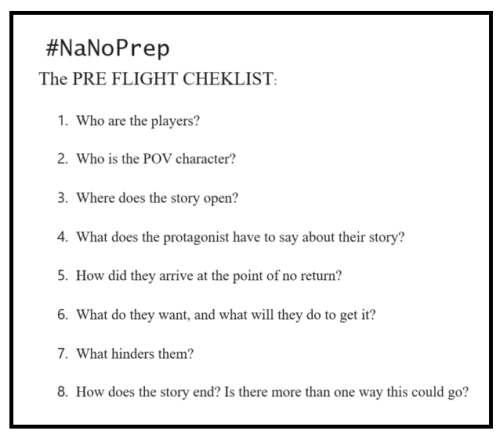
If you are new to NaNoWriMo, or to writing in general, this post is for you. A successful NaNoWriMo is easier to achieve if we have a preflight checklist (which can be found at the bottom of this post). Today, we will take an hour or so to do some pre-writing, building our main character and their sidekicks.
 No matter how many characters you think are involved, one will stand out. That person will be the protagonist.
Character creation crosses all genres. Even if you are writing a memoir detailing your childhood, you must know who you were in those days. You want the reader to see the events that shaped you, but not through the lens of memory. They must see the events as they unfold.
I have mentioned (a gazillion times) that I use Excel, a spreadsheet program, to outline my projects. But you can use a notebook or anything that works for you. You can do this by drawing columns on paper by hand or using post-it notes on a whiteboard or the wall. Everyone thinks differently, so we all have to find the way that works best for us. I just happen to like working with Excel or Google Sheets.
Some people use a dedicated writer’s program like Scrivener—which I find mind-bogglingly incomprehensible. No matter your method, the characters aren’t fully formed when you begin writing the first chapters. They will evolve as a result of the experiences you write for them, but you want an idea of who they are now.
The storyboard is where I brainstorm characters and plot. When I find myself floundering in the writing process, I can see where I have gone off the rails and into the weeds.
First, we want to get to know who we’re writing about. I always have a reasonably good idea of how my characters look. However, that image can drift as the first draft evolves, and brown eyes are suddenly green (yes, this did happen, but my editor is amazing).
But don’t get too detailed. Readers have their own image of beauty, so don’t force your idea of loveliness on them. General descriptions and the reactions of other characters should convey how they look. Skin tones and hair color, curly or straight, are pretty much all you need.
 Once I know the basic plot, I make a page in my workbook with a bio of each character, a short personnel file. Sometimes, I include images of RPG characters or actors who most physically resemble them and who could play them well—but this is only to cement them in my mind.
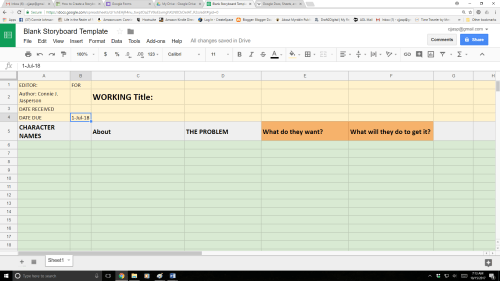
The personnel file is laid out this way:
Column A: Character Names. I list the important characters by name and the point where they enter the story.
Column B: About: Their role, a note about that person or place, a brief description of who and what they are.
Column C: The Problem: What is the core conflict?
Column D: What do they want? What does each character desire?
Column E: What will they do to get it? This column usually remains empty until I am well into the first draft, because at this point, I don’t know how far they will go to achieve their desire.
This is an image of a Storyboard Template, created in Google Sheets which is a FREE spreadsheet program. Google Docs is also free and is a perfectly fine word-processing tool if you don’t have the money for MS Office 360 or other programs.
 Names say a lot about characters. If you give a character a name that begins with a hard consonant, the reader will subconsciously see them as more intense than one whose name starts with a soft sound. It’s a little thing, but it is something to consider when conveying personalities.
Also, I’ve said this before, but with the growing popularity of audiobooks, I suggest writing names that are easy to pronounce. It will simplify the process of having your book narrated—but again, that is your choice.
A great story evolves when the antagonist and protagonist are powerful but not omnipotent. Both must have character arcs that show personal growth or an inability to grow. For the antagonist to be realistic, this must be clearly established, so once we know who they are, they should also get a personnel file.
So first, let’s create a main character. The story will grow from her experiences, so she must be someone you want to know.
Our protagonist is Lilly. For this exercise, I chose a flower name, suggesting someone who is kind, a good friend.
Who is this person? Start with the basics: race, ethnicity, age, gender, sexuality, appearance/coloration.
Race: This is a post-apocalyptic world. When the survivors prepared to leave the catacombs, they divided into 50 tribes. They blended the various races and ethnicities as evenly as possible to widen the gene pool. Everyone is of mixed-race heritage, regardless of outward coloring and appearance.
Appearance and coloration: Lilly is tall and physically fit and has straight black hair, brown eyes, and dark coloring.
Ethnicity: She was born into Asgrim’s tribe, which settled in the north.
Age: 27
Gender/sexuality: This is important, as gender and sexuality play a role in my novel. A broad view of gender/sexuality is a fact of life in their culture. Lilly and Kaye are life partners.
My co-municipal liaison, Lee French, suggests you write one sentence to describe them and move on. I’m not good at one-sentence descriptions, so a paragraph is more my style.
I suggest you write what comes to mind, and don’t worry if you can’t think of anything at this stage. Once you begin writing the narrative, the characters will tell you what you need to know.
It sounds hokey, but it’s true.
Characters don’t leap onto the page fully formed. They begin to reveal who they really are as we lay down the first draft, and this is why my narratives rarely keep to the original outline.
One thing that helps when creating a character is identifying the verbs embodied by each individual’s personality. Lilly’s verbs are: fight, defend, create, care. These words tell me how she will react in any given situation.
Also, I try to identify each character’s motivation, the metaphorical “hole” in their life. What pushes them to do the crazy stuff they do? Sometimes, that loss or lack doesn’t emerge until you’re well into writing the first draft.
What we are doing is pre-writing. It helps me to have the characters in place when I begin writing a novel on November 1st. Below is a PNG image of my pre-flight checklist. Feel free to right-click and save as a PNG or .jpeg for your own use!
We have looked at steps one and two. Next up is step three: the world as it is when the story opens.
Previous in this series:
#NaNoPrep: What do I want to write? #nanowrimo | Life in the Realm of Fantasy (conniejjasperson.com)


I am something like shot down, Connie! 😉 Thanks for sharing this very useful guide. I will try to get this in my brain. Best wishes, Michael
LikeLiked by 2 people
Hello, Michael, 😀 Don’t stress, and don’t worry. It’s more important that you enjoy the experience of writing!
LikeLike
Pingback: #NaNoPrep: The initial setting #amwriting | Life in the Realm of Fantasy
Pingback: #NaNoPrep: What we think the story might be about #amwriting | Life in the Realm of Fantasy
Pingback: #NaNoPrep: The Heart of the Story #amwriting. | Life in the Realm of Fantasy
I NEVER thought about the impression I get from a character’s name starting with hard/soft consonants! I know when writing I “feel like” this person is an Edna, or a Kyle, or a Amy….but never considered why that fit so well. Thanks, Connie! 💞
LikeLiked by 1 person
Thank you, Dawn! I don’t know why that is so in books, but that’s how we perceive things. I know it isn’t true in real life–I’ve known a “Sarah” whom I found less than kind, but also several with that name who are wonderful friends.
LikeLiked by 2 people
Pingback: #NaNoPrep: Signing up and getting started 2023 #amwriting | Life in the Realm of Fantasy
Pingback: #NaNoPrep: How a strong theme will help you write that novel #amwriting | Life in the Realm of Fantasy
Pingback: #NaNoPrep: worldbuilding – society and how we live #amwriting | Life in the Realm of Fantasy
Pingback: #NaNoPrep: worldbuilding – war elephants, magic, and the paranormal #amwriting | Life in the Realm of Fantasy