
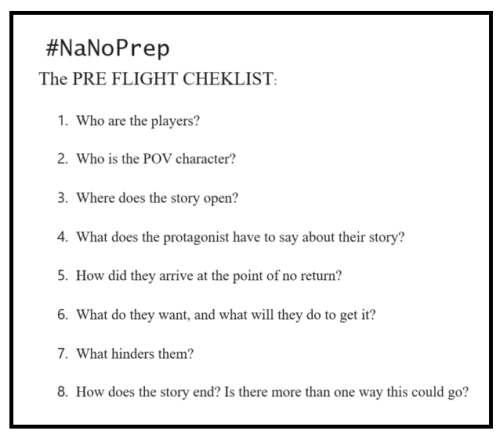
If you are new to NaNoWriMo (or to writing in general), this series of posts is for you. The goal of participating in NaNoWriMo is to write 50,000 words on your novel in the month of November. A successful NaNoWriMo is easier to achieve if we have a preflight checklist (which can be found at the bottom of this post).
 We talked about getting a start on our characters in Monday’s post. Today, we’re going to visualize the place where our proposed novel is set, the place where the story opens.
Where do you see your story taking place? In the real world? A fantasy realm? Space? An alternate dimension? Alternate Earth? Today, we’re focusing on the opening setting.
I write fantasy, and much of my work is set in an invented world. I began creating this world as the storyline for a post-apocalyptic anime-style RPG game for PC (that never went into production).
Fifteen years on, most of what I need to know about this world is canon and can’t be changed. But at the outset in 2007, all I knew was the premise of the conflict: the gods had been at war, and it involved three worlds. I needed to see how that conflict had changed the landscape because a disaster on that scale would dramatically affect the people of three worlds.
In science fiction and other genres, in series that are set in one world/universe, the word canon refers to historic and previously established events and occurrences in that reality. When something is declared impossible in the early narratives, it cannot be possible in later novels without some logical explanation.
 All worldbuilding must show a world that feels as natural to the reader as their native environment. I used the forests and lowlands of Western Washington State as my template. The entire series evolved out of three paragraphs that answered the following question:
- The “War of the Gods” broke three worlds – how did that affect their civilizations?
The War of the Gods is central to Neveyah’s religion, a trauma that shapes their lives as much as it does their world. One can never escape the visible scar, the immensity that divides the world in half: the Escarpment. It is the wound where the World of Cascadia was joined to the World of Neveyah.
Once I have a mental image of the visuals of the world I am writing, I ask myself, “Does the environment shape society?”
Since this example is set in a post-apocalyptic world, the characters live in a low-tech agricultural society. Resources are scarce.
- How can the environment create tension in the narrative?
I want to see that raw, just-born environment when I begin writing. In the case of this world, one fundamental theme binding the narratives together is the balance of nature and how delicate it is.
Here is a quick, easy exercise in worldbuilding, one that will take less than five minutes:
- Close your eyes and visualize your real-world environment.
- Then, without looking around, write a word picture of it.
I am sitting on a balcony. My chair is a saucer chair, not easy to get out of but comfortable once I’m in it. Traffic on the street below is noisy, but the sun is shining, and rain is expected to move in over the next few days.
Once you have written a paragraph or two that describes your personal world, you understand how worldbuilding works. You can visualize your characters’ community and write a two-paragraph word picture of that imaginary place.
So—about the storyboard we discussed in Monday’s post. Now is a good time to start if you haven’t already done so. Here is a screenshot of the tabs on my storyboard/stylesheet that has been fifteen years in the making:

Your storyboard/stylesheets will be much simpler, just one page to start out with.
If your work is set in an actual location, you should know where to find resources for appropriate slang, urban myths, and other local peculiarities. My co-municipal Liaison, Lee French, reminds us that we don’t have to immerse ourselves immediately. We just want to lay the groundwork for November, to have things handy when we start writing in earnest on November 1st.
Sci-fi writers should bookmark or list sites for any science you may need. If it takes place on a spaceship, you should have a good idea of what the ship looks, sounds, and smells like, a floorplan, and maybe consider what might power it.
Fantasy writers, if your novel is set in a made-up universe/world/town, what is the big-picture of your setting? Is the starting point near a river, forest, an ocean, or a desert? Again, you don’t have to know everything in precise detail, but you should put down some starter notes, because environment determines food and resources that may come into play later.
If you’re writing in the real world as we know it—make good use of Google Earth. Bookmark (or make a list of) the websites that offer accurate information about those places.
If you intend to add sci-fi or fantasy elements, such as zombies, magic, dragons, or future tech to our current world, you’ll want to think about the effect those elements will have on the environment. The presence of large flying predators would limit outdoor activities. Even if your dragons aren’t carnivorous, they are usually depicted as rather birdlike in appearance and habit.
 Seagulls are a good example of what could happen. They fly and do their business while on the wing, and sometime find enjoyment in “bombing” windshields.
That sort of package dropping from the sky could make for a startling end to the average family barbecue. Grandma’s potato salad would likely be served indoors so as to not encourage dragonly target practice.
My RPG-based world has creatures that cast certain magic as weapons or defensively. Their presence in the wild makes traveling without guards dangerous. Thus, the environment offers plot opportunities for employment.
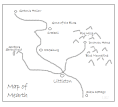 Some of us (Me! Me!) will make pencil-sketched maps of our fantasy world or the sci-fi setting. I find that maps are excellent brainstorming tools for when I can’t quite jostle a plot loose. It’s a form of doodling, a kind of mind wandering, and helps me find creative solutions to minor obstacles.
But you don’t have to go to all that trouble at one sitting. Just briefly note your ideas for worldbuilding because we will come back to this and flesh out the details later. For now, all you need is the overview of the world on the day your story opens.
Previous in this series:
#NaNoPrep: creating the characters #amwriting | Life in the Realm of Fantasy (conniejjasperson.com)


 Life in the Realm of Fantasy
Pingback: #NaNoPrep: What we think the story might be about #amwriting | Life in the Realm of Fantasy
Pingback: #NaNoPrep: The Heart of the Story #amwriting. | Life in the Realm of Fantasy
Pingback: #NaNoPrep: Signing up and getting started 2023 #amwriting | Life in the Realm of Fantasy
Pingback: #NaNoPrep: How a strong theme will help you write that novel #amwriting | Life in the Realm of Fantasy
Pingback: #NaNoPrep: worldbuilding – society and how we live #amwriting | Life in the Realm of Fantasy
Pingback: #NaNoPrep: worldbuilding – war elephants, magic, and the paranormal #amwriting | Life in the Realm of Fantasy