
Week one of NaNoWriMo (National Novel Writing Month) is now behind us. I’m still zooming along and making good progress. However, this is where many writers will fall by the way. They can’t visualize what to write next and then lose momentum.
 The well of inspiration has gone dry.
Getting word count becomes too important for some of us, and we go a bit off the rails. We flail around and end up with bunny trails to nowhere.
There are ways to move the story ahead and still write something worth reading. And the story is what matters. The quest for word count is only a personal goal. National Novel Writing Month is not a race or a contest. It is a time dedicated to the act of writing.
I spent many years working in corporate America and often had my best ideas while at my job. If your employment isn’t a work-from-home job, using the note-taking app on your cellphone to take notes during business hours will be frowned upon. To work around that, I suggest keeping a pocket-sized notebook and pen to write those ideas down as they come to you.
That is an old-school solution that worked for me. The best part is that you don’t appear distracted or off-task.
Ideas come to me when I stop forcing my brain to work when it’s on its last legs. Trust me, pounding out 1,667 new words a day severely tests your creativity and endurance.
Strangely, cleaning and organizing my living space allows my mind to rest. Taking the time to wash dishes or clean the house helps reset my short-circuited creative mind. But getting outside and walking helps even more. I suggest taking a notebook or dictating into your note-taking app.
 Arcs of action drive plots. Every reader knows this, and every writer tries to incorporate that knowledge into their work. Unfortunately, when I’m tired, random, disconnected events that have no value will seem like good ideas.
- But action inserted for shock value can derail what might have been a good plot.
I avoid acting on unplanned stupidity by brainstorming in a separate document and outlining as I go. This method helps me keep the overall logic in mind.
So, where are we in the story arc when the first lull in creativity occurs? At the story’s outset, we find our protagonist and see them in their familiar surroundings. The inciting incident occurs once we have met them, whether they are ready for it or not. At that point, we must take them to the next stumbling block. But what is that hurdle and how do they leap it?
Answering that question isn’t always easy and this is where some writers give up.
I’m writing a fantasy, and I know what must happen next in the novel because it’s an origin story. I’m writing it from a historical view. I know how this tale ends, so I am writing the motivations that lead to that ending.
Sometimes, it helps to write the last chapter first – in other words, start with the ending. That is how my first NaNoWriMo novel in 2010 began. I was able to pound out 68,000 words in 30 days because I had great characters, and I was desperate to uncover how they got to that place in their lives.
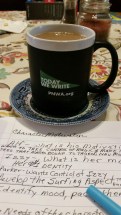 As you clarify why the protagonist must struggle to achieve their goal, the words will come.
- How does the protagonist react to pressure from the antagonist?
- Why does the enemy have the upper hand?
- How does the struggle affect the relationships between the protagonist and their cohorts/romantic interests?
- What complications arise from a lack of information?
- How will the characters acquire that necessary information?
As I write, a broad outline of my intended story arc evolves. I keep my notes in an Excel workbook. It contains maps, calendars, and everything pertaining to any novel set in that world, keeping it in one easy-to-find place.
When logic forces change to the plot (as it always does), I go to my storyboard and update my plot outline, calendar, or maps.
If you are stuck, it sometimes helps to go back to the beginning and consider these questions:
- What is the goal/objective?
- Is the objective compelling enough to warrant risking everything to acquire it?
- What will the protagonist face to challenge their moral values and sense of personal honor? How will this force them to be stronger?
- Who is the antagonist? What do they want, and what are they willing to do to achieve it? Are they facing ethical quandaries, too?
Every obstacle we throw in the path to happiness for the protagonists and their opposition forces change. They shape the narrative’s direction and the characters’ personal arcs.
When your creative mind needs a rest, step away from the keyboard and do something else for a while. I find that when I take a break to cook or clean out a corner, ideas for what to do next in my novel will occur to me. These little flashes of inspiration carry me a few chapters further into the story.
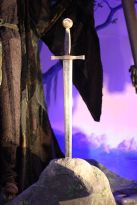
Excalibur London_Film_Museum_ via Wikipedia
Finally, let’s talk about murder as a way to kickstart your inspiration.
I suggest you don’t resort to suddenly killing off characters just to get your mind working. Readers become angry with authors who casually kill off characters they have grown to like.
When a particular death is planned from the beginning, it is one thing. But developing characters is a lot of work. If you kill off someone with an important role, who or what will you replace them with?
You may need that character later, so plan your deaths accordingly.
Whether you are participating in NaNoWriMo or not, may the words flow freely for you, and may you never run out of new ideas to write.


 Life in the Realm of Fantasy
Yes, I’m a day behind in reading your wonderful blog, but yesterday it may not have been as useful, supportive, and encouraging as it is today. Thank you!
LikeLiked by 1 person
Hello, Johanna! I’m glad you found something useful here ❤
LikeLike