
Emotions are tricky to convey, and I’ve read a few books lately where this was poorly handled (he was angry, she was enraged, etc.). So, today, I want to revisit a post from August 2021 that examined this problem.
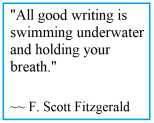 When we write about mild reactions, wasting words on too much description is unnecessary because mild is boring. But if you want to emphasize the chemistry between two characters, good or bad, strong gut reactions on the part of your protagonist are a good way to do so.
I often use examples of how to convey simple emotions from F. Scott Fitzgerald’s The Great Gatsby. First, you haven’t gotten the real story if you haven’t read the book but have seen the various movie adaptations. Adaptations are stories that have been reworked, so it never hurts to go to the source material and discover what the author intended.
The prose has power despite the fact it was written a century ago. I don’t feel qualified to get into the debate over whether Fitzgerald stole prose from Zelda or not. Their relationship was a hot mess. I’m a casual reader, not a scholar, so I leave that can of worms to those more knowledgeable.
However, we can learn from how the prose was constructed and how Nick Carraway sees the world. There are lessons here, things we can put into action in our own work.
About The Great Gatsby, via Wikipedia:
The Great Gatsby is a 1925 novel by American writer F. Scott Fitzgerald. Set in the Jazz Age on Long Island, near New York City, the novel depicts first-person narrator Nick Carraway‘s interactions with mysterious millionaire Jay Gatsby and Gatsby’s obsession to reunite with his former lover, Daisy Buchanan.
The novel was inspired by a youthful romance Fitzgerald had with socialite Ginevra King and the riotous parties he attended on Long Island’s North Shore in 1922. Following a move to the French Riviera, Fitzgerald completed a rough draft of the novel in 1924. He submitted it to editor Maxwell Perkins, who persuaded Fitzgerald to revise the work over the following winter. After making revisions, Fitzgerald was satisfied with the text, but remained ambivalent about the book’s title and considered several alternatives. Painter Francis Cugat‘s cover art greatly impressed Fitzgerald, and he incorporated aspects of it into the novel. [1]
If you are curious, an excellent book on Sara and Gerald Murphy, the people who inspired Fitzgerald’s novels (and a glimpse into the real world he introduces us to), is Everybody Was So Young: Gerald and Sara Murphy: A Lost Generation Love Story by Amanda Vail.
The following passages show us what is happening inside Nick Carraway, the protagonist. Every word is intentional, chosen, and placed so as to evoke the strongest reaction in the reader.
Here, Fitzgerald describes a feeling of hopefulness:
And so with the sunshine and the great bursts of leaves growing on the trees—just as things grow in fast movies—I had that familiar conviction that life was beginning over again with the summer.
Next, he describes shock:
It never occurred to me that one man could start to play with the faith of fifty million people—with the single-mindedness of a burglar blowing a safe.
Jealousy:
Her expression was curiously familiar—it was an expression I had often seen on women’s faces but on Myrtle Wilson’s face it seemed purposeless and inexplicable until I realized that her eyes, wide with jealous terror, were fixed not on Tom, but on Jordan Baker, whom she took to be his wife.
The discomfort of witnessing a marital squabble:
The prolonged and tumultuous argument that ended by herding us into that room eludes me, though I have a sharp physical memory that, in the course of it, my underwear kept climbing like a damp snake around my legs and intermittent beads of sweat raced cool across my back.
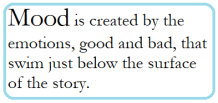 Fitzgerald shows us Nick’s emotions, AND we see his view of everyone else’s emotions. We see their physical reactions through his eyes and through visual cues and conversations.
Nick Carraway’s story is told in the first person, and Fitzgerald stays in character throughout the narrative.
I suggest playing with narrative POV until you find the best one. Sometimes, a story falls out of my head in the first person, and other times, not. Whether we are writing in the first-person or close third-person point of view, seeing the reactions of others is key to conveying the sometimes-tumultuous dynamics of any group.
Writing emotions with depth is a balancing act. The internal indicator of a particular emotion is only half the story. We see those reactions in the characters’ body language.
This is where we write from real life. When someone is happy, what do you see on the outside? When a friend looks happy, you assume you know what they feel.
I spend a great deal of time working on prose, attempting to combine the surface of the emotion (physical) with the deeper aspect of the emotion (internal). I want to write it so I’m not telling the reader what to experience.
Great authors allow the reader to decide what to feel. They make the emotion seem as if it is the reader’s feeling.
 If you have no idea how to begin showing the basic emotions of your characters, a good handbook that offers a jumping-off point is The Emotion Thesaurus by Angela Ackerman and Becca Puglisi.
Their entire series of Writers Helping Writers books is affordable and full of hints for adding depth to your characters.
Just don’t go overboard. These books will offer nine or ten hints that are physical indications for a wide range of surface emotions. You can usually avoid dragging the reader through numerous small facial changes in a scene simply by giving their internal reactions a little thought.
I usually reread The Great Gatsby and several other classic novels in various genres every summer.
Fitzgerald’s prose is written in the literary style of the 1920s. It was a time in which we still liked words and the many ways they could be used and abused, hence the massive amount of Jazz Age slang that seems incomprehensible to us only a century later.
If you’re like me, you might need to find a bit of a translation for some of the slang: 20’s Slang | the-world-of-gatsby (15anniegraves.wixsite.com). The problem of slang falling out of fashion as quickly as it enters everyday speech is an excellent reason to avoid using it.
For example, one bit of slang confused me because of the context in which it was used: Police dog. It was a slang noun referring to a young man to whom one is engaged.
Myrtle Wilson said “I’d like to get one of those police dogs.”
When I read it the first time, I thought the speaker meant a German shepherd, and it didn’t make sense.
 Students taking college-level classes in literature and English are often required to read The Great Gatsby and other classic novels from that era, such as James Joyce’s Ulysses. Reading classic literature as a group and discussing every aspect is central to understanding it. Also, you get a glossary as part of the course, so that’s a bonus.
While these novels are too complex for most people’s casual reading, I wanted to understand how these books were constructed.
We twenty-first-century writers can learn something important from studying how Fitzgerald showed his characters’ thoughts and internal reactions. My personal goal is to improve how my first drafts read.
Who knows if I will succeed–but I’ll have fun trying.
Credits and Attributions:
[1] Wikipedia contributors, “The Great Gatsby,” Wikipedia, The Free Encyclopedia, https://en.wikipedia.org/w/index.php?title=The_Great_Gatsby&oldid=1190673325 (accessed January 10, 2024).


Nice 👌
LikeLiked by 1 person
Hello Satyam – so glad you liked it.
LikeLiked by 1 person
A happy new year to you, Connie! Also thanks for discussing another important part of writing. xx Michael
LikeLiked by 1 person
Hello, Michael! Happy new year to you too! May you enjoy ALL the blessings!
LikeLike
This is an excellent post. I agree about Scot Fitzgerald’s writing. Superb example of ‘show don’t tell’.
LikeLike
Hello, V! He had wide vocabulary beyond the slang–I have a wide vocabulary, but it pales in comparison to his.
LikeLiked by 1 person