
I think of writing as a muscle, one that must be exercised the same as other muscles. We’re healthiest when we exercise regularly. Once writing becomes a behavioral habit, we find we can’t go very long without indulging it.
 The more frequently you write, the more confident you become. Spending a small amount of time writing every day is crucial. It develops discipline, and personal discipline is essential if you want to finish a writing project.
 Maybe you plan to write a novel “someday” but aren’t there yet. Writing random short scenes and vignettes helps develop that story without committing too much time and energy to the project. This is also a good way to create well-rounded characters.
In writing these scenes, you have the chance to identify the themes and subthemes you hope to explore in your novel. Theme is different from the subject of a work. An example I have used before, and one that most people know of, is the Star Wars franchise.
- The subject of those movies and books is “the battle for control of the galaxy between the Galactic Empire and the Rebel Alliance.”
- The major themesexplored in those films are moral ambiguity, coming of age, and the conflict between technology and nature.
- The subthemes are finding love, abuse of power, and family dynamics.
At some point, you will write something you think worthy of submitting to a contest or publisher. Your manuscript must demonstrate your understanding of what is meant by the word ‘theme,’ as well as your ability to craft clean and compelling prose.
If you do an internet search, you will find contests for drabbles and micro-fiction, some offering cash prizes. Some contests post pictures for prompts, others offer a word or sentence, and still others no prompt at all. I mentioned this site in the previous post: go to 700+ Weekly Writing Prompts if you need an idea.
 However, the Lascaux Prizes in Poetry and Flash Fiction are now open for submission and will close on March 31, 2024. The Lascaux Prize in Creative Nonfiction will reopen on April 1, 2024. The Lascaux Prize in Short Fiction will reopen on July 1, 2024.
 The Lascaux Review is one of the best contests around. It is exceptionally open to writers who are just beginning their journey. Their fee is reasonable, $15.00 in every category, and submissions are accepted through Submittable. Contest Guidelines | The Lascaux Review
For practice, try picking a theme and thinking creatively. Think a little wide of the obvious tropes (genre-specific, commonly used plot devices and archetypes). Look for an original angle that will play well to a strong theme, then go for it.
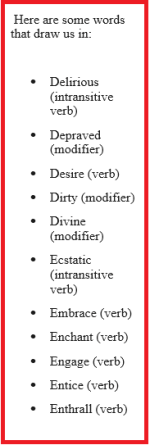
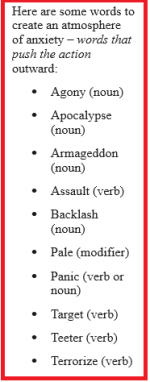
If you are choosing to write a drabble, you must use nouns and verbs with the most visual impact. Your word choices must convey an atmosphere, show a character, and tell a story.
 A way to get a grip on these concepts is what I think of as literary mind-wandering. For me, these ramblings hold the seeds of short stories.
I gain a different perspective on my work in progress when I write a short story detailing a side character’s background. These side characters appear in the longer manuscript as having distinct personalities because I am well-acquainted with them.
If you’re experiencing a lull in your ability to advance your novel, why not challenge yourself to write a drabble? It’s a whole story in 100 words or less.
Writing such short fiction forces me to develop an economy of words. Your narrative will be limited to one or two characters. There is no room for anything that does not advance the plot or affect the story’s outcome.
What are the nuts and bolts of writing micro-fiction?
I’ve said this before, but all writing is a time commitment, no matter the intended length of the piece. When writing a drabble, you can expect to spend an hour or more getting it to fit within the 100-word constraint.
Extremely short fiction must showcase the same essential components as a longer story:
- A setting
- One or more characters
- A conflict
- A resolution.
First, we need a prompt, a jumping-off point. For a drabble, we have 100 words to write a scene that tells the entire story of a moment in a character’s life. That’s about two paragraphs, which is the length of many scenes in longer works.
In a previous post on writing short stories, I showed how I use a loose outline to break short stories into three acts.
 I break down the word count to know how many words to devote to each act in the story arc. I allow around 25 words to open the story and set the scene. Then, I give myself about 50 – 60 for the heart of the story. That leaves me 10 – 25 words to conclude it.
Some contests will ask for work that fits exactly into their word count parameter: if they ask for 50 words, they want exactly 50, no more and no less. Choose your words with care and intention.
That is when writing micro-fiction becomes fun.
Spend an hour to get that idea and emotion down before you forget it. The completed scene is a small gift you give yourself. I suggest you save your short work and proto scenes in a clearly labeled file for later use. Each one has the potential to be a springboard for writing a longer work or for submission to a contest.
Whether you submit a drabble to a contest or hang on to it doesn’t matter. Either way, writing micro-fiction hones your skills, and you will have captured the emotion and ambiance of a brilliant idea.
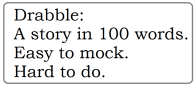 Extremely short fiction is the distilled essence of a novel. It contains everything the reader needs to know and makes them wonder what happened next.
That desire to know what happened next is why readers keep reading and why they might seek out your other work.


 Life in the Realm of Fantasy