
I love looking at visual art. Viewing paintings and photographs offers us a glimpse of a moment in time that may have occurred centuries ago or may not have occurred at all. Regardless, that moment is frozen and will never change.
But I’m a writer. Paintings always show me a story with a past and a possible future.
 I’m not educated as an art historian and would never claim to be one. I’m just a woman who loves the paintings of great artists because they tell a story. Thanks to Wikimedia Commons, an online museum of sorts, anyone with access to the internet can see the great art and photography of the past and the present.
Every week, I scour Wikimedia Commons, looking for images that intrigue me. My goal is to give others like me access to see the art that humanity is capable of, good and bad.
Art can be beautiful or savage, depending on the story the artist is trying to present. I love beautiful scenes, but I like images that tell a story. I feel compelled to look deeper when I view a painting, to see what symbolism the artist snuck into the scene. I want to challenge my perception of the story that is being depicted.
According to Wikipedia, the fount of all knowledge, Perception (from Latin perceptio ‘gathering, receiving’) is the organization, identification, and interpretation of sensory information in order to represent and understand the presented information or environment. (…) Perception is not only the passive receipt of these signals, but it is also shaped by the recipient’s learning, memory, expectation, and attention. [1]
In other words, looking at art can lead the viewer to new ways of looking at the world.
As I mentioned above, I see paintings as depicting the middle of the story. Unintentionally, I put a personal spin on my interpretation, and ideas are born. I don’t mean to, but everyone does.
Some artists offer us fantasy, and other artists show us the truth of historical events. Both are necessary.
Let’s take a look at Guernica, a 1937 painting by the Spanish artist Pablo Picasso (1881 – 1973). This painting is considered to be one of the most powerful antiwar statements of all time. This single painting, done in shades of black and white, tells the story of the bombing of Guernica, a Basque Country town in northern Spain that Nazi Germany and Fascist Italy destroyed at the request of the Spanish Nationalists. (Yes, a faction in Spain bombed their own country.)
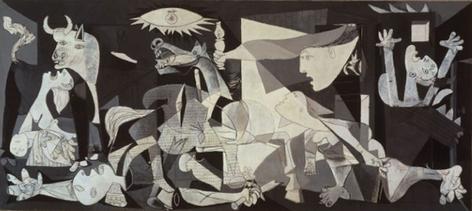
Picasso’s choice to use black and white to tell that story is both brilliant and symbolic. Newsreels of the day were in black and white, and newsreels were how the world was shown the horror of this tragedy.
This piece is powerful because of the emotion the artist painted into the image.
But, Picasso himself was inspired by the great art that he was privileged to see. In planning the layout of Guernica, Picasso was inspired by the Consequences of War by Peter Paul Rubens.
There is a motherlode of symbolism packed into this painting. Watch this excellent YouTube video to see a short explanation of what inspired the artist and his view of both the horrific attack and the fundamentals of classic art. It explains Guernica well: Picasso’s Guernica by Great Art Explained.
We’ve looked at Picasso and his desire to show the horrors of modern warfare. But let’s look at something fun. Let’s see the symbolism of Jan Steen and the scenes he painted of everyday life in the seventeenth century. His paintings were composed with as much symbolism as Picasso’s.
Jan Steen (1626 – 1679) was a celebrated painter during the Dutch Golden Age. He was fond of painting peasants and ordinary people, and the picture I’m featuring for this post is a good example of his art.
 I love the chaos in this painting. Is this a New Year’s party? Whatever they are celebrating, they’re having a great time.
I love the clutter of pans and dishes that have heedlessly fallen to the floor. I love the boisterous enjoyment of wine and song. The obvious lack of parental control is wonderfully depicted. The children are smoking and drinking to excess, vices that weren’t acceptable diversions for youngsters in those days any more than they are now.
The baby is exceedingly plump, which was uncommon in those days. Its chubbiness represents the vice of gluttony–in one hand, it holds bread, and in the other, it waves a spoon.
Chaos reigns, and who knows what these little hooligans will get up to next? Will they be drunks and ne’er-do-wells or sober model citizens?
The best part of the scene goes almost unnoticed unless one looks deeper: The note on the wall contains the moral of the story.
According to the Rijksmuseum website, “The note hanging from the mantelpiece gives away the moral of the story: ‘As the old sing, so shall the young twitter.’ What will become of the children if their parents set the wrong example?”
In modern terms, that means “children learn what they live,” a saying we should all give thought to.
This painting is a wonderful visual reminder to all good people, encouraging them to live a sober life. Steen himself was not a puritan, as he was born into a family of brewers and ran taverns and breweries off and on throughout his life. However, he needed to sell his paintings as he was never a successful businessman, and his allegorical paintings were quite popular.
Consider going out to www.wikimediacommons.org and see what the picture of the day inspires in you. Will you come away with an idea for a story?
 Perhaps so. But take the time to write those thoughts down. Your notes could become a storyboard, which could become a novel.
A photograph or painting might inspire you, but the way you put those ideas into action will be uniquely yours. They will be expressions of your voice and your art.
Credits and Attributions:
[1] Wikipedia contributors, “Perception,” Wikipedia, The Free Encyclopedia, https://en.wikipedia.org/w/index.php?title=Perception&oldid=1229599104 (accessed July 13, 2024).
Guernica by Pablo Picasso. 1937. Oil on canvas. © Picasso’s Estate and the People of Spain, Fair Use. https://en.wikipedia.org/wiki/Guernica_(Picasso) accessed July 13, 2024.
The Merry Family, Jan Steen, 1668 PD|100 via Wikimedia Commons


 Life in the Realm of Fantasy