
Before we set the first words on a blank page, our minds have formed images of scenes we want to describe. Steven Pinker is a professor of psychology at Harvard University who specializes in visual cognition and developmental linguistics. He reminds us that we are not born with language, so we are NOT engineered to think in words alone. We also think in images.
 It follows that certain words become a kind of mental shorthand, small packets of letters that contain a world of images and meaning for us. Code words are the author’s multi-tool—a compact tool that combines several individual functions in a single unit. One word, one packet of letters will serve many purposes and convey a myriad of mental images.
These words are sometimes used too often in the first draft as they are efficient. We write as fast as we can when we have the inspiration. Code words convey a wide range of information concisely, and because we use them, we can write the first draft of a story from beginning to end before we lose the fire for it.
In my current writing, I hope to portray my protagonists as I see them without bashing my readers with how I see their appearance. The big temptation is to go into detail about each person’s specific characteristics.
This is not necessary. We think in images, and so do our readers, who will fill in the details in a way that is pleasing to them. I want to convey their characteristics naturally and without beating the reader over the head.
A few years ago, I read a novel featuring a caterer who solves mysteries. She is continuously described as Junoesque, ample, vast, chubby, size eighteen, fat, large … and on and on. In every chapter, at least once and usually twice, we were given a visual description of her, along with indications of how she aroused the males around her.
Those constant descriptions were meant to emphasize the author’s perception of her protagonist as plump but irresistible to the males. However, as the book wore on, it became jarring and unnecessary. I skipped to the end and then set it aside, never to be read again.
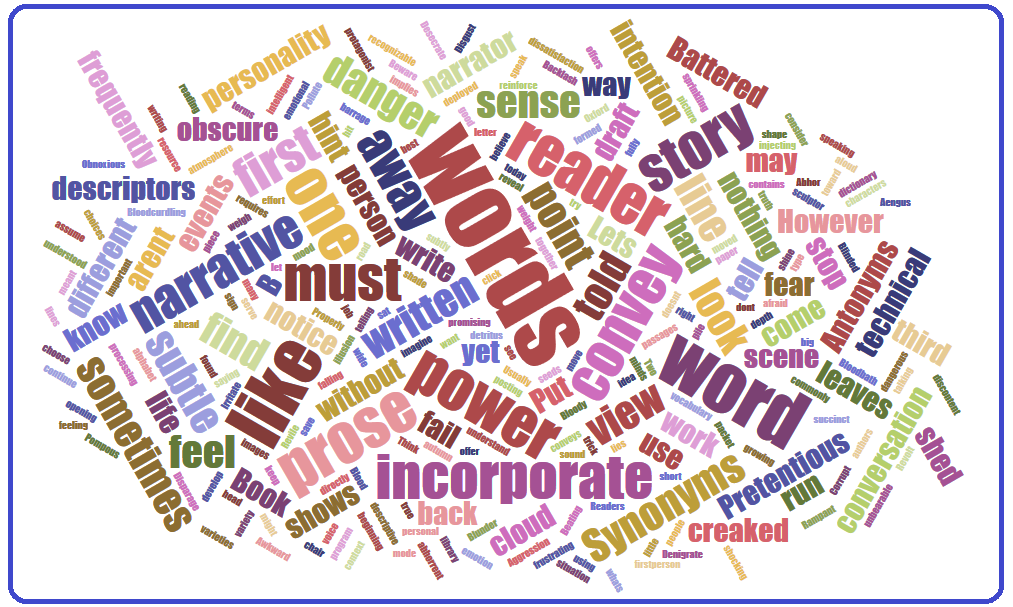 I want to avoid that sin in my work, but what are my code words? What words are being inadvertently overused as descriptors? A good way to discover this is to make a word cloud. The words that see the most screen time will be the largest. Free online word cloud generator and tag cloud creator – WordClouds.com.
A word frequency search is also a good tool. Word Frequency Counter – Counts frequency of words in text, free online tool (charactercounter.com)
In my current work, a prominent side character is an important mentor. He is tall with dark skin and dark eyes. His hair is a wiry halo shot with white and trimmed close to his head. This is a mixed-race society, a world where “race” means “species.” One is a human born in the world of Neveyah, a large minotaur from the Bull God’s world, or a small person with rat-like features from the Mountain God’s world. Those are the only racial differences people notice.
So, when showing my people, I use general descriptors, and thanks to my use of word frequency search, the code words are now used only a few times. My hope is that a reader will make appropriate visualizations as needed.
Every author thinks a little differently, so your code words will be different from mine. Another way to find your secret code words is to have the Read Aloud tool read each section. I find many inadvertent crutch words that way.
One of the code words I subconsciously overuse is “felt.” My thesaurus says I could exchange felt for:
 endured
- experienced
- knew
- saw
- suffered
- tasted
- underwent,
- witnessed
The thesaurus offers some other words related to felt:
- regarded
- viewed
- accepted
- depended
- trusted
- assumed
- presumed
- presupposed
- surmised
It’s natural to overuse certain words without realizing it, but that is where revisions come in.
As you go along, you’ll discover that some words have very few synonyms that work.
Consider the word “smile.” It’s a common code word, a five-letter packet of visualization. Synonyms for “smile” are few and don’t show what I mean:
- beam
- grin
- leer
- smirk
Each occurrence of the word “smile” in my work must be considered individually. Sometimes, this requires a complete re-visualization of the scene. It hurts my heart to murder my darlings, but I look for a different way to convey my intention.
We don’t have to drag the reader through a long list of ever-moving facial expressions, such as lips turning up, down, drawing to one side, etc.
When done sparingly and combined with a conversation, this kind of visual display can work.
By sparingly, I mean no more than one facial change per interaction, please.
 Sometimes, the only thing that works is the brief image of a smile. Nothing is more boring than reading a story where a person’s facial expressions take center stage. As a reader, I want to know what is happening inside our characters and can be put off by an exaggerated outward display.
Once you become aware of your first draft code words, go to the thesaurus, find all the synonyms you can, and list them in a document for easy access. If it is a word such as smile or shrug, you have your work cut out, but it will speed things up if you make a small list of visuals that you can use and change up as needed.
A list of mood indicators can keep you from losing your momentum and will readily give you the words you need to convey all the vivid imagery you see in your mind. I saved my list to my desktop, so I don’t have to waste time searching for it.
Here are some instances of body language an observer would see if a character was wary.
- Crossed arms.
- A stiff posture.
- Narrowed eyes.
 If you don’t have it already, a book you might want to invest in is The Emotion Thesaurus by Angela Ackerman and Becca Puglisi. Some of the visuals they list aren’t my cup of tea, but they understand how to use words that show what people are thinking.
This aspect of the revision process is sometimes the most difficult. It takes time to examine each instance of our code words. They don’t always need changing—sometimes, a smile is a smile, and that is okay.


 Life in the Realm of Fantasy
Pingback: Reblog: The Second Draft: Decoding My Mental Shorthand #writing | Jeanne Owens, author
Jeanne, thank you for the reblog! I hope you have a great week!
LikeLike
I have that marvelous book.
I, too, have problems with ‘smile’, and my characters tend to sigh a lot.
Thanks for the links. They will be useful, if only to stop them from sighing.
LikeLiked by 1 person
Thank you for that last comment, V! I laughed and woke my husband up!
LikeLiked by 1 person
Pingback: The second draft: agency and consequences #writing | Life in the Realm of Fantasy
Pingback: The Second Draft: Logic, Objectives, and Circumstances #writing | Life in the Realm of Fantasy