
The best stories have an arc of rising action flowing smoothly from scene to scene. The changes from scene to scene should feel organic to the narrative and not jar the reader.
 These transitions are often small moments of conversation, italicized thoughts (internal dialogues), or contemplations written as free indirect speech. These moments are a form of action that can work well when a hard break, such as a new chapter, doesn’t feel right. The reader and the characters receive information simultaneously, but only when they need it.
Pacing has a scientific equation that can be described in two ways:
Action + reaction +action +reaction = pacing.
Push + glide + push +glide = pacing.
Usually, the overall pacing isn’t apparent while the reader is involved in the story. However, if the pacing is off, a narrative can quickly become jarring or boring, and readers will notice that.
Dialogue is an excellent tool for the reaction part of the pacing equation, but it must have a purpose and move toward a conclusion of some sort. This means conversations or ruminations should offer information of some kind to keep moving the story forward.
What can be revealed in conversations or free indirect speech? Necessary information is the obvious answer, but what else? We use it as a component of world-building to convey the atmosphere and show the scene. We also use it to expand on our theme.
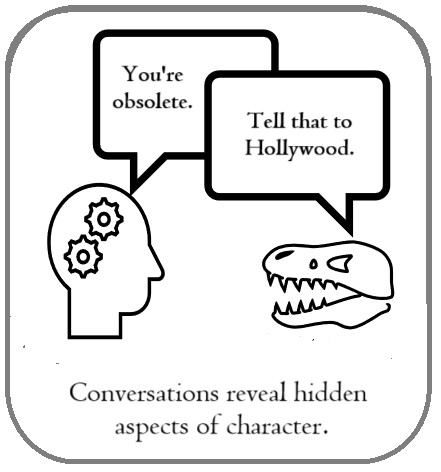 A character’s personal mood can be shown in many ways. A moment of gallows humor lightens and shows certain characters as human. Exchanging information about the backstory in a bantering way when characters are under great stress is more entertaining than a blunt dump.
Whether humor comes into it or not, moments of regrouping and processing what just occurred are necessary for the reader as well as for the pacing.
Sometimes, a writer comes to the end of a scene and doesn’t know how to transition to the next. We have a choice to either end it with a hard break or write a short transition scene.
I always look at the overall length of what has gone before. If it’s too short, say 500 or so words, I look for a way to expand the action without slowing it, or I write a brief transition scene.
For the transition conversation, whether it’s an internal monologue or spoken aloud, I ask myself three questions:
- Who needs to know what?
- Why must they know it?
- How many words do I intend to devote to it?
Once I know what must be conveyed and why, I find myself walking through the Minefield of Too Much Exposition.
It is easy to write long paragraphs with lines and lines and lines of uninterrupted dialogue.
 Trim that back to “Just the facts, ma’am,” and add a little guesswork to show the characters don’t know everything. We have to keep the carrot (information) dangling just out of reach, or we’ll lose the reader.
We want to avoid bloated exposition because readers will skip over walls of words, hoping to “get to the good part,” and they could miss the information they need, lending confusion to the narrative.
A certain amount of information from the protagonist’s point of view can be dispersed via indirect speech. The point of view character is an unreliable narrator, so their thoughts and conversations are suspect. It’s a good way to misdirect the reader and add an element of surprise when their suppositions are proven wrong.
Let’s look at a scene that opens upon a place where the reader and the protagonists must receive information. The way the characters speak to us can take several forms:
- Direct dialogue: Nattan said, “I was going to give it to Benn in Fell Creek, but he wasn’t home, and I had to get on the road.”
- Italicized thoughts: Nattan stood looking out the window. Benn’s not home. What now?
- Free indirect speech: Nattan stood looking out the window. Benn wasn’t home, so who should he give it to?
Wikipedia describes free indirect speech as a style of third-person narration that uses some of the characteristics of a third-person point of view along with the essence of a first-person direct speech.
The following is an example of sentences using direct, indirect and free indirect speech:
Quoted or direct speech: He laid down his bundle and thought of his misfortune. “And just what pleasure have I found, since I came into this world?” he asked.
Reported or normal indirect speech: He laid down his bundle and thought of his misfortune. He asked himself what pleasure he had found since he came into the world.
Free indirect speech: He laid down his bundle and thought of his misfortune. And just what pleasure had he found, since he came into this world?
According to British philologist Roy Pascal, Goethe and Jane Austen were the first novelists to use this style consistently and nineteenth century French novelist Flaubert was the first to be consciously aware of it as a style. [1]
When I began writing seriously, I was in the habit of using italicized thoughts and characters talking to themselves to express what was happening inside them.
That wasn’t wrong, but I used italics too freely. When used sparingly, italicized thoughts and internal dialogue have their place. We have to be careful with them because a wall of italicized words is difficult for people with compromised vision (like me) to read.
In the years since I first began writing seriously, I’ve evolved in my writing habits. Nowadays, I am increasingly drawn to using the various forms of free indirect speech to show who my characters think they are and how they see their world, and I rarely use italics.
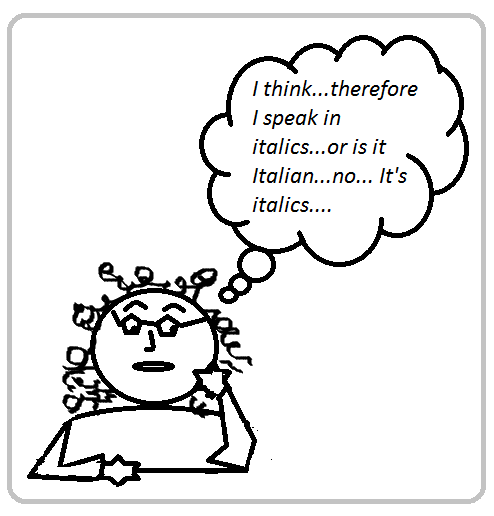 The main thing to watch for when employing indirect speech in a scene is to stay only in one person’s head. You can show different characters’ internal workings, provided you have a hard scene or chapter break between each character’s dialogue.
If you aren’t careful, you can slip into “head-hopping,” which is incredibly confusing for the reader. First, you’re in one person’s thoughts, and then another—like watching a tennis match.
Readers like it when we find ways to get the story across with a minimum of words.
Writing conversations and showing a character’s critical thoughts as an organic part of the unfolding plot make good transition scenes. They’re a good means of giving information and revealing hidden aspects of a character.
I hope your writing has continued now that November and the month of writing quests has passed. Keep writing new words every day, even if it’s only a paragraph or two. This will keep you in the habit and bring your novel closer to completion.
Credits and Attributions:
[1] Wikipedia contributors, “Free indirect speech,” Wikipedia, The Free Encyclopedia, https://en.wikipedia.org/w/index.php?title=Free_indirect_speech&oldid=817276599 (accessed Dec 7, 2024).


 Life in the Realm of Fantasy