
The events we imagine as we begin to write a story have the power to move us because we see each scene fully formed in our minds. We are under the illusion that what we have written conveys to a reader the same power that moved us. Once we’ve written “the end” it requires no further effort, right?
 I don’t know about your work, but usually, at that stage my manuscript reads like it was written by one-hundred monkeys at a writers’ workshop.
The trick is to understand that, while the first draft has passages that shine, most of what we have written is still in the proto-stage. It contains the seeds of what we believe we have written.
Like Michaelangelo sculpting David, we must work to shave away the detritus and reveal the truth of the narrative.
One way we do this is by injecting subtly descriptive prose into our narrative. Properly deployed, power words can serve as modifiers and descriptors, yet don’t tell the reader what to feel.
Think of these commonly reviled words like falling leaves in autumn. A sentence made of a noun and a verb weighs nothing, feels like nothing: She runs.
Put those leaves in a pile, add a day or two of October rain, and they have weight. She runs through the leaves.
Our words gain weight when we incorporate descriptors into the narrative. If we are careful, our modifiers and descriptors add to the prose, coming together to convey a sense of depth.
 And yes, modifiers and descriptors are also known as adjectives and adverbs.
Modifiers are like any other medicine: a small dose can cure illnesses. A large dose will kill the patient. The best use of them is to find words that convey the most information with the most force.
Let’s consider a story where we want to convey a sense of danger, without saying “it was dangerous.” What we must do is find words that shade the atmosphere toward fear.
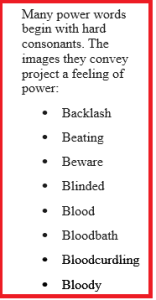
Power words can be found beginning with every letter of the alphabet, but words that begin with consonants convey strength. What are some “B” words that convey a hint of danger, but aren’t “telling” words?
- Backlash
- Blinded
- Blood
- Blunder
When you incorporate any of the above “B” words into your prose, you are posting a road sign for the reader, a notice that “ahead lies danger.” Mingle them with other power words, and you have an air of danger.
As authors, it is our job to convey a picture of events.
But words sometimes fail us. I look at each instance of a modifier and see how it fits into that context. If a word or phrase weakens the narrative, I rewrite the sentence. I either change it to a more straightforward form or remove it. For example, bare is an adjective, as is its sibling, barely. Both can be used to form a strong image depending on context.
Revising your manuscript seems like an overwhelming task, but it isn’t. The best resource you can have in your personal library is a dictionary of synonyms and antonyms. Your word processing program may offer you some synonyms when you right-click on a word to open the thesaurus.
- I rely on the Oxford Dictionary of Synonyms and Antonyms in my quest to develop a wide vocabulary of commonly understood words.
For most genre work, I suggest you don’t use “highfalutin” words or use acronyms and technical jargon.
But don’t dumb it down. Readers like it when you assume they are intelligent and aren’t afraid to use a variety of words. Yes, sometimes one must use technical terms, but I appreciate authors who assume the reader is new to the terminology and offer us a meaning.
 The book of synonyms and antonyms is full of words we’re familiar with and which we often forget are available for our use when we want to convey an overall mood.
Let’s look at the emotion of discontent and how we can shape the overall mood of a scene and reinforce a character’s growing dissatisfaction without saying “they were discontented.”. The following words can serve as descriptors. If you are sparing about adding suffixes [ly or ing], they’re not fluffy. But you must work harder to compose showing sentences when you avoid mushy suffixes.
- Aggression [noun] aggressive [adjective]
- Awkward [adjective]
- Disgust [verb or noun, depending on context]
- Denigrate [verb}
- Disparage [verb]
How we incorporate words into our prose is up to each of us. We all sound different when we speak aloud even when we speak the same language and the same dialect. The same is true for our writing voice.
We can tell the story using any mode or narrative tense we choose but the opening lines on page one must hook the reader, must hint at what they are in for if they stick with the story.
I meant to run away today.
If that were the opening line of a short story or novel, I would continue reading. Two words, run away, hit hard in this context, feel a little surprising as an opener. The protagonist is the narrator and is speaking directly to us, which is a bold choice. Right away, you hope you are in for something out of the ordinary.
 That single sentence comprised of five words indicates intention, implies a situation that is unbearable, and offers us a hint of the personality of the narrator.
Some lines from a different type of story, one told from a third person point of view:
The battered chair creaked as Angus sat back. “So, what’s your plan then? Are we going to walk up to his front door and say, ‘Hello. We’re here to kill you’?”
This is a conversation, but it shows intention, environment, and personality in thirty-one words. Battered is a power word and so is creaked.
And here is one final scene, one told from a close third person point of view and uses a form of free indirect speech. This is a style of third-person narration which uses some of the characteristics of third-person along with the essence of first-person direct speech; it is also referred to as free indirect discourse, or free indirect style. The paragraph ends a scene, showing yet another way to incorporate world building along with subtle power words into the prose:
Sara saw the vine-covered ruins of Marlow as an allegory of herself. The core of her, the essence of her that was Josh had been burned away. She’d been destroyed but was coming back to life in ways she’d never foreseen.
The power words are ruins, burned away, destroyed.
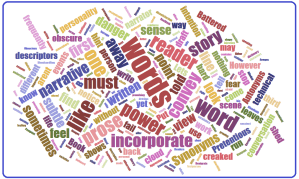
When we are consumed with just getting the story down, we often lean too heavily on one word that says what we mean. This is hard for us to spot in our own work, but a friend of mine uses word clouds to show her crutch words.
When we turn a document into a word cloud, the words we use most frequently show up as the largest. Word clouds are a great way to discover where we need to consult the thesaurus and expand our word choices. Free Word Cloud Generator.


 Life in the Realm of Fantasy
Pingback: Reblog: Making Effective Revisions: Power Words part one #writing | Jeanne Owens, author
good examples!!!
LikeLiked by 2 people
Hello, Jane–and thank you!
LikeLiked by 1 person
What a great post, Connie. And the link to the word cloud generator will be a great help.Many thanks.
LikeLiked by 1 person
Anytime, Vivienne! The word cloud has surprised me [unpleasantly] with the word “sword.” The type of blade my people swing is a broadsword, so words like “cutlass,” “sabre,” “rapier” or “epee” don’t work. I try to jazz it up by alternating between sword, blade, and weapon, lol.
LikeLike
Haha!
LikeLiked by 1 person