
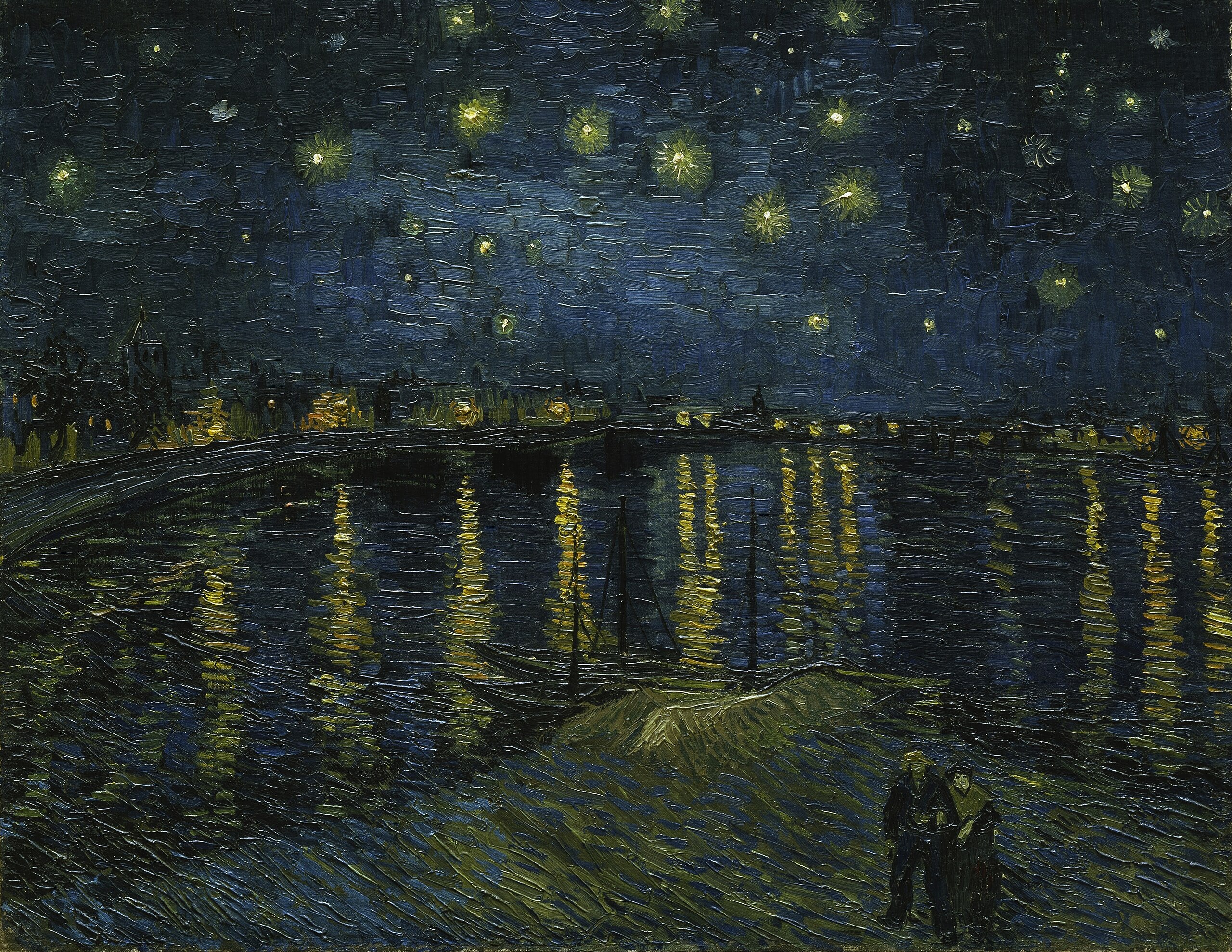
 Artist: Vincent van Gogh (1853–1890)
Title: Starry Night Over the Rhone
Genre: landscape painting
Date:1888
Medium: oil on canvas
Dimensions: height: 720 mm (28.3 in)
Collection: Musée d’Orsay
Exhibition history: Van Gogh and Britain, Tate Britain
What I love about this painting:
Vincent’s night sky is shown with reverence, the vault of heaven above shining the light of hope over the darkness of the world below. His colors are dark and intense, yet bright where light is needed—a kind of purity in execution that was one of his gifts.
In April of 2022, Fellow writer, Johanna Flynn and Greg and I joined friends to attend an immersive exhibit of Vincent van Gogh’s life through his work. We roamed freely inside an everchanging exhibit that flowed through many of his most famous works and zoomed in on bits one wouldn’t ordinarily notice.
The classical soundtrack was the perfect accompaniment. For several hours, we were immersed in Vincent’s visions of the world he loved but didn’t fit in.
The exhibit was such a moving, emotional experience. I felt as if I had seen into the man and his art.
That day, I became a Vincent van Gogh fangirl.
Vincent’s stars are surreal, yet they show the truth of how he saw the world.
About this painting, via Wikipedia:
Van Gogh announced and described this composition in a letter to his brother Theo:
Included a small sketch of a 30 square canvas – in short the starry sky painted by night, actually under a gas jet. The sky is aquamarine, the water is royal blue, the ground is mauve. The town is blue and purple. The gas is yellow and the reflections are russet gold descending down to green-bronze. On the aquamarine field of the sky the Great Bear is a sparkling green and pink, whose discreet paleness contrasts with the brutal gold of the gas. Two colorful figurines of lovers in the foreground.
In reality, the view depicted in the painting faces away from Ursa Major, which is to the north. The foreground indicates heavy rework, wet-in-wet, as soon as the first state was finished. The letter sketches executed at this time probably are based on the original composition.
Colors of the night
The challenge of painting at night intrigued van Gogh. The vantage point he chose for Starry Night allowed him to capture the reflections of the gas lighting in Arles across the glimmering blue water of the Rhône. In the foreground, two lovers stroll by the banks of the river.
Depicting colour was of great importance to Vincent; in letters to his brother, Theo, he often described objects in his paintings in terms of colour. His night paintings, including Starry Night, emphasize the importance he placed on capturing the sparkling colors of the night sky and of the artificial lighting that was new to the era.
The Great Bear
In September 1888, when Vincent van Gogh painted this picture on the banks of the Rhône, he saw the city of Arles looking south-west. The Great Bear will never be visible in that direction. On the other hand, he only had to turn his head to the north to see the constellation in exactly the position depicted. This painting is therefore an assemblage of a terrestrial plane and a celestial plane.
The Star Flowers
In 1888, when he painted the night sky, the stars resemble flowers. By the time he painted The Starry Night in 1889, his technique has evolved, the brightness of the stars being symbolized by concentric dotted circles. [1]
About the Artist, via Wikipedia:
Vincent Willem van Gogh, 30 March 1853 – 29 July 1890) was a Dutch Post-Impressionist painter who posthumously became one of the most famous and influential figures in Western art history. In a decade, he created about 2,100 artworks, including around 860 oil paintings, most of which date from the last two years of his life. They include landscapes, still lifes, portraits, and self-portraits, and are characterised by bold colours and dramatic, impulsive and expressive brushwork that contributed to the foundations of modern art. He was not commercially successful, struggled with severe depression and poverty, and committed suicide at the age of 37.
Van Gogh was born into an upper-middle-class family, While a child he drew and was serious, quiet and thoughtful. As a young man he worked as an art dealer, often traveling, but became depressed after he was transferred to London. He turned to religion and spent time as a Protestant missionary in southern Belgium. He drifted in ill health and solitude before taking up painting in 1881, having moved back home with his parents. His younger brother Theo supported him financially; the two kept a long correspondence by letter. His early works, mostly still lifes and depictions of peasant labourers, contain few signs of the vivid colour that distinguished his later work. In 1886, he moved to Paris, where he met members of the avant-garde, including Émile Bernard and Paul Gauguin, who were reacting against the Impressionist sensibility. As his work developed he created a new approach to still lifes and local landscapes. His paintings grew brighter as he developed a style that became fully realised during his stay in Arles in the South of France in 1888. During this period he broadened his subject matter to include series of olive trees, wheat fields and sunflowers.
Van Gogh suffered from psychotic episodes and delusions, and though he worried about his mental stability, he often neglected his physical health, did not eat properly and drank heavily. His friendship with Gauguin ended after a confrontation between the two when, in a rage, Van Gogh severed a part of his own left ear with a razor. He spent time in psychiatric hospitals, including a period at Saint-Rémy. After he discharged himself and moved to the Auberge Ravoux in Auvers-sur-Oise near Paris, he came under the care of the homeopathic doctor Paul Gachet. His depression persisted, and on 27 July 1890, Van Gogh is believed to have shot himself in the chest with a revolver, dying from his injuries two days later. [2]
Credits and Attributions:
IMAGE: Wikimedia Commons contributors, “File:Starry Night Over the Rhone by Vincent van Gogh, ‘lightballs’.jpg,” Wikimedia Commons, https://commons.wikimedia.org/w/index.php?title=File:Starry_Night_Over_the_Rhone_by_Vincent_van_Gogh,_%27lightballs%27.jpg&oldid=979586430 (accessed February 21, 2025).
[1] About this Painting via Wikipedia: Wikipedia contributors, “Starry Night Over the Rhône,” Wikipedia, The Free Encyclopedia, https://en.wikipedia.org/w/index.php?title=Starry_Night_Over_the_Rh%C3%B4ne&oldid=1272866843 (accessed February 21, 2025).
[2] About the artist: Wikipedia contributors, “Vincent van Gogh,” Wikipedia, The Free Encyclopedia, https://en.wikipedia.org/w/index.php?title=Vincent_van_Gogh&oldid=1276412810 (accessed February 21, 2025).


 Life in the Realm of Fantasy
i had never seen this painting before! i also like it very much🙏🏼❤️ thanks for these friday art sharings🙏🏼
LikeLiked by 1 person
Hello my friend! This painting isn’t as famous as some of his others, but it touched me. I’m glad I found a new painting for you!
LikeLiked by 1 person
i’m also glad you found it! 🥰
LikeLiked by 1 person