
I discovered early on that keeping a calendar and a map gives me a realistic view of my plot arc. A calendar of events helps me remember in what season an incident occurred when something arises later in the first draft that pertains to it. Foliage changes with the seasons, and weather is a part of worldbuilding. Spring foliage is very different from autumn in the part of the world I am from.
 And there are other reasons for keeping a calendar as well as sketching a simple map that no one but yourself will see.
A calendar of events helps you with pacing and consistency. In conjunction with a map, a calendar keeps the roadblocks moving along the story arc. It ensures you allow enough time to reasonably accomplish large tasks, enabling a reader to suspend their disbelief.
When it comes to calendars, I suggest you stick with what is familiar, and here is why. In 2008, a lunar calendar seemed like a good thing when creating my first world. The storyline and world of Mountains of the Moon was originally for an anime-style RPG that was never built due to several reasons, a tech crash being only one. When the project was scrapped, I still had the rights to my storyline, maps, and calendars.
My calendar for that world was (and still is) a hot mess.
In the game as we envisioned it, the calendar wouldn’t have been a problem as the days of the week were only mentioned in terms of when a shop was open. But that storyline eventually became my Tower of Bones series, which is set in the world of Neveyah. The calendar I devised so long ago for the game is an annoyance to me now.
- Thirteen months, twenty-eight days each, named after astrological signs. Capricas, Aquis, Piscus, etc. (Not that many people know what time of year Taurus or Capricorn are unless it’s their birth sign.)
- The names I assigned to the dates and months are problematic: Lunaday, Tyrsday, Odensday, Torsday, Frosday, Sunnaday, and Restday.
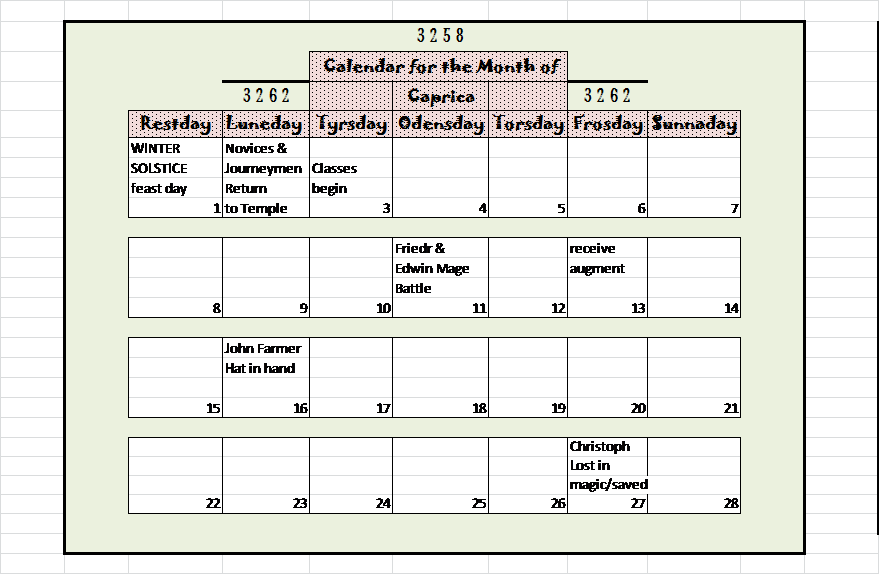 Not confusing at all. Nope.
In 2008, I had no idea just how awful my choice of names for the days and months would end up being. The calendar could have been scrapped and switched to our real-world calendar when I decided to turn it into a novel, but that didn’t occur to me.
And now, seventeen years later, I’m stuck with it. It’s why all my other books are plotted using the modern Gregorian calendar.
So take my advice and keep it simple.
But lets go back to the maps.
Maybe you think you aren’t artistic enough for mapmaking.
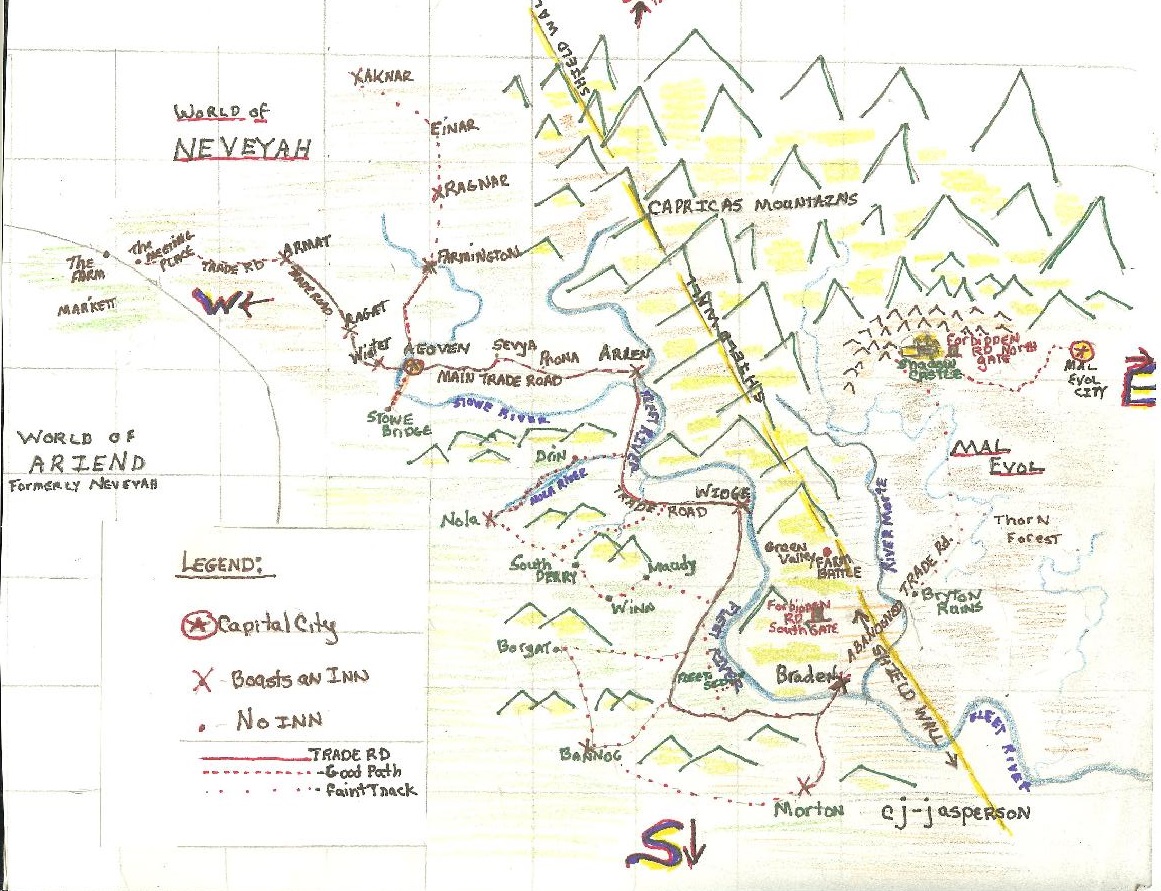
Original Map of Neveyah from 2008 © 2008 cjjasperson
You don’t have to be an artist to draw a rudimentary map of an imaginary place. The rudimentary elements of the first map of my World of Neveyah series were scribbled on graph paper during a phone conversation. It evolved from there to the map you see at the left.
Later, it evolved into an art piece for the books because I love pretty maps, such as those in the Wheel of Time books by Robert Jordan and Brandon Sanderson.
I use pencil and graph paper at this stage because the story chooses the geography. As the rough draft evolves, sometimes towns must be renamed. They may have to be moved to more logical places. Whole mountain ranges may have to be moved or reshaped so that forests and savannas will appear where they are supposed to be in the story.
Maybe you think you don’t need a map. If your characters are going from hither to yon, and you are writing about their travels, you probably should at least make good notes. But truthfully, it’s not a lot of work to scribble a few lines and note towns and landmarks. If you are designing a fantasy world, you only need a pencil-drawn map. Even if the story is set in a town, it helps to know where our characters are going in relation to their home base.
These maps and notes and calendars are for your use only, a way to avoid introducing confusion into the story. So, your map doesn’t have to be fancy. Lay it out like a standard map with north at the top, east to the right, south to the bottom, and west to the left. Those are called cardinal points, each at 90-degree intervals in the clockwise direction, which is standard in modern maps.
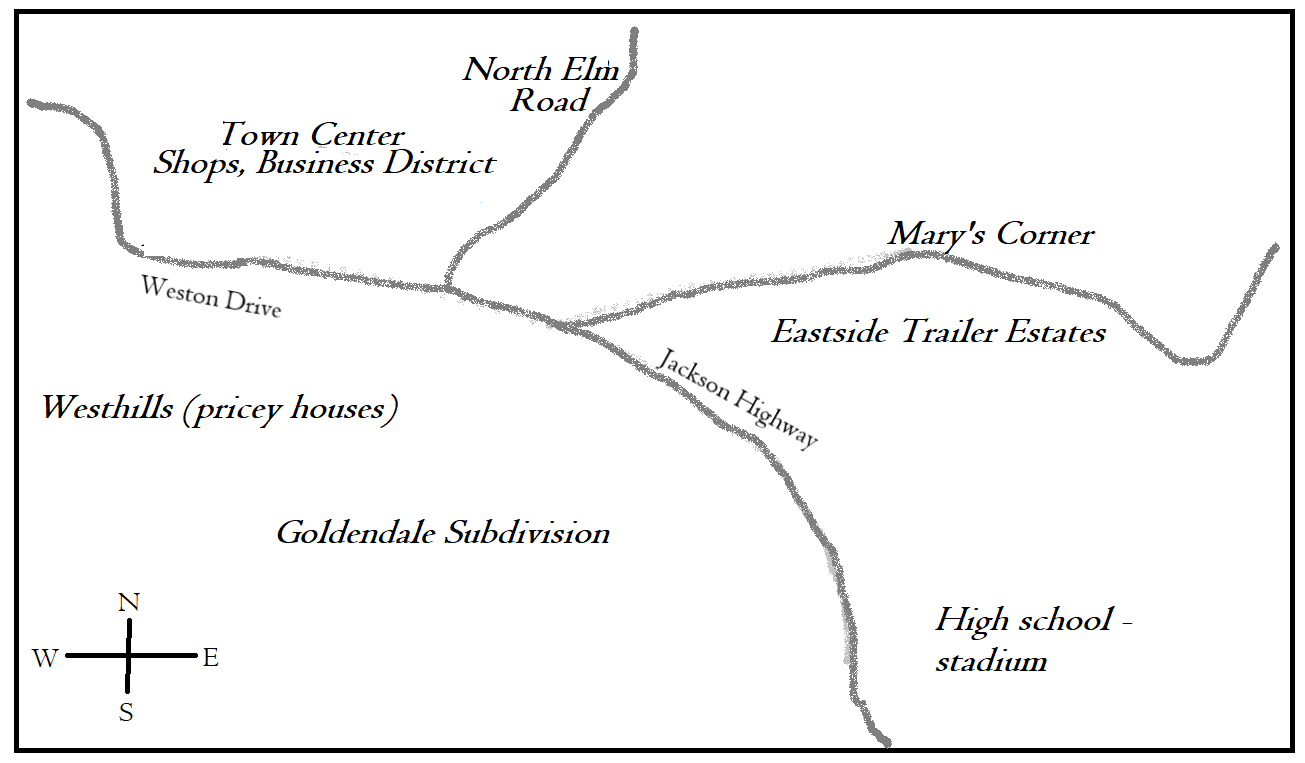
Many towns are situated on rivers. Water rarely flows uphill. While it may do so if pushed by the force of wave action or siphoning, water is a slave to gravity and chooses to flow downhill. When making your map, locate rivers between mountains and hills. Rivers flow to a valley and either continue on to the ocean or pool in low spots and form lakes and ponds.
You might want to note where rivers and forests are situated relative to towns, or in the case of towns, what streets and cross streets our Heroes must travel. We need to take into account the fact that detours add to the distance and increase the time it takes to travel using the common mode of transportation.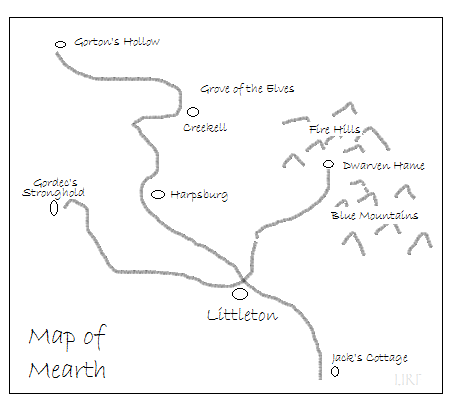 Rivers, mountains, lakes, and ponds make travel difficult, forcing a road or trail to go around them. This creates opportunities for plot twists in a fantasy story. Thieves, highwaymen—a lot of good plot fodder can be had with the right geography.
If your work is sci-fi, consider making a map of the space station/ship if that is where the story takes place. Billy Ninefingers is set in a wayside inn. I made a drawing of the floor plan for my purposes, noting who resided in each room, on the Rowdies’ floor because the inn is the world in which Billy’s story takes place.
If your characters travel, I suggest you keep the actual distances a bit general in the narrative because some readers will nitpick the details, no matter how accurate you are. Readers may not see it the way you do because their perception of a league might be three miles, while yours might be one and a half.
Both are correct. League (unit) – Wikipedia
Fantasy readers like maps. If you are writing fantasy but feel your hand-drawn map isn’t good enough to include in the finished product, consider hiring an artist to make a nice map from your notes.
No matter what genre we write in, we want the narrative to feel real for the reader. We do this through worldbuilding. Maps and calendars, no matter how rudimentary, are foundation tools of worldbuilding in my writing process.
I hope this little two-part series on worldbuilding has helped you visualize your work more easily.
Previous in this series:
Worldbuilding – the stylesheet/storyboard #writing | Life in the Realm of Fantasy


 Life in the Realm of Fantasy
i greatly enjoyed the stand-alone book that you recommended a while ago. after i read it, i donated it to our nursing home library where i live so others can enjoy it too. it also showed me how it relates to this instructive sharing on wordpress. it added to my understanding of what you share here.
i regret that i don’t remember the name of the book, but it had the name of a castle in it, & featured a bard & a couple of gay guys & a lady knight & merlin. thanks for the great read!
LikeLike
Thank you for the kind words. I think it was Bleakbourne on Heath. I had fun with that novel!
LikeLiked by 1 person
yes, that’s the one!👍🏼😊
LikeLiked by 1 person
Pingback: Reblog: Worldbuilding – Calendars and Maps #writing | Jeanne Owens, author