
Artist: Adriaen van Ostade (1610–1685)
Title: German: Der Maler in seiner Werkstatt. English: The painter in his Studio.
Date: 1663
Medium: oil on oak wood
Dimensions: height: 38 cm (14.9 in); width: 35.5 cm (13.9 in)
Collection: Gemäldegalerie Alte Meister
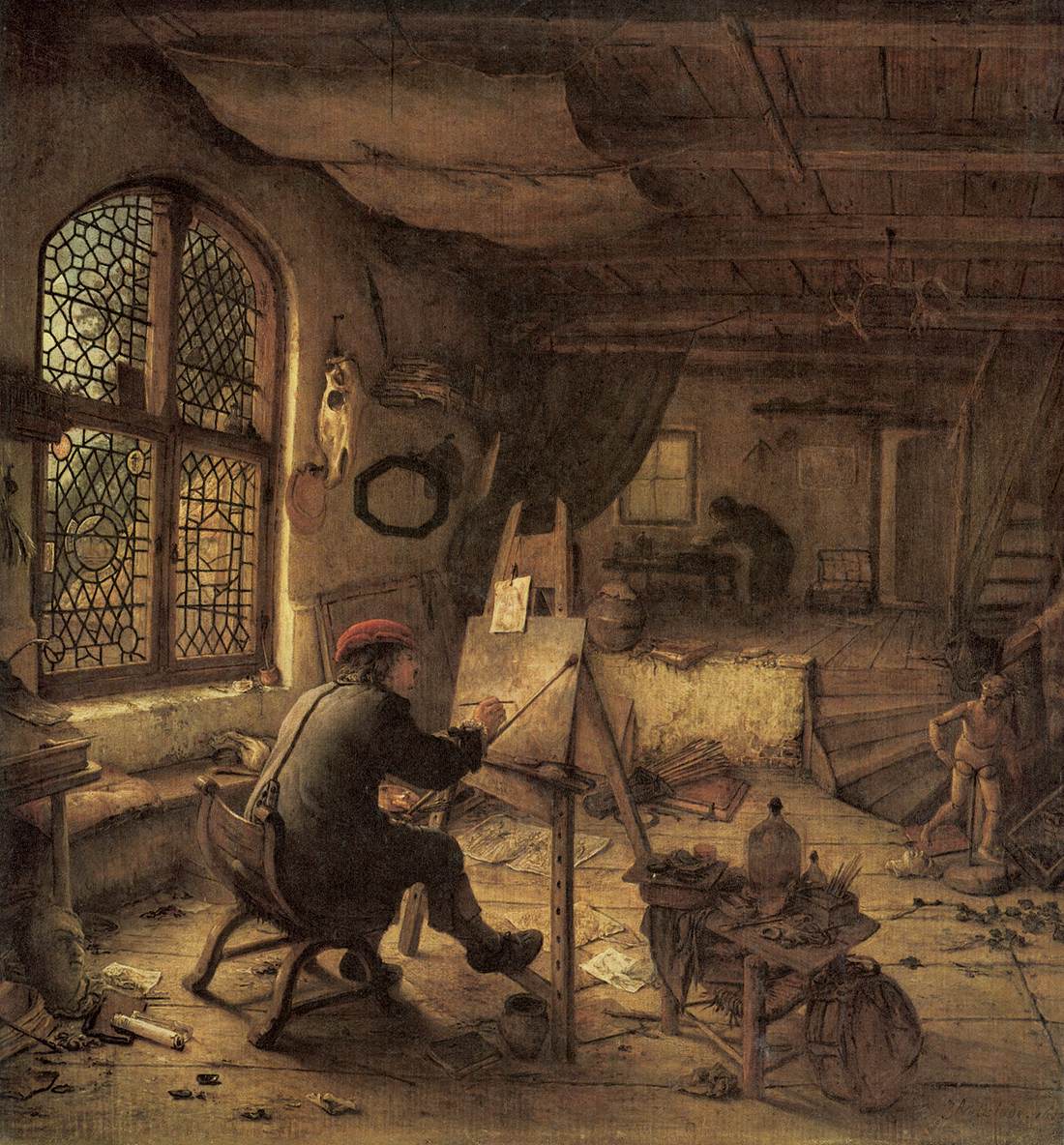
In “The Painter in his Studio” by Adriaen Van Ostade (1663), we see a self-portrait of the artist, sitting with his back to us. He is at his easel, and his brush hand rests on a ‘maulstick,’ a stick with a padded head used by painters to support the hand holding the paintbrush. In the shadowed background, a pupil is at work, possibly preparing a palette, or maybe preparing colors.
The window, the floor with all its debris, the walls, and the ceiling are depicted with great detail. The artist and his pupil are less detailed.
The studio is untidy, with brushes fallen on the littered floor. The room is cluttered with numerous odd objects and tools of the trade, including the head of a broken bust beneath a table. On the ceiling above the artist, a canvas canopy is tacked up, possibly to protect the artist’s work area from leaks, or perhaps falling dust.
A skull of some sort hangs near the window, and antlers also decorate the ceiling. The painter’s mannequin poses near the stairs, and an indistinct trunk stands open in the background.
The room is in desperate need of a good sweeping. The large leaded-glass window, however, is clean and lets in good light. It shows us how the artist saw himself and his work space.
A Netherlandish contemporary of the Flemish painters David Teniers the Younger and Adriaen Brouwer, Van Ostade was inspired by the work of Rembrandt.
As Rembrandt did, Van Ostade painted people who had seen hard times. They were often old, sometimes ill-favored, and not always beautiful. He painted dark interior scenes, where shadows are often the dominant features. He also painted the interiors of taverns and the homes of ordinary people, so through his work we who write can see how people really lived.
Van Ostade lived and painted in Haarlem. His subjects and the mood of his work is darker than that of his Flemish contemporaries, as hard times had fallen on the people of Holland, and Haarlem in particular.
About the artist, via Wikipedia:
Adriaen van Ostade (baptized as Adriaen Jansz Hendricx 10 December 1610 – buried 2 May 1685) was a Dutch Golden Age painter of genre works, showing everyday life of ordinary men and women. [1]
To read his full biography, go to Adriaen van Ostade – Wikipedia
Credits and Attributions:
Wikimedia Commons contributors, “File:Adriaen van Ostade – The Painter in His Studio – WGA16748.jpg,” Wikimedia Commons, https://commons.wikimedia.org/w/index.php?title=File:Adriaen_van_Ostade_-_The_Painter_in_His_Studio_-_WGA16748.jpg&oldid=661600977 (accessed August 14, 2025).
[1] Wikipedia contributors, “Adriaen van Ostade,” Wikipedia, The Free Encyclopedia, https://en.wikipedia.org/w/index.php?title=Adriaen_van_Ostade&oldid=1212324357 (accessed August 14, 2025).


 Life in the Realm of Fantasy
I like the rickety stairs and the fact that the painting is done in a dull monochrome in contrast to his art.
LikeLike
Hello Leon, thank you for your insight, a different way of looking at it. And I do like that staircase!
LikeLiked by 1 person
My mother painted once upon a time… her studio was much neater! Thanks for the glimpse into the life of a true artist!
LikeLiked by 1 person
Hello Stella! My sister’s studio is much neater too, lol! I keep thinking it must have been a drafty, uncomfortable place for the apprentice. But they wore a lot more clothes than we do nowadays.
LikeLiked by 1 person
It also demonstrates that being an artist was a trade, that is, a “real job” back in the day without cameras or iphones. A great piece of art and history.
LikeLiked by 1 person