
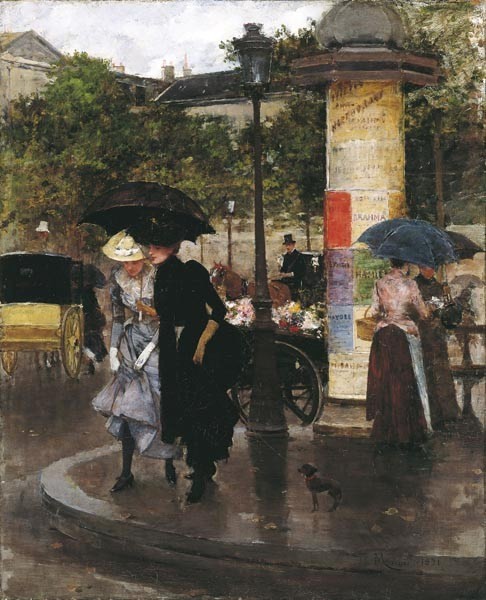
Title: Escena de carrer en un dia de pluja (Eng: Street Scene on a rainy Day)
Artist: Francisco Miralles Galup
Date: circa 1891
What I love about this painting:
Francesco Miralles Galup understood how to show the reality of weather, especially weather that was only mildly uncomfortable. We see a perfect rainy spring afternoon in a busy cosmopolitan city. It could have been any large city at the end of the 19th century. The sky is gray, the street is busy, full of carriages, and pedestrians must be careful where they step.
A cart full of flowers passes in the background, headed for the market. Two well-dressed ladies dodge puddles in their effort to cross the street. Around them, people stop to gossip, and umbrellas abound.
Like every chihuahua I’ve ever known, the little dog is miserable, unhappy with the damp.
I think this may be one of my favorite paintings of that era, one showing real people and their social lives. It was an era before refrigeration, so people went to the market each day to purchase whatever food they planned to serve. The market is where they met up with their friends and heard news of both the wider world and the local gossip.
He shows us ordinary people, happy and living their best lives.
About the Artist, via Wikipedia:
Francesco Miralles Galup was born Francesc Miralles i Galaup (6 April 1848, Valencia – 30 October 1901, Barcelona). He was a Catalan painter, best known for his realistic scenes of bourgeois life and high society.
When he turned eighteen, he received parental permission (and financial support) to study in Paris, where he would remain until 1893, with occasional visits home. During his first years there, he copied masterworks at the Louvre and may have worked briefly with Alexandre Cabanel. He eventually had several small studios in Montmartre and on the Rue Laffitte.
He exhibited regularly at the Salon and the Sala Parés, back home in Barcelona. He also became a client of the well-known art dealership Goupil & Cie, attracting wealthy buyers throughout Europe and America. This was a relief to his family, who had initially been concerned that they might have to support him indefinitely. Their ability to do so had been compromised as they had lost much of their fortune in the Panic of 1866 and were losing more of it as they paid off their debts. In fact, they eventually moved to Paris so he could help support them. [1]
Credits and Attributions:
IMAGE: Escena de carrer c1891, Francisco Miralles Galup / Public domain. Wikimedia Commons contributors, “File:Francesco Miralles Galup – Escena de carrer c1891.jpg,” Wikimedia Commons, https://commons.wikimedia.org/w/index.php?title=File:Francesco_Miralles_Galup_-_Escena_de_carrer_c1891.jpg&oldid=1039428081 (accessed August 28, 2025).
[1]Wikipedia contributors, “Francesc Miralles i Galaup,” Wikipedia, The Free Encyclopedia, https://en.wikipedia.org/w/index.php?title=Francesc_Miralles_i_Galaup&oldid=1291581678 (accessed August 28, 2025).


 Life in the Realm of Fantasy
