
 Artist: Eero (1863–1937)
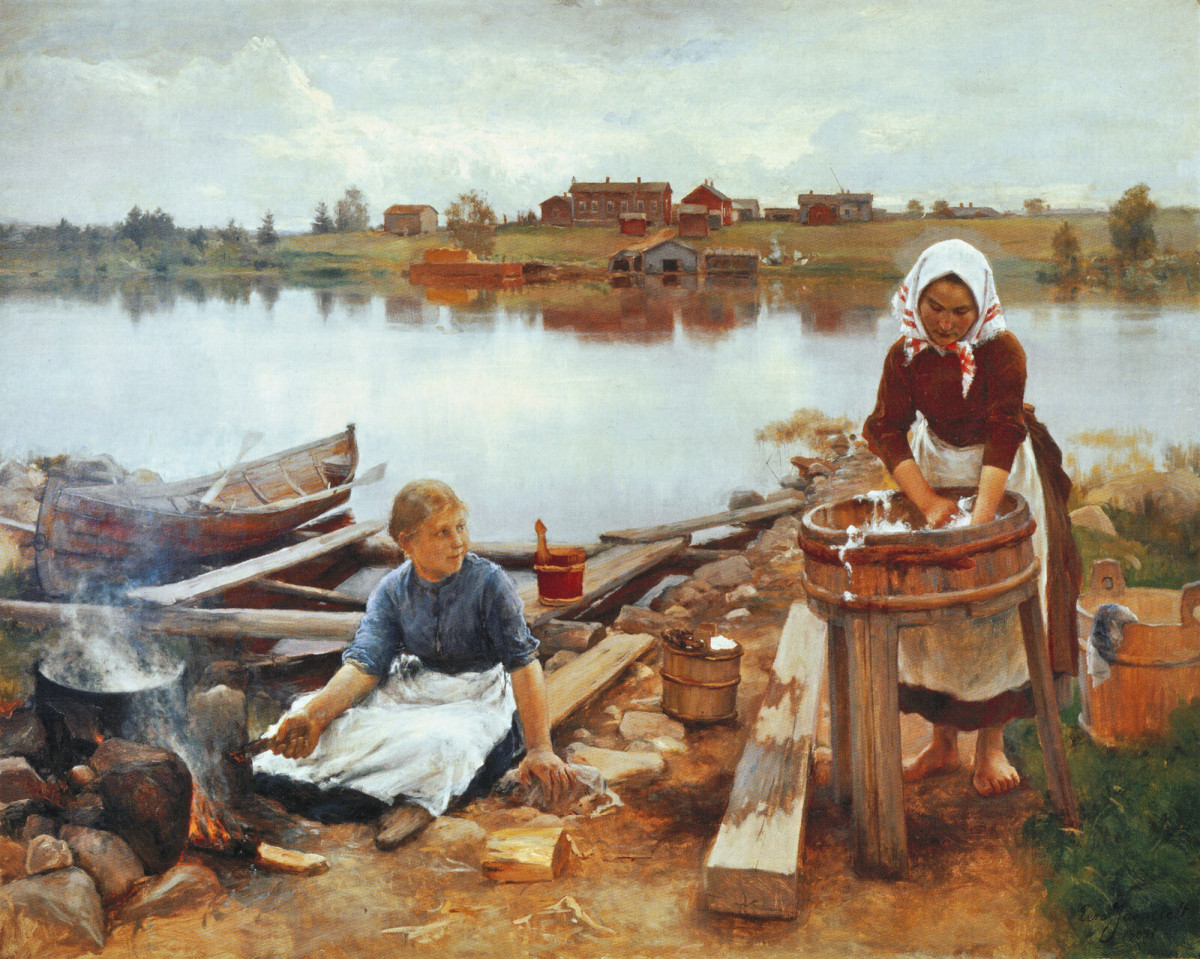
Title: English: Laundry at the River Bank (Suomi: Pyykkiranta)
Date: 1889
Medium: oil on canvas
Dimensions: height: 104 cm(40.9 in) width: 134 cm (52.7 in)
Collection: Private collection
What I love about this painting:
When writers need to know how things were done historically, Wikimedia Commons is a vast resource of paintings and images made during all stages of recorded history.
This is a scene featuring two women on a sunny afternoon in the far north—Finland. They are spending the overcast summer’s day doing the distinctly not-so-glorious task of laundry. Very few artists painted scenes of women at work. So, those of us with modern conveniences have no real idea how labor-intensive women’s work was.
It was hot, heavy work. One had to carry and heat all the water, and once the clothes were washed, they had to be wrung out by hand unless one was fortunate enough to own a wringer/mangle. (Where I live, it’s called a wringer. Elsewhere in the world, it’s a mangle.) Then, it had to be hung on a line or spread out somewhere to dry.
And once the clothes were dry, they had to be ironed. This solid, heavy iron tool was heated on the stove and if one got it a bit too hot it could scorch the clothes. Not hot enough and it wouldn’t smooth away the wrinkles.
Thus, laundry was an all-day job.
Soaps were most often made of animal fats and lye (ashes steeped in water), along with other ingredients to improve the smell. This lye soap was harsh but effective.
In this scene, one woman keeps the water hot, adding wood to the fire. A bucket and ladle sit on the rocks behind her, handy for fetching more water and adding it to the boiler as needed. Certain items of clothing are most likely soaking in the boiling water. Whites were usually boiled.
While the peasants of the time didn’t know about germs, they did know that boiling water made things cleaner and that cleanliness made their families healthier.
My grandmother was born in 1909 in a rural cabin on the Olympic Peninsula of Washington State. She often pointed out how lucky I was because, prior to getting her first wringer washing machine in 1929, she had to do laundry the hard way. She boiled diapers, Grampa’s shirts, and “women’s things.” In the era before disposable bandages, material intended for use as bandages would also be boiled for at least an hour.
Peasant women were unaware of solar radiation and ultraviolet light. But they did know that diapers dried in the summer sun were less likely to cause a rash than those dried indoors in the winter.
Clearly, Järnefelt knew the amount of work it took to produce a clean shirt and respected the women who made his life easier.
About the artist, via Wikipedia:
Erik “Eero” Nikolai Järnefelt (8 November 1863 – 15 November 1937) was a Finnish painter and art professor. He is best known for his portraits and landscapes of the area around Koli National Park, in the North Karelia region of Finland. He was a medal winner at the Paris Exposition Universelle of 1889 and 1900, taught art at the University of Helsinki and was chairman of the Finnish Academy of Fine Arts.
To read more about the artist go to: Eero Järnefelt – Wikipedia
Credits and Attributions:
IMAGE: Laundry at the River Bank. Wikimedia Commons contributors, “File:Järnefelt Laundry.jpg,” Wikimedia Commons, https://commons.wikimedia.org/w/index.php?title=File:J%C3%A4rnefelt_Laundry.jpg&oldid=866950564 (accessed June 5, 2025).


 Life in the Realm of Fantasy