Tag Archives: adverbs and adjectives

Making Effective Revisions: Power Words part one #writing

The events we imagine as we begin to write a story have the power to move us because we see each scene fully formed in our minds. We are under the illusion that what we have written conveys to a reader the same power that moved us. Once we’ve written “the end” it requires no further effort, right?

I don’t know about your work, but usually, at that stage my manuscript reads like it was written by one-hundred monkeys at a writers’ workshop.  

The trick is to understand that, while the first draft has passages that shine, most of what we have written is still in the proto-stage. It contains the seeds of what we believe we have written.

Like Michaelangelo sculpting David, we must work to shave away the detritus and reveal the truth of the narrative.

One way we do this is by injecting subtly descriptive prose into our narrative. Properly deployed, power words can serve as modifiers and descriptors, yet don’t tell the reader what to feel.

Think of these commonly reviled words like falling leaves in autumn. A sentence made of a noun and a verb weighs nothing, feels like nothing: She runs.

Put those leaves in a pile, add a day or two of October rain, and they have weight. She runs through the leaves.

Our words gain weight when we incorporate descriptors into the narrative. If we are careful, our modifiers and descriptors add to the prose, coming together to convey a sense of depth.

And yes, modifiers and descriptors are also known as adjectives and adverbs.

Modifiers are like any other medicine: a small dose can cure illnesses. A large dose will kill the patient. The best use of them is to find words that convey the most information with the most force.

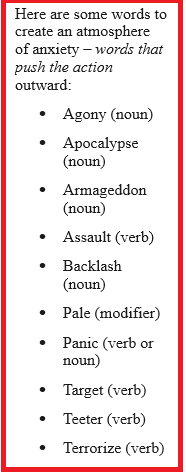
Let’s consider a story where we want to convey a sense of danger, without saying “it was dangerous.” What we must do is find words that shade the atmosphere toward fear.

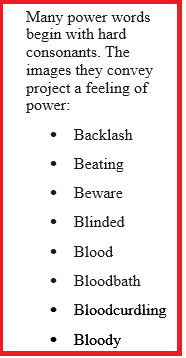
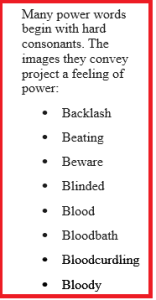
Power words can be found beginning with every letter of the alphabet, but words that begin with consonants convey strength. What are some “B” words that convey a hint of danger, but aren’t “telling” words?

  • Backlash
  • Blinded
  • Blood
  • Blunder

When you incorporate any of the above “B” words into your prose, you are posting a road sign for the reader, a notice that “ahead lies danger.” Mingle them with other power words, and you have an air of danger.

As authors, it is our job to convey a picture of events.

But words sometimes fail us. I look at each instance of a modifier and see how it fits into that context. If a word or phrase weakens the narrative, I rewrite the sentence. I either change it to a more straightforward form or remove it. For example, bare is an adjective, as is its sibling, barely. Both can be used to form a strong image depending on context.

Revising your manuscript seems like an overwhelming task, but it isn’t. The best resource you can have in your personal library is a dictionary of synonyms and antonyms. Your word processing program may offer you some synonyms when you right-click on a word to open the thesaurus.

For most genre work, I suggest you don’t use “highfalutin” words or use acronyms and technical jargon.

But don’t dumb it down. Readers like it when you assume they are intelligent and aren’t afraid to use a variety of words. Yes, sometimes one must use technical terms, but I appreciate authors who assume the reader is new to the terminology and offer us a meaning.

The book of synonyms and antonyms is full of words we’re familiar with and which we often forget are available for our use when we want to convey an overall mood.

Let’s look at the emotion of discontent and how we can shape the overall mood of a scene and reinforce a character’s growing dissatisfaction without saying “they were discontented.”. The following words can serve as descriptors. If you are sparing about adding suffixes [ly or ing], they’re not fluffy. But you must work harder to compose showing sentences when you avoid mushy suffixes.

  • Aggression [noun] aggressive [adjective]
  • Awkward [adjective]
  • Disgust [verb or noun, depending on context]
  • Denigrate [verb}
  • Disparage [verb]

How we incorporate words into our prose is up to each of us. We all sound different when we speak aloud even when we speak the same language and the same dialect. The same is true for our writing voice.

We can tell the story using any mode or narrative tense we choose but the opening lines on page one must hook the reader, must hint at what they are in for if they stick with the story.

I meant to run away today.

If that were the opening line of a short story or novel, I would continue reading. Two words, run away, hit hard in this context, feel a little surprising as an opener. The protagonist is the narrator and is speaking directly to us, which is a bold choice. Right away, you hope you are in for something out of the ordinary.

That single sentence comprised of five words indicates intention, implies a situation that is unbearable, and offers us a hint of the personality of the narrator.

Some lines from a different type of story, one told from a third person point of view:

The battered chair creaked as Angus sat back. “So, what’s your plan then? Are we going to walk up to his front door and say, ‘Hello. We’re here to kill you’?”

This is a conversation, but it shows intention, environment, and personality in thirty-one words. Battered is a power word and so is creaked.

And here is one final scene, one told from a close third person point of view and uses a form of free indirect speech. This is a style of third-person narration which uses some of the characteristics of third-person along with the essence of first-person direct speech; it is also referred to as free indirect discourse, or free indirect style. The paragraph ends a scene, showing yet another way to incorporate world building along with subtle power words into the prose:

Sara saw the vine-covered ruins of Marlow as an allegory of herself. The core of her, the essence of her that was Josh had been burned away. She’d been destroyed but was coming back to life in ways she’d never foreseen.

The power words are ruinsburned awaydestroyed.

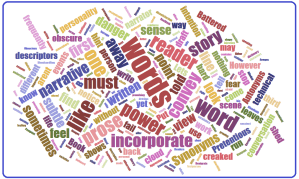
When we are consumed with just getting the story down, we often lean too heavily on one word that says what we mean. This is hard for us to spot in our own work, but a friend of mine uses word clouds to show her crutch words.

When we turn a document into a word cloud, the words we use most frequently show up as the largest. Word clouds are a great way to discover where we need to consult the thesaurus and expand our word choices. Free Word Cloud Generator.

6 Comments

Filed under writing

How the Written Universe Works part 6 – modifiers, descriptors, and quantifiers #amwriting

The written universe can seem like a cold, unfriendly place to new writers. At first, it is difficult to find other writers, and we wonder if we are alone in the universe. When we finally are able to see across the void, we discover writing groups in our local area.

How the written universe works 6We are not alone. We are part of a vast cosmos of authors much like us, some far more advanced and others less so.
At times, we wonder if our star will ever shine as brightly as theirs.

We attend groups and submit our best work. In the beginning, we feel bombarded with reprimands, x-rays highlighting our beloved narrative’s flaws.

  • Show it, don’t tell it.
  • Simplify, simplify.
  • Don’t write so many long sentences.
  • Don’t be vague—get to the point.
  • Don’t use “ten-dollar words.”
  • Cut the modifiers—they muck up your narrative.

These comments are painful but necessary. This knowledge enables us to produce work our readers will find enjoyable.

However, all rules can be taken to an extreme. I’ve said this before, but it bears repeating. The most important rules are:

  • Trust yourself,
  • Trust your reader.
  • Be consistent.
  • Write what you want to read.

We must understand how to balance mechanics and grammar and other obvious rules and still write with our own voice and style.

Participating in a critique group requires delicacy and dedication. It also involves restraint and the ability to allow other authors to write their own work. A group shouldn’t micromanage a manuscript, as too much input and direction can remove the author’s unique voice from a piece.

One of the admonitions we regularly hear refers to the number of modifiers (adjectives and adverbs) we might habitually use. As writers, we all want to be accepted and have others like our work, but we must write from the heart. That means using modifiers, descriptors, or quantifiers when they are needed.

Chuck Wendig, in his post The Danger of Writing Advice from Industry Professionals, says,

And so the advice really should be, don’t use adverbs or adjectives when they sound awkward, or when they fail to tell us something that we need to know. [1]

When we read, we see that certain words and phrases don’t add to the narrative and only serve to increase wordiness. These words hamper our ability to suspend our disbelief when used too freely.

These words fall out of my fingers and into my keyboard randomly and out of my voluntary control. During NaNoWriMo, I don’t self-edit as I go because, at that point, I’m just trying to get the story down. The second and third drafts are where I shape my grammar and phrasing.

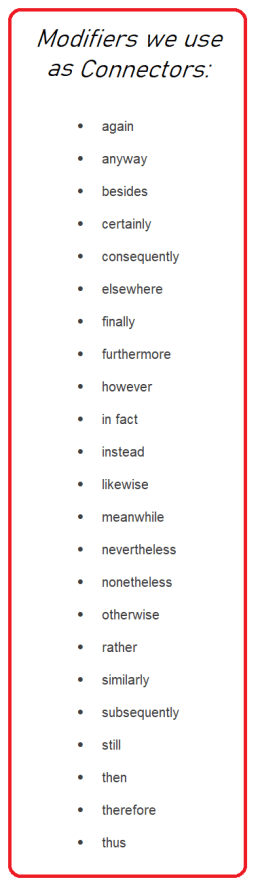
modifying-conjunctions-04262022Modifiers change, clarify, qualify, or limit a particular word in a sentence to add emphasis, explanation, or detail. We also use them as conjunctions to connect thoughts: “otherwise,” “then,” “besides.”
Descriptors: Adverbs and adjectives, known as descriptors, are helper nouns or verbs, words that help describe other words. However, they can be reviled by writing groups armed with a little dangerous knowledge.

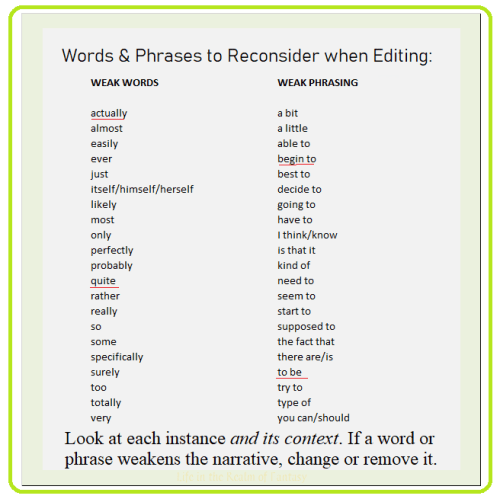
Many descriptors are easy to spot as they often end with the letters “ly.” When I begin revising a first draft, I do a global search for the letters “ly,” and a list will pop up in my left margin. My manuscript will become a mass of yellow highlighted words.

It’s a daunting task, but I look at each instance and see how they fit into that context. If a word or phrase weakens the narrative, I change or remove it.

Quantifiers: abstract nouns (or noun phrases) meant to convey a vague number or impression, such as: very, a great deal of, a good deal of, a lot, many, much. The important word there is abstract, which shows a thought or idea that doesn’t have a physical or concrete existence.

Removing descriptors and quantifiers often strengthens the prose by eliminating the sense of vagueness. If they are necessary, I leave them. As Chuck Wendig said, words like “later,” or “everywhere,” or “never” or “alone” are also adverbs.

I don’t see myself reading a book written with no adverbs whatsoever.

Sometimes I feel married to a particular passage. Even so, certain words and phrases don’t add to the narrative and only serve to increase the wordiness. Used too freely, they make the story seem unreal, and that is something we don’t want. These are known as “weed words.”

Before I bother a professional editor with my work, I seek out the words I would flag as an editor, making what is called a “global search.”

Caution: if you are hasty or impatient, a global search can be dangerous. This is a boring, time-consuming task. Don’t take shortcuts. If you panic and choose to “Replace All,” you risk ruining your work.

The word “very” is a quantifier. It attracts abuse in writing groups and writers’ chat rooms and is considered a weed word.

Perhaps you decide to simply eliminate every instance of the word “very” because you have discovered you overuse it. You open the navigation pane and the advanced search dialog box. Next, you don’t key anything in the “Replace With” box, thinking this will eliminate the problem.

Before you click “replace all,” consider three common words that have the letters v-e-r-y in their makeup:

  • Every
  • Everyone
  • Everything

A hard truth about weed words is that they are often components of larger words.

Examine the context. Have you used the word “actually” in a conversation? You may want to keep it, as dialogue must sound natural, and people use that word when speaking.

However, if you have used “actually” to describe an object, it’s probably unnecessary.

Context is everything. Take the time to look at each example of the offending words and change them individually. You have already spent a year or more writing that novel. Why not take a few days to do the job right?

There is no quick way to do this. Every aspect of editing must be done with the human eye, patience, and attention to detail.

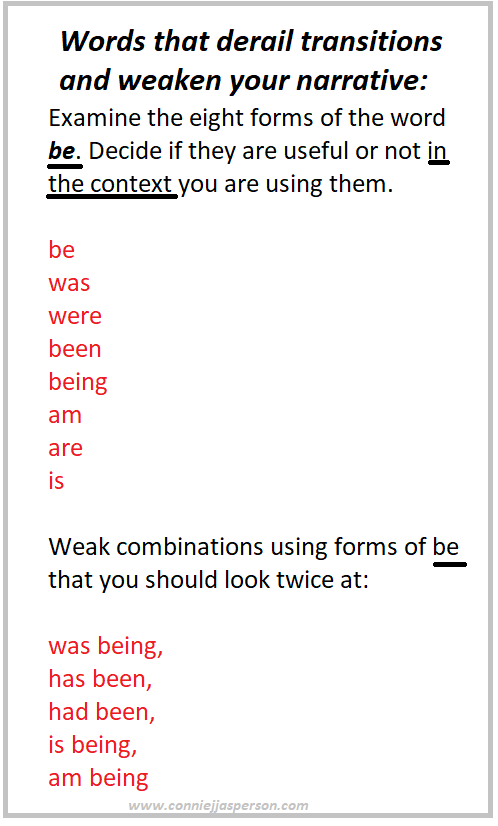
weak-words-LIRF04262022Feel free to copy the above image and save it to your files as a .png or .jpeg, and also the modifiers as connectors image, above right.
As I have mentioned before, editing programs are available, some free, and some for an annual fee. Your word processing program has spell check, which can help or hinder you. Grammarly is an editing program I use for checking my own work. Unfortunately, these programs are unable to see the context of the work they are analyzing.

We define context as the parts of a written or spoken statement that precede or follow a specific word or passage, usually influencing its meaning or effect. 

A person with limited knowledge of grammar and mechanics won’t benefit from relying on Grammarly or any other editing program for advice. This is because these programs operate by algorithms and finite rules.

The program will often strongly suggest you insert an unneeded article or change a word to one that is clearly not the right one for that situation. I recommend investing in the Chicago Guide to Grammar, Usage, and Punctuation. Look things up and learn how grammar works.

I don’t mind taking the time to visit each problem and resolve them one at a time. I see this as part of my job, just what an author does to make sure her work is finished to the best of her ability.

>>><<

PREVIOUS POSTS IN THIS SERIES:

How the Written universe works part 1: the connecting particle 

How the Written universe works part 2: the physics of conversation 

How the Written Universe Works part 3: Lay, Lie, Laid

How the Written Universe Works part 4: Relativity and Possessives 

How the Written Universe Works part 5: ellipsis, em dash, hyphen, semicolon 

Credits and Attributions:

[1] The Danger of Writing Advice from Industry Professionals, by Chuck Wendig, Terribleminds,  The Ramble, http://terribleminds.com/ramble/2017/12/12/the-danger-of-writing-advice-from-industry-professionals/  ©2017. Accessed 25 April 2022.

11 Comments

Filed under writing

Conveying Mood part 2: adverbs #amwriting

Today is the second installment of a series on modifiers, words we use to describe nouns and verbs. I’m on a quest to find ways to use fewer of them and make the most of the ones I do use.

In the previous post, I  mentioned going to an online thesaurus and looking up your overall mood word. This is where you will find synonyms for your mood words and also the opposites.

In the root form, adverbs are adjectives, words that modify nouns. Add the suffix ‘ly’ to them, and they become words that modify verbs.

Adverbs tend to be fluffy. Most readers don’t like fluffy prose. I suggest you don’t muck up your modifiers by adding ‘ly’ at the end of them unless it is the only thing that works.

With that said, my rule is don’t write clumsy prose just to avoid using ‘ly.’

In the first draft, modifiers are brain-storming words. They show us what we intended to convey when we first wrote the narrative.

For that reason, they are essential parts of English and can’t be completely discarded as some deluded authors loudly swear they have done.

I suppose one could write a novel without using any modifiers whatsoever, but I wouldn’t want to read it. However, modifiers can weaken verbs by telling the story rather than showing it.

I don’t self-edit my first drafts as I write, so my prose is always a mess when I begin revisions.

This year’s NaNoWriMo novel was written with no outline, so it’s an example of my worst “thinking habits.” It is a sea of adverbs and adjectives, but these words are the roadmap that tells me what prose need reshaping to show the story.

At the time, I was imagining the scenes and plotting as I wrote. When I look back, the early drafts for all my work are littered with adverbs.

When you imagine your adverbs as signals from your creative mind, you see them a guide leading you to the story you really wanted to write.

In the second draft, I want to inject impact into the opening paragraphs and all the sentences that follow right to the grand finale. But I also want them to show what I envision.

That requires rewording the sentences to make them active. Look at your sentence structure.

Sentence structure matters.

Where you place an adjective relative to the noun they are modifying affects how a reader perceives it. Noun-verb is a strong lead in. Nouns work best when one strong, well-chosen adjective shows us what the point-of-view characters sees, hears, smells, touches, and tastes, rather than fluffing the verbs and hindering the action.

Sunlight glared over the ice, a cold fire in the sky that cast no warmth but burned the eyes.

The example sentence contains four nouns, one modifier (an adjective), and three verbs. The sentence is structured this way: noun-verb (sunlight glared) adjective-noun (cold fire), verb-adjective-noun (cast no warmth), and finally, verb-article-noun (burned the eyes).

Verb followed by noun shows us what the noun did. Verb-adjective-noun shows us how the noun looked (smelled, tasted, or felt) during the action.

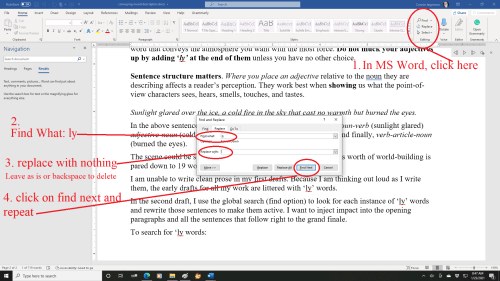
To search for unnecessary adverbs, look for ‘ly’ words in MS Word:

1: Click replace in the upper right corner of the Home tab.

2: Type ly into the “Find What” box.

3: Leave the “Replace With” box blank.

4: Look at each instance individually and decide to keep the ly or delete it. Many words, such as early or easily, have ly as their suffix, so look at each instance and decide if it stays or goes.

5: Once you have decided, click find next and repeat the process.

The above instructions are for MS Word, but Google Docs and Open Office both have some kind of search and replace function. Go to the internet and find the instructions!

In the first draft, the important thing is to get the idea down without self-editing. For this reason, we don’t publish our first drafts.

If you are like me in your first drafts, cleaning up and strengthening the prose could take a while, especially in a large manuscript. However, it is part of the revision process and is well worth the time you put into it.

The English language has evolved over the last century. The word very has become a ‘fluff word’ that sticks out when we see it written too freely in a narrative. It has a purpose but is easy to overuse. In that case, it adds nothing of value to the prose, so editors will suggest you remove it to make your sentences stronger.

Below is a list of modifiers, words that paint an image of the world our characters inhabit. Some will change the voice from active to passive, so be wary of how you use them.

When you do use a modifier, be creative. Sometimes, using an unexpected adjective lends life to an otherwise ordinary scene.

Nouns like a well-placed modifier, but most of the time, verbs are stronger when they work alone.

313 Modifiers for Nouns

  • Abnormal
  • Absentminded
  • Accidental
  • Adventurous
  • Afterward
  • Almost
  • Always
  • Annual
  • Anxious
  • Arrogant
  • Awkward
  • Bashful
  • Beautiful
  • Bitter
  • Bleak
  • Blind
  • Blissful
  • Boastful
  • Bold
  • Brave
  • Brief
  • Bright
  • Brisk
  • Broad
  • Busy
  • Calm
  • Careful
  • Careless
  • Cautious
  • Certain
  • Cheerful
  • Clear
  • Clever
  • Close
  • Coaxing
  • Colorful
  • Common
  • Continual
  • Cool
  • Correct
  • Courageous
  • Cross
  • Cruel
  • Curious
  • Dainty
  • Dear
  • Deceiving
  • Deep
  • Defiant
  • Deliberate
  • Delightful
  • Diligent
  • Dim
  • Doubtful
  • Dreamy
  • Easy
  • Elegant
  • Energetic
  • Enormous
  • Enthusiastic
  • Equal
  • Especial
  • Even
  • Even
  • Eventual
  • Exact
  • Excited
  • Extreme
  • Fair
  • Faithful
  • Famous
  • Far
  • Fast
  • Fatal
  • Ferocious
  • Fervent
  • Fierce
  • Fond
  • Foolish
  • Fortunate
  • Frank
  • Frantic
  • Free
  • Frenetic
  • Frightful
  • Full
  • Furious
  • General
  • Generous
  • Gentle
  • Glad
  • Gleeful
  • Graceful
  • Grateful
  • Great
  • Greedy
  • Happy
  • Hasty
  • Healthy
  • Heavy
  • Helpful
  • Helpless
  • High
  • Honest
  • Hopeless
  • Hungry
  • Immediate
  • Innocent
  • Inquisitive
  • Instant
  • Intense
  • Intent
  • Interesting
  • Inward
  • Irritable
  • Jagged
  • Jealous
  • Jovial
  • Joyful
  • Joyous
  • Jubilant
  • Judgmental
  • Just
  • Keen
  • Kidding
  • Kind
  • Kindhearted
  • Knavish
  • Knowing
  • Knowledgeable
  • Kooky
  • Lazy
  • Less
  • Light
  • Like
  • Limp
  • Live
  • Lofty
  • Longing
  • Loose
  • Loud
  • Loving
  • Loyal
  • Mad
  • Majestic
  • Meaningful
  • Mechanical
  • Merry
  • Miserable
  • Mocking
  • Month
  • More
  • Mortal
  • Most
  • Mysterious
  • Natural
  • Near
  • Neat
  • Nervous
  • Never
  • Nice
  • Noisy
  • Not
  • Obedient
  • Obnoxious
  • Odd
  • Offensive
  • Official
  • Often
  • Open
  • Optimistic
  • Overconfident
  • Painful
  • Partial
  • Patient
  • Perfect
  • Physical
  • Playful
  • Polite
  • Poor
  • Positive
  • Potential
  • Powerful
  • Prompt
  • Proper
  • Punctual
  • Quaint
  • Queasy
  • Queer
  • Questionable
  • Quick
  • Quicker
  • Quiet
  • Quirky
  • Quizzical
  • Random
  • Rapid
  • Rare
  • Ready
  • Real
  • Reassuring
  • Reckless
  • Regular
  • Reluctant
  • Repeated
  • Reproachful
  • Restful
  • Righteous
  • Rightful
  • Rigid
  • Rough
  • Rude
  • Safe
  • Scarce
  • Scary
  • Searching
  • Sedate
  • Seldom
  • Selfish
  • Separate
  • Serious
  • Shaky
  • Sharp
  • Sheepish
  • Shrill
  • Shy
  • Silent
  • Sleepy
  • Slow
  • Smooth
  • Soft
  • Solemn
  • Solid
  • Sometimes
  • Soon
  • Speedy
  • Stealthy
  • Stern
  • Strict
  • Successful
  • Sudden
  • Supposed
  • Surprising
  • Suspicious
  • Sweet
  • Swift
  • Sympathetic
  • Tender
  • Tense
  • Terrible
  • Thankful
  • Thorough
  • Thoughtful
  • Tight
  • Tomorrow
  • Too
  • Tremendous
  • Triumphant
  • True
  • Truthful
  • Ultimate
  • Unabashed
  • Unaccountable
  • Unbearable
  • Unethical
  • Unexpected
  • Unfortunate
  • Unimpressive
  • Unnatural
  • Unnecessary
  • Upbeat
  • Upright
  • Upside-down
  • Upward
  • Urgent
  • Useful
  • Useless
  • Usual
  • Utter
  • Vacant
  • Vague
  • Vain
  • Valiant
  • Vast
  • Verbal
  • Very
  • Vicious
  • Victorious
  • Violent
  • Vivacious
  • Voluntary
  • Warm
  • Weak
  • Weary
  • Well
  • Wet
  • Whole
  • Wild
  • Willful
  • Wise
  • Woeful
  • Wonderful
  • Worried
  • Wrong
  • Yawning
  • Year
  • Yearning
  • Yesterday
  • Yielding
  • Youthful
  • Zealous
  • Zest
  • Zestful

Previous in this series:

Conveying Mood Part 1: Adjectives

Short Story part 1: word choice

The Short Story part 2: Setting and Atmosphere 

Theme part 1

Theme part 2

7 Comments

Filed under writing