
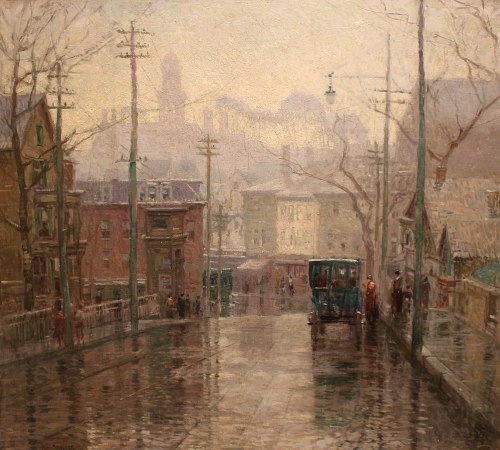
 Title: After the Rain Gloucester
Artist: Paul Cornoyer (1864–1923)
Medium: Oil painting
Style: Pointilist/Tonalist/Impressionist
What I love about this painting and why it deserves a closer look:
Paul Cornoyer was a master of depicting weather. In this painting, a hard rain has just passed, and the late afternoon sun attempts to emerge behind us. It casts a rosy glow over the wet pavement and rising mist, a rare moment of beauty that is the only apology bad weather ever makes.
This painting is considered representative of the Ashcan School of art, an American art movement depicting urban scenes.
I especially appreciate the way Cornoyer depicts the far reaches of the city of Gloucester Massachusetts in the distance, using a pointillist technique. The church tower looms, a ghostly presence dominating the skyline. Near the church, smoke from a distant factory hangs low, an ominous presence that lingers and then drifts away.
It’s as if the artist has just stepped outside and shows us the cold dampness of a rainy day to us. The sheen of water on the street and the way it reflects the surroundings is masterfully done, one of the finest examples of water in art.
Cornoyer is one of my favorite artists. While he isn’t as well-known as some others of that era, he was nonetheless a master and is deserving of an important place in American art history. His work is as meticulous and moving as that of John Singer Sargent or Childe Hassam.
About the artist:
Via Wikipedia: Paul Cornoyer (1864–1923) was an American painter, currently best known for his popularly reproduced painting in an Impressionist, tonalist, and sometimes pointillist style.
Born in St. Louis, Missouri, Cornoyer began painting in Barbizon style and first exhibited in 1887. In 1889, He moved to Paris, where he studied at the Académie Julian alongside Jules Lefebvre and Jean-Joseph Benjamin-Constant.
After returning from his studies in Paris in 1894, Cornoyer was heavily influenced by the American tonalists. At the urging of William Merritt Chase, he moved to New York City in 1899. In 1908, the Albright–Knox Art Gallery (formerly the Albright Gallery) hosted a show of his work. In 1909, he was elected into the National Academy of Design as an Associate Academician. He taught at Mechanics Institute of New York and in 1917, he moved to Massachusetts, where he continued to teach and paint. [1]
Quote from Cornoyer’s bio on Questroyal Fine Art: In New York, Cornoyer worked in a predominantly tonalist style, creating city and street scenes that received praise from critics and won awards. He favored rainy and snowy views of Washington Square Park, Madison Square Park, and Fifth Avenue, rendered in subtle grayed tones. Contemporaries observed that rather than conveying urban chaos, Cornoyer preferred images of calm amidst the bustle of the city. The poetic nature of his work and his sensitivity to atmosphere and color were duly noted. [2]
Credits and Attributions
IMAGE: After the Rain Gloucester, Paul Cornoyer [Public domain], via Wikimedia Commons. Wikimedia Commons contributors, “File:After the Rain Gloucester by Paul Cornoyer.jpg,” Wikimedia Commons, https://commons.wikimedia.org/w/index.php?title=File:After_the_Rain_Gloucester_by_Paul_Cornoyer.jpg&oldid=786054148 (accessed February 6, 2025).
[1] Wikipedia contributors, “Paul Cornoyer,” Wikipedia, The Free Encyclopedia, https://en.wikipedia.org/w/index.php?title=Paul_Cornoyer&oldid=1118249028 (accessed February 6, 2025).
[2] Paul Cornoyer | Questroyal (questroyalfineart.com) (accessed Feb. 6, 2025).


 Life in the Realm of Fantasy
