Tag Archives: Allegory

#FineArtFriday: Winter Scene in New Haven, Connecticut, by George Henry Durrie

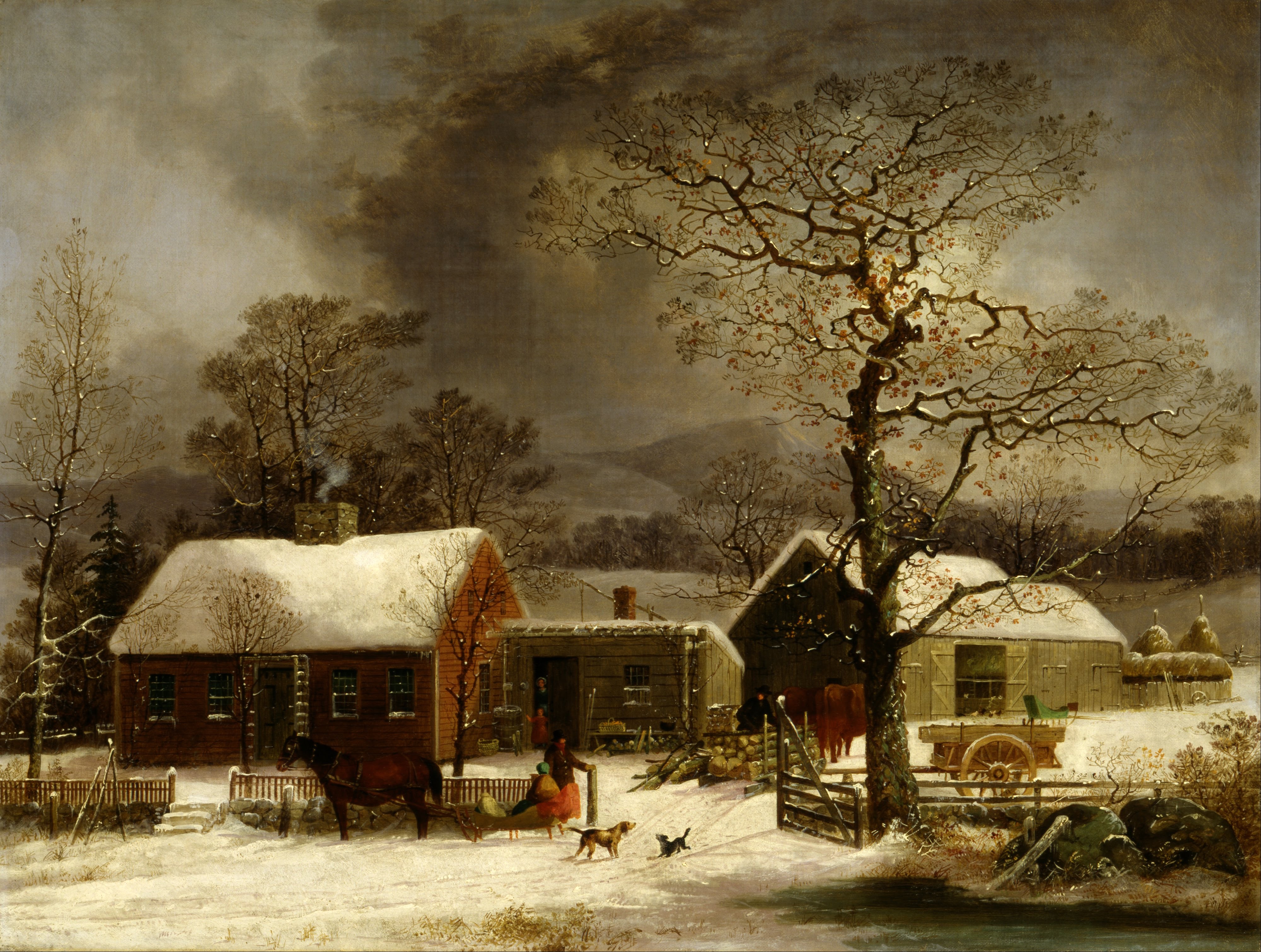
I frequently find myself perusing the vaults at Wikimedia Commons, looking for clues about how people lived in times past. Winter Scene in New Haven, Connecticut, by George Henry Durrie is an intriguing window into the winter of 1858, a surprisingly intimate view of life in America just before the Civil War. I first posted this image in December of 2017, and it remains one of my favorite paintings, for a number of reasons.

Durrie had a modest reputation during his lifetime, an indie struggling unsuccessfully to market his works. After his death, the American printmaking firm, Currier and Ives, ensured his works were kept in the public eye.

The grandeur of the sky is reminiscent of Constable’s work, and the painting, overall, is both bold and comforting. Under a large sky, we find a small farm. It’s a simple pastoral scene, a moment painted during a winter long passed into memory. It’s pleasant, almost boring scene in its common hominess. When you look at the larger picture, you may ask, “How is this intimate? The landscape and the sky provide the drama, while the people are completely overshadowed by the scenery.”

But there is another, deeper story, one that is overshadowed by the majestic landscape and threatening winter skies, and Durrie included these people for a reason.

In Connecticut in 1858 things were not as simple and bucolic as the wide view of this image portrays.

Quote from Matthew Warshauer in his article for Connecticut History:

The state descended into chaos at the start of the war, splitting into warring Republican and Democratic factions that sometimes faced off violently.  Before the Southern states even seceded, the two parties faced off in the 1860 gubernatorial election, a contest that would decide the level of the state’s involvement once the war began.

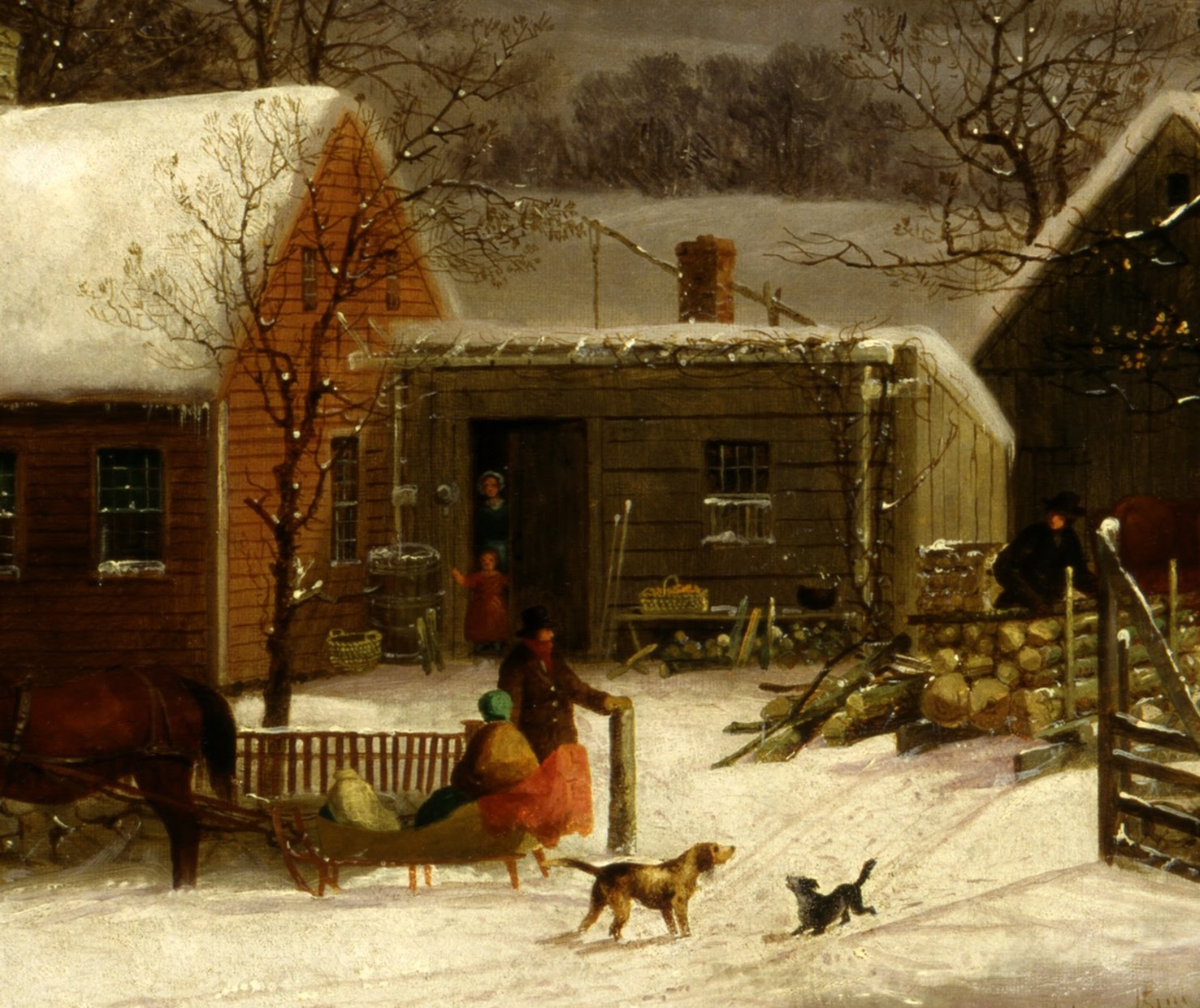
Artists, then and now, frequently deal in allegory and misdirection. Then, as now, they were pressured to portray an acceptable vision of life as it should be. They had to sell their work to live, so they did do that, but they still painted what they saw, inserting the truth into each painting. The story that Durrie hid within this painting can be found by examining the painting in detail. I have enlarged the important section for you.

A sled, drawn by a single horse and driven by a woman, has pulled up beside the gate. A man has emerged and is talking to her. In the doorway of the farmhouse, a woman and girl stand, watching the scene at the gate.

We can imagine that some drama exists in their relationships, beginning with the way the man is standing there, not inviting the woman in. She obviously doesn’t expect to be invited in by him but has come anyway.

The man speaks to the traveler, but his gaze is not focused on the woman who has traveled through the snow, bringing a large sack filled with… what? Presents? Food-gifts? Instead, he looks away, focusing on the fencepost. Is the visitor an unwelcome mother-in-law, or is she, perhaps, a travelling merchant and he is negotiating with her?

Did she purchase something? Perhaps they’re merely chatting and he just happens to be looking away.

The sky can be a clue to the deeper story, too. Dark clouds take up fully half of the scene, dwarfing the homestead. Storms threaten the peace and prosperity of this farm, and barren trees flourish. It’s 1858 and the country is divided politically and ideologically, and the threat of a civil war looms.

The final subliminal clue is in the title: Winter Scene in New Haven, Connecticut. The artist names the picture after the larger community, a town that doesn’t appear at all in the painting, instead of offering the farm’s name. Thus, the scene. the approaching storm threatening the peaceful farm, is an allegory depicting the mood of the larger community.

Does this small detail hidden in the larger picture depict a travelling merchant, a customer, or a disliked mother-in-law bringing gifts despite her son-in-law’s aversion? Or is there something deeper here? Nothing breaks up families or divides communities as surely as strongly held opposing opinions, and we were deeply divided in those turbulent times.

The story is there, and the world in which it is set is all prepared for you. George Henry Durrie painted it, and if you are looking for a deep story that echoes our modern political state of affairs, here it is.

Or, it could simply be a passing stranger, asking for directions on a winter’s day.

When you examine the art of the past closely and look for allegories, you may find a large story hidden within the the image.  It’s up to you to interpret it and then write it.


Credits and Attributions:

Wikimedia Commons contributors, “File:George Henry Durrie – Winter Scene in New Haven, Connecticut – Google Art Project.jpg,” Wikimedia Commons, https://commons.wikimedia.org/w/index.php?title=File:George_Henry_Durrie_-_Winter_Scene_in_New_Haven,_Connecticut_-_Google_Art_Project.jpg&oldid=761233247 (accessed January 23, 2025).

The Complicated Realities of Connecticut and the Civil War, by Matthew Warshauer, Ph.D., Professor of History at Central Connecticut State University. Copyright © Connecticut Humanities. Licensed under a Creative Commons Attribution Non-Commercial Share Alike 3.0 License (accessed January 23, 2025).

3 Comments

Filed under #FineArtFriday, writing

The Writer’s Toolbox – Allegory and Symbolism #amwriting

Allegory and symbolism – tools in a writer’s toolbox that are similar but different. The difference between them is how they are presented.

  • Allegory is a narrative, a moral lesson in the form of a story, heavy with symbolism.
  • Symbolism is a literary device that uses one thing throughout the narrative (perhaps red) to represent something else (danger).

allegory2Symbolism is one aspect of a story that helps create mood and atmosphere. It supports and strengthens the theme and is subtle, subliminal. When a little thought is applied to how it is used, symbolism conveys meaning to the reader without beating them over the head.

So, what is an allegory?

The storytelling in The Matrix series of movies is a brilliant example of an allegory. The Matrix was written by The Wachowskis. The narrative is an allegory for Plato’s Allegory of the Cave, a depiction of reality and illusion. The movies in the series employ heavy symbolism in both the setting and conversations to drive home the multilayered themes of humankind, machine, fate, and free will.

Wikipedia says: In the allegory “The Cave,” Plato describes a group of people who have lived chained to the wall of a cave all their lives, facing a blank wall. The people watch shadows projected on the wall from objects passing in front of a fire behind them and give names to these shadows. The shadows are the prisoners’ reality, but are not accurate representations of the real world. The shadows represent the fragment of reality that we can normally perceive through our senses, while the objects under the sun represent the true forms of objects that we can only perceive through reason. [1]

Plato used heavy symbolism in his allegorical work. In The Matrix, reality and illusion are portrayed with layers of symbolism:

  • The names of the characters
  • The words used in conversations
  • The androgynous clothes they wear

Everything on the set or mentioned in conversations underscores those themes, including the lighting. Inside The Matrix, the world is bathed in a green light, as if through a green-tinted lens. In the real world, the lighting is harsher, unfiltered.

Everything that appears or is said onscreen in the movie is symbolic and supports one of the underlying concepts. When Morpheus later asks Neo to choose between a red pill and a blue pill, he essentially offers the choice between fate and free will.

Symbolism on its own is a powerful tool. We can show more with fewer words. But while a tale may be heavily layered with symbolism, it might not be an allegory.

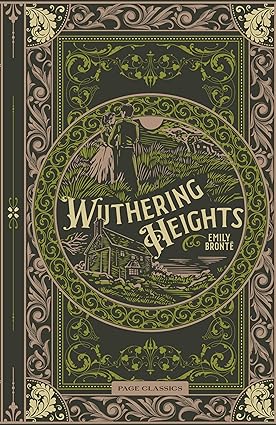
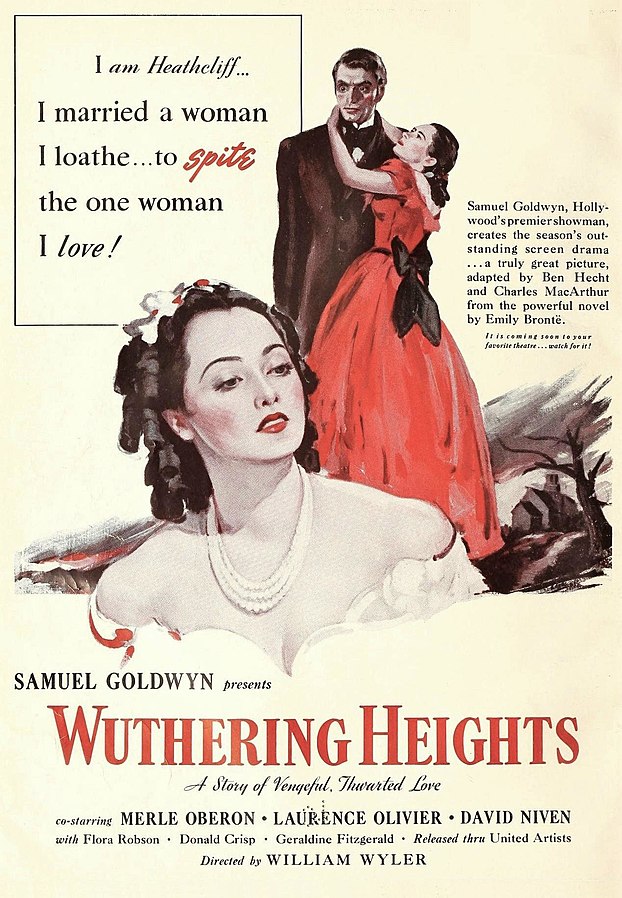
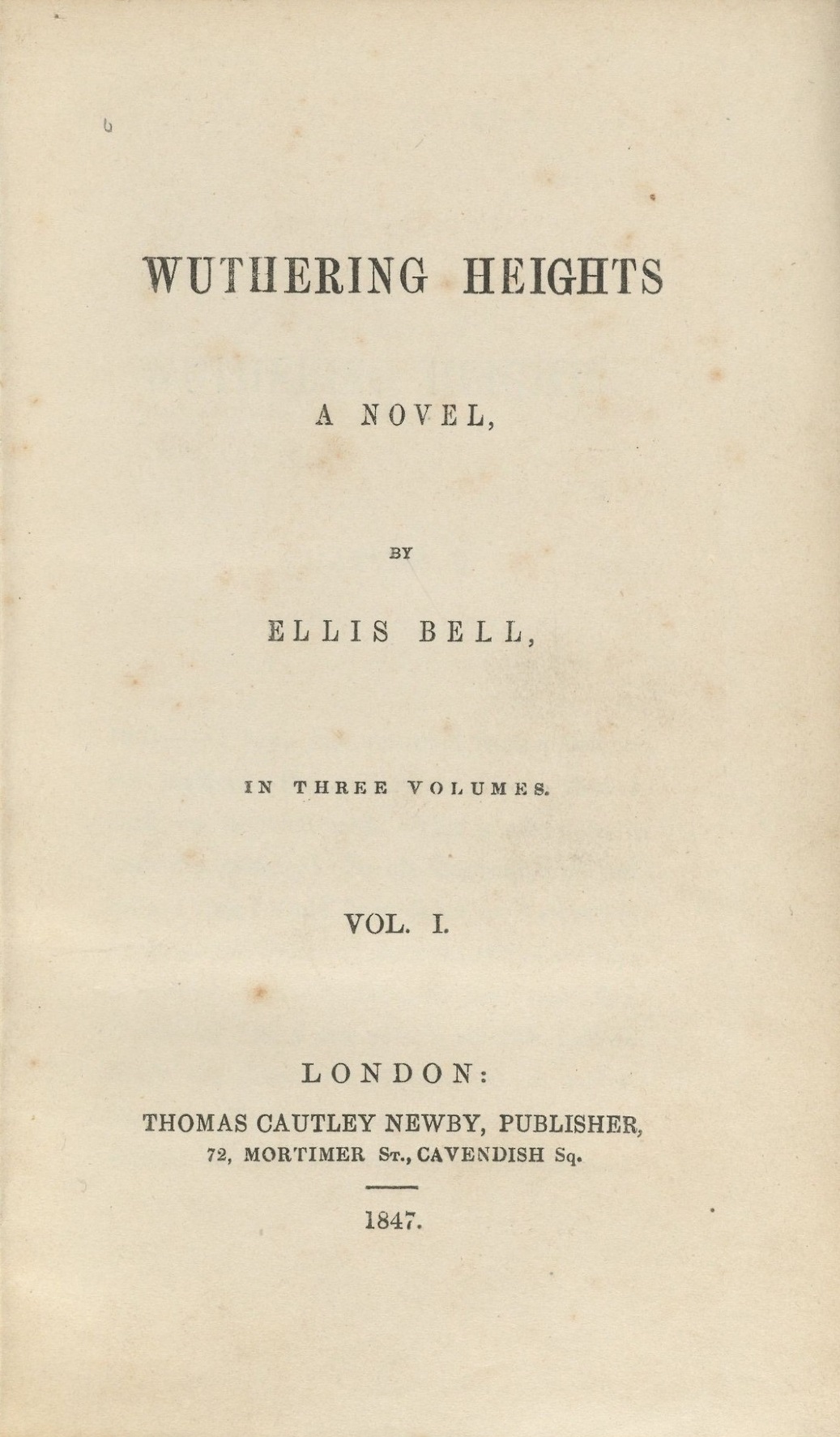
Take the classic Gothic novel Wuthering Heights.

It’s not an allegory because it doesn’t explore a moral or symbolic meaning beyond its obvious story. Brontë’s symbolism in her world-building supports and underscores the themes of love, revenge, and social class.

622px-Merle_Oberon_and_Laurence_Olivier_in_'Wuthering_Heights',_1939The way Emily Brontë employed atmosphere in Wuthering Heights is stellar. I would love to achieve that level of world-building.

We can find allegories in nearly any written narrative because humans love making connections and often imagine them where there are none. While Wuthering Heights is not considered an allegory in the literary sense, it is heavily symbolic.

Spark Notes says:

The constant emphasis on landscape within the text of Wuthering Heights endows the setting with symbolic importance. This landscape is comprised primarily of moors: wide, wild expanses, high but somewhat soggy, and thus infertile. Moorland cannot be cultivated, and its uniformity makes navigation difficult. It features particularly waterlogged patches in which people could potentially drown. (This possibility is mentioned several times in Wuthering Heights.) Thus, the moors serve very well as symbols of the wild threat posed by nature. As the setting for the beginnings of Catherine and Heathcliff’s bond (the two play on the moors during childhood), the moorland transfers its symbolic associations onto the love affair.

The two large estates within the book create a pocket world of sorts, where little, if anything, lies beyond their existence. Thus, windows both literal and figurative serve to showcase what exists on the other side while still keeping the characters trapped. [2]  Wuthering Heights: Symbols | SparkNotes

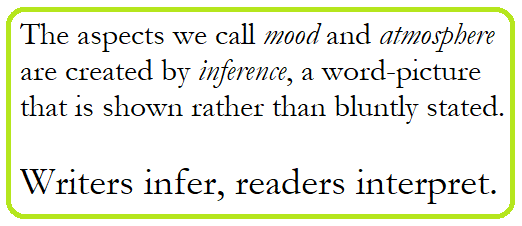
Like symbolism and allegory, mood and atmosphere are separate but entwined forces. They form subliminal impressions in the reader’s awareness, sub currents that affect our mood and emotions.

Emotion is the experience of contrasts, the experience of transitioning from the negative to the positive and back again. Symbolism and allegory exist in both the surface and the subtext of a story.

Mood, atmosphere, and emotion are part of the inferential layer of a story. The reader must infer (deduce, understand, fathom, grasp, recognize) the emotional experience, and it must feel personal to them.

mood-emotions-2-LIRF09152020How a setting is shown contributes to atmosphere. But the setting is only a place—it is not atmosphere. Atmosphere is created as much by odors, scents, ambient sounds, and visuals as by the characters’ moods and emotions. Emily Brontë‘s moors and windows are subliminal background elements. They convey information to the reader on a subconscious level, supporting the moods of the characters and their actions and conversations.

I create an outline as I go because using symbolism is critical if I want to convey mood and atmosphere without resorting to an info dump.

Just to be clear, a plan is not always required because sometimes the flash of inspiration we begin with is strong enough, and the theme develops as you write.

For me, a strong theme will whisper suggestions and symbols to me as I create the world and the visual environment. I note them in the outline, so I don’t lose track of them.

In my case, I need a plan most of the time, even though it evolves as the story does.

The casual reader doesn’t notice symbolism on a conscious level. They may not see the symbolic nature of your narrative. However, dedicated readers will, and that is what will keep them reading. Dedicated readers love work that holds up on closer examination, enjoying work with layers of depth, work they can read again and again and always find something new in it.
Yet, for the casual reader, the story and the characters who live out those events are what matters. The allegories and symbolisms created in the narrative sink into the reader’s subconscious, stirring thoughts and raising ideas they might not otherwise have considered.


Credits and Attributions:

[1] Wikipedia contributors, “Allegory of the cave,” Wikipedia, The Free Encyclopedia, https://en.wikipedia.org/w/index.php?title=Allegory_of_the_cave&oldid=1165911183 (accessed 12 August 2023).

[2] Wuthering Heights: Symbols | SparkNotes Copyright © 2023 SparkNotes LLC (accessed 12 August 2023). Fair Use.

3 Comments

Filed under writing

#FineArtFriday: The Dutch Proverbs by Pieter Bruegel the Elder, revisited

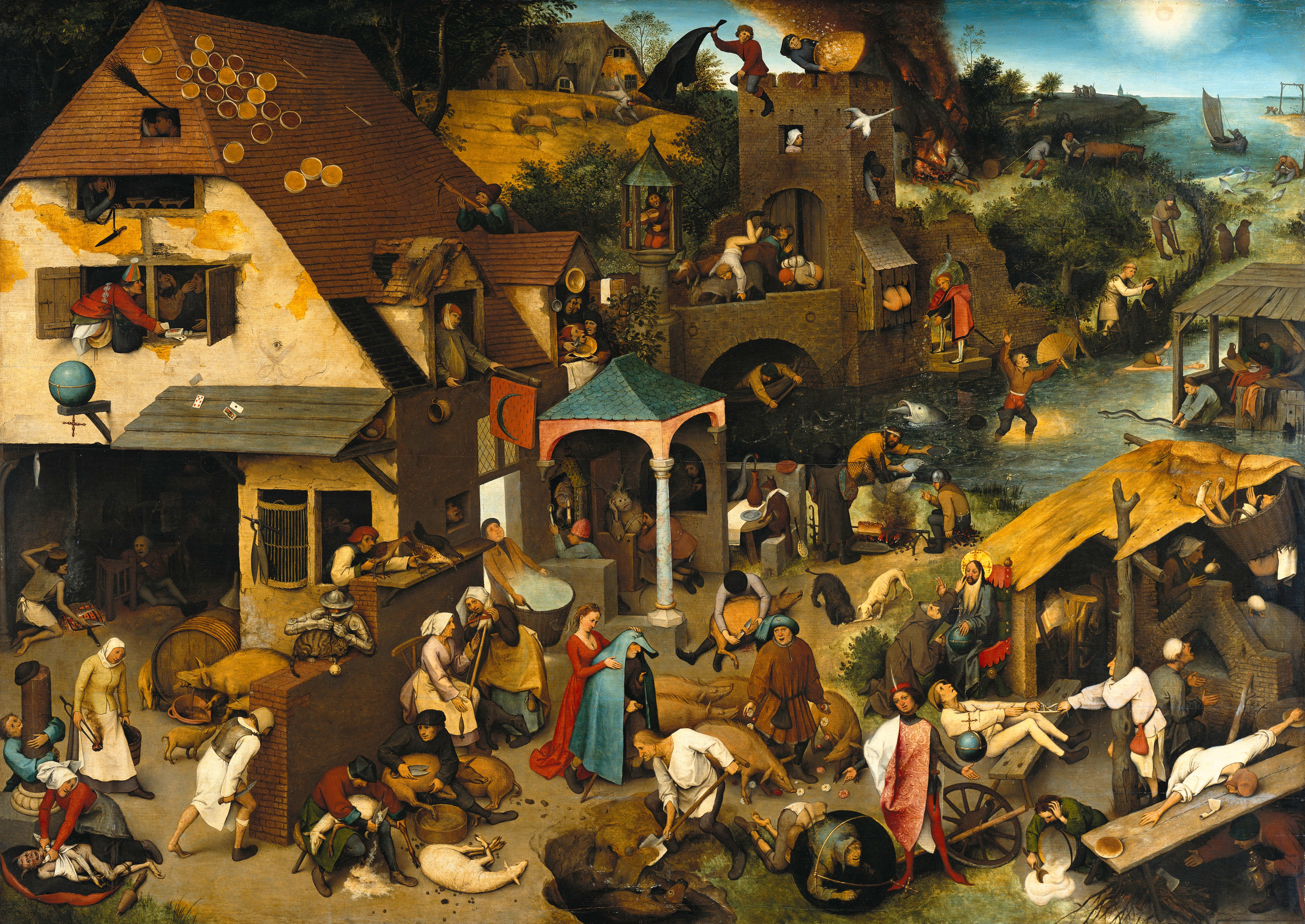
Pieter_Brueghel_the_Elder_-_The_Dutch_Proverbs_-_Google_Art_ProjectToday I’m revisiting one of the best allegorical paintings of all time, The Netherlandish Proverbs (also known as The Dutch Proverbs) by Pieter Brueghel the Elder, which was painted in 1559. A master at humor, allegory, and pointing out the follies of humanity, Brueghel the Elder is one of my favorite artists.
Artist: Pieter Bruegel the Elder
Year: 1559
Medium: Oil-on-panel
Dimensions: 117 cm × 163 cm (46 in × 64 in)
Location: Gemäldegalerie, Berlin

Quote from Wikipedia:

Critics have praised the composition for its ordered portrayal and integrated scene. There are approximately 112 identifiable proverbs and idioms in the scene, although Bruegel may have included others which cannot be determined because of the language change. Some of those incorporated in the painting are still in popular use, for instance “Swimming against the tide”, “Banging one’s head against a brick wall” and “Armed to the teeth”. Many more have faded from use, which makes analysis of the painting harder. “Having one’s roof tiled with tarts”, for example, which meant to have an abundance of everything and was an image Bruegel would later feature in his painting of the idyllic Land of Cockaigne (1567).

The Blue Cloak, the piece’s original title, features in the centre of the piece and is being placed on a man by his wife, indicating that she is cuckolding him. Other proverbs indicate human foolishness. A man fills in a pond after his calf has died. Just above the central figure of the blue-cloaked man another man carries daylight in a basket. Some of the figures seem to represent more than one figure of speech (whether this was Bruegel’s intention or not is unknown), such as the man shearing a sheep in the centre bottom left of the picture. He is sitting next to a man shearing a pig, so represents the expression “One shears sheep and one shears pigs”, meaning that one has the advantage over the other, but may also represent the advice “Shear them but don’t skin them”, meaning make the most of available assets.

You can find all of the wonderful proverbs on the painting’s page on Wikipedia, along with the thumbnail that depicts the proverb.

My favorite proverbs in this wonderful allegory?

Horse droppings are not figs. It meant we should not be fooled by appearances.

He who eats fire, craps sparks. It meant we shouldn’t be surprised at the outcome if we attempt a dangerous venture.

Now THAT is wisdom!


Credits and Attributions:

The Netherlandish Proverbs (Also known as The Dutch Proverbs) by Pieter Brueghel the Elder 1559 [Public domain], via Wikimedia Commons.

Wikipedia contributors, “Netherlandish Proverbs,” Wikipedia, The Free Encyclopedia, https://en.wikipedia.org/w/index.php?title=Netherlandish_Proverbs&oldid=829168138  (accessed November 24, 2022).

4 Comments

Filed under #FineArtFriday, writing

Exploring Theme part 4: Allegory #amwriting

Over the previous three posts, we’ve looked at the many ways themes can be employed in the stories we write. Themes exist in every story but can be difficult to identify if we have no plan to write to.

allegory2When you are pantsing it (writing-by-the-seat-of-your-pants), themes are like your drunk uncle. They hang out at the local pub until closing time and then weave their way home through dark alleys. Sometimes, as you are leaving for work in the morning, you find them under the neighbor’s shrubs. Other times they make it home.

If you still haven’t identified the defining theme when you have finished your first draft, look in the first chapters of your story. You may find clues sprinkled throughout the story, hints to point the reader toward the theme.

If you still haven’t identified the theme, you may be trying too hard. Often, the theme can be found in the things and events that are hindrances to happiness.

Allegory is an excellent tool to use when we want to emphasize a theme without beating our readers over the head. Allegories are objects within a story, poem, or picture that can be interpreted to reveal a hidden meaning,

A well-crafted allegory can subtly underscore your themes to drive home your point without resorting to an info dump.

Using symbolism and allegory allows an author to pack the most information into the least number of words. But it requires intention when you first begin creating the story arc. Words, phrases, and settings must be chosen, and the narrative’s prose must be purposefully crafted.

At the surface level, each genre looks widely different. But when you go deeper, you find that all literary genres have one thing in common: they have protagonists and side characters who all must deal with and react to the book’s underlying theme.

Highlighting a strong theme can be a challenge if you begin without an outline. A plan is not always required because, in some stories, the flash of inspiration we start with is a strong theme. The theme develops as you write, and immediately, you see what it is.

Personally, I need an outline most of the time.

Whatever the case, once you have identified the central theme, you can write the story in such a way that it is shown through:

  • Actions
  • Symbolic settings/places
  • Allegorical objects deliberately placed within the setting
  • Conversations

It can be difficult to decide the underlying theme, making the story weak. It has no legs and won’t ring true until you find what that unifying idea-thread is. This requires a little mind-wandering on your part.

allegoryI often sit on my back porch and just let my thoughts roam, thinking about nothing in particular. Usually, I will end up considering the character’s quest or dilemma. I ask myself what the root cause of the issue is—if it is a crime, why is crime rampant? Is it a societal problem, such as poverty or war? If the core dilemma is unrequited love, what are the roadblocks to a resolution?

Once I identify the root cause of the problem, I can see the themes. If the problem is poverty, dealing with and overcoming it becomes the theme throughout the story. You don’t have to say “they were dirt-poor” every scene. Yes, many of the poorest people are homeless. However, most people whose incomes are near or below the poverty line have homes and jobs.

People are not cliches. Most poor people work one or two jobs to keep food on the table and a roof over their family’s heads. They don’t have the time or money to be drunks or drug abusers—their wages go to providing as good a life as they can for their families. People can be shown as being basically happy in an environment that isn’t wealthy. Life has subtleties, and a strong theme can reinforce those nuances when it is shown through the use of allegories.

Poverty can be represented through many symbolic objects in their home or neighborhood:

  • Cracks in sidewalks
  • Cracks in mirrors
  • Chips in crockery
  • Peeling wallpaper
  • Broken-down vehicles

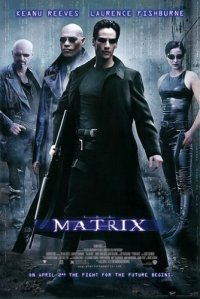
Whenever I talk about allegory, I like to use the movie, The Matrix as my example. Most people are familiar with the movie but aren’t consciously aware of the amount of symbolism and allegory that is laced into it. The films of The Matrix franchise pit man against machine in a clearly drawn battle, but they also reveal that the humans are more machinelike than they think and that the machines possess human qualities as well.

These are the prominent themes, but there are several simultaneous underlying concepts.

In the movie’s opening scenes, symbolism is used to underscore Neo’s unacknowledged dissatisfaction, a discontent he is unaware of. This unspoken unhappiness is shown in many ways. Allegory is built into their androgynous costumes and in the screenwriters/authors’ choice of words used in every conversation.

The symbolism continues in the way the setting is so sparsely dressed. Every object that is shown onscreen has a purpose and a meaning. Even the characters’ names are symbolic.

The themes are represented with heavy symbolism in the lighting used on the movie set:

>Inside The Matrix, the world is bathed in a green light as if filmed through a green-tinted lens.

>In the real world, the lighting is harsher, unfiltered.

In the movie, everything that appears or is said onscreen is symbolic and supports one of the underlying concepts. When Morpheus later asks Neo to choose between a red pill and a blue pill, he essentially offers the choice between fate and free will.

powerwordsWordCloudLIRF06192021These layers offer us an incredible amount of subliminal information about that surreal world and what is going on in reality, what the Matrix truly is.
I try to picture conversations, clothing, setting, and the broader environment as if I were creating a scene in a movie. How can I use allegory to support my story arc?

When we are immersed in reading a book or watching a movie, we don’t notice the heavy symbolism on a conscious level. However, it is all there on closer examination, making the imaginary real, solid, and concrete.

This post winds up our four-part dip into theme. Thank you for sticking with me! Below are the links to the previous posts in this series.

Exploring Theme part 1 – Henry James

Exploring Theme part 2 – Jane Austen

Exploring Theme part 3 – Learning from poetry

16 Comments

Filed under writing

#FineArtFriday: The Dutch Proverbs by Pieter Bruegel the Elder, revisited

Pieter_Brueghel_the_Elder_-_The_Dutch_Proverbs_-_Google_Art_ProjectOne of the best allegorical paintings of all time is The Netherlandish Proverbs (also known as The Dutch Proverbs) by Pieter Brueghel the Elder, which was painted in 1559. A master at humor, allegory, and pointing out the follies of humanity, Brueghel the Elder is one of my favorite artists.

Artist: Pieter Bruegel the Elder
Year: 1559
Medium: Oil-on-panel
Dimensions: 117 cm × 163 cm (46 in × 64 in)
Location: Gemäldegalerie, Berlin

Quote from Wikipedia:

Critics have praised the composition for its ordered portrayal and integrated scene. There are approximately 112 identifiable proverbs and idioms in the scene, although Bruegel may have included others which cannot be determined because of the language change. Some of those incorporated in the painting are still in popular use, for instance “Swimming against the tide”, “Banging one’s head against a brick wall” and “Armed to the teeth”. Many more have faded from use, which makes analysis of the painting harder. “Having one’s roof tiled with tarts”, for example, which meant to have an abundance of everything and was an image Bruegel would later feature in his painting of the idyllic Land of Cockaigne (1567).

The Blue Cloak, the piece’s original title, features in the centre of the piece and is being placed on a man by his wife, indicating that she is cuckolding him. Other proverbs indicate human foolishness. A man fills in a pond after his calf has died. Just above the central figure of the blue-cloaked man another man carries daylight in a basket. Some of the figures seem to represent more than one figure of speech (whether this was Bruegel’s intention or not is unknown), such as the man shearing a sheep in the centre bottom left of the picture. He is sitting next to a man shearing a pig, so represents the expression “One shears sheep and one shears pigs”, meaning that one has the advantage over the other, but may also represent the advice “Shear them but don’t skin them”, meaning make the most of available assets.

You can find all of the wonderful proverbs on the painting’s page on Wikipedia, along with the thumbnail that depicts the proverb.

My favorite proverbs in this wonderful allegory?

Horse droppings are not figs. It meant we should not be fooled by appearances.

He who eats fire, craps sparks. It meant we shouldn’t be surprised at the outcome if we attempt a dangerous venture.

Now THAT is wisdom!


Credits and Attributions:

The Netherlandish Proverbs (Also known as The Dutch Proverbs) by Pieter Brueghel the Elder 1559 [Public domain], via Wikimedia Commons.

Wikipedia contributors, “Netherlandish Proverbs,” Wikipedia, The Free Encyclopedia, https://en.wikipedia.org/w/index.php?title=Netherlandish_Proverbs&oldid=829168138  (accessed May 3, 2018).

Comments Off on #FineArtFriday: The Dutch Proverbs by Pieter Bruegel the Elder, revisited

Filed under #FineArtFriday, writing

The Inferential Layer of the Word-Pond – Symbolism #amwriting

The Word-Pond is dark, and near the bottom the waters are murky. It’s hard to find your way, but knowing the theme gives us a diver’s guide-rope to hold onto.

We’ve identified the theme, but we need to strengthen it. We want to add depth to our narrative, but wonder how. This becomes easier when we remember that theme, mood, and atmosphere work closely together.

An important tool in our writer’s toolbox is Symbolism. It is an aspect of Story that helps create mood, atmosphere, and supports and strengthens the theme. When a little thought is applied to how you place it, symbolism becomes a subtle tool that speaks subliminally to the reader.

Intentionally placing symbolic objects in the setting influences the characters’ emotional mood. It represents the theme and will help reinforce the desired atmosphere without your having to resort to an info dump.

Words can have subtle meanings beyond the obvious, when used as allegories. Using allegory in the narrative offers images for the reading mind to see and understand.

So, what is an allegory? An allegory is an essential tool of the author who wants to convey important ideas with the least amount of words.

The storytelling in The Matrix series of movies is a brilliant example of employing heavy allegory in both the setting and conversations to drive home the multilayered theme of humankind, machine, fate, and free will. The theme is represented with heavy symbolism in:

  • The names of the characters,
  • The words used in conversations
  • The androgynous clothes they wear

Everything on the set or mentioned in conversation underscores those themes, including the lighting. Inside The Matrix, the world is bathed in a green light, as if through a green-tinted lens. In the real world, the lighting is harsher, unfiltered.

In the movie, everything that appears or is said onscreen is symbolic and supports one of the underlying concepts. When Morpheus later asks Neo to choose between a red pill and a blue pill, he essentially offers the choice between fate and free will.

Neo chooses the red pill—real life—and learns that free will can be unpleasant. Cypher regrets choosing the red pill and ultimately chooses to return to the Matrix.

The reader/viewer infers the mood and atmosphere by virtue of embedded symbolic clues, hints that also strengthen the theme.

One of my works-in-progress that is in its infancy is a contemporary novel. I want to convey a Gothic atmosphere in this piece and yet maintain the setting and time-frame of a novel set squarely in the  21st century. I can only do this through the use of allegory. I will have to approach writing a scene as it would be portrayed in a movie, keeping the symbolism in mind.

In this novel’s case, I have several character threads that converge in the large themes of trust and fidelity. It’s a multilayered piece, and each layer has its own sub-theme

  • Social responsibility.
  • Ethics and the lengths we will go to achieve a goal.
  • What constitutes family, nurture or nature?

Making good use of symbolism and allegory will be critical if I want to convey the mood and the atmosphere without resorting to an info dump.

Just to be clear, a plan is not always required because sometimes the flash of inspiration we begin with is a strong theme in itself.

If you are lucky, the theme develops as you write, and immediately, you see what it is. This strong theme will whisper suggestions and symbols to you as you create the world and the visual environment.

In my case, I need a plan fifty percent of the time.

Whatever the case, once you have identified the main theme, you can write the story in such a way that it is shown through:

  • Actions
  • Symbolic settings/places
  • Allegorical objects in the setting
  • Conversations

We try to picture conversations, clothing, settings, and wider environments as if they were scenes in a movie. As you do so, consider how you can insert small allegories and symbols to support your theme.

The casual reader doesn’t notice symbolism on a conscious level. However, dedicated readers will, and that is what will keep them reading. Dedicated readers love work that holds up on closer examination, enjoying work that has layers of depth.

Yet, for the casual reader, it is all there, making the imaginary surface look and feel real, solid, and concrete.


Credits and Attributions

The Matrix movie poster, © 1999 Warner Bros. Entertainment Inc. (US, Canada, Bahamas and Bermuda); © 1999 Village Roadshow Films Limited. (All Other Territories) Fair Use

The Temptation of St Anthony, Joos van Craesbeeck ca. 1650 [Public domain], via Wikimedia Commons

Comments Off on The Inferential Layer of the Word-Pond – Symbolism #amwriting

Filed under writing

Theme, Allegory, and The Matrix #amwriting

One question I hear often when I am giving seminars is “How do I identify the theme of my story?”

Theme is what the story is about on a deeper level than what is seen on the surface. It’s the big meaning, a thread that is woven through the entire story, and often it’s a moral. Love, honor, family, redemption, and revenge are all common, underlying themes. Theme is an idea-thread that winds through the story and supports the plot.

A question was asked in an online group for writers “How do I emphasize my theme without bludgeoning my reader with it?”

Making good use of allegory can subtly underscore your themes to drive home your point without resorting to an info dump.

Using symbolism and allegory allows an author to pack the most information into the least amount of words, but it requires intention when you first begin creating the story arc. Words, phrases, and setting must be chosen, and the narrative’s prose must be purposefully crafted.

Whenever I talk about allegory, I like to use the movie, The Matrix, as my example: In this movie, you see lean dialogue, conversations that are spare and to the point. The symbolism continues in the way the setting is so sparsely portrayed, and even the characters’ names are symbolic. Allegory is built into their androgynous costumes, and in the screenwriters/authors’ choice of words used in every conversation. All these layers offer us an incredible amount of subliminal information about that world and what is really going on.

The themes are represented with heavy symbolism in the lighting used on the movie set:

>Inside The Matrix the world is bathed in a green light, as if through a green-tinted lens.

>In the real world, the lighting is harsher, unfiltered.

In the movie, everything that appears or is said onscreen is symbolic and supports one of the underlying concepts. When Morpheus later asks Neo to choose between a red pill and a blue pill, he essentially offers the choice between fate and free will.

>Neo chooses the red pill—real life—and learns that free will can be unpleasant. Cypher regrets choosing the red pill and ultimately chooses to return to the Matrix.

In one of my favorite scenes, when Neo answers the door and is invited to the party, he at first declines. But then he notices that Du Jour, the woman with Choi, bears a tattoo of a white rabbit. He remembers seeing the words: follow the white rabbit, on his computer. Curious and slightly fearful of what it all means, he changes his mind and goes to the party, setting a sequence of events in motion. The white rabbit tattoo is an allegorical reference to Alice in Wonderland, a subliminal clue that things are not what they seem.

In my stories, I try to picture conversations, clothing, settings, and wider environments as if they were scenes in a movie. This is where I consider how I could use allegory to support and underscore my theme. I’m not as adept at this as I hope to become, but I try to consider the books that really moved me as a reader. All were allegorical in some way.

When we are immersed in reading a story laden with allegory, many times we don’t notice the symbolism on a conscious level. But on closer examination it is all there, making what is imaginary into something real, solid, and concrete.

This is what I hope to achieve in my current work.


Credits and Attributions:

Quote from the Matrix, screenplay written by Larry and Andy Wachowski © 1999 Warner Bros. Pictures

3 Comments

Filed under writing

#FineArtFriday: Winter Scene in New Haven, Connecticut, by George Henry Durrie

I frequently find myself perusing the vaults at Wikimedia Commons, looking for clues about how people lived in times past. Winter Scene in New Haven, Connecticut, by George Henry Durrie is an intriguing window into the winter of 1858, a surprisingly intimate view of life in America just before the Civil War.

Durrie had a modest reputation during his lifetime, an indie struggling unsuccessfully to market his works. After his death, the American printmaking firm, Currier and Ives, ensured his works were kept in the public eye.

The grandeur of the sky is reminiscent of Constable’s work, and the painting, overall, is both bold and comforting. Under a large sky, we find a small farm. It’s a simple pastoral scene, a moment painted during a winter long passed into memory. It’s pleasant, almost boring scene in its common hominess. When you look at the larger picture, you may ask, “How is this intimate? The landscape and the sky provide the drama, while the people are completely overshadowed by the scenery.”

But there is another, deeper story, one that is overshadowed by the majestic landscape and threatening winter skies, and Durrie included these people for a reason.

In Connecticut in 1858 things were not as simple and bucolic as the wide view of this image portrays.

Quote from Matthew Warshauer in his article for Connecticut History:

The state descended into chaos at the start of the war, splitting into warring Republican and Democratic factions that sometimes faced off violently.  Before the Southern states even seceded, the two parties faced off in the 1860 gubernatorial election, a contest that would decide the level of the state’s involvement once the war began.

Artists, then and now, frequently deal in allegory and misdirection. Then, as now, they were pressured to portray an acceptable vision life as it should be. They had to sell their work to live, so they did do that, but they still painted what they saw, inserting the truth into each painting. The story that Durrie hid within this painting can be found by examining the painting in detail. I have enlarged the important section for you.

A sled, drawn by a single horse and driven by a woman, has pulled up beside the gate. A man has emerged and is talking to her. In the doorway of the farmhouse, a woman and girl stand, watching the scene at the gate.

We can imagine that some drama exists in their relationships, beginning with the way the man is standing there, not inviting the woman in. She obviously doesn’t expect to be invited in by him but has come anyway.

The man speaks to the traveler, but his gaze is not focused on the woman who has traveled through the snow, bringing a large sack filled with… what? Presents? Food-gifts? Instead, he looks away, focusing on the fencepost. Is the visitor an unwelcome mother-in-law, or is she, perhaps, a travelling merchant and he is negotiating with her?

Did she purchase something? Perhaps they’re merely chatting and he just happens to be looking away.

The sky can be a clue to the deeper story, too. Dark clouds take up fully half of the scene, dwarfing the homestead. Storms threaten the peace and prosperity of this farm, and barren trees flourish. It’s 1858 and the country is divided politically and ideologically, and the threat of a civil war looms.

The final subliminal clue is in the title: Winter Scene in New Haven, Connecticut. The artist names the picture after the larger community, a town that doesn’t appear at all in the painting, instead of offering the farm’s name. Thus, the scene. the approaching storm threatening the peaceful farm, is an allegory depicting the mood of the larger community.

Does this small detail hidden in the larger picture depict a travelling merchant, a customer, or a disliked mother-in-law bringing gifts despite her son-in-law’s aversion? Or is there something deeper here? Nothing breaks up families or divides communities as surely as strongly held opposing opinions, and we were deeply divided in those turbulent times.

The story is there, and the world in which it is set is all prepared for you. George Henry Durrie painted it, and if you are looking for a deep story that echoes our modern political state of affairs, here it is.

Or, it could simply be a passing stranger, asking for directions on a winter’s day.

When you examine the art of the past closely and look for allegories, you may find a large story hidden within the the image.  It’s up to you to interpret it and then write it.


Credits and Attributions:

Wikimedia Commons contributors, “File:George Henry Durrie – Winter Scene in New Haven, Connecticut – Google Art Project.jpg,” Wikimedia Commons, the free media repository, https://commons.wikimedia.org/w/index.php?title=File:George_Henry_Durrie_-_Winter_Scene_in_New_Haven,_Connecticut_-_Google_Art_Project.jpg&oldid=249454341  (accessed December 14, 2017).

The Complicated Realities of Connecticut and the Civil War, by Matthew Warshauer, Ph.D., Professor of History at Central Connecticut State University. Copyright © Connecticut Humanities. Licensed under a Creative Commons Attribution Non-Commercial Share Alike 3.0 License. (accessed December 14, 2017)

5 Comments

Filed under #FineArtFriday, writing

#amwriting: theme

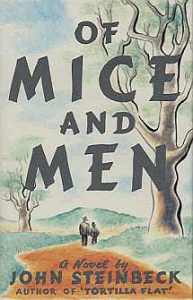
ofmiceandmenTheme is the core of the plot, an idea-thread that runs through your story from the opening pages to the end, binding the elements of characters, conversations, actions, and reactions. Theme is independent of the setting or genre.

Wikipedia, the fount of all knowledge, describes theme as:

The most common contemporary understanding of theme is an idea or point that is central to a story, which can often be summed in a single word (e.g. love, death, betrayal). Typical examples of themes of this type are conflict between the individual and society; coming of age; humans in conflict with technology; nostalgia; and the dangers of unchecked ambition. A theme may be exemplified by the actions, utterances, or thoughts of a character in a novel. An example of this would be the theme loneliness in John Steinbeck‘s Of Mice and Men, wherein many of the characters seem to be lonely. It may differ from the thesis—the text’s or author’s implied worldview.

Often we can visualize a complex theme but we can’t explain it. If we can’t can’t explain it, how do we show it? Consider the theme of “grief.” It is a common emotion that can play out against any backdrop, sci-fi or reality based, where there are humans interacting on an emotional level.

Perhaps you have a story about a woman who has just lost her husband to a preventable accident. Her grief is the main theme. When you learn the accident that killed him was preventable, you know the subtheme: anger. The protagonist’s goal in this story is to prevent such accidents from happening again–perhaps she must battle a corporation or take on a government agency. Rage is the motivator that forces her to wake up each day and take on the Goliaths, but at the root of the story it is her grief that is the driving force behind her subsequent actions.

But the main theme of grief is an extremely complex experience, as anyone who has ever suffered the loss of a loved one will tell you. It is a fundamental emotion, chaotic and weighing heavy in the heart of one who grieves. It is experienced in many identifiable stages with elements of loneliness, anger, guilt, and deep suffering. It is sometimes accompanied by thoughts of suicide.

Everything your character sees and experiences in the opening pages underscores and represents her sense of loss and inspires the accompanying emotions of anger, futility, and depression. As her story progresses and she begins live despite her loss, she will still be affected on many levels and to a certain extent, driven by those complex emotions. While she is interacting with others who are happy and who believe she has gotten past her pain, you can employ allegories and symbolism to paint the deeper picture of her mental state to show how she is deeply depressed and possibly suicidal.

Once your protagonist has beaten the enemy, what is her reaction? Without the battle to sustain her rage, does she learn to accept her loss begin to find happiness? Or does she allow herself to spiral into ever worsening depression?

Perhaps you are writing a tale where a group of people faces terrible challenges in a war. On the surface, this looks like it is all about the action, but in reality, it is not. It is about relationships, the bonds of friendship, and the way the events of this war bind a group of soldiers together and also the way events test those bonds, perhaps breaking them. The theme of this tale is brotherhood: the way fighting a common enemy binds strangers from all walks of life together, creating brothers- and sisters-in-arms.

How do you identify your theme? Sometimes it’s difficult unless you start out with one in mind. Most of my books are based around the hero’s journey, and how the events my protagonists experience shape them. The hero’s journey allows me to employ the theme of good vs. evil and the sub-themes of brotherhood, and love of family.

These concepts are important to me on a personal level, and so they find their way into my writing.

What themes are important to you? When you look for a book, what catches your interest? I am not talking genre here, I am speaking of the deeper story. When you look at it from a distance, what do all the stories you love best have in common?

Political thrillers: Set against the backdrop of a political power struggle. Political corruption, terrorism, and warfare are common themes.

Romance Novel: Two people as they develop romantic love for each other and work to build a relationship. Both the conflict and the climax of the novel are directly related to that core theme of developing a romantic relationship, although the novel can also contain subplots that do not specifically relate to the main characters’ romantic love.

Literary fiction focuses on the protagonist of the narrative, creating introspective. These are in-depth character studies featuring interesting, complex and developed characters. Action and setting are not the primary drivers of the story arc here. Instead, action and setting are carefully developed in such a way they frame the character, and provide a visual perspective. Allegory is a featured motif in many literary fiction novels.

allegoryScience Fiction: realistic speculation about possible future events, based solidly on adequate knowledge of the real world, past and present, and on a thorough understanding of the nature and significance of the scientific method. Science and technology are a dominant theme but based on current reality. Characters are still subject to sub-themes such as morality and love, but setting and science are the main themes.

Fantasy: Often set in alternate Earths, medieval times, or ancient worlds, the common themes are good vs. evil, hero’s journey, coming of age, morality, romantic love. Can also be set in urban settings with paranormal tropes.

On the surface, these types of books look widely different but all have one thing in common–they have protagonists and side-characters. These imaginary people will all have to deal with and react to the underlying theme of the book.

Morality, love, coming of age–these ideas can be found in nearly every book on my shelves or in my Kindle.


Credits:

Wikipedia contributors, “Theme (narrative),” Wikipedia, The Free Encyclopedia, https://en.wikipedia.org/w/index.php?title=Theme_(narrative)&oldid=765573400 (accessed February 22, 2017).

2 Comments

Filed under writing

#amwriting: using allegory to underscore theme

the Matrix PosterGreat novels, like great movies, are built of many layers. Theme is what the story is about on a deeper level than what is seen on the surface. It’s the big meaning, and often it’s a moral. Love, honor, family, redemption, and revenge are all common, underlying themes.

Allegory is an essential tool of the author who wants to convey important ideas with the least amount of words. One of my works-in-progress is a contemporary novel. I need to convey a Gothic atmosphere in this piece and yet maintain the setting and time-frame of a novel set squarely in the  21st century. The way I am doing this is through the use of allegory. With symbolism in mind, I try to approach writing a scene as it would be portrayed in a movie. Each conversation is an event and must advance the story.

Consider this scene from one of my favorite movies of all time, The Matrix. The films of The Matrix trilogy pit man against machine in a clearly drawn battle, but they also reveal that the humans are more machine-like than they think, and that the machines possess human qualities as well. These are the obvious themes, but there are several underlying concepts going at the same time.

The movies in this series are famous for the action, and rightfully so.  But great choreographed martial arts sequences can’t convey the concepts the authors needed to express. The advancement of the plot hinges on dialogue. Dialogue drives the action and connects the fundamental ideas of the story through the intentional use of allegory. The authors never lost the way, because every aspect of that script is steeped in symbolism that directly points to the overall theme(s).

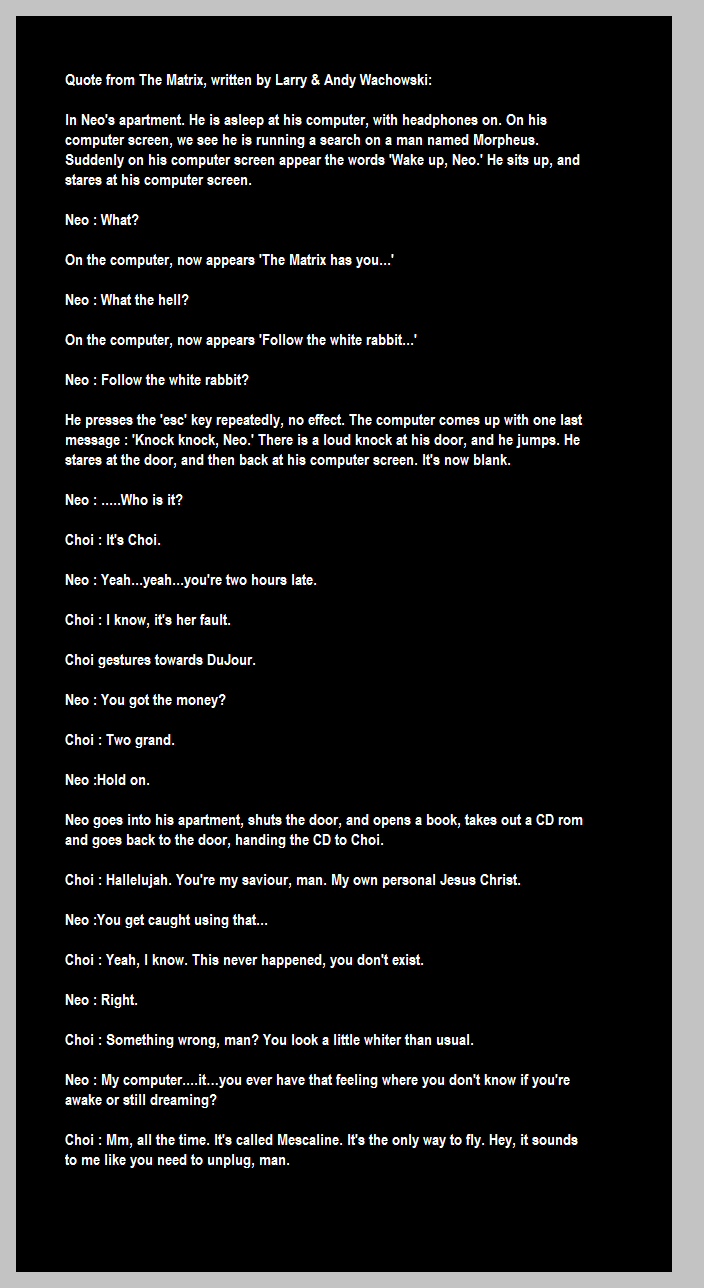
Quotes from the matrix


The conversation concerns a drug deal, but the overarching idea of the blurred line between humans and machines is never lost.

The key words are in the first line, written on Neo’s computer:

  1. The Matrix has you,
  2. the third line,follow the white rabbit,
  3. and in that very last line, telling Neo to unplug.

The obvious plot of The Matrix series of films details a questioning of what reality is and portrays Neo as the potential savior of the world, which has been enslaved by a virtual reality program. Dig slightly deeper, and you see that it is about escaping that program, at which point the audience sees that a larger theme is in play: fate vs. free will.

Even before that larger concept is made clear, the conversations that happen in the course of the film all advance that theme, even the minor interactions, from the first conversation to the last.

The storytelling in The Matrix movies is a brilliant example of employing heavy allegory in both the setting and conversations to drive home the motifs of man, machine, fate, and free will.

The themes are represented with heavy symbolism in the names of the characters, the words used in conversations, and even the androgynous clothes they wear. Everything on the set or mentioned in conversation underscores those themes, including the lighting. Inside The Matrix the world is bathed in a green light, as if through a green-tinted lens. In the real world, the lighting is harsher, unfiltered.

In the movie, everything that appears or is said onscreen is symbolic and supports one of the underlying concepts. When Morpheus later asks Neo to choose between a red pill and a blue pill, he essentially offers the choice between fate and free will.

Neo chooses the red pill—real life—and learns that free will can be unpleasant. Cypher regrets choosing the red pill and ultimately chooses to return to the Matrix.

The creators of the movie even used the lighting as an allegory showing that Neo’s world is filtered through something else: The Matrix.

The arc of the story is driven by

  1. who has the information,
  2. when they learned it, (and when the audience learns it)
  3. what they did on learning that information.

In our own work, if we don’t keep the arc of the story moving toward the final conclusion with each scene, we will lose our reader. To that end, we disseminate information in small increments, with the reader learning what she must know at the same time our protagonist does. Using symbolism and allegory is a way to get the most information out there in the least amount of words, but it requires intention on the part of the author. Words, phrases, and setting must be chosen and the narrative’s prose must be crafted.

Crafted prose does not mean flowery prose. If you reexamine the above excerpt from The Matrix, you see lean dialogue, spare and to the point. It is in the symbolism of the setting, their names, their attire, and the authors’ choice of words that we get the most information. When Neo answers the door and is invited to the party, he at first declines. But then he notices that Du Jour, the woman with Choi, bears a tattoo of a white rabbit. He remembers seeing the words: follow the white rabbit, on his computer. Curious and slightly fearful of what it all means, he changes his mind and goes to the party, setting a sequence of events in motion.

We build the overall arc of the story from scenes, each of which is a small arc, in the same way a gothic cathedral is constructed of many arches that all build toward the top.  The underlying arches strengthen the overall construction. Without arches, the cathedral wouldn’t remain standing for very long.

Theme is a thread that winds through the story and supports the plot. Using allegory and symbolism in the environment to subtly underscore your themes allows you to show more without resorting to info dumps.

Picture conversations, clothing, settings, and wider environments as if they were scenes in a movie, and consider how you can use allegory to support your story arc. When we are immersed in reading it, we don’t notice the heavy symbolism on a conscious level, but on closer examination it is all there, making the imaginary real, solid and concrete.

By using allegory and conversations to create many layers, we can build memorable stories that will stand out in the reader’s mind.

1 Comment

Filed under writing