
I have been prepping for NaNoWriMo 2023, trying to complete the outline so I can hit the ground running on November 1st. As always, I’m mentally committed to writing at least 1,667 (or more) new words every day during that writing rumble.
 By just doing that, I will have 50,000 (or more) words by midnight on November 30th.
Every year, I wonder how I’ll meet this goal. I don’t have a one-size-fits-all answer for that, as authors must be able to pay their bills, or no books will ever be written.
Sometimes, I feel guilty for taking the time to indulge in such a profoundly personal pleasure. It does take time. I tend to resent anything stopping me from having at least one hour of dedicated writing time each day.
But life tosses up roadblocks. We’re retired, and even so, keeping to a regular routine for writing is difficult. One would think we could do whatever we want and to heck with the world’s demands.
But life is not that way. Even people who are retired have obligations that take them away from home. Extra work and other activities that come along with living our lives take up space in our heads as well as the calendar. Finding the energy to be creative is a challenge.
When I was younger, I was a single parent. I had two jobs and children and sang in the choir at our church. I had many demands upon my time, but somehow, I always managed a little time for writing. Admittedly, it wasn’t much.
In those days, I wrote while my children were doing their homework. Sometimes I wrote for half an hour or so at night after they were asleep, pouring my angst into lyrics for songs. This is why my poetry has a more traditional rhyming rhythm. I’m a songwriter at heart, and there is always a melody in my head.
Everyone has a different creative process. What works in December might not work in April. When the tried-and-true fails, give yourself permission to change and find a way that works.
 Be willing to be flexible. Do you work best in short bursts? Or, maybe you’re at your best when you have a long session of privacy and quiet time. Something in the middle, a melding of the two, works best for me.
But what if the way that worked last month no longer works? Varying my projects and writing in bursts broken up by daily activities works best for my schedule nowadays.
We must be open to finding the way that makes us feel productive, whether it works for someone else or not. We feel good when we’re productive.
I have my best ideas when I’m about to leave the house—no joke. If that is you too, do as I do and write those thoughts down. I keep a notebook around just for those moments.
You will be productive once you find your best style.
But first—you must give yourself permission to write.
I have plenty of downtime between my daily tasks. That is when I work on whatever revisions are needed. You would be amazed at what you can get done in ten-minute bursts.
We who wish to write must set aside time to do it. This allows us to be creative and still support our families, who all have activities and interests of their own.
As I have said many times before, being a writer is to be supremely selfish about every aspect of life, including family time.
 A good way to ensure you have that time is to encourage your family members to indulge in their own interests and artistic endeavors. That way, everyone can be creative in their own way during that hour, and they will understand why you value your writing time so much.
A balanced life is a happy one. Don’t become so obsessed with writing about fictional lives that you aren’t present in your own.
- Some people manage to fit short bursts of writing into their daily schedule, writing at work during breaks or at lunch.
- Others must schedule a dedicated block of time for writing, either rising two hours before they depart for work or skipping some TV in the evening.
- Write in small increments—ten minutes here, half an hour there. These short bursts add up.
Perhaps your mind has gone blank. An idea is locked in your head, but you don’t have the words to free it. Step back and view your story from a distance:
- Write several paragraphs detailing what must happen in your story, such as: Next morning, Stan arrives with the recruits. His drama ensues. Ends well, with Neela asking him to walk to the market with her.
Taking a break and doing something completely different is a good thing. When you return to writing, you may have nothing to add to the old project, but something new may be forming.
Write it.
I always have many manuscripts in the works because I come to a point where I begin flailing. I move between each project as I have inspiration for them. Right now, I have a short story, a novella, a novel in the final stage of editing, a novel at the halfway point, and this blog to keep me interested and writing something every day.
I am a slow keyboard jockey, and I can do about 1,100 wonky, misspelled words an hour during NaNoWriMo. Remember, misspelled or not, in NaNoWriMo every word counts and moves you closer to having a completed first draft. The important thing is to get the whole story down from the beginning to the end. Once that is done, you can fiddle with phrasing to your heart’s content.
 Writers and other artists do have to make some sacrifices for their craft. It’s just how things are. But don’t sacrifice your family for it.
If the urge to write is there, get up an hour early to have that quiet time. Or give up something ephemeral and unimportant, like one hour of TV.
I always encourage writers who are falling behind and unsure they can “do” NaNoWriMo to live their lives and write in short bursts during the moments between other things. We should write what we’re inspired to, and find the blessings in each day. If we do that, the words will come.
Happy writing!
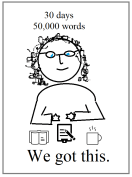 Many authors are prepping for NaNoWriMo 2022. They are mentally committing to writing 1,667 new words every day beginning on November 1st or a total of 50,000 words by midnight on November 30th.
 Until this past June, I wrote best when I had a long stretch of time to just sit down and immerse myself. Then my husband was diagnosed with Parkinson’s, a degenerative neurological disease, and our life underwent a fundamental change. I am now the only driver in the family, and we live in an area without public transportation.
 A good way to ensure you have that time is to encourage your family members to indulge in their own interests and artistic endeavors. That way, everyone has the chance to be creative in their own way during that hour, and they will understand why you value your writing time so much.
 Perhaps your mind has gone blank. An idea is locked in your head, but you don’t have the words to free it. You can still advance your rough draft and meet your word count goal. Step back and view your story from a distance:


 Life in the Realm of Fantasy