Tag Archives: busting through writer’s block

Replenishing the Dry Well of Inspiration #amwriting

Week one of NaNoWriMo (National Novel Writing Month) is now behind us. I’m still zooming along and making good progress. However, this is where many writers will fall by the way. They can’t visualize what to write next and then lose momentum.

WritingCraftSeries_character-arcThe well of inspiration has gone dry.

Getting word count becomes too important for some of us, and we go a bit off the rails. We flail around and end up with bunny trails to nowhere.

There are ways to move the story ahead and still write something worth reading. And the story is what matters. The quest for word count is only a personal goal. National Novel Writing Month is not a race or a contest. It is a time dedicated to the act of writing.

I spent many years working in corporate America and often had my best ideas while at my job. If your employment isn’t a work-from-home job, using the note-taking app on your cellphone to take notes during business hours will be frowned upon. To work around that, I suggest keeping a pocket-sized notebook and pen to write those ideas down as they come to you.

That is an old-school solution that worked for me. The best part is that you don’t appear distracted or off-task.

Ideas come to me when I stop forcing my brain to work when it’s on its last legs. Trust me, pounding out 1,667 new words a day severely tests your creativity and endurance.

Strangely, cleaning and organizing my living space allows my mind to rest. Taking the time to wash dishes or clean the house helps reset my short-circuited creative mind. But getting outside and walking helps even more. I suggest taking a notebook or dictating into your note-taking app.

8ce052b8e7c8182a51dc4999859c1061Arcs of action drive plots. Every reader knows this, and every writer tries to incorporate that knowledge into their work. Unfortunately, when I’m tired, random, disconnected events that have no value will seem like good ideas.

  • But action inserted for shock value can derail what might have been a good plot.

I avoid acting on unplanned stupidity by brainstorming in a separate document and outlining as I go. This method helps me keep the overall logic in mind.

So, where are we in the story arc when the first lull in creativity occurs? At the story’s outset, we find our protagonist and see them in their familiar surroundings. The inciting incident occurs once we have met them, whether they are ready for it or not. At that point, we must take them to the next stumbling block. But what is that hurdle and how do they leap it?

Answering that question isn’t always easy and this is where some writers give up.

I’m writing a fantasy, and I know what must happen next in the novel because it’s an origin story. I’m writing it from a historical view. I know how this tale ends, so I am writing the motivations that lead to that ending.

Sometimes, it helps to write the last chapter first – in other words, start with the ending. That is how my first NaNoWriMo novel in 2010 began. I was able to pound out 68,000 words in 30 days because I had great characters, and I was desperate to uncover how they got to that place in their lives.

Lucky Coffee CupAs you clarify why the protagonist must struggle to achieve their goal, the words will come.

  • How does the protagonist react to pressure from the antagonist?
  • Why does the enemy have the upper hand?
  • How does the struggle affect the relationships between the protagonist and their cohorts/romantic interests?
  • What complications arise from a lack of information?
  • How will the characters acquire that necessary information?

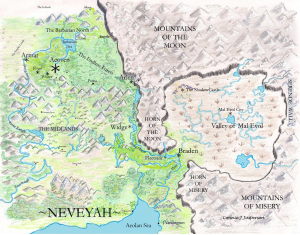
As I write, a broad outline of my intended story arc evolves. I keep my notes in an Excel workbook. It contains maps, calendars, and everything pertaining to any novel set in that world, keeping it in one easy-to-find place.

When logic forces change to the plot (as it always does), I go to my storyboard and update my plot outline, calendar, or maps.

If you are stuck, it sometimes helps to go back to the beginning and consider these questions:

  • What is the goal/objective?
  • Is the objective compelling enough to warrant risking everything to acquire it?
  • What will the protagonist face to challenge their moral values and sense of personal honor? How will this force them to be stronger?
  • Who is the antagonist? What do they want, and what are they willing to do to achieve it? Are they facing ethical quandaries, too?

Every obstacle we throw in the path to happiness for the protagonists and their opposition forces change.  They shape the narrative’s direction and the characters’ personal arcs.

When your creative mind needs a rest, step away from the keyboard and do something else for a while. I find that when I take a break to cook or clean out a corner, ideas for what to do next in my novel will occur to me. These little flashes of inspiration carry me a few chapters further into the story.

Excalibur London_Film_Museum_ via Wikipedia

Excalibur London_Film_Museum_ via Wikipedia

Finally, let’s talk about murder as a way to kickstart your inspiration.

I suggest you don’t resort to suddenly killing off characters just to get your mind working. Readers become angry with authors who casually kill off characters they have grown to like.

When a particular death is planned from the beginning, it is one thing. But developing characters is a lot of work. If you kill off someone with an important role, who or what will you replace them with?

You may need that character later, so plan your deaths accordingly.

Whether you are participating in NaNoWriMo or not, may the words flow freely for you, and may you never run out of new ideas to write.

2 Comments

Filed under writing

#amwriting: sit down and write

This last weekend, I attended the 2017 PNWA Conference. I had the chance to connect with friends whom I rarely get to see in person elsewhere, and met many, many new friends.

I immersed myself into four days of seminars on writing craft, with the intention of kickstarting the rough draft of the one manuscript which has stalled for the last two months.

Let’s be clear—I always have three or four projects in various stages of completion, so I always have one novel in the first, rough draft. Usually, I have no difficulty getting my idea onto the paper but, as I have mentioned before, life sometimes throws us curve balls. When that happens, I have no trouble writing blog posts or making revisions on finished manuscripts as requested by my intrepid beta readers and editor. But it is then that completing whatever story is in the rough draft form becomes a struggle for me.

So, let’s talk about getting past that mysterious thing some people call writer’s block, the horrible nightmare that is only a temporary lull in the creative process. This is when you hear those voices mocking you, “you claim to be a writer but you haven’t written a new word in days.” (Or weeks, or months.)

First, you must understand that this is not a permanent, career killing disability. It is a fleeting, dry period where the project you want to work on is not moving forward. But other writing can and should happen!

My recommendation is to sit down and write your way through it—don’t abuse yourself over whatever project you have that is stalled. Clear your mind of those little mental voices of doom and guilt because they are the carrion birds whose songs of despair lure you along the path to failure.

Focus on writing something completely unrelated instead.

In a seminar I attended this last weekend, taught by the award-winning sci fi/fantasy author and current SFWA president, Cat Rambo, she admitted that rather than beat herself up for a momentary lapse of creativity, she works her way through the rough patches with timed stream-of-consciousness writing sessions. She does this every day and shoots for 2000 new words a day, whether they are good words or not.

The way I interpreted her comments, she does this in the NaNoWriMo style, where you set a timer and write whatever nonsense comes into your head for a certain length of time and do not stop writing for any reason whatsoever until the timer goes off.

Cat’s advice? If all you can do when you sit down for that timed writing session is to write “I can’t think of anything” repeatedly, just write that. She said (and she is right) that after a few minutes of that sort of boredom, your creative mind will rebel, your subconscious mind will take over and push you in new directions. When I do this, I usually end up with some of my best ideas embedded in those long strings of rambling words.

Those nuggets of good writing and ideas are straw I can spin into gold.

My personal advice is to not set absurdly unrealistic goals for your work. Target goals are good, but in my opinion, setting too a high wordcount for new words on your rough draft each day is a good way to set yourself up to fail, as you can’t sustain it. I find that when I am involved in NaNoWriMo, which is a different kind of writing, I can put down 2000 to 4000 words each morning–but that kind of output is not sustainable over more than just the month of November. My usual output is 1000 to 2000 new words per writing session.

Consider setting your minimum goal of writing for at least one fifteen-minute increment per day, working straight with no stopping.  Repeat the fifteen-minute sessions as many times as you like each day, if you are really fired and inspired to write.

I am a fulltime author, but even when I was holding down three part-time jobs, I still managed to write every evening. When my children were still at home, I wrote when they were doing homework, or I wrote after they went to bed. I made my time to write by choosing to only watch the TV shows that meant the most to me and ditching the rest. That meant that most evenings I had at least one hour (but sometimes two or three) of good writing time after dinner was done and the kitchen was clean.

I understand if you are emotionally invested in some TV shows, but you must choose to make time to write—choose your entertainment wisely and don’t waste what could be writing time on shows you don’t absolutely love.

So, what about multiple projects? I find that having multiple projects in the works is good for me, as switching from one to another allows me to rest my writing mind. I am fortunate, in that writing is my full-time career.  Because it is my job, I always have three or four projects going, so I do have a certain, inviolable time of the day that I will work no matter what. On Sundays, I write all the blog posts I might need for that week, both for this blog and for several other websites where I have a regular column.

I need to keep regular office hours to be productive, so the morning hours of 6:00 a.m. to 12:00 p.m. are divided like this:

6:00 to 8:00, I work on adding new words to the current rough draft.

8:00 to 9:00, if I don’t have a writing group to attend, I handle my social media stuff—a nasty but necessary task that is part of the job if you don’t have a personal PR person but hope to connect with both readers and other writers.

I don’t have a PR person.

9:00-10:00, (again if I don’t have a writing group) I take a break from writing and make a stab at cleaning my house.

10:00 – 12:00 I do revisions on other projects as my editors ask for them or I edit for clients.

I always take a break at noon and either take a walk or sit on my back porch and just watch the world go by.

In the afternoon, I make maps or do other support work that may be required for one or another of my projects, depending which is firing my mind most intensely, or if I have a client’s manuscript to edit I will go back to that.

I’m no different than any other writer—I do have times when the well of creativity runs dry. But I have the support of other authors, and I have the mental tools I need to pull me out of those rocky spots. I hope this post offers you some idea of how to jumpstart your creativity, and remember–I am always here to talk you off the ledge.

5 Comments

Filed under writing