
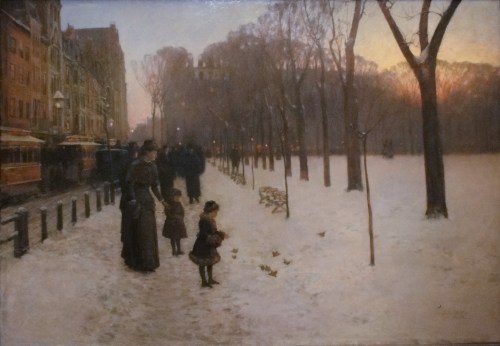
Title: At Dusk (Boston Common at Twilight) by Childe Hassam
Date: between 1885 and 1886
Medium: oil on canvas
Dimensions: height: 42 in (106.6 cm); width: 60 in (152.4 cm)
Collection: Museum of Fine Arts, Boston Massachusetts
What I love about this painting:
Childe Hassam was known for his bold landscapes but by the mid-1880s, Hassam began painting cityscapes. This painting, Boston Common at Twilight was of his first cityscapes.
I particularly like the way he used a dark palette of blacks and browns, colors rarely used with such abandon by strict Impressionists (such as his contemporary, Claude Monet). The dark of the buildings and the clothes of the people are contrasted with many shades of white. The dirty snow trodden on the sidewalk shows us the truth of winter in an urban setting.
The contrasting of darkness against lightness on the land below forces the viewer’s eye upward to the dusky-blue sky and the rosy glow of sunset peeking from behind the trees, to the twilight mist forming in the chill evening air.
Two small girls use these last moments of light to play, perhaps to make snowballs under the eye of their mother or governess.
About the Artist, via Wikipedia:
Frederick Childe Hassam was known to all as “Childe” (pronounced like child), a name taken from an uncle. Hassam was born in the family home on Olney Street on Meeting House Hill in the Dorchester neighborhood of Boston, on October 17, 1859. His father, Frederick Fitch Hassam (1825–1880), was a moderately successful cutlery businessman with a large collection of art and antiques. He descended from a long line of New Englanders. His mother, Rosa Delia Hawthorne (1832–1880), a native of Maine, shared an ancestor with American novelist Nathaniel Hawthorne.
His father claimed descent from a seventeenth-century English immigrant whose name, Horsham, had been corrupted over time to Hassam. With his dark complexion and heavily lidded eyes, many took Childe Hassam to be of Middle Eastern descent—speculation which he enjoyed stoking. In the mid-1880s, he took to painting an Islamic-appearing crescent moon (which eventually degenerated into only a slash) next to his signature, and he adopted the nickname “Muley” (from the Arabic “Mawla”, Lord or Master), invoking Muley Abul Hassan, a fifteenth-century ruler of Granada whose life was fictionalized in Washington Irving‘s novel Tales of the Alhambra.
In 1882, Hassam became a free-lance illustrator (known as a “black-and-white man” in the trade) and established his first studio. He specialized in illustrating children’s stories for magazines such as Harper’s Weekly, Scribner’s Monthly, and The Century. He continued to develop his technique while attending drawing classes at the Lowell Institute and at the Boston Art Club, where he took life painting classes.
Having had relatively little formal art training, Hassam was advised by his friend and fellow Boston Art Club member Edmund H. Garrett to join him on a two-month “study trip” to Europe during the summer of 1883. They traveled throughout the United Kingdom, the Netherlands, France, Italy, Switzerland, and Spain, studying the Old Masters together and creating watercolors of the European countryside. Hassam was particularly impressed with the watercolors of J. M. W. Turner. Sixty-seven of the watercolors that Hassam painted on this trip formed the basis of his second exhibition in 1884. During this period, Hassam taught at the Cowles Art School. He also joined the “Paint and Clay Club”, expanding his contacts in the art community, which included prominent critics and “the readiest and smartest of our younger generation of artists, illustrators, sculptors, and decorators—the nearest thing to Bohemia that Boston can boast.” Friends found him to be energetic, robust, outgoing, and unassuming, capable of self-mockery and considerate acts, but he could be argumentative and wickedly witty against those in the art community who opposed him. Hassam was particularly influenced by the circle of William Morris Hunt, who like the great French landscape painter Jean-Baptiste-Camille Corot, emphasized the Barbizon tradition of working directly from nature. He absorbed their credo that “atmosphere and light are the great things to work for in landscape painting.” [1]
Credits and Attributions:
[Image] Wikimedia Commons contributors, “File:Childe Hassam, ‘Boston Common at Twilight’, 1885–86.jpg,” Wikimedia Commons, the free media repository, https://commons.wikimedia.org/w/index.php?title=File:Childe_Hassam,_%27Boston_Common_at_Twilight%27,_1885%E2%80%9386.jpg&oldid=618750219 (accessed May 26, 2022).
[1] Wikipedia contributors, “Childe Hassam,” Wikipedia, The Free Encyclopedia, https://en.wikipedia.org/w/index.php?title=Childe_Hassam&oldid=1087821182 (accessed May 26, 2022).


 Life in the Realm of Fantasy