
When I am looking for a new book to read, I gravitate to stories of redemption. This is the time of year when I reread A Christmas Carol by Charles Dickens or watch one of the many movie adaptations of it.
 That timeless story was written in 1843 as a serialized novella. It has inspired a landslide of adaptations in both movies and books and remains one of the most beloved tales of redemption in the Western canon.
Charles Dickens was a master of storytelling, deftly employing hooks and heavy foreshadowing. But did you know that one of the most famous and inspirational books in the English language was self-published initially and didn’t do as well as the author intended? (How familiar is that?)
He began to write A Christmas Carol in September 1843, completing the book in six weeks, with the final pages written at the beginning of December.
As I mentioned before, this book is only a novella. It was comprised of 66 handwritten pages. Some people think they aren’t “a real author” if they don’t write a 900-page doorstop. Nonetheless, Dickens’s masterpiece shows us that novellas can offer some of the most enduring stories in modern literature.
Unfortunately, Dickens quarreled with his publisher over the meager earnings of his previous novel, Martin Chuzzlewit. He declined a lump-sum payment and chose a percentage of the profits, hoping to earn more.
Dickens then published A Christmas Carol in book form at his own expense. He had a vision of what he wanted the finished volume to look like, but publishing quality print books was as expensive then as it is now.
Publishing in those days involved printing and binding a book in house. In other words, Publishers owned the printing press and did the binding on their premises. It was a complicated, specialized craft. Some printers turned out better quality books than others, and some were better at selling books than others.
Indie publishing (both print and eBooks) is a breeze for me in today’s world, thanks to the fantastic people at Draft2Digital.
Dickens was unhappy with the appearance of the first edition of the tale. It contained drab, olive-colored endpapers that Dickens disliked.
The publisher, Chapman and Hall, quickly replaced them with yellow endpapers, but those clashed with the title page, which was then redone. The final product was bound in red cloth with gilt-edged pages and was completed only two days before the December 19, 1843 release date.
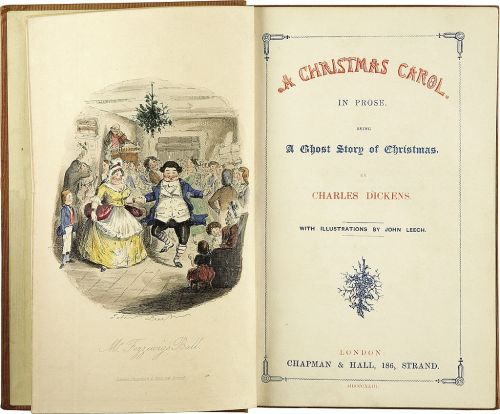 I wish he could have seen how beloved his creation is now, one hundred and eighty years later.
A Christmas Carol remains relevant even in today’s hyper-connected world. It resonates with us because of that deep, underlying call for compassion that resounds through the centuries and is, unfortunately, relevant in any era.
In the past, I have watched every single version of A Christmas Carol that could be found. Alastair Sims, George C. Scott, Patrick Stewart, Mr. Magoo, and Jim Carey occupied the small screen, reminding me of what is really important in life – love and family. Even Mickey Mouse warmed the cockles of my heart in the role of Bob Cratchit.
Dickens shows us that poverty is not a lack of morals. Poverty is a systemic lack of opportunity and the resulting lack of cash.
Olympia is the capital city of Washington State and is in the midst of a homeless crisis. Sometimes, people I know socially (but not well) will sermonize about the lack of morals and laziness embodied by the street people in our town. This shows a lot about who they are as people. Lack of charity is something we believe we conceal. Casual comments on the perceived worthiness of others are a window into who we truly are underneath the mask we wear in public.
If one has ever moved back to live with family or friends because of illness, poor personal choices, or sudden unemployment, they should be a bit more understanding. They had someone to catch them when they fell from grace. Not everyone has family or friends willing to take them in.
And yes, my husband and I walk that talk. We took in my homeless, drug-addicted brother for three monumentally difficult years, but that struggle was worth it. He is clean and sober and back with his wife and living a productive life.
But you don’t need to open your home to someone you can’t endure living with. Donations of food and cash to food banks are needed year-round, not just at this time of the year.
And if you are able and want to do more, I can recommend the following charities as they are on the frontlines working to find solutions rather than applying an annual “band-aid” to the problem.
The Olympia Union Gospel Mission is on the street and working to lift addicts and the mentally ill out of the cycle of unemployment and homelessness. They provide meals, hygiene, and addiction recovery services to the homeless.
Clean Water for the World is an organization that provides simple, adaptable water purification systems to communities without access to potable water.
Heifer International | Ending Poverty and Caring for the Earth – Ending poverty begins with agriculture. Heifer International aims to end hunger and poverty sustainably by supporting and investing alongside local farmers and their communities.
I’ve mentioned before that my husband has Parkinson’s, and that is more than a minor inconvenience. But all that aside, we are happy, well-fed, and comfortable. I am grateful for the blessings we enjoy, and don’t worry about what we can’t change. The Michael J. Fox Foundation for Parkinson’s Research | Parkinson’s Disease (michaeljfox.org) is working tirelessly to fund research into the skyrocketing specter of Parkinson’s disease. The search for the causes and ways to mitigate the symptoms is an ongoing struggle. It’s a worthy charity that we feel a deeply personal connection to.
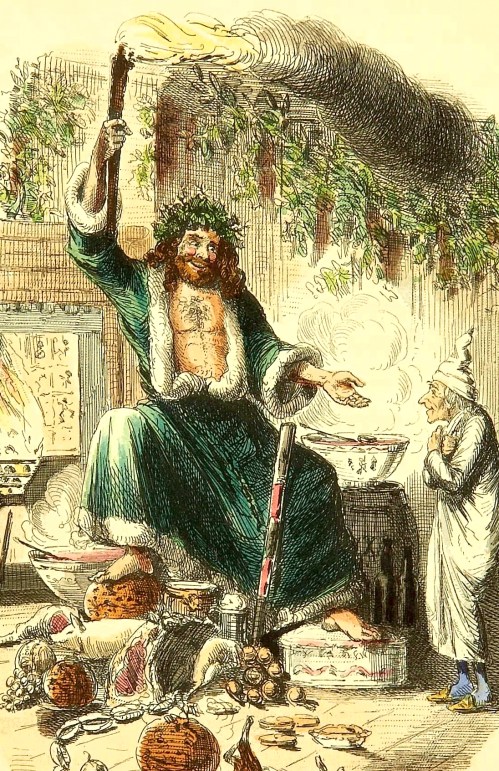 Charles Dickens showed us that charity and generosity to those less fortunate must become a year-round emotion. Our local community is a good place to start.
Maybe you are in a place of comfort and have extra money to share. If so, I encourage you to make donations to your local charities. If you have no extra, donating a few hours of your time is a good way to give thanks for the blessings you enjoy.
Numerous worthy charities abound, and all will benefit your local community in diverse ways. Any gift of time or money helps people you have never met, but who might be your neighbors.
That gives me a warm feeling, as comforting as a cup of cocoa and an evening spent before the TV reliving the redemption of Ebenezer Scrooge.
Credits and Attributions:
Wikimedia Commons contributors, “File:Christmascarol1843 — 040.jpg,” Wikimedia Commons, the free media repository, https://commons.wikimedia.org/w/index.php?title=File:Christmascarol1843_–_040.jpg&oldid=329166198 (accessed December 17, 2023)
A colourised edit of an engraving of Charles Dickens’ “Ghost of Christmas Present” character, by John Leech in 1843. Wikimedia Commons contributors, “File:Ghost of Christmas Present John Leech 1843.jpg,” Wikimedia Commons, the free media repository, https://commons.wikimedia.org/w/index.php?title=File:Ghost_of_Christmas_Present_John_Leech_1843.jpg&oldid=329172654 (accessed December 17, 2023).


 Life in the Realm of Fantasy