
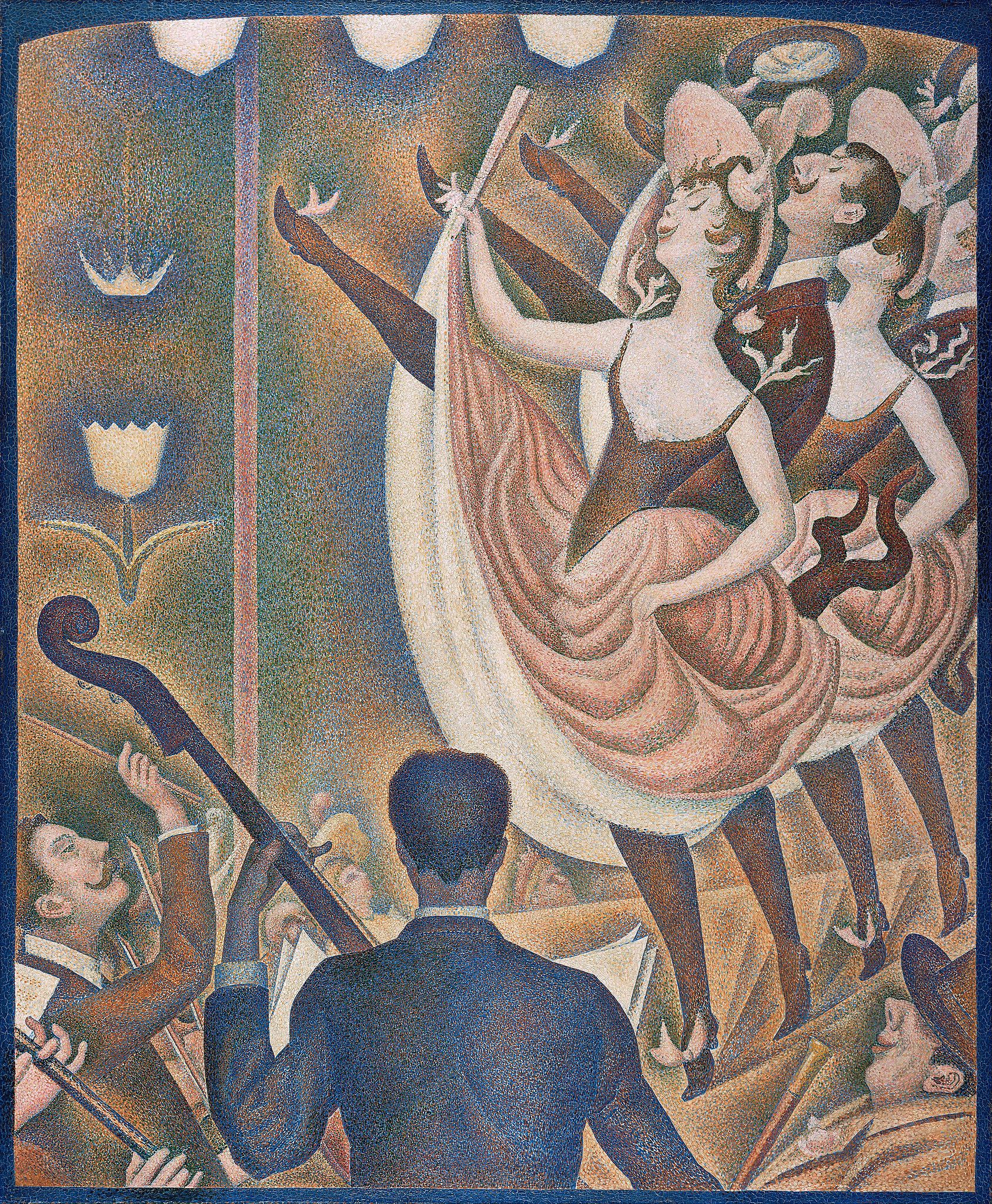
 Artist: Georges Seurat (1859–1891)
Title: Chahut (English: The Can-Can)
Genre: Genre Art
Description: Français : Le Chahut | English: Can-can
Date: 1889
Medium: oil on canvas
Dimensions: 170 × 141 cm (66.93 x 55.51 in)
Collection: Kröller-Müller Museum
Current location: Otterlo
What I love about this painting:
I love everything about Seurat’s work. This painting is full of life—the vibrant, amazing, and unsavory life of dancehalls like the Moulin Rouge in Montmartre. It was a part of Paris the decent people didn’t go. It was a free-wheeling place where the artists and students of the day partied and lived on the edge, pushing the boundaries of sexual morality as far as they were able. An ordinary middle-class woman such as I am would have been out of place here. But she would have secretly enjoyed the hedonism while decrying the lack of public decency–and would have loved the opportunity to indulge in a little moralizing to the younger generation. (Hypocrisy and “do-as-I-say, not-as-I-did” never goes out of style.)
About this painting via Wikipedia:
Le Chahut (English: The Can-can) is a Neo-Impressionist painting by Georges Seurat, dated 1889–90. It was first exhibited at the 1890 Salon de la Société des Artistes Indépendants (titled Chahut, cat. no. 726) in Paris. Chahut became a target of art critics, and was widely discussed among Symbolist critics.
Formerly in the collection of French Symbolist poet and art critic Gustave Kahn, Chahut is located at the Kröller-Müller Museum in Otterlo, Netherlands.
John Rewald writes of both Le Chahut and Le Cirque:
The figures in these paintings are dominated by monotony or joy (there is no sadness in the pictures of Seurat) and are, of course, governed by strict rules, being controlled by that play of line and color whose laws Seurat had studied. In these canvases, Seurat, without yielding in any way to the literary or the picturesque, rehabilitated the subject which had been relinquished by the impressionists. His works are “exemplary specimens of a highly developed decorative art, which sacrifices the anecdote to the arabesque, nomenclature to synthesis, the fugitive to the permanent, and confers on nature—weary at last of its precarious reality—an authentic reality,” wrote Fénéon. [1]
About the artist via Wikipedia:
Georges Pierre Seurat, 2 December 1859 – 29 March 1891) was a French post-Impressionist artist. He devised the painting techniques known as chromoluminarism and pointillism and used conté crayon for drawings on paper with a rough surface.
Seurat’s artistic personality combined qualities that are usually thought of as opposed and incompatible: on the one hand, his extreme and delicate sensibility, on the other, a passion for logical abstraction and an almost mathematical precision of mind. His large-scale work A Sunday Afternoon on the Island of La Grande Jatte (1884–1886) altered the direction of modern art by initiating Neo-Impressionism, and is one of the icons of late 19th-century painting.
Seurat took to heart the colour theorists’ notion of a scientific approach to painting. He believed that a painter could use colour to create harmony and emotion in art in the same way that a musician uses counterpoint and variation to create harmony in music. He theorized that the scientific application of colour was like any other natural law, and he was driven to prove this conjecture. He thought that the knowledge of perception and optical laws could be used to create a new language of art based on its own set of heuristics and he set out to show this language using lines, colour intensity and colour schema. Seurat called this language Chromoluminarism.
In a letter to the writer Maurice Beaubourg in 1890 he wrote: “Art is Harmony. Harmony is the analogy of the contrary and of similar elements of tone, of colour and of line. In tone, lighter against darker. In colour, the complementary, red-green, orange-blue, yellow-violet. In line, those that form a right-angle. The frame is in a harmony that opposes those of the tones, colours and lines of the picture, these aspects are considered according to their dominance and under the influence of light, in gay, calm or sad combinations.”
Seurat died in Paris in his parents’ home on 29 March 1891 at the age of 31. The cause of his death is uncertain and has been variously attributed to a form of meningitis, pneumonia, infectious angina, and diphtheria. His son died two weeks later from the same disease. His last ambitious work, The Circus, was left unfinished at the time of his death. [2]
Credits and Attributions:
[1] Wikipedia contributors, “Le Chahut,” Wikipedia, The Free Encyclopedia, https://en.wikipedia.org/w/index.php?title=Le_Chahut&oldid=1177459932 (accessed August 1, 2024).
[2] Wikipedia contributors, “Georges Seurat,” Wikipedia, The Free Encyclopedia, https://en.wikipedia.org/w/index.php?title=Georges_Seurat&oldid=1231112655 (accessed August 1, 2024).
IMAGE: Wikipedia contributors, “Le Chahut,” Wikipedia, The Free Encyclopedia, https://en.wikipedia.org/w/index.php?title=Le_Chahut&oldid=1177459932 (accessed August 1, 2024).


 Life in the Realm of Fantasy