
This last weekend, we went to a family party, a fun, noisy gathering typical of how we roll. Three of our children were there with their children and all the in-laws and outlaws. The food was fabulous, of course.
 The best thing about this weekend was seeing the grandchildren behaving like their parents did at their ages. We loved hearing their parents shouting the same gentle admonishments we offered when they were children: “Hey you! Stay in the yard!” and the ever popular “Get your hand away from that cake!” followed by, “Oh God! Here, let me wipe your face.”
I had the distinctly uncomfortable experience of driving in an unfamiliar area and trying to obey the law while following the verbal directions of the GPS—an epic fail. Fortunately, my husband is the soul of patience. Greg says soothing things like, “Don’t worry. They’ll calm down,” and “I think that was where we were supposed to turn.”
And the GPS lady, tranquil and unflustered no matter what the half-crazed woman at the wheel does, says, “Route recalculating ….”
 So now we’re home and nobody died. Once again, I am preparing a short story for submission to an anthology. I think it fits the theme, but whether or not the editor will agree is another question. I know it is correctly formatted because I read and followed the submission guidelines.
Each publisher, magazine, or contest website will have a ” Submission Guidelines ” page or section.” That page contains the rules specific to that particular publication or contest:
- length of submissions in word count, (Do not exceed or fudge this.)
- how they want you to format your work for their best use,
- where to submit the work,
- what date submissions close,
- if it is a contest, fees will be listed there.
I try to have a backlog of short fiction on hand for submission. It saves time if I have submission-ready work, as it will require minimal adjustment to fit various requirements.
 Most publishers use what is considered the industry standard, Shunn Manuscript Format. William Shunn didn’t invent it but made this knowledge available to all would-be authors via the Internet.
Use a 12-point font, which prints out at a pitch of ten characters per inch. This is critical knowledge because the font that the publisher’s guidelines require is the only one that will make it past the first editor’s inbox.
The preferred font will be clearly stated in their submission guidelines.
IF YOU INTEND TO FORMAT YOUR MS FOR HARD-COPY SUBMISSION TO AN OLD-SCHOOL PUBLISHER:
- Set the margins for your document at 3cm (1 inch) on all four sides.
- Align to the left side only; the right side should remain jagged. (THIS IS CRITICAL)
- Use a twelve-point font in black type only. Courier, Times New Roman, or Arial fonts may be specified, so check the magazine or anthology submission guidelines.
- Lines should be double-spaced with no extra spaces between paragraphs. (THIS IS CRITICAL)
- Single space between sentences after periods. (This is also critical)
- Indent new paragraphs and each new section of dialogue.
- Indicate scene breaks by inserting a blank line and centering the hash sign (#) in the center of that line.
- Center a hash sign # one double-spaced blank line down at the end of the manuscript. Or, simply write The End. This assures the editor that no pages are accidentally missing.
- Use underline for italicized words if you are using Courier font. If you are using Times New Roman, you can use proper italics. (Again, check the submission guidelines)
The header goes in the upper-right corner of every page of your manuscript except the first.
Your first page should include:
- The name of the work.
- The approximate word count, some will want it only to the nearest hundred.
- In the upper left, your contact details are formatted in the same font and size as the manuscript font.
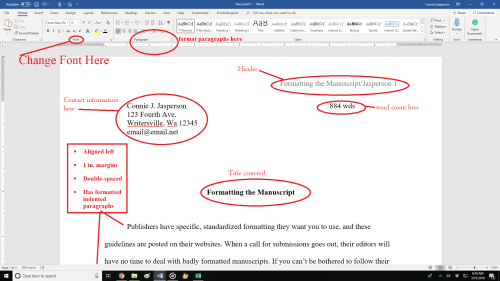 MANY contests and e-magazines want your manuscript formatted similarly but may require a different font. Some want the header on all pages, and others want your full author name in the header.
I use MS Word, but other word-processing programs are similar. To format your header in MS WORD:
- Go to the Insert Tab and click on: page numbers > top of page.
- From the drop-down menu, select > plain number three (the upper right-hand corner).
- Type your name and the title just before the number.
- Click on the body of your document, and the header/page number is set. It will appear to gray out.
To Format your manuscript so the page numbers start on page two: click on this link to go to the MS Word Learning and Help Center if you are using MS Word. The process is a little more involved, and I didn’t want to fill this post up with that, so use the resource your word-processing software manufacturer offers. That’s the way I learned to use this program.
 Be aware that ALL contests and magazines will want original work that has never been published.
Most anthologies will also want original, never-before-published work. The exception to this is if the collection is a promotional anthology showcasing stories the publisher printed the previous year. Often these collections are the editors’ favorites.
Most contracts will state that you can reuse or republish the work 3 months or 90 days after the date of their publication. Don’t accept any contract that doesn’t allow you to regain the rights to your own work at some point.
When you do republish the work, you must include a caveat on the copyright page stating that it was originally published in their anthology or magazine and what issue/year it appeared.
 At some point this year, I plan to publish a compilation of short stories. I love reading anthologies and short story compilations. Some of the best work I’ve read has been in short story form.
I hope you have been writing short stories or flash fiction. They are fun to write and are easier to sell than novels. It’s a happy day when my work resonates with the right editor, and I get that email of acceptance.


 Life in the Realm of Fantasy