Tag Archives: how to query an agent or editor

Cover Letters and Queries #amwriting

Every author who wants to sell their work will find themselves crafting a query or cover letter at some point in their career. This is frequently a requirement for submission to a magazine or contest.

MyWritingLife2021BSome authors despise that process so much that they go indie, thinking they won’t have to leap that hurdle. But there is no escaping it.

The difference between queries and cover letters is this: while both are letters of introduction, cover letters assume the editor will read the attached work. Editors ask for them when they have open calls for short stories.

Queries are letters requesting permission to submit unsolicited work to an agent or publisher. They have not requested it, so don’t assume the attached synopsis and first chapter will be read—your query must convince the editor to look at your work.

money_computer_via_microsoftWriting these kinds of personal introductions is a pain—but only because we don’t know what is expected or what we should include.

I’ve attended several seminars on queries and cover letters. While I no longer query agents, I have written many cover letters. Submissions to anthologies, contests, and magazines all require cover letters.

The best place I have found with a simple description of what your query letter should look like is at the NY Book Editors website.

Boiled down, what they tell you is this:

  1. If you are mailing it or submitting a cover/query letter as a separate document, be formal:
  • Your address goes to the right and should be justified.
  • The agent’s address goes to the left.

how to head a formal letter screen shot

In an email, you don’t do step one. However, you DO make sure your contact information is in your signature.

  1. Be personal and polite. Greet and acknowledge the agent or editor by name:
  • Dear Ms. Stuart

The body: This is important – the body of your query letter should not exceed three to five paragraphs. The 1st paragraph is where you introduce yourself. Perhaps you met at a convention or seminar or are a fan of one of the authors they represent. If you have a connection with the agent or editor you are approaching, mention it but be brief.

If you have no previous connection, NY Editors suggest you get down to business right away with your attempt to sell your short story or book. Their point of view on this is that you only have a few paragraphs to sell your work, so make those words count.

The 3 most important things to include in the 1st paragraph are:

  1. Title of the story (or novel)
  2. Genre
  3. Word count

The 2nd and possibly 3rd paragraphs must briefly describe the work. Showcase the plot and tell them why you believe it fits their publication. Make it as brief as possible—do NOT write a 3,000-word synopsis.

ALL prospective publishers, whether for magazines or larger houses, want the hook and the essence of that short story/novel in these paragraphs. They want to get a feel for who you are as an author.

Shkespere bio memePlease do NOT give it the hard sell. The www.NYBookEditors.com website says: “You must walk a very fine line between selling your manuscript without coming across like the parent who knows his kid is the best player on the bench.”

In the final paragraph, you post a short (as in BRIEF) bio of yourself. Mention your published works and whatever awards you have acquired. If samples of your work are available on your website, say so.

The submission guidelines will differ when submitting queries to anthologies or magazines. They are widely different, and their editors seek specific kinds of work. However, the basic cover or query letter will be the same.

Magazines: Most magazines are available online nowadays rather than in print, and they usually want electronic submissions. Many publishers use Submittable, a service offered by a submissions manager software that makes the process simpler for both authors and editors. If they want their submissions sent via email, the body of the email is your cover letter.

desk_via_microsoft_stickersLarge Publishing Houses: Large traditional publishers want agented submissions only. On the rare occasions they open the doors to unagented authors, their editors expect a 1-page, 300-word description of your novel. This is the query letter, as described above. Your manuscript is not attached to this—if they like what they see in the query, they will look at the synopsis and possibly ask for the first chapter.

Every magazine, publisher, editor, or agent has a website detailing how they want things submitted. In general, the larger publishers and agents want to receive letters and/or emails formatted to the rules posted on their websites.  You must read and follow those guidelines carefully.

I have mentioned the word “brief” numerous times in this post—and hopefully, you see why. Choose your words carefully so that your brief paragraphs showcase you and your work in the best way possible.

Most importantly, don’t forget to double-check your letter for typos and spelling errors. We all make them and don’t want them to be our legacy.

A sample email cover letter might read:

Dear Ms. Editor,

My name is Connie Jasperson. I was introduced to you at the 2022 PNWA conference during the book signing event. I hope my story, A Cold and Dangerous Place, might fit the theme of your proposed anthology.

A Cold and Dangerous Place is a quest tale about forgiveness and human frailty, with some elements of high fantasy. It has a strong female protagonist and is 3,500 words in length. It has never before been published. I have attached the manuscript as a Word document in Vonda McIntyre’s manuscript format, as specified in the submission rules.

I live and write in the Olympia area of Washington State and am active in several writing groups. I am a founding member of Myrddin Publishing Group, an indie cooperative, and have independently published nine novels. My short stories have appeared in several anthologies. One of my stories was included in the 2019 anthology Swords, Sorcery and Self-Rescuing Damsels, featuring stories by authors such as Jody Lynn Nye and Katie Cross.

Thank you for your consideration,

Connie J. Jasperson

123 Writer Rd. SE.

Buymybook, WA 01234

c.jasperson@writer.com (email)

123-456-7890 (phone)

The body of any cover or query letter will be laid out in the same fashion. Title, word count, and genre are important. Agents and editors want to know that you offer the kind of work they specialize in.

icream_via_microsoft_stickersSometimes my queries get good results, and sometimes not. I’ve said this before, but query letters are like ice cream. Everyone likes certain flavors and must be pushed to try new ones.

You can only cross your fingers and hope your manuscript and letter arrive on a day when the editor or agent in question is in the mood for a story exactly like what you are selling.

Rejection only means that editor isn’t the right one. Keep trying.
14 Comments

Filed under writing

Cover and Query Letters #amwriting

Just as in any other profession,  authors,  whether indie or traditionally published, must sometimes craft either a cover letter or a query letter. In business, that cover letter may go with our resume, but for authors, we must write one each time we submit work to a contest, anthology, or literary publication.

For many, avoiding having to do that is one of the reasons they went indie in the first place. However, if you write short stories and submit them, you must also write cover letters, which are a form of the query letter.

But what goes into a cover letter?

For authors, cover letters are our resume, which makes writing them quite tricky. They are one page documents, usually in the body of an email. Sometimes, if the publication uses Submittable, you can copy and paste your cover letter into a template. They may ask for it to be page one of your submission, or they may want it uploaded on a separate word document.

A cover letter:

  1. Introduces you to the editor of the contest, anthology, or literary publication.
  2. Mentions how you came across their publication.
  3. Explains why you think your story is a good fit for their needs (include title, genre, and word count).
  4. Gives a short bio of you and a quick rundown of your publishing history.

The cover letter should be kept brief.

Dear Ms. French,

My name is Author J. Mayhem. I heard about your magazine via a post in a Literary Writers group and saw you were still accepting submissions. I picked up and read the last issue and judging from the kind of work I saw published there, I think my story, Eternity’s Gate, might be a good fit for you.

I live and write in the Olympia area of Washington State, and am active in several writing groups. I have independently published nine novels. My short stories have appeared in several anthologies and other publications, listed in my bio. Eternity’s Gate, has never before been published, but was selected out of over a thousand entries as the winner of the 2018 North Pacific Writers’ Conference ‘Stars of Excellence’ short story contest award. 

I have attached the manuscript as a word document in William Shunn’s manuscript format as specified in the submission rules, and also as specified, I have attached my full bio as a word document.

Thank you for your consideration,

Author J. Mayhem

The query letter is similar but different and more detailed. Most editors and publishers want a one page, 300-word description of your novel. They want the hook and the essence of that novel, and they want to get a feel for who you are. Both aspects of this 1-page extravaganza must intrigue them.

Every editor or agent has a website detailing the way they want queries submitted. In general, they want letters/emails that follow a certain pattern, and that basic format is readily available via the internet.

The www.NYBookEditors.com website has this to say about query letters: “You must walk a very fine line between selling your manuscript without coming across like the parent who knows his kid is the best player on the bench.”

That, my friends, is more complicated than it sounds. I’ve attended several seminars on the subject and written many of them. I’ve had good results and also bad results with mine. The best place I have found with a simple description of what your query letter should look like is at the NY Book Editors website.

In essence, what they tell you is this:

  1. If the letter is a hard copy, format your letter this way:
  • Your address at the top of the page, right justified.
  • The agent’s address, this time left justified.
  1. If the letter is an email or a hard copy, continue from here:
  • Use a personalized greeting where you acknowledge the agent or editor by name.
  • Keep the body of your query letter to three to five paragraphs.

The 1st paragraph is where you introduce yourself. If you have a connection with the agent or editor you are approaching (perhaps you met at a convention or seminar, or you are a fan of one the authors they represent) mention that. Briefly.

Dear Ms. Jones,

I met you at the 2017 PNWA convention during the author meet-and-greet party. I attended the pitch fest, and after seeing the sort of work you were interested in, I think my novel might be a good fit for your list.

If you have no previous connection, NY Editors suggest you get down to business right away with your attempt to sell your book. Their point of view on this is that you only have a few paragraphs in which to make that sale, so every word must count.

I am currently seeking representation for my 70,000 word, contemporary fiction novel, Baron’s Hollow.

The three most important things to include in that paragraph are:

  1. Title
  2. Genre
  3. Word count

The next paragraph must give a brief description of the work—highlight the plot to show why you think it is a good fit for this agent/editor. Do this in one paragraph, and don’t give it the hard sell.

Five people, two women and three men, each with a secret, rent a house on a secluded Washington coast beach for the summer. The high-profile, wealthy group is comprised of three authors, a musician, and an artist. My protagonist, Isobel, has a deadline for her work, as do the others, so the vacation is intended as a working retreat. Isobel’s marriage is crumbling, and she is worried about her stepsister’s opioid addiction. The revelation of her stepsister’s unplanned pregnancy and her refusal to name the father pushes my protagonist to the breaking point and another character to attempted murder. With the notorious Washington weather keeping them indoors, tensions run high. Privilege and power may not be enough to save their careers when a suicide attempt goes awry.

The final paragraph should be a quick bio of you, your published works, and whatever awards you have acquired. If a full biography and samples of your work are available on your website, say so.

This is most important: don’t forget to double-check your letter for typos and spelling errors. We all make them, and we don’t want them to be our legacy.

Any time you send out a query letter or submit a story with a cover letter, you just have to cross your fingers and trust you have done your best. All we can do is hope our story hits their desk on a day when the person in question is in the mood for a story exactly like what we’re selling.


Credits and Attributions:

How to Write a Darn Good Query Letter,  © 2015 NY Book Editors, https://nybookeditors.com/2015/12/how-to-write-a-darn-good-query-letter/ (accessed August 16, 2016)

Underwood Standard Typewriter, PD|75 yrs image first published in the 1st (1876–1899), 2nd (1904–1926) or 3rd (1923–1937) edition of Nordisk familjebok.

IBM Selectric, By Oliver Kurmis [CC BY 2.5 (https://creativecommons.org/licenses/by/2.5)%5D, from Wikimedia Commons

10 Comments

Filed under writing

#amwriting: The Query Letter

My Writing LifeEvery author, indie or traditionally published, comes to a point in their career where they must craft a query letter. For many, avoiding having to do that is one of the reasons they went indie in the first place.
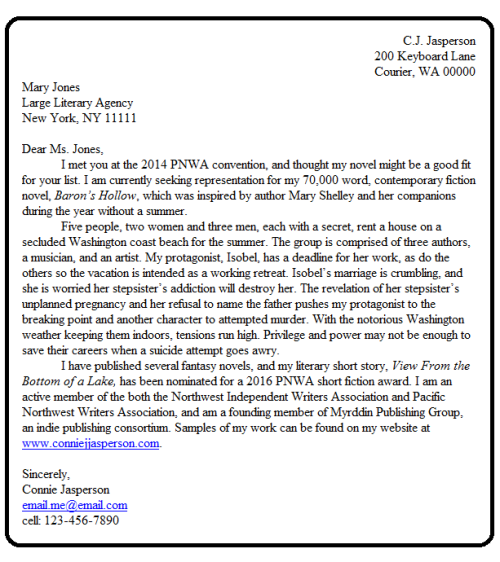
Most editors and publishers want a 1 page, 300-word description of your novel. They want the hook and the essence of that novel in 2 paragraphs, and they want to get a feel for who you are. Both aspects of this 1-page extravaganza must intrigue them. Every editor and agent has a website detailing the way they want queries submitted. In general, they want letters/emails that follow a certain pattern, and that basic format is readily available via the internet.

The www.NYBookEditors.com website has this to say about query letters: “You must walk a very fine line between selling your manuscript without coming across like the parent who knows his kid is the best player on the bench.”

That, my friends, is more complicated than it sounds. Of course, we are firm believers that what we wrote IS the best player on the bench. I’ve always known that about my children and my books!

Anyway, back to the query letter. I’ve attended several seminars on the subject and written many of them. I’ve had good results and also bad results with mine. The best place I have found with a simple description of what your query letter should look like is at the NY Book Editors website.

In essence, what they tell you is this:

  1. Format your letter this way:
  • Your address at the top of the page, right justified.
  • The agent’s address, this time left justified.
  1. Use a personalized greeting where you acknowledge the agent or editor by name.
  2. Keep the body of your query letter to three to five paragraphs.

The 1st paragraph is where you introduce yourself. If you have a connection with the agent or editor you are approaching, say you met at a convention or seminar, or you are a fan of one the authors they represent, mention that. Briefly.

If you have no previous connection, NY Editors suggest you get down to business right away with your attempt to sell your book. Their point of view on this is that you only have a few paragraphs to sell your book, so make those words count.

In the 1st paragraph are the 3 most important things to include:

  1. Title
  2. Genre
  3. Word count

The 2nd paragraph must give a brief description of the work—showcase the plot, and show why you think it is a good fit for this agent/editor. Do this in one paragraph, and don’t give it the hard sell.

The 3rd paragraph should be a quick bio of you, your published works, and whatever awards you have acquired. If samples of your work are available on your website, say so.

This is most important: don’t forget to double-check your letter for typos and spelling errors. We all make them and we don’t want them to be our legacy.

As I have said, my luck with queries has been uneven. I think query letters are like ice cream—you just have to cross your fingers and hope your query arrives on a day when the person in question is in the mood for a story exactly like what you are selling.

Query letter image

2 Comments

Filed under Publishing, writing