
Last week, we discussed the query and cover letter, so today, we’re talking about the other thing we dread: the synopsis. A synopsis is a short summary, and in this case, it summarizes the content of your story or book.
 Indies occasionally have to write a synopsis if they submit their longer work to contests, agents, or publishers. When a literary contest or publisher asks for a synopsis, they don’t want a book blurb, which is a “this is why you should buy my book” teaser.
They do want a short description filled with all the spoilers so that the work goes to the right editor or (in the case of a contest) reader.
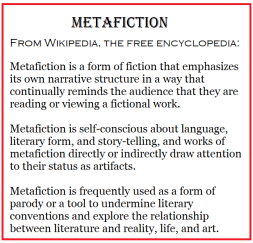
You want an editor or reader who reads metafiction if that is what you are submitting. The synopsis lets them know you understand what kind of work they’re seeking.
Most submissions these days are electronic. I know I say this far too often, but properly naming your files is crucial to a happy work life. You want your submission to be easily found in an editor’s files.
 Don’t label your synopsis file with a generic name like “synopsis.docx.” Be specific and include the book title in the label:
- Don_Quixote_synopsis.docx
Underscores are used in place of spaces in file names because some operating systems don’t recognize spaces. But most operating systems recognize the underscore as a space. You never know if your intended recipient is using a Mac, a PC, or a Linux machine, and you want them to be able to open your files.
The requested length of a synopsis can vary—some agents and editors will want a shorter synopsis, so check their website for the guidelines. For an average novel of less than 100,000 words, 500 to 800 words is a good length for the summary and won’t scare your intended editor/publisher.
No one likes being faced with an endless wall of words.
- All that is usually required to summarize a short story is a paragraph or two in the cover letter.
You might wonder why agents and editors want a synopsis when they can have the whole manuscript? They receive a mountain of submissions daily and must find the time to look at everything that lands in their inbox.
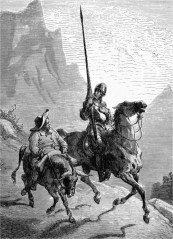
Don Quixote and Sancho Panza, Gustave Dore PD|100
If they like the cover letter, they will turn to the synopsis. Once you’re past that hurdle, if the characters intrigue them and they like how the plot evolves, they will look at the first chapter or two. After that, they might ask for the entire manuscript.
Your synopsis is not intended to entertain the editor, but you want your voice to interest them. It is meant to briefly recount the who, what, where, when, and why of your entire novel, but it must sound like you.
What do we include in our synopsis if we must boil a novel down to 500 – 800 words? (Which is only around two pages.) This is the most difficult aspect of my life as a writer, and frankly, I stink at it.
I can easily summarize my friends’ novels, but my own? It’s like trying to summarize your child to the new teacher who will be in charge of them for the next year. The quirks and backstory get in the way of an impartial discussion.
The Jericho Writers website tells us to summarize your novel, include all the twists, and don’t give it the hard sell. Start at the beginning and hit the high points of the plot all the way to the end.
Try to make it interesting and still keep it within the word count.
In this, as in most things, the internet is your friend. For a great article with an excellent example of a synopsis, a good template, and many more details on how to write a synopsis, go to https://jerichowriters.com/synopsis/.
The following synopsis is of a book published in 1605, which is 1,072 pages long. A book of this length would require a 2,000-word synopsis to cover the high points.
400-word Synopsis of the first 10 chapters of The Ingenious Gentleman Don Quixote of La Mancha by Miguel de Cervantes
Don Quixote is a metafictional account of the mid-life crisis and adventures of a nobleman (hidalgo) from La Mancha named Alonso Quixano. The first chapters are taken from “the archives of La Mancha,” and the rest is translated from an Arabic text by the Moorish author Cide Hamete Benengeli.
Nearing 50 years of age and living in an unnamed section of La Mancha with his niece and housekeeper, Quixano is usually a rational man. He is obsessed with reading tales of chivalry and knights-errant. However, by not sleeping adequately because he was reading, Quixano is easily given to anger. He believes every word of his fictional books of chivalry to be true.
While he is asleep in his bed, his niece, the housekeeper, the parish curate, and the local barber burn most of his chivalric and other books. The priest must decide which books are bad for morality, so he can know them well enough to describe every naughty scene.
After the books are burned, the niece and priest seal up the room which contained the library, later telling Quixano that it was the action of a wizard.
The loss of his books causes him to lose his mind. Quixano decides to become a knight-errant. He will revive chivalry and serve his nation, under the name Don Quixote de la Mancha.
After a short period of feigning health, Don Quixote requests his neighbor, Sancho Panza, to be his squire, promising him a governorship. Sancho is a poor and simple farmer but is far more practical than Don Quixote. He agrees to the offer, sneaking away with Don Quixote in the early dawn.
They begin their quest to revive chivalry, starting with Don Quixote’s attack on windmills that he believes to be ferocious giants.
The two next encounter two Benedictine friars traveling on the road ahead of a lady in a carriage. The friars are not traveling with the lady but happen to be on the same road. Don Quixote believes the friars are enchanters who hold the lady captive. He knocks a friar from his horse and is challenged by an armed Basque traveling with the company.
As he has no shield, the Basque uses a pillow from the carriage to protect himself, which saves him when Don Quixote strikes him. The combat ends with the lady leaving her carriage and commanding those traveling with her to “surrender” to Don Quixote. [1]
 I recommend you go to the Jericho Writers site and follow their guidelines if asked for a synopsis. The article there is one of the most comprehensive and useful ones I’ve read anywhere. Again, that article can be found at https://jerichowriters.com/synopsis/.
Once you have written your cover letter and synopsis, attach them to the email or submissions website with whatever else the contest or publisher asks for—the first two chapters, possibly the first twenty pages, etc.
This is where luck comes into the equation. We can only hope the submission is opened on the day and moment when the editor is looking for a story exactly like the one we have submitted.
CREDITS AND ATTRIBUTIONS:
[1] 400-word Synopsis of the first 10 chapters of The Ingenious Gentleman Don Quixote of La Mancha by Miguel de Cervantes, condensed from Wikipedia. Wikipedia contributors, “Don Quixote,” Wikipedia, The Free Encyclopedia, https://en.wikipedia.org/w/index.php?title=Don_Quixote&oldid=943081150 (accessed 1 Aug 2023).
Don Quijote de La Mancha and Sancho Panza, 1863, Gustave Doré [Public domain], via Wikimedia Commons.
Don Quixote in the Library, by Adolf Schrödter, 1834 PD|100, via Wikimedia Commons.


 Life in the Realm of Fantasy