Tag Archives: How to write thoughts without italics

Emotional show and tell #writing

The books I love are written with bold words crafted into evocative prose. The way the words are shaped into sentences and paragraphs engages me. But the words are only there to illuminate the emotional lives and actions of the characters.

The prose makes the story real and immediate to me. In the best stories, the characters have depth and are memorable because both the antagonist and protagonist are powerful but not omnipotent. They have character arcs that change and grow as the story progresses.
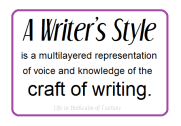
a writer's style Characters aren’t fully formed when you first lay pen to paper. They evolve as you go, growing out of the experiences you write for them. Sometimes, these changes take the story in an entirely different direction than was planned, which involves a great deal of rewriting. It helps me remain consistent if I note those changes on my outline because then I don’t forget them.

I like stories featuring characters who are sometimes hasty, sometimes wrong-headed. They make mistakes and cause themselves more trouble because they’re inexperienced and don’t know what they’re doing.

As the story falls from our imagination, each character’s personal arc is shaped by the events they experience within the story arc.

How do they handle setbacks? How do they handle success? How do they see their future when we meet them on page one? Has their view of the future changed by the time we arrive at the final page?

If the characters are changed by the events they experience, the reader will be, too. Our characters’ emotional state is critical because emotions engage readers. We want our readers to experience the crisis, so we must craft that scene carefully.

emotion-thesaurus-et-alI highly recommend the Writers Helping Writers Series of textbooks written by Angela Ackerman and Becca Puglisi. They are a wonderful resource for when you need ideas for showing a variety of emotions rather than telling them.

We want a balanced narrative, one where the telling and showing are seamlessly woven together.

The tricky part of this is in the execution, in knowing what to tell and what to show. When someone is happy, what do you see? Bright eyes, laughter, and smiles. When you are happy, how do you feel? Energized, confident. Show those feelings briefly and move on. Don’t swamp us with detailed shoulder sagging, lips twisting, and face drooping all in one sentence.

So now, we need to combine the surface of the emotion (physical) with the deeper aspect of the emotion (internal). Not only that, but we want to write it so that we aren’t telling the reader what to feel. We are still in the inferential layer of the story. Our job is to make the reader experience that emotion.

A short list of simple, commonly used, easy-to-describe surface emotions:

  • Admiration
  • Affection
  • Anger
  • Anticipation
  • Awe
  • Confidence
  • Contempt
  • Denial
  • Desire
  • Desperation
  • Determination
  • Disappointment
  • Disbelief
  • Disgust
  • Elation
  • Embarrassment
  • Fear
  • Friendship
  • Grief
  • Happiness
  • Hate
  • Interest
  • Love
  • Lust
  • Pride
  • Revulsion
  • Sadness
  • Shock
  • Surprise

Other emotions are complex and challenging to show. They are complicated and deeply personal. These are the gut-wrenching emotions that make our work speak to the reader.

So, here is an even shorter list of rarely well-described, difficult-to-articulate, complex emotions:

  • Anguish
  • Anxiety
  • Defeat
  • Defensiveness
  • Depression
  • Indecision
  • Jealousy
  • Ethical Quandary
  • Inadequacy
  • Powerlessness
  • Regret
  • Resistance
  • Temptation
  • Trust
  • Unease
  • Weakness

Complex emotions are often best when shown by an immediate physical reaction combined with internal dialogue or conversations. Conversations are opportunities to show depth as well as convey information. This pertains to the internal monologues of your characters, too.

We have mental conversations with ourselves in real life. Sometimes, we even speak our thoughts aloud, convincing the neighbors that we’re crazy.

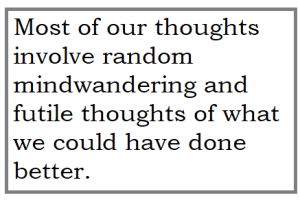
Researchers say that most of the time, our inner monologue is about how we see ourselves. These thoughts are often in whole sentences and phrased negatively. And most telling of all, we aren’t usually aware of our inner thoughts when we have them.

However, an interior monologue is a good tool for revealing motives. What our characters think but don’t speak aloud tells the reader a lot about them.

It shows who they think they are as well as how they perceive others. Sometimes, revealing a critical bit of backstory can only be accomplished through the protagonist’s thought processes or those of a companion.
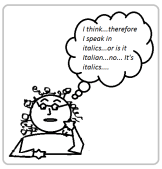
strange thoughtsAt any gathering of authors, a determined group will proclaim that thoughts should not be italicized under any circumstances. While I disagree with that view, I do see their point.

As a reader, my eyes tend to skip over long passages of italicized words. Italicizing thoughts is an accepted practice in the genres of Sci-fi, Fantasy, and YA novels, and readers of those genres expect to see thoughts shown that way.

  • However,we need to be aware of how overwhelming it is for a reader to be faced with a wall of words written in a leaning font.

If the author makes it clear that the characters are having mental conversations with themselves, italics aren’t needed.

It was, he thought, one of those rare days where the sun shone benevolently upon mankind, a day when the constant wind was gentle, benign. Aloud, he said, “Enjoy the sun while you can, my friend. The rain is eternal here.”

Dialogue, both spoken and interior, serves two purposes. It sets the scene and reveals the theme. Your word choices show the characters as they are, gradually revealing their secrets and showing us their personalities.

Your word choices reveal you, the author. Through those words, we hear your voice.

Contrasts are key. Consider the relative security of the characters’ lives as they were in the opening paragraphs contrasted against the hazards of where they are now. Each person experiences uncertainty, fear, anger, and a sense of loss differently. Those differences make them unique to us.

Jack Kerouak on writing LIRF07252022In a good story, bad things have happened, pushing the characters out of their comfortable rut. They must become creative and work hard to acquire or accomplish their desired goals.

How they overcome their doubts and make themselves stronger is what makes each character interesting. That internal and emotional journey is the real story.

So next up, we’ll talk about motivations. Nothing happens unless a character is sincerely motivated.

Comments Off on Emotional show and tell #writing

Filed under writing

Writing the Short Story part 2: indirect speech #amwriting

In a short story, our words are limited, so we must craft our prose to convey a sense of naturalness. Scenes have an arc of rising and ebbing action, so let’s consider how conversation fits into the arc of the scene.

J.R.R. Tolkien said that dialogue must have a premise or premises and move toward a conclusion of some sort. If nothing comes of it, the conversation is a waste of the reader’s time.

What do we want to accomplish in this scene? Ask yourself three questions.

  1. Who needs to know what?
  2. Why must they know it?
  3. How many words do you intend to devote to it?

My rule of thumb is, keep the conversations short and intersperse them with scenes of actions that advance the plot.

Author James Scott Bell says dialogue has five functions:

  1. To reveal story information
  2. To reveal character
  3. To set the tone
  4. To set the scene
  5. To reveal theme

So now that we know what must be conveyed and why, we find ourselves in the minefield of the short story: 

  • Delivering the backstory.

Don’t give your characters long paragraphs with lines and lines and lines of uninterrupted dialogue. A short story has no room for bloated exposition.

Let’s look at a scene that opens upon a place where the reader and the protagonists must receive information. The way the characters speak to us can take several forms:

  1. Direct discourse. Nattan said, “I was going to give it to Benn in Fell Creek, but he wasn’t home, and I had to get on the road.”
  2. Italicized thoughts: Nattan stood looking out the window. Benn’s not home. What now?
  3. Free indirect speech: Nattan stood looking out the window. Benn wasn’t home, so who should he give it to?

Examples two and three are versions of indirect speech, which is a valuable tool in your writer’s toolbox

Wikipedia describes free indirect speech this way:

Free indirect speech is a style of third-person narration which uses some of the characteristics of third-person along with the essence of first-person direct speech; it is also referred to as free indirect discoursefree indirect style, or, in Frenchdiscours indirect libre.

Free indirect discourse can be described as a “technique of presenting a character’s voice partly mediated by the voice of the author” (or, reversing the emphasis, “that the character speaks through the voice of the narrator”) with the voices effectively merged. This effect is partially accomplished by eliding direct speech attributions, such as “he said” or “she said”.

The following is an example of sentences using direct, indirect and free indirect speech:

  • Quoted or direct speechHe laid down his bundle and thought of his misfortune. “And just what pleasure have I found, since I came into this world?” he asked.
  • Reported or normal indirect speechHe laid down his bundle and thought of his misfortune. He asked himself what pleasure he had found since he came into the world.
  • Free indirect speechHe laid down his bundle and thought of his misfortune. And just what pleasure had he found, since he came into this world?

According to British philologist Roy Pascal, Goethe and Jane Austen were the first novelists to use this style consistently and nineteenth century French novelist  Flaubert was the first to be consciously aware of it as a style. [1]

When I began writing seriously, I was in the habit of using italicized thoughts and characters talking to themselves as a way to express what was going on inside of them.

That isn’t necessarily wrong. When used sparingly, thoughts and internal dialogue have their place. When they are used as a means for dumping information, they can become a wall of italicized words.

The_Pyramid_Conflict_Tension_Pacing

In the last few years, as I’ve evolved in my writing habits, I am drawn more and more to the various forms of free indirect speech as a way of showing who my characters think they are and how they see their world.

The main thing to watch for when employing indirect speech in a short story is to stay only in one person’s head. Remember, short stories are limited for space, so it’s essential to only tell the protagonist’s story.

In  longer pieces, such as novels, you could show different characters’ internal workings provided you have clear scene or chapter breaks between each character’s dialogue.

If you aren’t careful, you can slip into “head-hopping,” which is incredibly confusing for the reader. First, you’re in one person’s thoughts, and then another—it’s like watching a tennis match.

When you are limited in word count, you must find the most powerful ways to get the story across with a minimum of words. Showing important ruminations as an organic part of the unfolding plot is one way to give information and reveal a character while keeping to lean, powerful prose.


Credits and Attributions:

[1] Wikipedia contributors, “Free indirect speech,” Wikipedia, The Free Encyclopedia, https://en.wikipedia.org/w/index.php?title=Free_indirect_speech&oldid=817276599 (accessed March 30, 2021).

7 Comments

Filed under writing

Thoughts on Interior Dialogues #amwriting

It’s a fact that in the early stages of craft development, beginning authors can rely too heavily on thoughts as a way to insert information into a narrative. Most of the time, conversations can convey all the information the protagonist and the reader need.

A fact that may surprise you–most people do not speak words in their minds 24 hours a day, 7 days a week. Our random thought processes are often comprised of complex images of what we plan to do or create, arguments and interpersonal problems we’re occupied with, and flashes of memory.

And cognitive studies (verified by Descriptive Experience Sampling) have shown that 1/3 of people experience abbreviated inner speech, where an  entire complex thought is represented by a single word.

For most people, inner monologues are composed of short bursts of sentences that we “hear” as if spoken aloud.

Researchers say that most of the time, our inner monologue concerns how we see ourselves. These thoughts are often in whole sentences and phrased in a negative way. And most telling of all, we aren’t usually aware of our inner thoughts when we are having them.

However, this shouldn’t negate the usefulness of a properly deployed interior monologue.

In my opinion, there are times when revealing a critical bit of backstory can only be accomplished through the thought processes of the protagonist or a companion.

For me as a reader, the problem arises mostly when private thoughts are italicized. This is an accepted practice in the genres of Sci-fi, Fantasy, and YA novels. Many readers expect to see them presented in italics. However, we need to be aware of how daunting it is for a reader to be faced with a wall of words written in a leaning font.

And, the fact is, if the author makes it clear that the character is having the conversation with themselves, italics aren’t needed.

It was, he thought, one of those rare days, where the sun shone benevolently upon mankind. Aloud he said, “Enjoy the sun while you can, my friend. The rain is eternal here.”

A rather vocal contingent at any gathering of authors will say thoughts should not be italicized. While I disagree with that stance, I do see their point.

These authors feel that changing the font to italics creates a greater narrative distance. They think it halts the eye and sets readers apart from the character and the events of the scene.

As an avid reader, I disagree with that statement if it is applied broadly, and will argue the point, although more than a sentence or two of italicized mental dialogue does precisely that. This is a literary style choice that you, as an author, must make for yourself based on your personal preferences.

So why italicize thoughts?

  • If we choose to omit dialogue tags for these internal conversations and don’t set them off with italics or a “thought tag,” the reader can become confused.

I will add here that having the bulk of the narrative in one font, such as Garamond, and the thoughts in another, such as Times New Roman, does not eliminate the confusion. In fact, that visual contradiction makes focusing on the narrative more difficult.

If you are going to go to that much trouble, just use italics. At least the reader won’t be confused.

What is the best way to indicate that a sentence or two of interior monologue in the middle of a scene is the viewpoint character’s thoughts (and not the narrator narrating)? We have three options.

We could write the thought in first person, present tense (which is the way we actually think them) vs. writing it in the third person, past tense (so that they blend in with the rest of the text) and add a speech tag.

We can italicize vs. using standard text. I overused that in my early work, but it’s too late to go back and change that now. We all evolve as we go along in the craft, and our work reflects that growth.

As a reader, I would suggest you never use quotation marks around a character’s thoughts. Why?

The reader will assume the words are being said out loud. Then they see a “she thought” tag, rather than a “she said” dialogue tag. This throws the reader out of the narrative, and they may put the book down out of frustration, or worse, leave a “one-star, did not finish” review.

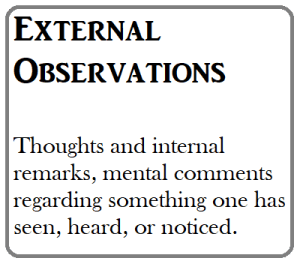
The third option is the external observation.

The following excerpt is from Benny’s Gambit, a short story. It illustrates how I write interior monologues now, ten years on in my quest to learn something about writing. My intention is that the protagonist’s thoughts are natural and organic to the flow of the narrative. I hope to write them in such a way that they fit as smoothly into the story as conversations.

Benny watched Charlotte as she left the office. Everyone knew she came from a wealthy family. The gold watch and the sleek sports car she drove could have been owned by any well-employed girl, but something about her screamed confidence and money.

Those thoughts are seen as external observations, Benny’s outside view of another character. I could verbalize all that by giving him a conversation with a co-worker, but why? This way, the reader is shown all they need to know about Charlotte, without resorting to a conversational info dump.

There are times when we want to convey information about the way the protagonists see themselves. I believe some things must be expressed as an interior monologue, if you want the reader in your protagonist’s head, as in the next paragraph.

Benny looked down at his mop. I’m such an idiot.

The first sentence is in the third person, past tense. The thought is italicized because it is in the first person present tense, showing his real-time experience. One could write it with a thought tag.

Benny looked down at his mop. I’m such an idiot, he thought.

However, at this point in my writing life I would probably write it this way:

Benny looked down at his mop and thought what an idiot he was.

In an early draft, I chose italics because it felt smoother to me. Nowadays, I would likely opt for the external view.

Whichever way you would choose to write them, the reader has gained a lot of information about Benny’s situation in two short paragraphs, but weren’t treated to an info dump.

Interior monologues are crucial to the flow of novels in which the author wants the reader firmly in the protagonist’s mind. However, these are tools we must use sparingly.

The majority of thoughts should be shown through actions or external observations by the characters. These ruminations are critical to creating an intimate portrait of your protagonist but shouldn’t take over the narrative.

So, to wind this up, interior monologues are an organic part of some narratives but are not right for all. Some stories don’t need thoughts displayed.

When they are done well and sparingly, interior monologues can create an intimate connection with the protagonist.

If an interior monologue is used in most speculative fiction, it should be short and set off by italics or phrased in the present tense and identified with the speech tag ‘thought.’

Please, if you choose to use italics, do your readers a favor, and avoid indulging in long paragraphs.

12 Comments

Filed under writing