
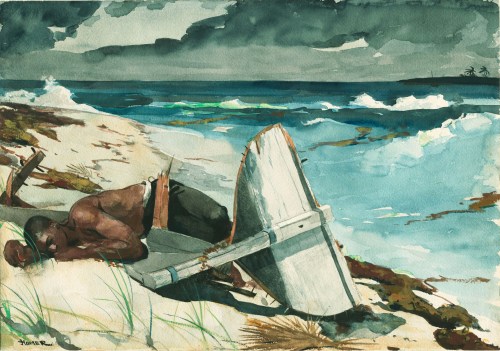
Artist: Winslow Homer (1836–1910)
Title: After the Hurricane
Date: 1899
Medium: Transparent watercolor, with touches of opaque watercolor, rewetting, blotting and scraping, over graphite, on moderately thick, moderately textured (twill texture on verso), ivory wove paper.
Dimensions: Height: 38 cm (14.9 in); Width: 54.3 cm (21.3 in)
Inscriptions: Signature and date bottom left: Homer 99
Current Location: Art Institute of Chicago, not on view
October 2024 has been a terrible month for the East Coast of the US. Two intense hurricanes swept up from the tropics, devastating the southern coastal region and bringing flooding inland.
The swath of death and destruction wrought by these storms is hard to describe. For those who lived through them but lost everything, life will always be defined in terms of “before the hurricane” and “after.”
In view of the deadly nature of these storms, I thought it appropriate to revisit “After the Hurricane, Bahamas” by Winslow Homer.
If you live in the US, Walmart and Kroger stores offer an option to donate a dollar or more to various hurricane relief organizations at checkout, as do many other grocery chains. Also, you can donate directly to the relief effort by going to How to help those impacted by Hurricane Helene: Charities, organizations to support relief efforts – ABC News (go.com).
About Hurricane Helene, via Wikipedia: Hurricane Helene – Wikipedia
In advance of Helene’s expected landfall, states of emergency were declared in Florida and Georgia due to the significant impacts expected, including very high storm surge along the coast and hurricane-force gusts as far inland as Atlanta. Hurricane warnings also extended further inland due to Helene’s fast motion. The storm caused catastrophic rainfall-triggered flooding, particularly in western North Carolina, East Tennessee, and southwestern Virginia, and spawned numerous tornadoes. As of October 12, at least 252 deaths have been attributed to the storm. [1]
About Hurricane Milton, via Wikipedia: Hurricane Milton – Wikipedia
Ahead of the hurricane, Florida declared a state of emergency in which many coastal residents were ordered to evacuate. Preparations were also undertaken in Mexico’s Yucatán Peninsula. The hurricane spawned a deadly tornado outbreak and caused widespread flooding in Florida. As of October 14, 2024, Hurricane Milton killed at least 28 people: 25 in the United States and three in Mexico. Preliminary damage estimates place the total cost of destruction from the storm at over US $30 billion. [2]
What I love about this painting:
After the Hurricane, Bahamas is a watercolor painting by the American artist, Winslow Homer. It shows a man washed up on the beach after a storm, surrounded by the fragments of his shattered boat. The wreckage of the boat gives evidence of the severity of the powerful hurricane, which is retreating. Black clouds still billow but recede into the distance, and sunlight has begun to filter through the clouds.
The man may have lost his boat, but he has survived.
I love the way the whitecaps are depicted, and the colors of the sea are true to the way the ocean looks after a severe storm. Winslow Homer’s watercolor seascapes are especially intriguing to me as they are extremely dramatic and forceful expressions of nature’s power. The beauty and intensity of Homer’s vision of “ocean” are unmatched—in my opinion his seascapes are alive in a way few other artists can match.
This painting was done in 1899 and marked the end of Homer’s watercolor series depicting man against nature. That series was begun with Shark Fishing in 1885, the year he first visited the Caribbean and is comprised of at least six known paintings. The most famous of these watercolor paintings is The Gulf Stream, which was also painted in 1899. After the Hurricane, Bahamas is the last of the series.
About the artist, via Wikipedia
Winslow Homer (February 24, 1836 – September 29, 1910) was an American landscape painter and printmaker, best known for his marine subjects. He is considered one of the foremost painters in 19th-century America and a preeminent figure in American art.
Homer started painting with watercolors on a regular basis in 1873 during a summer stay in Gloucester, Massachusetts. From the beginning, his technique was natural, fluid and confident, demonstrating his innate talent for a difficult medium. His impact would be revolutionary. [3]
Credits and Attributions:
After the Hurricane, Bahamas by Winslow Homer, [Public domain], via Wikimedia Commons
[1] Wikipedia contributors, “Hurricane Helene,” Wikipedia, The Free Encyclopedia, https://en.wikipedia.org/w/index.php?title=Hurricane_Helene&oldid=1251667279 (accessed October 17, 2024).
[2] Wikipedia contributors, “Hurricane Milton,” Wikipedia, The Free Encyclopedia, https://en.wikipedia.org/w/index.php?title=Hurricane_Milton&oldid=1251634007 (accessed October 17, 2024).
[3] Wikipedia contributors, “Winslow Homer,” Wikipedia, The Free Encyclopedia, https://en.wikipedia.org/w/index.php?title=Winslow_Homer&oldid=1055649094 (accessed December 9, 2021).
IMAGE: Wikimedia Commons contributors, “File:Winslow Homer – After the Hurricane, Bahamas.jpg,” Wikimedia Commons, the free media repository, https://commons.wikimedia.org/w/index.php?title=File:Winslow_Homer_-_After_the_Hurricane,_Bahamas.jpg&oldid=428549979 (accessed December 9, 2021).


 Life in the Realm of Fantasy