
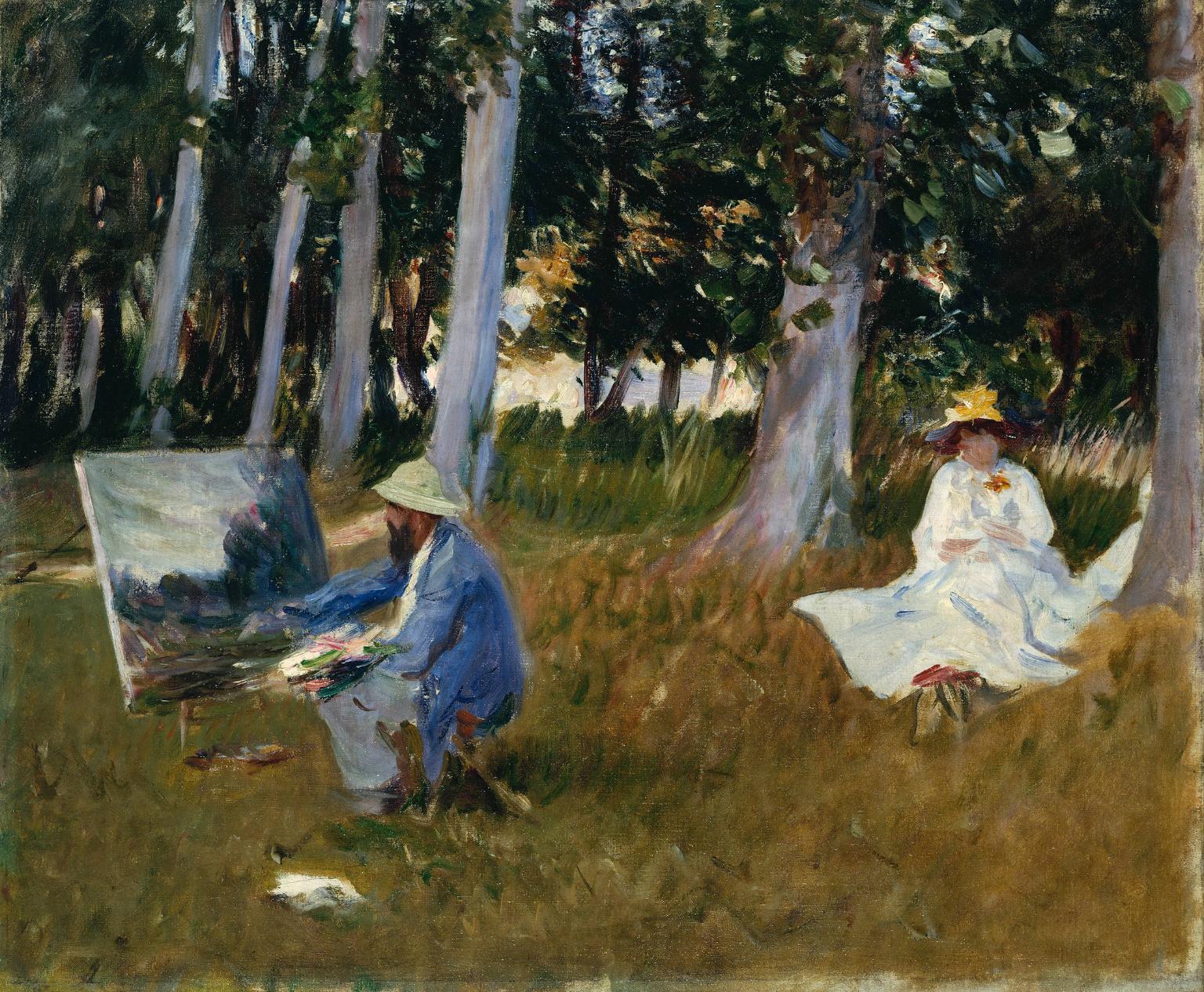
Artist: John Singer Sargent (1856–1925)
Title: Claude Monet Painting by the Edge of a Wood
Depicted people: Claude Monet, Alice Hoschedé
Date: 1885
Medium: oil on canvas
Dimensions: height: 54 cm (21.2 in); width: 64.8 cm (25.5 in)
Collection: Tate Britain
What I love about this painting:
This is the record of a pleasant summer’s day spent with friends, just relaxing and enjoying life. I feel sure a picnic basket lurks just out of sight, filled with good French food.
John Singer Sargent was a complicated man in so many ways, but his art came first. He was wholly dedicated to his art, and yet he had to earn money. He is most famous for his (sometimes scandalous) portraits of famous people of the late 19th and early 20th centuries, all of which are outstanding and worthy of a closer look.
While his portraits paid the bills, his best work was done when painting scenes of ordinary people going about their daily business. Claude Monet is a legend in our time, but he was just another painter friend, albeit a respected one, in Sargent’s time. Thus, portraying his friend as he worked was absolutely Sargent’s idea of painting for fun.
The influence of the French impressionists on his work is clear, and yet he remained committed to a style of realism that was uniquely his own.
About this painting, via Wikipedia:
Sargent spent much time painting outdoors in the English countryside when not in his studio. On a visit to Monet at Giverny in 1885, Sargent painted one of his most Impressionistic portraits, of Monet at work painting outdoors with his new bride nearby. Sargent is usually not thought of as an Impressionist painter, but he sometimes used impressionistic techniques to great effect. His Claude Monet Painting at the Edge of a Wood is rendered in his own version of the Impressionist style. In the 1880s, he attended the Impressionist exhibitions, and he began to paint outdoors in the plein-air manner after that visit to Monet. Sargent purchased four Monet works for his personal collection during that time. [1]
About the artist via Wikipedia:
About The Artist via Wikipedia:
John Singer Sargent (January 12, 1856 – April 14, 1925) was an American expatriate artist, considered the “leading portrait painter of his generation” for his evocations of Edwardian-era luxury. He created roughly 900 oil paintings and more than 2,000 watercolors, as well as countless sketches and charcoal drawings. His oeuvre documents worldwide travel, from Venice to the Tyrol, Corfu, the Middle East, Montana, Maine, and Florida.
Born in Florence to American parents, he was trained in Paris before moving to London, living most of his life in Europe. He enjoyed international acclaim as a portrait painter. An early submission to the Paris Salon in the 1880s, his Portrait of Madame X, was intended to consolidate his position as a society painter in Paris, but instead resulted in scandal. During the next year following the scandal, Sargent departed for England where he continued a successful career as a portrait artist.
From the beginning, Sargent’s work is characterized by remarkable technical facility, particularly in his ability to draw with a brush, which in later years inspired admiration as well as criticism for a supposed superficiality. His commissioned works were consistent with the grand manner of portraiture, while his informal studies and landscape paintings displayed a familiarity with Impressionism. In later life Sargent expressed ambivalence about the restrictions of formal portrait work and devoted much of his energy to mural painting and working en plein air. Art historians generally ignored society artists such as Sargent until the late 20th century.
With his watercolors, Sargent was able to indulge his earliest artistic inclinations for nature, architecture, exotic peoples, and noble mountain landscapes. And it is in some of his late works where one senses Sargent painting most purely for himself. His watercolors were executed with a joyful fluidness. He also painted extensively family, friends, gardens, and fountains. In watercolors, he playfully portrayed his friends and family dressed in Orientalist costume, relaxing in brightly lit landscapes that allowed for a more vivid palette and experimental handling than did his commissions (The Chess Game, 1906). His first major solo exhibit of watercolor works was at the Carfax Gallery in London in 1905. In 1909, he exhibited eighty-six watercolors in New York City, eighty-three of which were bought by the Brooklyn Museum. Evan Charteris wrote in 1927:
To live with Sargent’s water-colours is to live with sunshine captured and held, with the luster of a bright and legible world, ‘the refluent shade’ and ‘the Ambient ardours of the noon.’
Although not generally accorded the critical respect given Winslow Homer, perhaps America’s greatest watercolorist, scholarship has revealed that Sargent was fluent in the entire range of opaque and transparent watercolor technique, including the methods used by Homer. [1]
Credits and Attributions:
IMAGE: Claude Monet Painting by the Edge of a Wood by John Singer Sargent, 1885. P|D 100. File:Sargent MonetPainting.jpg – Wikipedia. Accessed March 5, 2026.
[1] Wikipedia contributors, “John Singer Sargent,” Wikipedia, The Free Encyclopedia, https://en.wikipedia.org/w/index.php?title=John_Singer_Sargent&oldid=1337829485 (accessed March 5, 2026).


 Life in the Realm of Fantasy