
October has arrived, or as many writers will tell you, Preptober. This is the month when November Writers begin preparing for November’s annual writing rumble, the event formerly known as NaNoWriMo. They may create a list of characters and their respective roles.
 Some, like me, will begin with worldbuilding, drawing a map of where the story will take place and thinking about the people who will bring that world to life.
Creating characters and maps means devising names for people and places. If you are setting your story in a real-world environment, half of the work is done for you. All you have to do is download a few Google Maps, and you have your world.
However, you still need to give your people names. You may also need to invent a town or county that doesn’t exist, but which will fit seamlessly into the real world.
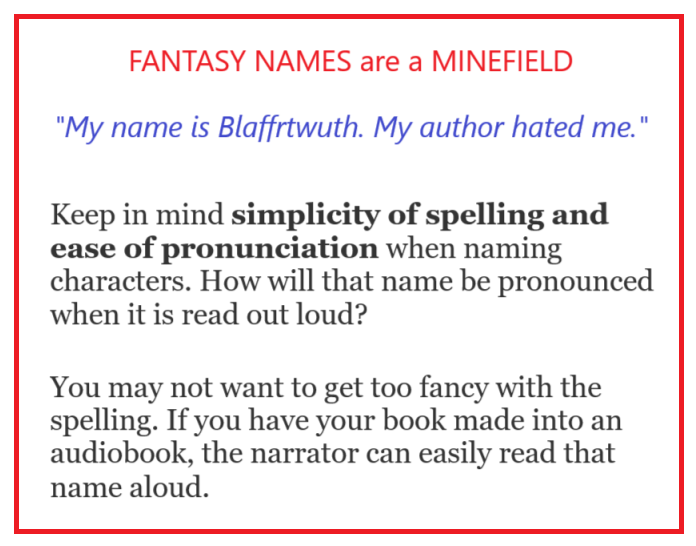 Names are a part of the subtext, an aspect that adds to the reader’s mental view but usually goes unnoticed. The names you assign people and places are a part of worldbuilding. If you give your characters names that don’t fit the time, society, and geographical area, readers will find them jarring.
Although I usually start with an outline, my first drafts are often a mess. My stream of consciousness takes over, and I give every walk-on a name, right down to the dog.
This happens because when I am in the creative zone, I forget to look at the outline.
During the first stage of revisions, I whittle down my cast of thousands to a reasonable level.
Here are three rules for deciding who should be named and who should not. Don’t worry about these rules when you are laying down the first draft. Think about them when the story is finished and you are making revisions, as that is when you are making the story flow better.
- Is this character someone the reader should remember?
- Does the person return later in the story?
- Only give names to characters who advance the plot.
These suggestions are true of a novel, a screenplay, or a short story. Names alert us, telling us a character will play an important role in the story.
In my experience as a reader, the pacing an author is trying to establish comes to a halt when a character who is only included for the ambiance has too much time devoted to them.

Book Cover image “Story” by Robert McKee.
Novelists can learn a lot about writing a good, concise scene from screenwriters. An excellent book on craft is an older one, but it’s still relevant. Story by Robert McKee.
We want the reader to stay focused on the protagonist(s) and their story. Having too many named characters in a scene is easy to fix. Consider removing characters from the scene if they have nothing to contribute. An example of this is one I’ve used before. It is a transition scene between two characters involved in solving a mystery. One has learned something crucial and needs to meet with the other before he stumbles into trouble.
Julie entered the café at 3:30. All the seats were taken, except for one at the counter, between a man in paint-stained coveralls and a woman with a briefcase at her feet. She caught Nathan’s eye, and he brought her a coffee. “We need to talk,” she whispered. “I’ll wait until you’re free.”
Nathen raised an eyebrow. “I get off at four. See you then.” He refilled several coffees at the counter, then carried the pot to the tables.
This scene depicts Nathan in his job, serving as both worldbuilding and character development. Julie doesn’t need to talk to the people on either side of her onscreen, as idle chit-chat is not necessary and fluffs up the wordcount. The scene can skip forward, and the conversation with Nathan will pick up outside the café after he is off work.
Transition scenes between action scenes are dangerous because the tendency to make every random character memorable is one we can’t indulge. The reader will become confused and irritated if too many characters are named. If a character is set dressing, they should be like the furniture, included solely to lend atmosphere to the scene.
So what about the names we give our people? I’ve mentioned before that I learned a lesson the hard way about naming characters. I have a main character named Marya in one of my early novels, and she’s central to that series. Also, in the first book, a side character was important enough to have a name, but my mind must have been in a rut when I thought that one up.
For some reason, I named her Marta. Marya … Marta … the two names are nearly identical.
To make that faux pas worse, halfway through the first draft of the second book in the series, Marta suddenly became a protagonist with a significant storyline. She actually becomes Marya’s mother-in-law in the next book.
Fortunately, I was in the final stages of editing Book One for publication. I immediately realized I had to make a major correction, and Marta was renamed Halee.
An author should introduce as many characters as necessary to tell the story but should also use common sense.
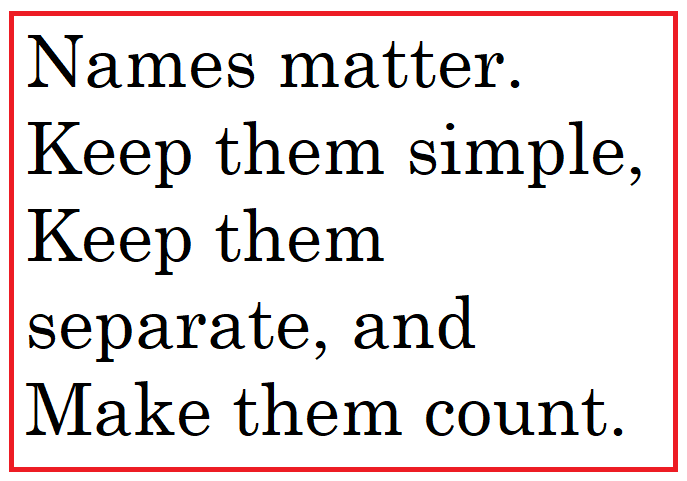 One last thing to consider is how that name will be pronounced when read aloud. Something that looks good on paper might be impossible to pronounce. Audiobooks have become a big thing, so you may not want to get too fancy with the spelling. That way, a narrator can easily read that name aloud.
In conclusion, don’t confuse your readers by giving unimportant walk-on characters names, and never give two characters names that are nearly identical.
Consider making your spellings of names and places pronounceable, just in case you decide to have your novel made into an audiobook. Your narrator will thank you!


 Life in the Realm of Fantasy