Tag Archives: pacing your novel

Calendars and Maps #amwriting

Time can get a little mushy when I am winging it through a manuscript. I discovered early on that keeping a calendar and a map gives me a realistic view of how long it takes my characters to travel from point A to point B.
dylan moran quote TIMEAlso, the two combine to help in deciding how long it will take to complete a task.

It helps to know what season your events occur in, as foliage changes with the seasons, and weather is a part of worldbuilding. But there are other reasons for keeping a calendar as well as sketching a map.

A calendar helps you with pacing and consistency. In conjunction with a map, a calendar keeps the events moving along the story arc. It ensures you allow enough time to reasonably accomplish large tasks, enabling a reader to suspend their disbelief.

They ensure you don’t inadvertently jump from season to season when describing the scenery surrounding the characters.

The calendar keeps the timeline believable. Here is where I confess my great regret: in 2008, a lunar calendar seemed like a good thing while creating my first world.

  • Thirteen months, twenty-eight days each,
  • One extra day at the end of the year, which ends on the Winter solstice.
  • Winter solstice is called Holy Day. Every four years, they have two Holy Days and a big party.

That arrangement of thirteen months is easy to work with because it is on paper. However, the names I assigned to the dates and months are problematic.
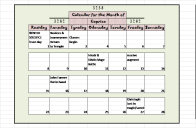
Calendar Capricas 3262 NeveyahWhile I had finished the RPG game’s plot and the synopsis, I didn’t have some details of the universe and the world figured out. So, in a burst of creative predictability, I went astrological in naming the months. I thought it would give the player a feeling of familiarity.

We were only beginning to design the game when it was scrapped. Fortunately, I retained the rights to my work. Unfortunately, the calendar I had invented for the RPG was incorporated into the world of Neveyah, and now (while I wish it wasn’t) it is canon.

In a bout of desperate unoriginality, I went with the names we currently use when I named the days, except—I twisted them a bit and gave them the actual Norse god’s name. The gods and goddesses of Neveyah are not Norse.

I could have changed all of that when the game was abandoned, but it didn’t occur to me. That lapse is an example of how what seems like a good idea at the time might not be workable in practice.

One thing I did right was sticking to a 24-hour day and a standard 12-hour clock. Experience is a cruel teacher. I can’t stress enough how important it is to keep things simple when we are world-building. Simplicity minimizes chaos when the plot gets complicated.

Digital Clock FaceTime has a tendency to be elastic when we are writing the first draft of a story where many events must occur. Sometimes, many things are accomplished in too short a period for a reader to suspend their disbelief.

Calendars are maps of time. They turn the abstract concept of time into an image we can understand.

Even though I regret how I named the days in Mountains of the Moon, I have a calendar, so my characters progress through their space-time continuum at a rate I can comprehend. I can adjust events in the first and second drafts, moving them forward or back in time by looking at and updating their calendar. The sequence of events forming the plot arc remains believable.

I heartily suggest you stick to a simple calendar. That is the advice I would give any new writer—stick to something close to the calendar we’re familiar with, and don’t get too fancy.

Speaking of fancy, what about distance? Stories often involve traveling, and in fantasy tales, one could be walking or riding a horse. The distance a person can walk in one hour depends on the walking speed and the terrain. People can walk between 2.0 miles (3.22 K) and 5.0 miles (8.47 K) in 1 hour (60 minutes) depending on walking speed. A healthy person can probably walk 5 to 7 miles (8.04 to 11.256 K) in two hours of walking at a steady pace.
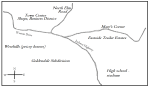
protomapWhat if your fantasy world uses leagues as a measure of distance? A league is 3.452 miles or 5.556 kilometers. Generally speaking, a horse can walk 32 miles or 51.5 K in a day.

Thus, a day of walking or riding a horse on a level road can take one quite a distance.

But roads are NOT always level, and they don’t always cross flat ground.

As I said above, the distance a person can walk in one hour depends on the walking speed and the terrain. But let’s say you settle down and walk at a steady speed. If you go at the typical walking pace of 15 to 20 minutes per mile, it could take you 2–3 hours to get to your destination if it is ten miles (16 K) away on a good road.

If you are writing sci-fi or fantasy, calendars, and rudimentary maps work together to keep the plot moving and believable. Will your characters encounter forests? Mountains? Rivers?

Maybe they live in a city.

Each of these areas will impact how long it takes to go from one place to another. This is where a calendar comes into play.
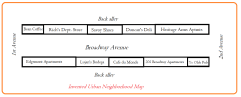
proto_city_map_LIRF07052022Many readers have a route they walk or run daily to maintain their health. These readers will know how long it takes to walk ten blocks. They will also know how far a healthy person can walk in one hour on a good road.

This is where the map comes into play. You can’t travel in a straight line over mountains or forests. Sometimes, you must travel parallel to a river for a long way until you come to a place shallow enough to cross.
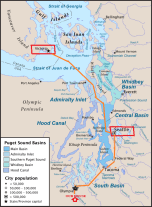
Map-pugetsoundThe part of the world where I live has large tracts of forests, many wide rivers, and is mountainous, with numerous volcanos. Our roads are often winding and sometimes travel in switchbacks up and over many of these obstacles. It takes time to go places even though the original road-builders plotted the roads through the most accessible paths.

And we’ll just toss this out there – while you can drop a tall tree across a narrow creek, building bridges over rivers requires a certain amount of engineering. Cultures from the Neolithic to modern times have had the skills needed to make bridges.

We are creative, and archaeology shows us that our ancestors were capable of far more than we have traditionally believed. Archeology and history both tell us that humans, as a species, are tribal by nature. We band together for protection, shelter, better access to resources, and companionship, and these gathering places become towns.

Humans have always created communities where resources are plentiful, but climate changes over time.

Your maps should take into consideration all the terrain your characters must deal with.

calendarTravel and events take time. A calendar, either fantasy or the standard Gregorian calendar we use today, and a simple hand-drawn map will help you maintain the logic of your plot.
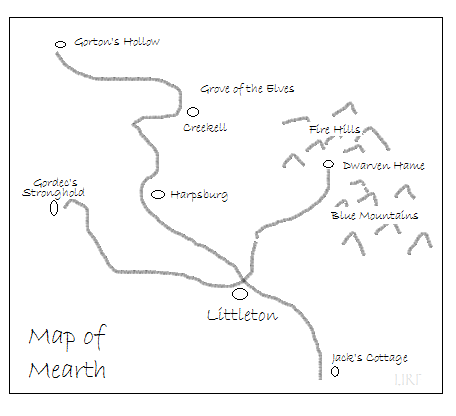
sample-of-rough-sketched-map

2 Comments

Filed under writing

Pacing part one: foreshadowing and the strong opening #amwriting

I’ve been struggling to find the place where the narrative of my new novel actually begins. Is it the day of his divorce? Is it the day of his brother’s death? Or is it the day he is released from the care of the healers after his breakdown?

MyWritingLife2021BAnd what of my female protagonist? Where does her story begin?
And the other pair—the ones that really need their own book but aren’t going to get it. What about them?

At this point, all I have is a mountain of backstory. It’s important because it tells me who my people are the day the novel begins.

It doesn’t need to be the opening chapter.

Every story begins with an opening act. The characters are introduced, and the scene is set. These paragraphs establish the tone of what is to follow, and if I have gotten my phrasing and pacing right, they will hook the reader.

This is where pacing comes into it. The intended impact of the book can and should be established in the first pages—but it takes work. I am writing a first draft right now, so most of what I write is a code telling me what I need to know when I get to the revision process.

I have introduced the setting. Where are the characters? Well, in this case, it’s easy. They are in the World of Neveyah, and fortunately for me, the world, the society, and the magic systems are already built. Some things are canon, which forces me to be creative and work within those limits.

Finally, I must introduce the conflict. What does the protagonist want? What hinders them?

My female protagonist must learn to live with her limits and trust her team. She must learn to delegate.

While she is doing that, my male protagonist must move beyond what he has lost and learn to appreciate what he still has.

My other female lead must be the friend the protagonist needs and make a choice between her career as a soldier or choosing to leave and raise a family.

Conversely, the other male lead must emerge from his father’s domination and choose to make his career as an artisan.

Not only that, but I must use my words in such a way that my readers don’t want to put the book down.

Novels are built the same way as a Gothic cathedral. Small arcs support other arcs in layers, creating an intricate structure that rises high and withstands all that nature can throw at it for the centuries to come.

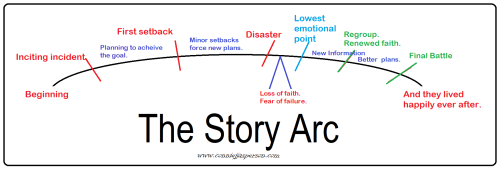
Like our cathedral, the strength of a novel’s story arc depends on the foundation you lay in the book’s first quarter.

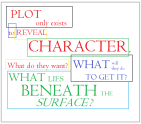
Plot-exists-to-reveal-characterI must introduce a story-worthy problem in those pages, a test propelling the protagonist to the middle of the book. The opening paragraphs are vital. They are the hook, the introduction to my voice, and must offer a reason for the reader to continue past the first page.
So, I must find where that story really begins, and trust me, it isn’t with a mental breakdown. The story begins with each character arriving at their new duty stations, each with a history that makes them who they are that day. Their pasts are known to others and do come out, but only when the other characters and the reader needs it.

I find pacing is the most challenging part of writing a first draft. Eighty percent of my writing will not make it into the final manuscript.

But it will be available in a file labeled ‘backstory’ for me to access when needed. I note names and relationships in my stylesheet and outline as I go.

One character is dark and brooding. I won’t explain why at the outset, as his backstory must emerge gradually, each morsel emerging when my female character must know. My side characters have an easier path, but their task is to provide information when required and to assist in the surface quest—catching a murderer.

With the back history in a separate file, I must open the novel with my characters in place. A  question must be raised, or I must introduce the inciting incident. This sets the four on the trail of the answer, throwing them into the action.

It’s too easy to frontload the opening pages with a wall of backstory. We always think, “Before you learn this, you must know that.”

All of that is true, but the history belongs in a separate file. I learned this the hard way—long lead-ins don’t hook the reader.

If my characters don’t need to hear the history of the Caverns of Despair, it’s likely that the readers also don’t care. The name is a pretty descriptive indicator of what lies ahead, so the twelve paragraphs detailing how the caves got their name are probably unnecessary.

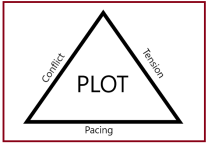
The_Pyramid_Conflict_Tension_PacingMy favorite books open with a minor conflict, evolving to a series of more significant problems, working up to the first pinch point, where the characters are set on the path to their destiny.
I will open with a strong scene, an arc of action that

  • illuminates the characters’ motives,
  • allows the reader to learn things as the protagonist does, and
  • offers clues regarding things the characters do not know that will affect the plot.
  • The end of one scene is the launching pad for the next scene, propelling the story arc.

The clues I offer at the beginning are foreshadowing. Through the book’s first half, foreshadowing is important, as it piques the reader’s interest and makes them want to know how the book will end.

In the opening paragraphs, I will focus on the protagonists and hint at their problems. Subplots, if there are any, will be introduced after the inciting incident has taken place. They must relate to that incident in some way.

If you introduce side quests too soon, they are distracting. They make for a haphazard story arc if they don’t relate to the central quest. I think side quests work best if they are presented once the book’s tone and the central crisis have been established. Good subplots are excellent ways of introducing the emotional part of the story.

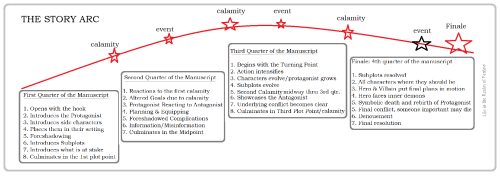
Even if I were to open the story by dropping my characters into the middle of an event, I’d need a pivotal event at the 1/4 mark that completely rocks their world. The event that changes everything is the core of the story.

Following the inciting incident is the second act: more action occurs, leading to more trouble and rising to a severe crisis.

I know how long I plan the book to be. I will take that word count and divide it by 4. I place the first significant event in the first quarter, presenting it after I introduce the characters. The following two quarters form the second act, the middle. If I have plotted well, the middle of the story arc should fall into place like dominoes.

We’ll talk about that in my next post.

storyArcLIRF10032021

3 Comments

Filed under writing

Characterization part two – writing subtle emotions and reactions

Most writers find it easy to connect with flamboyant emotions, such as hate, anger, desire, and adoration. However, emotions have “volume,” ranging from soft to loud. Today we are looking at emotions we need to show with less noise.

mood-emotions-1-LIRF09152020Volume control is a crucial part of the overall pacing of your story. “Loud” deafens us and loses its power when it’s the only sound. However, like the opening movement of Beethoven’s 5th Symphony, the entire range of volume can be effectively used to create a masterpiece.
Subtle reactions have power when contrasted against more forceful displays of emotion.

Low-key thoughts and feelings can go almost unnoticed. Under the surface, positive or negative vibes give us a rounded view of a character, making them less two-dimensional, a more natural person.

We’re all aware of one positive emotion that can go bad – love. When love is reciprocated, it’s a positive feeling. We all enjoy a good love story.

However, when love starts out with promise and then goes terribly wrong, you have the makings of a deep, dark story filled with possibilities. Anger, despair, revenge—these can be loud and also be subtle, brooding.

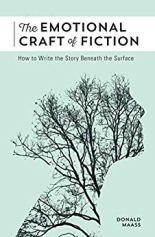
Maas_Emotional_Craft_of_FictionDark emotions, such as depression, can be shown through a character’s reactions to things that once pleased them. Perhaps they no longer find beauty in the things they once enjoyed.

What about lighter emotions? The way we feel joy ranges from mild to overwhelming, from a slight smile to an experience so profound it brings tears to one’s eyes.

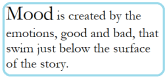
Subtle emotions don’t stand out and grab the reader. But when they’re swimming just under the surface, they have impact. Subtleties color and shape the reader’s opinions about the story and the characters.

One negative aspect of our human character is our tendency to experience an uncharitable emotion known as schadenfreude. We all go through it on a personal level every now and then. Some people take great joy in it, gaining a sense of superiority. But most of us are embarrassed to admit to it.

Small, quiet emotions linger and leave an impression but are hard to articulate. It helps to include small indicators of mood such as:

  1. Anguish
  2. Anxiety
  3. Competence
  4. Confidence in their friends
  5. Cooperation
  6. Courage
  7. Decisiveness
  8. Defeat
  9. Defensiveness
  10. Depression
  11. Discovery
  12. Ethical Quandaries
  13. Group ethics
  14. Happiness
  15. Inadequacy
  16. Indecision
  17. Individual moral courage
  18. Jealousy
  19. Paranoia
  20. Powerlessness
  21. Purposefulness
  22. Regret
  23. Resistance
  24. Revelation
  25. Satisfaction
  26. Self-confidence
  27. Serenity
  28. Strength
  29. Success
  30. Sufficiency
  31. Temptation
  32. Trust
  33. Unease
  34. Weakness

These attributes are rarely spelled out, but they color how the characters interact with each other.

Some positive emotions can be more intense, yet not overpowering. Those moments can be shown by an immediate physical reaction combined with internal dialogue or conversations.

Severe emotional shock strikes us with a one-two-three punch: the disbelief/OMG moment, followed by knocking knees, shaking hands, or a shout of “No!” which is sometimes followed by disassociation.

emotion-thesaurus-et-alVisceral reactions are involuntary—we can’t stop our face from flushing or our heart from pounding. We can pretend it didn’t happen or hide it, but we can’t stop it. An internal physical gut reaction is difficult to convey without offering the reader some information, a framework to hang the image on.
We use the same one-two-three trick when describing a mild experience as we do with louder emotions.

Start with the visceral response. There will be an instant reaction. How does a “gut reaction” feel? Nausea, gut-punch, butterflies … how do you respond to internal surprises?

Emotions are felt in the chest in varying degrees, from a slight warmth or chill to a stronger heart-pounding sensation. But we’re keeping it subdued here.

Follow the visceral up with a thought-response. Whatever your style and word choices are, showing the characters’ joy or dismay makes them human. If it is a mild reaction, give it a moderate thought response. Showing small moments of relatable happiness or displeasure makes our protagonist more sympathetic.

Third, finish up with body language. That is how emotions hit us. We feel the shock and then experience the mental reaction as we process the event. Our body language reflects these things.

What if you are writing a story where one of the antagonists eventually becomes part of the protagonist’s inner circle? Including small positive thoughts early on in their narrative can foreshadow that this character may become the ally that turns the tide.

Conversely, when the antagonist begins as part of the protagonist’s inner circle, minor negatives like envy and schadenfreude in their narrative can foreshadow that this character is not what they seem.

ICountMyself-FriendsConflict keeps the protagonist from achieving their goals. Significant conflicts and emotions are easy to write about. But in real life, our smaller, more internal conflicts frequently create more significant roadblocks to success than any antagonist might present.


Large emotions are easy to visualize. But frequently, in real life, our smaller joys have a longer-lasting impact, and the memory of these can be the impetus that keeps the soldier fighting during the darkest hours.

If we contrast the loud emotions against the soft ones, the reader will experience those emotions as if they are theirs. The story detailed in that book will be more meaningful to them.

14 Comments

Filed under writing

Thoughts on narrative perspective part 2: closeup on the antagonist #amwriting

For scriptwriters, the closeup is an essential aspect of pacing. It focuses on one character and shows us details about them and their role that they (the characters) might not be aware of. This importance transfers over to how we show scenes in our written narratives. To get the most out of our words, we who write stories must frame our scenes the way scriptwriters do theirs.

We vary the narrative distance, which is our best tool to show humanity in our characters. The wide view shows the protagonist and their companions as they move through their environment.

Then we narrow the focus, perhaps take it down to a conversation between two people. One person drops out of the conversation, and we are left with the closeup view of our protagonist.

At our closest to them, we are in their heads. We hear their mental ruminations in real-time. By listening to this voice, the reader sees what the characters believe is at stake and how weak or strong they consider their position.

When we are drawn into a character’s head, we view them through the mirror in which they see themselves.

What we, as authors, have to consider is how that mirror is distorted. Never forget that all self-reflections are skewed, often to the positive, but usually toward the negative. We see flaws in ourselves that no one else does, so we don’t usually see ourselves as heroes.

This is because we subconsciously compare ourselves to others. We observe their abilities and are acutely aware of our own vulnerabilities in comparison. So, we strive to better ourselves.

Through manipulating the narrative distance, the author shows how the protagonist regards their companions, and what kind of people they are.

Sometimes, it raises the stakes if the author writes a chapter focusing on the antagonist. Take this opportunity to show us who the antagonist sees when they gaze into the mirror of self-reflection. Since nothing happens without a root cause, we can learn why they oppose the protagonist, and what their strengths are.

Now here is where we can make things interesting. What if the antagonist isn’t trying to be wicked? What if they are fighting for what they believe is the right thing? What if, in their view, they are the heroes who have the moral high ground?

Think of how much evil has come out of civil wars in humanity’s history. Then consider how firmly the opposite sides believed in their moral superiority, and what was lost or gained in the end. All interpersonal disputes are wars, just on a lesser scale.

How will you choose to show this on a smaller, personal level? The closeup shows us who the antagonist believes they are and why they have the right to oppose the protagonist.

Sometimes, if the writer shows little sympathy for the devil, it raises the emotional stakes.

Readers want to understand why the action is happening. Both sides need an opportunity to explore what they perceive as the conflict’s fundamental cause.

Authors show this through internal dialogue, moving out to a broader view with conversations, and expanding again to an external narrative.

As a reader, having hints of what is at stake for the opposition makes me care about the outcome. With the relationship established, we can widen the picture and show what is at stake for both sides. I want to feel a little compassion, or if not that, I want to understand how failing will change the losers’ lives.

Good pacing of narrative distance—moving in close, then widening out, and then moving back in—adds emotional power to the story. This tempo allows the reader to process the information and action at the same time as the characters.

Keep the stakes high and the emotions intense, and I will stay immersed in that book.


Credits and Attributions:

Wikimedia Commons contributors, “File:Before the Mirror.jpg,” Wikimedia Commons, the free media repository, https://commons.wikimedia.org/w/index.php?title=File:Before_the_Mirror.jpg&oldid=462235289 (accessed October 6, 2020).

Wikimedia Commons contributors, “File:Mirror of the souls.jpg,” Wikimedia Commons, the free media repository, https://commons.wikimedia.org/w/index.php?title=File:Mirror_of_the_souls.jpg&oldid=478982509 (accessed October 6, 2020).

7 Comments

Filed under writing

The transition scene #amwriting

A well-paced narrative has a kind of rhythm. Instructors commonly refer to this as “push, glide, push, glide,” as if skating. What that means is that while the characters might be in the midst of chaos, there is order in the layout and pacing of the narrative.

  • action,
  • processing the action,
  • action again,
  • another connecting/regrouping scene

These “processing” scenes are transitions, moving the plot forward while allowing the reader to process what just happened.

We can’t have non-stop action, as that is exhausting to write and more exhausting to read. The character arc is often at the forefront during these transitional scenes as that period of relative calm is when you allow your characters’ internal growth to emerge.

We justify what just happened, making it believable. It is also where you ratchet up the tension.

When it comes to writing transitions between scenes, we have several paths to choose from.

Introspection:

  • Introspection offers an opportunity for new information important to the story to emerge.
  • It opens a window for the reader to see who the characters are, how they react and illuminates their fears and strengths. It shows that they are self-aware.

Keep the scenes of introspection brief, and go easy on them if you are given to using italics to set them off. A wall of italics is hard to read, so don’t “think” too much if you are using those.

  • Characters’ thoughts must serve to illuminate their motives at a particular moment in time.
  • In a conversation between two characters, introspection must offer information not previously discussed.
  • Internal monologues should not make our characters too wise. Humanize them, show them as a bit clueless about their flaws, strengths, or even their deepest fears and goals.

Conversations:

  • Conversations should not become clumsy info-dumps. “As you know….”
  • Each character must speak uniquely, sounding like themselves. Don’t dump conversations into a blender and pour out a string of commentary that makes them all sound alike.

Don’t get fancy with speech tags/attributions. It’s best for me as a reader when the author avoids words that take me out of the narrative. Some words are eye-stoppers. I recommend you stick with said, replied, answered—common and ordinary  tags that don’t leap out at the reader like ejaculated, disgorged, spewed, and so on. Occasionally, you can get away with more forceful tags, but keep them to a minimum. Make the characters’ actions and words show the force of their words. In my opinion, you can do away with speech tags for some brief exchanges if the scene contains only two characters.

Fade-to-black and hard scene breaks:

I’m in two minds about using fade-to-black scene breaks as transitions. Why not just start a new chapter?

One of my favorite authors, L.E. Modesitt Jr. sometimes has chapters of only five or six-hundred words, which keeps each character thread truly separate and flows well.

In a short story, a hard scene break is sometimes required, as you don’t have the option to do chapters. Use an asterisk or hashtag between scenes. * #

New chapter:

Each of the major players has a point of view. Some authors use the aftermath of an action scene as an opportunity to advance the antagonist’s story line. That is a good strategy, as we do need to show why the enemy is the enemy.

The key is to avoid “head-hopping,” and I feel like the best way to do that is to give a new chapter to the point-of-view character. Head-hopping occurs when an author switches point-of-view characters within a single scene. It happens most frequently when using a third-person omniscient narrative because the thoughts of every character are open to the reader.

My favorite authors will employ all the above listed transitions as they move their characters through the story arc. Each transition will lead us into a new scene, and when they are done right, we the readers won’t even notice that they are transitional.

The transition is the most difficult part of the narrative for me to formulate in the first draft. I get stuck, trying to decide what information needs to come out, and what should be held back.

Sometimes, a transition just will not work no matter what. This happens when a flaw in the logic exists in the scene preceding it. Usually, I can’t see it at that point, but my writing group will show me what the problem is.

This struggle to connect my action scenes into a seamless arc is why writing isn’t the easiest occupation I could have chosen. But when everything comes together, it is the most satisfying job.


Credits and Attributions:

Detail from: Journey of the Magi (East Wall) by Benozzo Gozzoli 1459Magi Chapel of Palazzo Medici-RiccardiFlorence, 1459–1461. Wikimedia Commons contributors, “File:Benozzo gozzoli, corteo dei magi, 1 inizio, 1459, 51.JPG,” Wikimedia Commons, the free media repository, https://commons.wikimedia.org/w/index.php?title=File:Benozzo_gozzoli,_corteo_dei_magi,_1_inizio,_1459,_51.JPG&oldid=179731811 (accessed April 24, 2019).

Wikimedia Commons contributors, “File:Sir Galahad (Watts).jpg,” Wikimedia Commons, the free media repository, https://commons.wikimedia.org/w/index.php?title=File:Sir_Galahad_(Watts).jpg&oldid=277887181 (accessed April 24, 2019).

9 Comments

Filed under writing

#amwriting: Pacing and the Story Arc

Pacing is a fundamental aspect of your story and is directly tied into the Story Arc.

But what, you ask, is “pacing” and how does it apply to the story I am writing?

Gerry Visco, for the Writers’ Store, describes pacing this way: “Pacing, as it applies to fiction, could be described as the manipulation of time. Though pacing is often overlooked and misunderstood by beginning writers, it is one of the key craft elements a writer must master to produce good fiction.”

As our narrative follows the arc of the story our characters experience action and reaction. The story has a certain life, almost as if it is breathing. It moves forward, then allows a brief moment where the reader and the protagonist process what just happened, and then it moves forward again. The speed with which these things occur is called “pacing.”

Depending on the type of story you are writing, this is more difficult to achieve than it sounds. When we’re in the throes of laying down our first draft, we usually manage to stick to the story arc we had envisioned, although sometimes it becomes more of a “story-wave.”  We have places where it moves along well, and then it bogs down.

The Story Arc copy


The website, Literary Devices, gives us some examples of pacing:

  • Action – An action scene dramatizes the significant events of the story and shows what happens in a story.
  • Cliffhanger – When the end of a chapter or scene is left hanging, naturally the pace picks up, because readers would turn the pages to see what happens next.
  • Dialogue – A rapid fire dialogue with lesser or irrelevant information is captivating, swift and invigorates scenes.
  • Word Choice – The language itself is a means of pacing, like using concrete words, active voice, and sensory information.

Action is a key element in genre fiction.

Conversation is also key, and in genre fiction it should pertain to and impart information the protagonist and the reader need to know, but only at the appropriate time. Writers Digest says, “The best dialogue for velocity is pared down, an abbreviated copy of real-life conversation that snaps and crackles with tension.”

In my opinion, this is true. In Literary Fiction, conversation and pacing can be more leisurely as the internal journey the protagonist is taking the reader on is the core of the story. For this reason, I disagree with the Literary Devices editors on this one point: even in slower-paced stories, irrelevant information doesn’t advance the story and will lose the reader.

If you are writing a murder mystery or a thriller, or sci fi or most kinds of fantasy, conversations have to show something important about the story or the characters at that moment and must move the story forward.

How fast do you want the events to unfold? Writers Digest points out three critical places in the Story Arc where a faster pace is optimal:

  • the opening,
  • middle,
  • and climax of your story.

They also say:

“Suspense and, by extension, forward movement are created when you prolong outcomes. While it may seem that prolonging an event would slow down a story, this technique actually increases the speed, because the reader wants to know if your character is rescued from the mountainside, if the vaccine will arrive before the outbreak decimates the village, or if the detective will solve the case before the killer strikes again.”

Book- onstruction-sign copyThat quote seems contradictory, but it isn’t. Consider the most popular genre: romance novels. These things fly off the shelves. Why? Because the path to love is never straightforward. Obstacles to the budding romance keep the reader involved and make them determined to see the happy ending even more.

In all stories, complications create tension, which is what keeps the reader reading.

The trick is to dole the action and reactions out in a smooth manner. Many instructors I have had taken seminars from have likened this to the way a skater skates: Push—glide—push—glide—push and so on, though the course of the novel.

Pacing is another area where screenwriters have something to offer us. Story, by Robert McKee, is an excellent reference manual.

Also, consider investing in The Sound on the Page, by Ben Yagoda. While it primarily deals with developing a unique style and voice, it has a lot to offer in terms of incidental information on the nuts and bolts of the craft. How you habitually pace your work is part of your style and voice.


For further reading on this subject, these are my sources for this post:

Gerry Visco, Pacing in Writing Techniques You Need to Know, Copyright © 1982 – 2017 The Writers Store ® Incorporated.

LiteraryDevices Editors. “Pacing” LiteraryDevices.net. 2013. http://literarydevices.net/pacing/      (accessed February 7, 2017)

Writers Digest 7 Tools For Pacing A Novel & Keeping Your Story Moving At The Right Pace By: Courtney Carpenter | April 24, 2012 (Accessed February 7, 2017)


Comments Off on #amwriting: Pacing and the Story Arc

Filed under writing