Tag Archives: Paul Gauguin

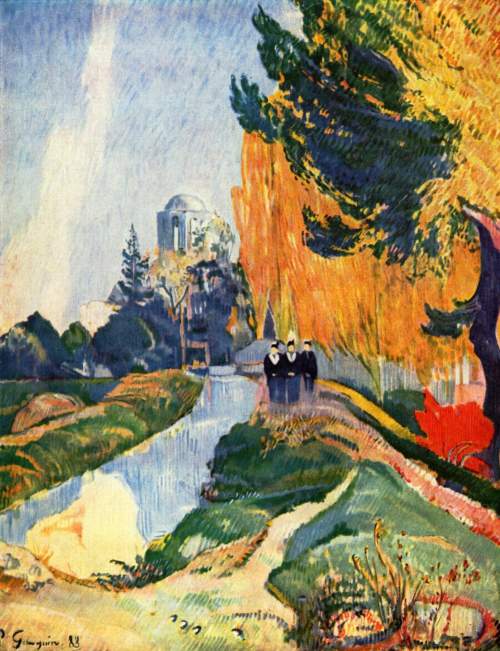
#FineArtFriday: A closer look at “The Alyscamps,” or “The Three Graces at the Temple of Venus” by Paul Gauguin 1888

Paul_Gauguin_les_alyscamps085

Artist: Paul Gauguin (1848–1903)

Title:  (English)The Alyscamps, or The Three Graces at the Temple of Venus

French: French: Les Alyscamps, ou Les Trois grâces au temple de Venus

Date: 1888

Medium: oil on canvas

Dimensions: height: 91.6 cm (36 in); width: 72.5 cm (28.5 in)

Collection: Musée d’Orsay

What I love about this painting:

Color! I love the vivid colors contrasted against the pale sky. The Three Graces in classical mythology are the goddesses of charm, beauty, nature, human creativity, goodwill, and fertility. They have come to symbolize faith, hope, and charity.

According to the internet, the traditional mythology Paul Gauguin explores in this composition demonstrates his early education and his appreciation of classical art. And truthfully, although he never trained formally, he did know his stuff. Before he became an artist, he was both a stockbroker and an art dealer/collector.

Gauguin is known for his use of bold colors, simplified forms, and strong lines. Again, according to the internet, this painting is a prime example of his study of form and color.

And he tells us a story. First, the eye is drawn to the vertical lines of the temple standing tall on the hill behind the figures. They are also depicted with a sense of height, and the hills beyond are tall and narrow.

A calm stream flows from beneath the temple, the river of time. The three women stand almost in the background, yet they are commanding, observing us and our lives as time passes them. They are as strong and unmovable as the rocky hills and the temple.

Gauguin tells us that time may pass, and things may change, but the Temple of Venus rises above it all. Does this Temple of Venus represent “agape,” a love that is selfless and unconditional? A kind of love that is spiritual in nature?

Maybe, and maybe not.

Paul Gauguin was a famously complicated man, conflicted and tormented by the contrasts of 19th century morality and the realities of his life.

Who knows what that temple meant to him on the day he created it? Either way, Gauguin’s Three Graces, Faith, Hope, and Charity, stand almost in the shadows, offering him comfort. They are as solid and eternal as time.

And who or what, I wonder, is the immense dark, nearly indistinct fourth shadow who peers over their left shoulder? It seems like a person’s form. Is it another of the Fates? Is it Death? There is so much to consider in this painting.

Paul Gauguin lived an eventful life. For a wonderful documentary on the man and his life, go to:

Why Is Gauguin So Controversial? (Waldemar Januszczak Documentary) | Perspective – YouTube

Also, check out Paul Gauguin – Wikipedia.


Credits and Attributions:

Image: Wikimedia Commons contributors, “File:Paul Gauguin 085.jpg,” Wikimedia Commons, https://commons.wikimedia.org/w/index.php?title=File:Paul_Gauguin_085.jpg&oldid=710795058 (accessed September 24, 2025).

Comments Off on #FineArtFriday: A closer look at “The Alyscamps,” or “The Three Graces at the Temple of Venus” by Paul Gauguin 1888

Filed under #FineArtFriday

#FineArtFriday:The Alyscamps, or The Three Graces at the Temple of Venus by Paul Gauguin 1888

Paul_Gauguin_les_alyscamps085

Artist: Paul Gauguin (1848–1903)

Title:  (English)The Alyscamps, or The Three Graces at the Temple of Venus

French: French: Les Alyscamps, ou Les Trois grâces au temple de Venus

Date: 1888

Medium: oil on canvas

Dimensions: height: 91.6 cm (36 in); width: 72.5 cm (28.5 in)

Collection: Musée d’Orsay

What I love about this painting:

Color! I love the vivid colors contrasted against the pale sky. The Three Graces in classical mythology are the goddesses of charm, beauty, nature, human creativity, goodwill, and fertility. They have come to symbolize faith, hope, and charity.

The traditional mythology Paul Gauguin explores in this composition demonstrates his early education and his appreciation of classical art. Before he became an artist, he was both a stockbroker and an art dealer/collector.

Although he never trained formally, Gauguin is known for his use of bold colors, simplified forms, and strong lines. This painting is a prime example of his study of form and color.

The eye is drawn to the vertical lines of the temple standing tall on the hill behind the figures. They are also depicted with a sense of height, and the hills beyond are tall and narrow.

A calm stream flows from beneath the temple, the river of time. The three women stand almost in the background, yet impressive, observing as time passes them. They are as strong and unmovable as the rocky hills and the temple.

Gauguin tells us that time may pass, and things may change, but the Temple of Venus rises above it all. Does this Temple of Venus represent “agape,” a love that is selfless and unconditional? A kind of love that is spiritual in nature? Paul Gauguin was a complicated man, conflicted and tormented by the contrasts of morality and the realities of his life.

Who knows what that temple meant to him on the day he created it, but either way, Gauguin’s Three Graces, Faith, Hope, and Charity stand almost in the shadows, offering him comfort. They are as solid as the mountains and eternal as time. And who is the dark, mysterious fourth who peers over their shoulder?

Paul Gauguin lived an eventful life. For a wonderful documentary on the man and his life, go to:

Why Is Gauguin So Controversial? (Waldemar Januszczak Documentary) | Perspective – YouTube

Also, check out Paul Gauguin – Wikipedia.


Credits and Attributions:

Image: Wikimedia Commons contributors, “File:Paul Gauguin 085.jpg,” Wikimedia Commons, https://commons.wikimedia.org/w/index.php?title=File:Paul_Gauguin_085.jpg&oldid=710795058 (accessed April 6, 2023).

7 Comments

Filed under #FineArtFriday