
 Author: László Mednyánszky (1852–1919)
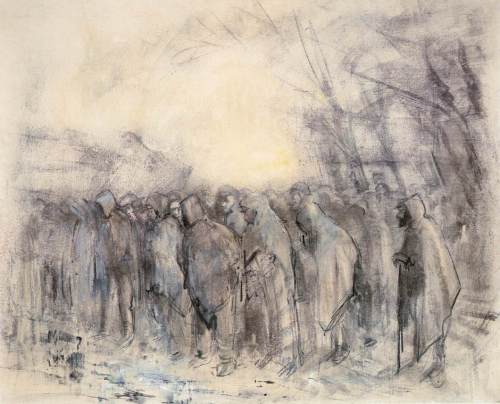
Description: English: Prisoners Marching Off
Magyar: Vonuló foglyok
Date: 1914
Today’s image is by the Slovak–Hungarian painter, László Mednyánszky. Despite his age (62), he was a war correspondent on the front-lines from 1914 when WWI broke out, until his death from wounds he received in 1918. He chronicled the chaos, the living conditions, and the tragedy of it all.
I think the fact he did this one in shades of black and gray (possibly mixed media, charcoal and oils) emphasizes the grimness of the scene. He shows us the hopelessness these prisoners feel, how they are just faceless playing pieces in a game they can’t even comprehend.
About the artist, via Wikipedia:
Baron László Mednyánszky, also known by his Latinized name Ladislaus Josephus Balthasar Eustachius Mednyánszky (Slovak: Ladislav Medňanský; 23 April 1852 – 17 April 1919), was a Slovak–Hungarian painter and philosopher, considered one of the most enigmatic figures in the history of Hungarian art
Mednyánszky’s works were largely in the Impressionist tradition, with influences from Symbolism and Art Nouveau. His works depict landscape scenes of nature, the weather and everyday, poor people such as peasants and workmen. The region of his birth, the northeastern part of the Kingdom of Hungary, part of Austria-Hungary, was the site and subject of many of his paintings; scenes from the Carpathian Mountains and the Hungarian Plains are numerous. He also painted portraits of his friends and family, and images of soldiers during the First World War whilst working as a war correspondent.
When the First World War broke out in 1914, Mednyánszky was in Budapest again. He worked as a war correspondent on the Austro-Hungarian frontlines in Galicia, Serbia, and the southern Tirol. In the spring of 1918, he returned to Nagyőr (Strážky) to recover from war wounds. After spending some time working in Budapest, Mednyánszky died in poor health in the spring of 1919, in Vienna. He was homosexual, having had several relationships with men throughout his life. The longest and most important one, with Bálint Kurdi of Vác, lasted for decades.
His works are currently displayed in the Slovak National Gallery in Bratislava and Strážky chateau, which was donated to SNG by his niece Margit Czóbel in 1972. Many of his works are displayed in the Hungarian National Gallery in Budapest as well. A large number of his works were destroyed during the Second World War.
In 2004 a New York gallery was host to a show of about seventy 19th- and early 20th-century Hungarian paintings, and a few works on paper, from the collection of Nicholas Salgo, a former United States ambassador to Hungary. The exhibition’s title, Everywhere a Foreigner and Yet Nowhere a Stranger, was drawn from Mednyánszky’s diary. [1]
Credits and Attributions:
IMAGE: Wikimedia Commons contributors, “File:László Mednyánszky Prisoners Marching Off 1914-18.jpg,” Wikimedia Commons, https://commons.wikimedia.org/w/index.php?title=File:L%C3%A1szl%C3%B3_Medny%C3%A1nszky_Prisoners_Marching_Off_1914-18.jpg&oldid=227591696 (accessed February 8, 2024).
[1] Wikipedia contributors, “László Mednyánszky,” Wikipedia, The Free Encyclopedia, https://en.wikipedia.org/w/index.php?title=L%C3%A1szl%C3%B3_Medny%C3%A1nszky&oldid=1197892373 (accessed February 8, 2024).


 Life in the Realm of Fantasy