
The books I love are written with bold words crafted into evocative prose. The way the words are shaped into sentences and paragraphs engages me. But the words are only there to illuminate the emotional lives and actions of the characters.
The prose makes the story real and immediate to me. In the best stories, the characters have depth and are memorable because both the antagonist and protagonist are powerful but not omnipotent. They have character arcs that change and grow as the story progresses.
 Characters aren’t fully formed when you first lay pen to paper. They evolve as you go, growing out of the experiences you write for them. Sometimes, these changes take the story in an entirely different direction than was planned, which involves a great deal of rewriting. It helps me remain consistent if I note those changes on my outline because then I don’t forget them.
I like stories featuring characters who are sometimes hasty, sometimes wrong-headed. They make mistakes and cause themselves more trouble because they’re inexperienced and don’t know what they’re doing.
As the story falls from our imagination, each character’s personal arc is shaped by the events they experience within the story arc.
How do they handle setbacks? How do they handle success? How do they see their future when we meet them on page one? Has their view of the future changed by the time we arrive at the final page?
If the characters are changed by the events they experience, the reader will be, too. Our characters’ emotional state is critical because emotions engage readers. We want our readers to experience the crisis, so we must craft that scene carefully.
 I highly recommend the Writers Helping Writers Series of textbooks written by Angela Ackerman and Becca Puglisi. They are a wonderful resource for when you need ideas for showing a variety of emotions rather than telling them.
We want a balanced narrative, one where the telling and showing are seamlessly woven together.
The tricky part of this is in the execution, in knowing what to tell and what to show. When someone is happy, what do you see? Bright eyes, laughter, and smiles. When you are happy, how do you feel? Energized, confident. Show those feelings briefly and move on. Don’t swamp us with detailed shoulder sagging, lips twisting, and face drooping all in one sentence.
So now, we need to combine the surface of the emotion (physical) with the deeper aspect of the emotion (internal). Not only that, but we want to write it so that we aren’t telling the reader what to feel. We are still in the inferential layer of the story. Our job is to make the reader experience that emotion.
A short list of simple, commonly used, easy-to-describe surface emotions:
- Admiration
- Affection
- Anger
- Anticipation
- Awe
- Confidence
- Contempt
- Denial
- Desire
- Desperation
- Determination
- Disappointment
- Disbelief
- Disgust
- Elation
- Embarrassment
- Fear
- Friendship
- Grief
- Happiness
- Hate
- Interest
- Love
- Lust
- Pride
- Revulsion
- Sadness
- Shock
- Surprise
Other emotions are complex and challenging to show. They are complicated and deeply personal. These are the gut-wrenching emotions that make our work speak to the reader.
So, here is an even shorter list of rarely well-described, difficult-to-articulate, complex emotions:
- Anguish
- Anxiety
- Defeat
- Defensiveness
- Depression
- Indecision
- Jealousy
- Ethical Quandary
- Inadequacy
- Powerlessness
- Regret
- Resistance
- Temptation
- Trust
- Unease
- Weakness
Complex emotions are often best when shown by an immediate physical reaction combined with internal dialogue or conversations. Conversations are opportunities to show depth as well as convey information. This pertains to the internal monologues of your characters, too.
We have mental conversations with ourselves in real life. Sometimes, we even speak our thoughts aloud, convincing the neighbors that we’re crazy.
Researchers say that most of the time, our inner monologue is about how we see ourselves. These thoughts are often in whole sentences and phrased negatively. And most telling of all, we aren’t usually aware of our inner thoughts when we have them.
However, an interior monologue is a good tool for revealing motives. What our characters think but don’t speak aloud tells the reader a lot about them.
It shows who they think they are as well as how they perceive others. Sometimes, revealing a critical bit of backstory can only be accomplished through the protagonist’s thought processes or those of a companion.
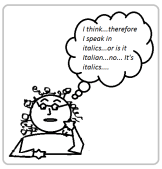 At any gathering of authors, a determined group will proclaim that thoughts should not be italicized under any circumstances. While I disagree with that view, I do see their point.
As a reader, my eyes tend to skip over long passages of italicized words. Italicizing thoughts is an accepted practice in the genres of Sci-fi, Fantasy, and YA novels, and readers of those genres expect to see thoughts shown that way.
- However,we need to be aware of how overwhelming it is for a reader to be faced with a wall of words written in a leaning font.
If the author makes it clear that the characters are having mental conversations with themselves, italics aren’t needed.
It was, he thought, one of those rare days where the sun shone benevolently upon mankind, a day when the constant wind was gentle, benign. Aloud, he said, “Enjoy the sun while you can, my friend. The rain is eternal here.”
Dialogue, both spoken and interior, serves two purposes. It sets the scene and reveals the theme. Your word choices show the characters as they are, gradually revealing their secrets and showing us their personalities.
Your word choices reveal you, the author. Through those words, we hear your voice.
Contrasts are key. Consider the relative security of the characters’ lives as they were in the opening paragraphs contrasted against the hazards of where they are now. Each person experiences uncertainty, fear, anger, and a sense of loss differently. Those differences make them unique to us.
 In a good story, bad things have happened, pushing the characters out of their comfortable rut. They must become creative and work hard to acquire or accomplish their desired goals.
How they overcome their doubts and make themselves stronger is what makes each character interesting. That internal and emotional journey is the real story.
So next up, we’ll talk about motivations. Nothing happens unless a character is sincerely motivated.


 Life in the Realm of Fantasy