
Mind-wandering … daydreaming … sitting around, and doing nothing, thereby annoying family members with agendas of their own. It’s an activity that is looked down upon because it represents idleness in a society that demands productivity. We have a culture that celebrates doing, achieving, producing, and succeeding.
 When observed by others, a person who is daydreaming appears lazy. Mind-wandering has no obvious purpose, but it is critical for creativity. Every groundbreaking discovery in science, every great invention we enjoy today—all were inspired by ideas that came to a person while thinking about something else or when they were mind-wandering.
Taking the time to sit and think about nothing in particular has everything to do with the nature and genesis of storytelling.
The ability to explain the world through stories and allegory emerges strongly in some people. Many are naturally able to form and express a story, even when discretion would be better. I can create a string of BS like no one else at the drop of a hat:
My oldest daughter, looking at our dinner, a casserole of beans with cornbread baked on top like a cobbler: “What the heck is that?”
Me, ever the smartass: “It’s stewed Yeti in gravy with a sweet cornbread topping. Try it. I think you’ll like it.”
Daughter: “Why can’t we have normal food, like normal people?” Takes a bite. “Mom. This tastes like the beans we had last night, except you added cornbread. You said the beans were jackalope nuggets.”
Me: “Did I say that? Sorry. I meant Yeti. I get the two confused.”
Daughter: “I’ll just have salad.”
Me: “Great choice. I made the ranch dressing with …”
Daughter: “Oh, God. Here it comes.”
Me: “… lion’s milk, since we’re out of buttermilk.”
Other people need the subliminal prompting of an image to spark their creativity. If you’ve visited here at Life in the Realm of Fantasy on a Friday, you know how much I love looking at and talking about art.
I’m not educated as an art historian, and I hope I don’t come off as pretending to be one. But I love the paintings of great artists because they tell a story. I like to research great art and the artists who created it. I love to share the images I come across and hopefully give others like me access to see the art that humanity is capable of, good and bad.
 Perception is in the eye of the beholder. Observation and thought are seeds that inspire extrapolation, leading the viewer to come away with new ideas. When I see the story captured in a single scene by an artist, my mind always surmises more than the painting shows. I see the picture as depicting the middle of the story and imagine what came before and what happened next. Unintentionally, I put a personal spin on my interpretation, and ideas are born. I don’t mean to, but everyone does.
Wikipedia tells us this about that: In mathematics, extrapolation is a type of estimation, beyond the original observation range, of the value of a variable on the basis of its relationship with another variable. It is similar to interpolation, which produces estimates between known observations, but extrapolation is subject to greater uncertainty and a higher risk of producing meaningless results. [1]
In real life, extrapolation is the act of an idea emerging from an idea, creating a chain of ideas that coalesce and form an assumption. That assumption generates more ideas, and the “thought party” roars on. This is how great novels begin.
Anthony Jack, a cognitive scientist at Case Western Reserve University in Ohio, says, “How we daydream and think depends on the brain’s structure. …(That) structure is constantly changing in small ways—as we learn new things the connections between nerve cells change.” (Read “Beyond the Brain” in National Geographic magazine.) [2]
We have long known that creative people are often guilty of mind-wandering. Researchers have shown that daydreaming makes you more creative. The mental conversation occurs when the daydreaming mind cycles through different parts of the brain and taps into the subconscious mind, bringing up information we had but were unaware of. The daydreaming mind connects bits of information we’ve never considered in that particular way.
According to a study published in the Proceedings of the National Academy of Sciences, a wandering mind can impart a distinct cognitive advantage. [3]
 This means that daydreaming is actually good for you. It boosts the brain, making our thought process more effective. Letting the mind wander allows a kind of ‘default neural network’ to engage when our brain is at wakeful rest, as in meditation, rather than actively focusing on the outside world. When we daydream, our brains can process tasks more effectively.
This is good to know because, as an author, I spend an astounding amount of time daydreaming, and I would hate to be simply wasting time!
Meditating on a tone, a pattern, or an image is a time-honored means of expanding one’s mind. Meditating or daydreaming turns off parts of your brain. Our brain has an analytic part that makes reasoned decisions and an empathetic part that allows us to relate to others.
Researchers have found when a person daydreams, their mind naturally cycles through different modes of thinking, analytic and empathetic. During this time, your brain’s rational and sympathetic parts tend to turn each other off, which is why this habit is crucial to creativity.
Creative people are often guilty of mind-wandering, but researchers have shown that daydreaming makes you more creative.
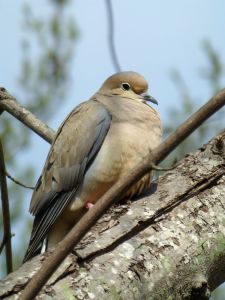
 You could be watching the birds, as my husband and I often do. Or maybe you’re perusing the display in a local art gallery or listening to music. I love all genres of music, but for writing I often find inspiration in powerhouse classical pieces such as Orff’s cantata, Carmina Burana, or Nobuo Uematsu‘s soundtracks to the Final Fantasy game franchise.
Whatever you choose to meditate on doesn’t matter. The act of mind-wandering generates ideas.
Let your mind wander. That feeling of stress will lessen, and soon, you may have an idea for a novel, a painting, or music.
Credits and Attributions:
Cornbread, Zankopedia, CC BY-SA 3.0 Wikimedia Commons contributors, “File:Skillet cornbread (cropped).jpg,” Wikimedia Commons, https://commons.wikimedia.org/w/index.php?title=File:Skillet_cornbread_(cropped).jpg&oldid=449104554 (accessed June 24, 2023).
[1] Wikipedia contributors, “Extrapolation,” Wikipedia, The Free Encyclopedia, https://en.wikipedia.org/w/index.php?title=Extrapolation&oldid=1144519982 (accessed June 24, 2023).
[2] Beyond the Brain by James Shreeve, Cognitive Function Article, Neuroscience Information, Mapping Brain Facts — National Geographic Copyright © 1996-2015 National Geographic SocietyCopyright © 2015-2023 National Geographic Partners, LLC. All rights reserved (accessed June 24, 2023)
[3] Where do our minds wander? Brain waves can point the way (medicalxpress.com) by Yasmin Anwar, University of California – Berkeley (accessed June 24, 2023)


 Life in the Realm of Fantasy
.jpg&oldid=449104554)