
I love writing short stories because they offer me opportunities to experiment with both style and genre. It’s a challenge for a wordy writer like me to build a world in only a few words and still tell a story with a beginning, a middle, and an end.
 In any story, the words we choose must do some heavy lifting. They must be strong and visual to show the setting, and when we combine them with a powerful theme, a few well-chosen words will convey atmosphere and mood.
Usually, I write my ideas in an outline form that becomes the first draft, but not always. Sometimes I write the story as it unfolds in my mind. Then, I take that very rough draft and turn it into an outline and rewrite it.
Let’s say I need to write a story for a contest or publication with a 2,000-word limit. Once I have the outline in shape, I will mentally divide the story into 3 acts. Act 1 must be told in 500 words. I will have 1,000 words to spend on Act 2, and finally, Act 3 will have to wrap things up in 500 words.
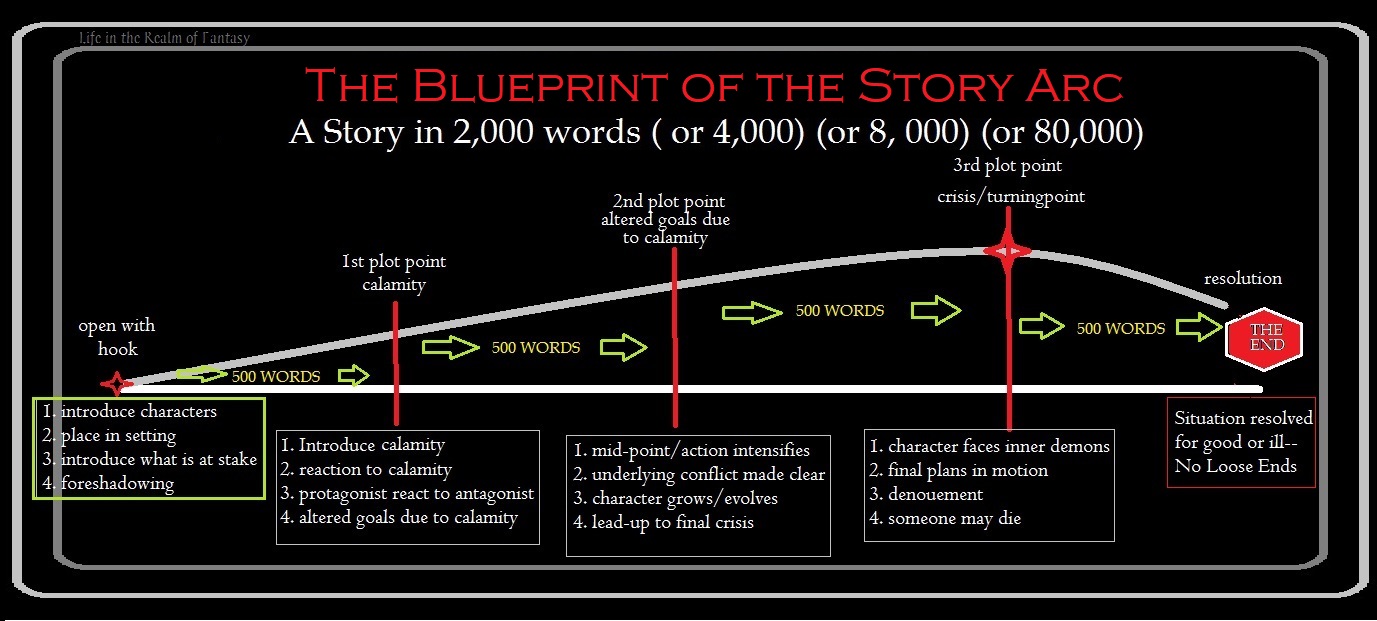
- For any story, if you know the intended word count, you can divide the plot outline that way.
Knowing my intended word count helps me write a story, from drabbles to novels. This method works for stories with a traditional arc as well as those with a circular arc.
 In a circular narrative, the story begins at point A, takes the protagonist through life-changing events, and brings them home, ending where it started. The starting and ending points are the same, and the characters return home, but they are fundamentally changed by the story’s events. The Hobbit is a tale with a circular story arc, as are many tales that follow the Hero’s Journey.
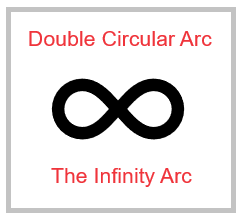
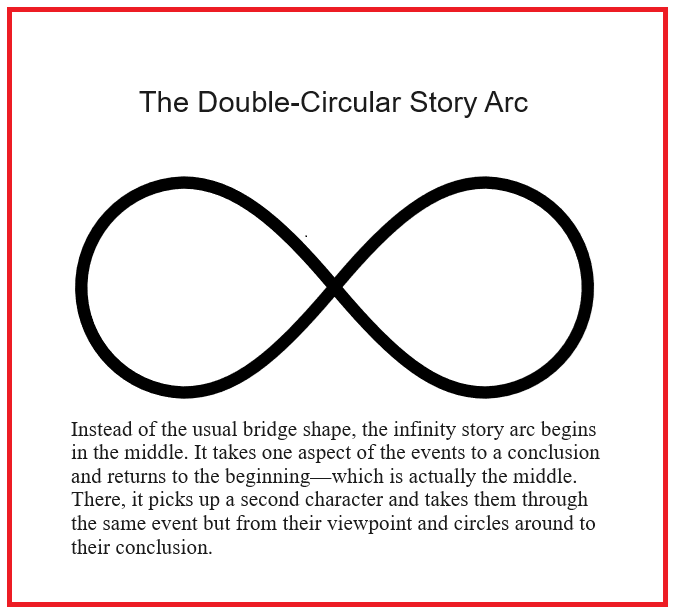
The infinity arc is similar but presents one story from two different viewpoints. The story begins with Character One, takes them through the events, and brings them back. At that point, the story shifts to Character Two and retells the events from their point of view, bringing them back to where they began. (Two circular story arcs joined by one event.) If we graphed it out, it would look something like an infinity sign, a figure-eight lying on its side: ∞
The story I’m using for today’s example is the Iron Dragon, which I wrote during NaNoWriMo 2015. That was the year I focused on experimental writing, putting out at least one short story every day and sometimes two. It’s the story of the web of time glitching and the perceptions of the characters who experienced it.
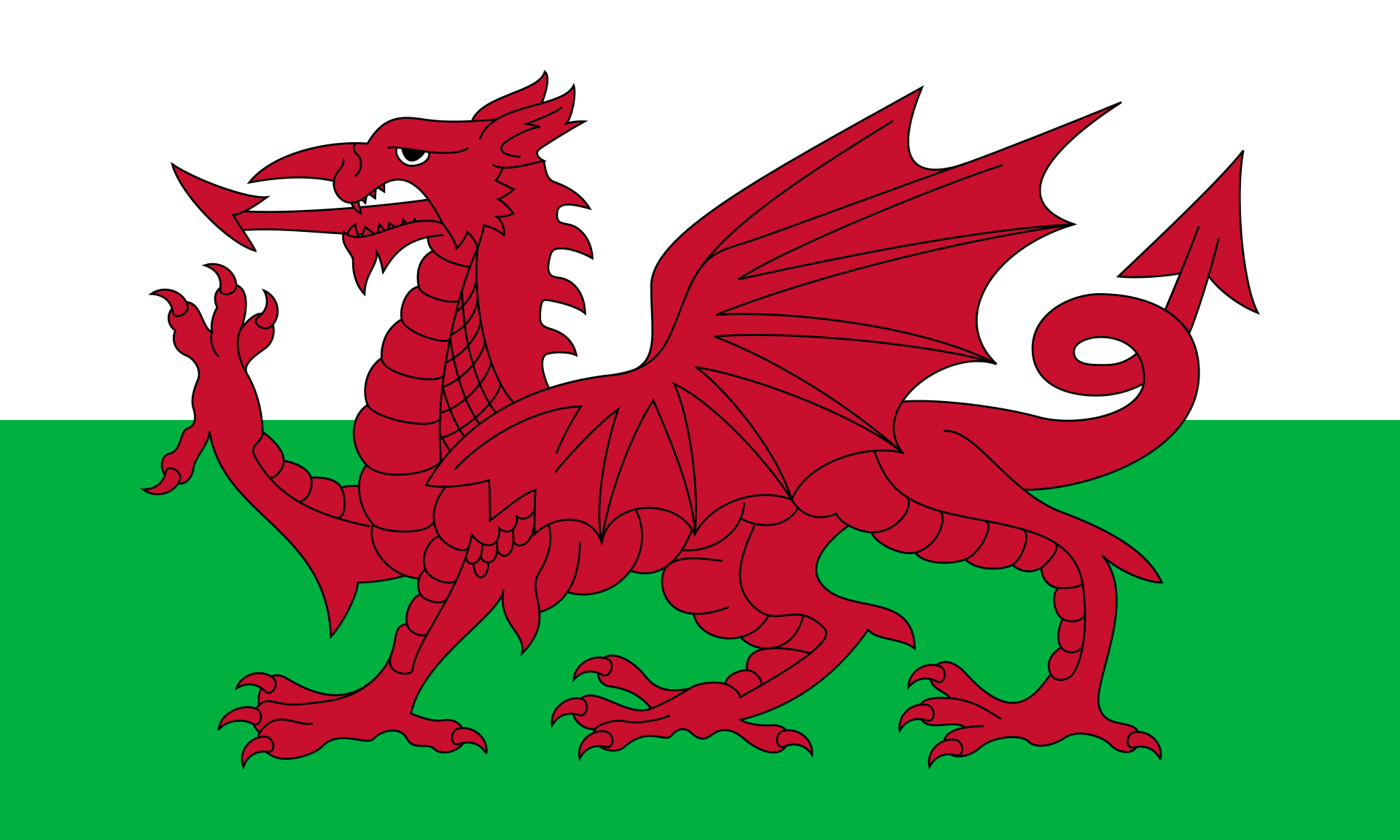 That year, a writing prompt I found on a writers’ website encouraged us to expand on the theme of dragons and use it to illustrate two aspects of a place. I chose to set my story in Wales, a country whose national symbol is the Red Dragon (Welsh: Y Ddraig Goch).
I am not Welsh, nor did we study Wales in school, so I had to go out and do some research. In the process, I learned a great deal and gained immense respect for a country I had known little about.
Once I had an idea of the two worlds I was building, I couldn’t resist setting two more goals to achieve.
- I decided to experiment with the double circular story arc, seeing it as a way to tell one story as lived by two protagonists separated by twelve centuries and a multitude of legends.
- I chose to use 1,000 words to tell both stories. I was not entirely successful, but I did keep it down to 1,025 words.
 As I mentioned above, in the double circular arc, two characters are protagonists. Their stories begin at the same place, the center of the infinity symbol. They experience the event simultaneously but separately and arrive back at the same place. Both characters are tested and changed by what they have lived through. In some stories with this kind of story arc, the two characters never meet.
In the Iron Dragon, my characters physically don’t meet in person. However, they briefly occupy the same patch of ground during a glitch in the space-time continuum.
This story ends where it began, but with the two sets of characters having seemingly experienced two different events. Their perception of the meeting is colored by the knowledge and superstitions of their respective eras.
- The first paragraph of the Iron Dragon begins in the middle of a story: the center of the infinity sign.
Those opening sentences establish the world, set the scene, and introduce the first protagonist.
- The following three paragraphs show the situation and establish the mood. They also introduce the antagonist, which appears to be an immense iron dragon.
 At this point, our first protagonist knows that he must resolve the problem and protect his people, which he does.
But this is a story with two sides. Aeddan’s point of view is not the entire story.
- Again, I had to set the scene and establish the mood and characters. Here, we meet the second protagonist, an engine driver named Owen. He has the same needs as Aeddan and also resolves the problem.
Neither character would have understood the strange physics of what just occurred had Brian Cox been around to explain it to them.
- Each character’s understanding of what they saw and experienced is firmly based on the beliefs and lore of their era, and both do what they must to protect their people.
- The final paragraphs wind it up. They also contribute to the overall atmosphere and setting of the second part of the story.
As a practice piece, the story had good bones. However, it’s not the right kind of story for submission to a magazine or contest, as it’s not a commercially viable piece.
The act of writing something different, a little outside my comfort zone, forces me to be more imaginative in how I tell my stories. We should all have a little fun with writing. Give that double circular arc a shot and see what you come up with.
Credits and Attributions:
IMAGE: The Hero’s Journey, Public Domain. Wikimedia Commons contributors, “File:Heroesjourney.svg,” Wikimedia Commons, https://commons.wikimedia.org/w/index.php?title=File:Heroesjourney.svg&oldid=1013027507 (accessed July 20, 2025).


 Life in the Realm of Fantasy