
When we write a tale involving human beings, morality will likely enter it at some point. What is our responsibility as authors when it comes to telling our stories? I feel it’s important to write honest characters, no matter the genre.
 Do you write your heroes with few flaws, or do you portray them as “warts and all?” That becomes a matter of what you want to read.
Some people want cozy, comfy stories, written in such a way that a happy ending is assured. There is nothing wrong with that and there is a market for those stories.
For myself, I gravitate to tales written with guts and substance. Give me the Flawed Hero any day.
In Huw the Bard, I describe a murder committed in cold blood. I take you from the worst moment in Huw’s life and follow him as he journeys to a place and an act which, if you had asked him two months prior, he would have sworn he was incapable of committing. Sadly, this is not the lowest point in his tale. It is, however, the beginning of his journey into adulthood.
Does my writing the story of this terrible act mean I personally advocate revenge murders? Absolutely not. I believe no human being has the right to take another’s life or harm anyone for any reason.
 Still, I write stories about people who might have existed and have their own views of morality. In each tale, I try to get into the characters’ heads. I want to understand why they sometimes make terrible choices, acts that profoundly change their lives.
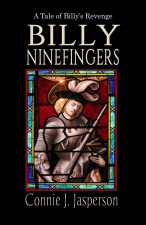
The Billy’s Revenge series is set in the world of Waldeyn. Billy Ninefingers appears as a character at the end of Huw the Bard and is the man the series is named after.
Having just inherited the captaincy of a mercenary band known as the Rowdies, Billy is on the verge of having everything he ever wanted. However, an unwarranted attack by a jealous rival captain seriously wounds him, destroying his ability to swing a sword. Desperate to hold on to his inheritance, Billy must build a new future for himself and the Rowdies despite his disability.
In keeping with the theme in this series, his tale explores how we justify our actions for good or ill and how his worst moments shape his life.
Toward the end of that book, Huw’s story converges with Billy’s, a small glimpse of the bard’s life as a mercenary. Some of my other favorite characters also appear in Billy’s tale of trouble and woe because his story and the Rowdies are intertwined.
Billy and Huw both came into existence thanks to the original draft of Julian Lackland. They were characters who had an immense influence on Lackland and who both deserved their own stories. All three men are heroes, and all three have done things they are not proud of.
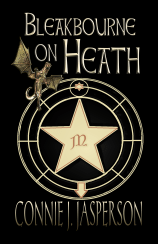 To me, the flawed hero has much to offer us. In my most recently published book, a stand-alone novel called Bleakbourne on Heath, we meet Leryn, a young bard with a romantic view of life.
His two primary desires are simple, the sort of dreams any young person might have. As a bard, he wants to find and write the stories of Angland’s romantic and mysterious past, and he hopes to someday be married and settled down.
Unfortunately, being situated at the crossroads between the mortal realm and Hell, Bleakbourne isn’t as quiet and peaceful as he had hoped. Against his will, Leryn becomes involved with people he thought were only legends, discovering that being a hero is a lot less glamorous than it sounds.
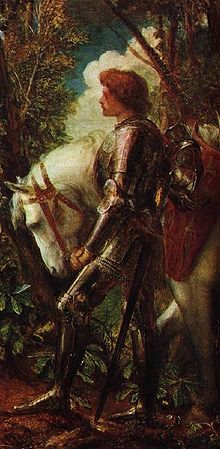
Sir Galahad by George Frederick Watts PD|100
One of my favorite characters in Bleakbourne is Lancelyn Reynfrey, Knight at Large. Lance believes in the purity of knighthood and the responsibility of a knight to serve and protect the humblest people. He is convinced he has no imperfections to cast a shadow on his worthiness.
Unfortunately, his relationship with a neighbor’s son led to his family hiring a matchmaker and marrying him off to a somewhat naïve sorceress. That didn’t go well, and when we meet Lance, he isn’t as white a knight as he wishes, although he is definitely not a black knight.
He’s more of a grayish knight, a man under a terrible curse and with vengeance in his heart.
However, Leryn the bard does meet a black-hearted knight, and while that encounter is not a high point in his week, it sets the plot in motion.
In real life, we all have areas of gray in our moral code, although we usually choose to ignore them. These areas of ethical ambiguity are what make the written character fascinating. Nothing is less intriguing to me than a perfect person doing perfect things in a perfect world.
I try to tell the best story I can, because I am writing for my own consumption–I am my target audience. This means sometimes I stretch the bounds of accepted morality. I sometimes look into the shadowed areas of human nature, not for the shock value but because the story demands it.
The fantasy genre is written for entertainment, and that is where my reading interests lie. So, when I write a story, I want to tap into the emotions of the moment, which means writing perfectly imperfect characters.
The story should take the reader on an emotional journey with the hero and the antagonist. Both must have goals, both must face setbacks, and both must work to overcome those hurdles.
 The difference between the antagonist and the hero is the amount of grayness in their moral compass. When does the gray area of morality begin edging toward genuinely dark? What are they not willing to do to achieve their goal?
Answering that question can take the story in a direction that surprises you. For me, those are the best moments as a writer, the days when I become fired up for my story and can’t stop thinking about it.


 Life in the Realm of Fantasy