Tag Archives: voice and style

Revisiting Voice, Word Choice and Placement #writing


This week’s post is a reprint of a post on voice and how we phrase things. It first appeared here on February 17, 2020.

Writing is journey.

When I began writing, the way I placed my words slowed my prose, made it more passive. As I have grown, I have learned to place my verbs in such a way that the prose is more active. I say the same things, but my style is leaner than it was.

My weekend was spent with my hubby at the hospital (all is well now) and I had no time or inclination to write a new take on how word choices form our writing voice. I hope you enjoy this second look at one of my favorite subjects.


We are drawn to the work of our favorite authors because we like their voice. An author’s voice is the unique, recognizable way they choose words and assemble them into sentences.
With practice, we become technically better at the mechanics (grammar and punctuation) but our natural speech habits shine through. Voice is how we bend the rules and is our authorly fingerprint.

When we begin the editing process with a professional editor, most will ignore the liberties we take with dialogue but will point out our habitual errors in the rest of the narrative.

Many times, what we want to say is not technically correct, but we want that visual pause in that place, in that sentence. Casual readers who leave reviews will have gained some understanding of grammar but if your voice is consistent, they will accept your choice. However, they will notice inconsistencies and illiterate writing.

This is why the process of editing is so important. Knowledge of the mechanics of writing is crucial. If you don’t understand the rules, you can’t break them with authority. (For the first part of this series, see my post Revisions: Self-Editing.)

Consider Raymond Chandler’s dismay when he discovered his grammar had been heavily edited by a line editor and then published without his input in the corrections:

“By the way, would you convey my compliments to the purist who reads your proofs and tell him or her that I write in a sort of broken-down patois which is something like the way a Swiss waiter talks, and that when I split an infinitive, God damn it, I split it so it will stay split, and when I interrupt the velvety smoothness of my more or less literate syntax with a few sudden words of barroom vernacular, this is done with the eyes wide open and the mind relaxed but attentive. The method may not be perfect, but it is all I have.”  – Raymond Chandler, in a letter to Edward Weeks, Editor of The Atlantic Monthly, dated 18 January 1947. (Read the letter in its entirety here.)

When we self-edit, we don’t have to wrestle for control of our work, true. But I have to be honest—I have worked with many editors over the past ten years, and only one tried to hijack my manuscript.

What is the mood you want to convey with your prose? Where you place the words in the sentence greatly affects the mood. Active prose is Noun-Verb centric. Compare these sentences, two of which are actively phrased, and two are passive. All say the same thing, and none are “wrong.”

I run toward danger, never away.

I never run away from danger.

Danger approaches, and I run to meet it.

If it’s dangerous, I run to it.

Can you tell which are passive and which are active? Which phrasing resonates with you? Could you write that idea in a different way?

Where we choose to place the core words, I run to danger, changes their voice but not their meaning. The words we choose to surround them with changes the mood but not their meaning.

Other ways to use the core concept of I run to danger:

Danger draws me. I race to embrace it, to make it mine.

If it’s dangerous or stupid, I will find it.

Danger—who cares. Running away is stupid; it always finds you. Meet it, grab it, and make it yours.

I saw him, and in that moment, I knew I’d met my destiny. He was the embodiment of danger, and I wanted him.

We could riff for half an hour on just four words, I run to danger. Each of us will write that idea with our own brand of brilliance, and none of us will sound exactly alike.

One of the things we must look at in our work is consistency. Is our narrative comprised of a smooth pattern? We don’t want our work to be jarring, so we want to think push, glide, push, glide.

Once you have established the mood you are trying to convey, look at how you have placed your verbs in the majority of your sentences.

Some are: noun – verb – modifier – noun. I run to danger when I see it. (Active)

Some are: infinitive – noun – verb –  modifier – noun. When I see danger, I run toward it. (Passive)

NOTE: PASSIVE VOICE DOES NOT MEAN WRONG!

Good writing is about balance. How we combine active and passive phrasing is part of our signature, our voice. By mixing the two, we choose where we direct the reader’s attention.

Some work you want to feel highly charged, action-packed. Genres such as scifi, political thrillers, and crime thrillers need to be verb forward in the way the words are presented. These books seek to immerse the reader so more sentences should lead off with Noun – Verb, followed by modifiers.

If you clicked on the link and read Raymond Chandler’s letter in full, you will see it is aggressive and verb-forward, just the way his prose was.

In other genres, like cozy mysteries, you want to create a sense of comfort and familiarity of place with the mood. Perhaps you want to slightly separate the reader from the action to convey a sense of safety, of being an interested observer. You want the reader to feel like they are the detective with the objective eye, yet you want them immersed in the romance of it. To do that, you balance the active and passive sentence construction, so it is leaning slightly more toward the passive than a thriller.

Weak prose makes free with all the many forms of to be (is, are, was, were).

  • He was happy.
  • They were mad.

Bald writing tells only part of the story. For the reader to see and believe the entire story, we must choose words that show the emotions that underpin the story.

To grow in the craft, we learn to convey what we see through words.

Passive voice balances Active voice.

It is not weak, as weak prose distances the reader from the experience, and when active prose is interspersed with passive, it does not.

Voice is defined by word choice, and Passive or Active prose is defined by word placement, not how many words are used.

Weak prose usually uses too many words to convey an idea. So, we want to avoid wordiness no matter what mood we are trying to convey.

  • One clue to look for is the overuse of forms of to be, which can lead to writing long, convoluted passages.

How many compound sentences do you use? How many words are in each sentence? Can you see ways to divide long sentences to make them more palatable?

A wall of words turns away most readers. Look at your style, as you work your way through your revisions, and see what positive changes you can make in how you consistently phrase things.

Take a short paragraph from a work in progress and rewrite it. Try to convey that thought in both passive and active voice. Then blend the two. You might learn something about how you think as a writer when you try to write in an unfamiliar style.

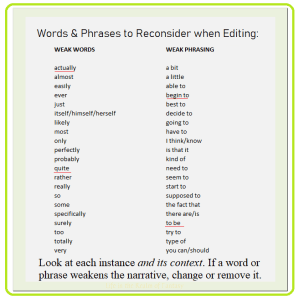
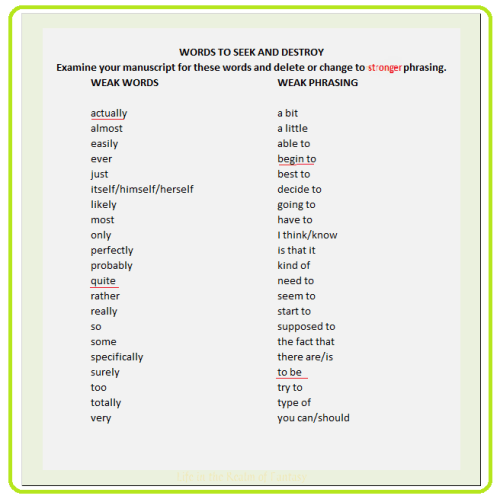
The following is a  list of words I habitually use in a first draft and then must look for in my own work. I look at each instance and decide if they work as they should or weaken the sentence. If they weaken the prose, I change or remove them.
Comments Off on Revisiting Voice, Word Choice and Placement #writing

Filed under writing

Making Effective Revisions part 2: crutch words, style, and voice #writing

Our stories are an unconscious reflection of what we wish our favorite authors would write. But what is it that attracts us to their writing?

We love their style, their voice.

Some authors are forceful in their style and throw you into the action. They have an in-your-face, hard-hitting approach that comes on strong and doesn’t let up until the end.

Others are more leisurely, casually inserting small hooks that keep you reading.

What are voice and style?

  1. The habitual choice of words shapes the tone of our writing.
  2. The chronic use and misuse of grammar and punctuation shapes the pacing of our sentences.
  3. Our deeply held beliefs and attitudes emerge and shape character arcs and plot arcs.

We develop our own voice and style when we write every day or at least as often as possible. We subconsciously incorporate our speech patterns, values, and fears into our work, and those elements of our personality form the voice that is ours and no one else’s.

The words we habitually choose are a part of our fingerprint. First drafts are rife with crutch words. This is because, in the rush of laying down the story, we tend to fall back on certain words and ignore their synonyms. A good online thesaurus is a necessary resource.

I prefer to keep my research in hardcopy form, rather than digital. I have mentioned this before, but The Oxford Dictionary of Synonyms and Antonyms is a handy tool when I am stuck for alternate ways to say something.

And it makes the perfect place to rest my teacup.

We all have words that we choose above others because they say precisely what we mean. I think of my fallback words as a code. At this point in my career, I know what those words are and when I am making revisions, I make a global search for them and insert alternatives that show my idea more vividly.

Looking at each example of a code word and their synonyms gives me a different understanding of what I am trying to say. It gives me the opportunity to change them to a more powerful form, which conveys a stronger image and improves the narrative. (I hope.)

Saying more with fewer words forces us to think on an abstract level. In poetry we have to choose our words based on the emotions they evoke, and the way they portray the environment around us. This is why I gravitate to narratives written by authors who are also poets—the creative use of words elevates what could be mundane to a higher level of expression, and when it’s done well, the reader doesn’t consciously notice the prose, but they are moved by it.

What are some words that convey powerful imagery, some that heighten tension when included in the prose?

  • Lunatic
  • Lurking
  • Massacre
  • Meltdown
  • Menacing
  • Mired
  • Mistake
  • Murder
  • Nightmare
  • Painful
  • Pale
  • Panic
  • Peril
  • Slaughter
  • Slave
  • Strangle
  • Stupid
  • Suicide
  • Tailspin
  • Tank
  • Targeted
  • Teetering

And those are just the beginning.

Our word choices are a good indication of how advanced we are in the craft of writing. For instance, in online writing forums, we are told to limit the number of modifiers (adjectives and adverbs) we might habitually use.

We are like everyone else. Our work is as dear to us as a child, and we can be just as touchy as a proud parent when it is criticized. We should respect the opinions of others, but we have the choice to ignore those suggestions if they don’t work for us.

Our voice comes across when we write from the heart. We gain knowledge and skill when we study self-help books, but we must write what we are passionate about. So, the rule should be to use modifiers, descriptors, or quantifiers when they’re needed.

How we use them is part of our style. Modifiers change, clarify, qualify, or sometimes limit a particular word in a sentence to add emphasis, explanation, or detail. We also use them as conjunctions to connect thoughts: “otherwise,” “then,” and “besides.”

Descriptors are adverbs and adjectives that often end in “ly.” They are helper nouns or verbs, words that help describe other words. Some descriptors are necessary but they are easy to overuse.

Do a global search for the letters “ly.” A list will pop up in the left margin and the manuscript will become a mass of yellow highlighted words.

I admit it takes time and patience to look at each instance to see how they fit into that context. If, after looking at the thesaurus, I discover that the problem descriptor is the only word that works, I will have to make a choice: rewrite the passage, delete it, or leave it.

Quantifiers are abstract nouns or noun phrases that can weaken prose. They convey a vague impression or a nebulous quantity, such as: very, a great deal ofa good deal ofa lot, many, much, and rather. Quantifiers have a bad reputation because they can quickly become habitual, such as the word very.

We don’t want our narrative to feel vague, nebulous, or abstract.

  • In some instances, we might want to move the reader’s view of a scene or situation out, a “zoom out” so to speak. The brief use of passive phrasing will do that. I saw the gazelles leaping and running ahead of the grassfire, hoping to outrun it. They failed.

I saw is a telling phrase, slightly removing the speaker from the trauma.

Limiting descriptors and quantifiers to conversations makes a stronger narrative. We use these phrases and words in real life, so our characters’ conversations will sound natural. The fact we use them in our conversation is why they fall into our first drafts.

Our narrative voice comes across in our choice of hard or soft words and where we habitually position verbs in a sentence. It is a recognizable fingerprint.

Many times, I read something, and despite how well it is constructed and written, it doesn’t ring my bells. This is because I’m not attracted to the author’s style or voice.

That doesn’t mean the work is awful. It only means I wasn’t the reader it was written for.

3 Comments

Filed under writing

Dissecting Voice/Style #writing

What does “voice” refer to in literature? It is an author’s habit, their fingerprint, a recognizable “sound” in the way they communicate their stories.

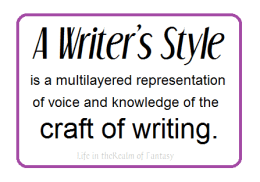
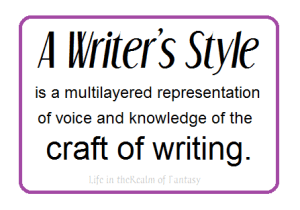
a writer's styleWhen we speak aloud, we habitually use certain words and phrase our thoughts a particular way. The physiology of our throats is unique to us. While we may sound very similar to other members of our family, pitch monitoring software will show that our speaking voice is distinctive to us.

For some of us, the moment we say “hello,” our friends and family know it’s us on the other end of the telephone, even without caller ID.

The same is true for our writing.

Our voice is comprised of the way we construct paragraphs, the words we choose, and the narrative mode and time/tense we prefer to write in.

Our content is shaped by our deeply held beliefs and attitudes. Those values change and evolve over time. Content includes the themes we instinctively write into our work and the ideals we subconsciously hold dear. Those elements shape a story’s character and plot arcs and represent who we were at the time we wrote it.

Our voice or style is the visual sound of our words as they appear on the page.

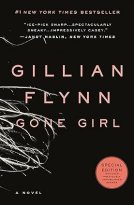
Let’s take another look at Gillian Flynn’s novel, Gone Girl.

Gone_Girl_FlynnFlynn’s style of prose is rapid-fire, almost stream-of-consciousness, and yet it is controlled and deliberate. She is creative in how she uses the literary device of narrative mode. Primarily, Gone Girl is written in the first person present tense. But sometimes Flynn breaks the fourth wall by flowing into the second person present tense and speaking directly to us, the reader.

This seamless manipulation of narrative tense reveals Flynn’s thought process.

One criticism you might hear about her style is that, at times, her characters all sound alike. Only the chapter title and subjects covered in that section let you know which person is speaking, Nick or Amy. That means we are hearing the author’s own voice in the role of the characters.

When Flynn slips into the second person mode and speaks directly to the reader, she forces us to consider the ideas she is presenting, involving us in the story.

That flowing from mode to mode is a literary device she is good at, and speaking as an editor, it is neither good nor bad. Whether it works depends on an author’s skill.

Your enjoyment of that kind of narrative depends on your personal taste. Flynn’s style of writing is unique, but her exploration of dark, unlikeable characters makes this a difficult novel for some readers.

A writer’s personal ethics and taste and the kernel of “what if” shape how they approach the subject matter and the themes of their work. Their knowledge of craft is demonstrated in the construction of sentences, paragraphs, and scenes. Skill in the craft shapes the overall arc of a story.

desk_via_microsoft_stickers

courtesy Office 360 graphics

The words we gravitate to and reuse and how we unconsciously punctuate our sentences combine to form our voice, our style.

This personal sound evolves as we develop more skills and knowledge of writing craft.

My own style has changed dramatically since my first novel. When I began writing seriously, I was in the habit of using italicized thoughts and characters talking to themselves to express what was happening inside them. I often employed compound sentences that, when I look back on them now, were too long.

Using italics for thoughts is an accepted practice and is not wrong. When used sparingly, italicized thoughts and internal dialogue have their place. However, thoughts can be used as a means for dumping information, which then becomes a wall of italicized words.

In the last few years, I’ve evolved in my writing habits. I am increasingly drawn to writing shorter sentences, but I vary sentence length to avoid choppiness.

When conveying my character’s internal dialogue, I use the various forms of free indirect speech to show who my characters think they are and how they see their world. So, in that regard, my author voice has changed.

We write for ourselves first. Then, we revise and edit for the enjoyment of other readers.

We do not iron the life out of our work, because that spark of joy that was instilled the moment we laid down those words must still shine through. It takes thought and the ability to recognize and cast aside prose that doesn’t say what we want it to, yet still have it sound like our writing and not someone else’s.

Be consistent with punctuation, whether you are right or wrong. If you “hate the Oxford comma” or some other widely accepted rule of grammar, you must be consistent when you avoid its use.

Inconsistency in a manuscript is not a voice or style.

It’s a mess.

Ernest Hemmingway rarely used commas. However, he was consistent in how he composed his sentences, and his work was original and readable.

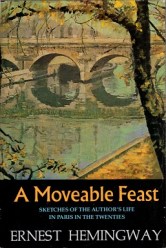
MoveableFeast“I was learning something from the painting of Cézanne that made writing simple true sentences far from enough to make the stories have the dimensions that I was trying to put in them. I was learning very much from him but I was not articulate enough to explain it to anyone. Besides it was a secret.”

~~Ernest Hemmingway, A Movable Feast

Some authors’ voices really stand out, and their writing skills are up to the task of conveying what they intend their words to say. Their stories find an important place in our hearts.

They are the writers that agents are desperately seeking.

5 Comments

Filed under writing

The Author’s Voice: Word Choice and Placement #amwriting

We are drawn to the work of our favorite authors because we like their voice. An author’s voice is the unique, recognizable way they choose words and assemble them into sentences.

With practice, we become technically better at the mechanics (grammar and punctuation) but our natural speech habits shine through. Voice is how we bend the rules and is our authorly fingerprint.

When we begin the editing process with a professional editor, most will ignore the liberties we take with dialogue but will point out our habitual errors in the rest of the narrative.

Many times, what we want to say is not technically correct, but we want that visual pause in that place, in that sentence. Casual readers who leave reviews will have gained some understanding of grammar but if your voice is consistent, they will accept your choice. However, they will notice inconsistencies and illiterate writing.

This is why the process of editing is so important. Knowledge of the mechanics of writing is crucial. If you don’t understand the rules, you can’t break them with authority. (For the first part of this series, see my post Revisions: Self-Editing.)

Consider Raymond Chandler’s dismay when he discovered his grammar had been heavily edited by a line editor and then published without his input in the corrections:

“By the way, would you convey my compliments to the purist who reads your proofs and tell him or her that I write in a sort of broken-down patois which is something like the way a Swiss waiter talks, and that when I split an infinitive, God damn it, I split it so it will stay split, and when I interrupt the velvety smoothness of my more or less literate syntax with a few sudden words of barroom vernacular, this is done with the eyes wide open and the mind relaxed but attentive. The method may not be perfect, but it is all I have.”  – Raymond Chandler, in a letter to Edward Weeks, Editor of The Atlantic Monthly, dated 18 January 1947. (Read the letter in its entirety here.)

When we self-edit, we don’t have to wrestle for control of our work, true. But I have to be honest—I have worked with many editors over the past ten years, and only one tried to hijack my manuscript.

What is the mood you want to convey with your prose? Where you place the words in the sentence greatly affects the mood. Active prose is Noun-Verb centric. Compare these sentences, two of which are actively phrased, and two are passive. All say the same thing, and none are “wrong.”

I run toward danger, never away.

I never run away from danger.

Danger approaches, and I run to meet it.

If it’s dangerous, I run to it.

Can you tell which are passive and which are active? Which phrasing resonates with you? Could you write that idea in a different way?

Where we choose to place the core words, I run to danger, changes their voice but not their meaning. The words we choose to surround them with changes the mood but not their meaning.

Other ways to use the core concept of I run to danger:

Danger draws me. I race to embrace it, to make it mine.

If it’s dangerous or stupid, I will find it.

Danger—who cares. Running away is stupid; it always finds you. Meet it, grab it, and make it yours.

I saw him, and in that moment, I knew I’d met my destiny. He was the embodiment of danger, and I wanted him.

We could riff for half an hour on just four words, I run to danger. Each of us will write that idea with our own brand of brilliance, and none of us will sound exactly alike.

One of the things we must look at in our work is consistency. Is our narrative comprised of a smooth pattern? We don’t want our work to be jarring, so we want to think push, glide, push, glide.

Once you have established the mood you are trying to convey, look at how you have placed your verbs in the majority of your sentences.

Some are: noun – verb – modifier – noun. I run to danger when I see it. (Active)

Some are: infinitive – noun – verb –  modifier – noun. When I see danger, I run toward it. (Passive)

NOTE: PASSIVE VOICE DOES NOT MEAN WRONG!

Good writing is about balance. How we combine active and passive phrasing is part of our signature, our voice. By mixing the two, we choose where we direct the reader’s attention.

Some work you want to feel highly charged, action-packed. Genres such as scifi, political thrillers, and crime thrillers need to be verb forward in the way the words are presented. These books seek to immerse the reader so more sentences should lead off with Noun – Verb, followed by modifiers.

If you clicked on the link and read Raymond Chandler’s letter in full, you will see it is aggressive and verb-forward, just the way his prose was.

In other genres, like cozy mysteries, you want to create a sense of comfort and familiarity of place with the mood. Perhaps you want to slightly separate the reader from the action to convey a sense of safety, of being an interested observer. You want the reader to feel like they are the detective with the objective eye, yet you want them immersed in the romance of it. To do that, you balance the active and passive sentence construction, so it is leaning slightly more toward the passive than a thriller.

Weak prose makes free with all the many forms of to be (is, are, was, were).

  • He was happy.
  • They were mad.

Bald writing tells only part of the story. For the reader to see and believe the entire story, we must choose words that show the emotions that underpin the story.

To grow in the craft, we learn to convey what we see through words.

Passive voice balances Active voice. It is not weak, as weak prose holds the reader away from the immediacy of the experience, and when active prose is interspersed with passive, it does not.

Voice is defined by word choice, and Passive or Active prose is defined by word placement, not how many words are used.

Weak prose usually uses too many words to convey an idea. So, we want to avoid wordiness no matter what mood we are trying to convey.

  • One clue to look for is the overuse of forms of to be, which can lead to writing long, convoluted passages.

How many compound sentences do you use? How many words are in each sentence? Can you see ways to divide long sentences to make them more palatable?

A wall of words turns away most readers. Look at your style, as you work your way through your revisions, and see what positive changes you can make in how you consistently phrase things.

Take a short paragraph from a work in progress and rewrite it. Try to convey that thought in both passive and active voice. Then blend the two. You might learn something about how you think as a writer when you try to write in an unfamiliar style.

The following is a  list of words I habitually use in a first draft and then must look for in my own work. I look at each instance and decide if they work as they should or weaken the sentence. If they weaken the prose, I change or remove them.

7 Comments

Filed under writing

Style and Voice #amwriting

The literary voice is the way a story is told. Literary voice has been compared to  music. We’ve all noticed how a well-known song can sound so different, depending on who is performing it. The words are the same, the basic melody is there, but some performances shine while others miss the mark.

The distinctive style of each writer forms when we engage personally with a topic and impart our personality to that piece of literature. We are each islands in a vast sea of writers, and the view from our place in the universe is slightly different from that of our fellows.

Therefore, how we convey what we see and imagine has an identifiable sound that is ours alone. Phrasing, word choices, these are the recognizable sounds of our literary style. Our habitual writing style is our unique fingerprint, the author’s voice.

However, voice is often what we love or hate about a certain author’s work. Editors for publications are readers who are looking for the best work to publish in their magazine or anthology. If a story has great characters and a good story arc, voice is what will attract or repel them.

These are the holy trinity that combines to make a classic tale:

  • great characters
  • unique voice
  • gripping plot

You may have noticed plot is listed last—and it is last for a reason. If the characters are not engaging and the writer’s style isn’t to my taste, the plot alone won’t sell me that book.

What is the writer’s voice? Wikipedia, the fount of all knowledge, says:  The writer’s voice is the individual writing style of an author, a combination of their common usage of syntax, diction, punctuation, character development, dialogue, etc., within a given body of text (or across several works).

Don’t confuse lazy writing with style. Lazy writers

  • Use too many quantifiers “It was really big.” “It was incredibly awesome.”
  • “Tell” the story instead of showing it: “Bert was mad.”
  • Swamp the reader with minute details: “Mary’s eyebrows drew together, her lips turned down, and her cheeks popped a dimple.”
  • Ruin the taste of their work with an avalanche of prettily written descriptors: “-ly” words
  • Have their characters natter on about nothing just to kill time. It doesn’t show them as human, it shows them as boring.

Lazy writers don’t realize how smart their readers are. We don’t have to offer up every minute detail of breakfast. Broad strokes will paint the picture.

In contrast, some enthusiastic writers go overboard in trying to create beautiful, literary prose. They’re confusing contrived writing with literary style.

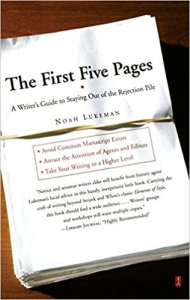
Literary agent, Noah Lukeman, in his book The First Five Pages: A Writer’s Guide To Staying Out of the Rejection Pile, says, “All of these writers think they add a distinctive flavor, a ‘richness’ to the text, but more often than not they are just indulging themselves—thus the term ‘self-indulgent’—a common symptom of the over-styled manuscript.”

As we grow in the craft, our style becomes more cohesive, less self-indulgent, and more able to reflect our ideas. Certain habits will remain, the core of who we are and how we express ourselves. This is our voice.

It gets a little confusing when voice can also mean the tense in which the narrative is presented. English is a language where one word can have a multitude of meanings and context is critical. Some writers incorrectly use the terms voice and point of view interchangeably, so when they are talking about third voice, they mean Third Person Point of View. In this case, they are speaking of the main character’s voice, how she tells her story.

In this aspect, there are two voices to every narrative: the author’s voice, and the character’s voice.

Narration is the use of a written or spoken commentary to convey a story to an audience. Perspective and voice are components of the narrative.

Wikipedia says “Narrative point of view or narrative perspective describes the position of the narrator, that is, the character of the storyteller, in relation to the story being told. It can be thought of as a camera mounted on the narrator’s shoulder that can also look back inside the narrator’s mind.” It also explains that a narrative consists of three components:

  • Narrative point of view: the perspective (or type of personal or non-personal “lens”) through which a story is communicated.
  • Narrative voice: the format (or type presentational form) through which a story is communicated.
  • Narrative time: the grammatical placement  of the story’s time-frame in the past, the present, or the future.

Anyone who is a member of a critique group is regularly beaten over the head with certain basically good, but occasionally clichéd, rules. Improperly applied, this mindless interpretation of proper grammatical style can inhibit an author’s growth.

These rules are fundamentally sound but cannot be rigidly applied across the board to every sentence. For editing and also for writing, when I have questions about grammar I rely on The Chicago Manual of Style, but I also understand common sense.

Again it’s all about context. Sometimes a sentence that is grammatically incorrect sounds better, especially in dialogue. The bold writer sometimes breaks grammatical laws to write great books. How they habitually break those laws is their fingerprint, their style.

English is a living language. As such it is in a continual state of evolution and phrasing that made sense one-hundred years ago may not work well in today’s English. We may be writing a period piece, but we are writing it for modern readers. Nevertheless,

  • You can split an infinitive: it is acceptable to boldly go where you will.
  • You can begin a sentence with a conjunction if you so choose. And no one will die if you do.

How you apply grammar, the words you gravitate to, the point of view you work best in—these are the identifiable aspects of your voice as an author. Your writing style is a combination of how you speak through your pen or keyboard, how you craft your prose—your voice.

As Noah Lukeman’s book tells us, your author’s voice should not be so distinct and loud that it makes your prose obnoxious. Sharing your work in the early stages with an interested reader who will be honest with you can help you avoid some of the pitfalls in developing your style and voice. Find a good editor you can work with, one who will understand your stylistic choices, but who will guide you away from bad writing. This is money that is well spent.

Write something new every day, even if it is only a paragraph. Of all the advice I have to offer, this is the most important because if you don’t write, you have no voice, no style, no story.


Credits and Attributions:

Quote from The First Five Pages: A Writer’s Guide To Staying Out of the Rejection Pile, by Noah Lukeman, published by Simon and Shuster, © 2000.

Wikipedia contributors, “Narration,” Wikipedia, The Free Encyclopedia, https://en.wikipedia.org/w/index.php?title=Narration&oldid=777375141 (accessed Mar 18, 2018).


12 Comments

Filed under writing