Tag Archives: what is head-hopping

Deciding the right chapter length #writing

I was recently asked what I think the right chapter length should be in a novel. We haven’t talked about this in a while, so today is as good a day as any.
I like it when an author considers the comfort of their readers. Many readers, including me, want to finish a chapter in one sitting. We rarely have the time to sit and read all day, no matter that we wish we could.

With that said, you must decide what your style is, and it will evolve as your writing career progresses.

Over the years, I’ve read and enjoyed many books where the authors made each scene a chapter, even if it was only two or three hundred words long. They ended up with over 100 chapters in their books, but because their story was so engaging, I barely noticed it.

In several seminars I’ve attended, the presenters suggested that we should have a specific word count limit for chapter length. One suggested 1500, while another said not more than 2500.

One of my favorite authors sometimes has chapters of only five or six hundred words, which keeps each character’s storyline separate and flows well. For my style of storytelling, 1,500 to 2,500 words is a good length.
As a reader, I have noticed that successful authors are careful to ensure that each chapter details the events of one scene or several closely related incidents. Chapters are like paragraphs in that cramming too many disparate ideas into one place makes the narrative feel erratic and disconnected.

My novel, Julian Lackland, has longer chapters. This is because the story arc details important events occurring over forty years of Julian’s life.

The novel follows the chronological order of his life, and the chapters detail the incidents that profoundly changed him. I inserted hard breaks within each chapter whenever a scene ended and a softer transition would have lent confusion to the narrative.

What is a soft transition? Conversations make good transitions to propel the story forward to the next scene. They also offer ways to end a chapter with a tidbit of information that will compel the reader to turn the page. Information is crucial, so we want to provide it when the protagonist and the reader require it.

Fade-to-black and hard scene breaks: I only use fade-to-black transitions as a finish to a chapter, as they leave the reader with something to think about.
Time must be considered too. When a real chunk of time has passed between the end of one scene and the beginning of the next, I suggest giving the scene a firm finish with a hook. That leads the reader to continue on to the next chapter.

With each scene, we push all the main characters forward and raise the stakes for each of them a little more. The action and dissemination of information entertain the reader. Good transitions allow the reader to reflect and absorb the information gained before moving on to the next scene.

This brings me to how the narrative point of view can influence the length of a scene or chapter. Some editors suggest you change chapters, no matter how short, when you switch to a different character’s point of view.

I (somewhat) agree with this stance, as a hard transition when you switch narrator-characters is the best way to avoid head-hopping and subsequent confusion.

But what is head-hopping? When you change the narrative point-of-view in the same scene, one paragraph to the next with no definite separation, you create a “viewpoint tennis match.”

First, you’re in Character A’s head hearing her thoughts, then you’re in Character B’s head hearing his. Then you’re back in A’s head. It becomes challenging to know who is speaking or thinking.

Also, the characters tend to lose their individuality. They begin to sound the same, further muddying the scene.

That is not to say that you should never switch viewpoints within a chapter. Sometimes, more than one character has a perspective that needs to be shown. However, readers will find it easier to follow the narrative if you are careful with how you handle the change of narrator.
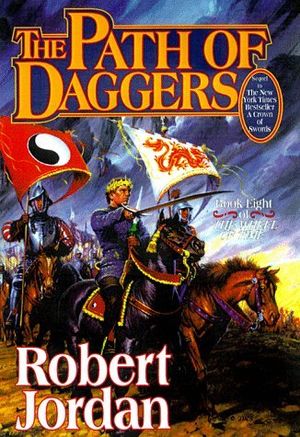
One of the problems some readers have with Robert Jordan’s Wheel of Time Series is the way he wanders between storylines as if he couldn’t decide who the main character is. Rand al’Thor begins as the protagonist, but the narrative soon wanders far away from him as Matrim, Perrin, Nynaeve, Elayne, Aviendha, and Egwene are given prime storylines. Each thread comes together in the end, but this is the main criticism of the series.

I’m a dedicated WoT fan, but even I found that exceedingly annoying by the time we reached book eight, Path of Daggers. I was halfway through reading that book when I realized there was a good chance that we would never see Rand do what he was reborn to do.

I try to concentrate on developing a single compelling, well-rounded main character, with the side characters well-developed but not upstaging the star. I kept reading the entire WoT series because Jordan’s (and later Sanderson’s) writing was brilliant, and the world and the events were intriguing.

It’s easier for the reader to follow the story when they are confined to one character’s perspective for the majority of the narrative. If you choose to switch POV characters, I suggest using a hard, visual break, such as two blank spaces between paragraphs or ending the chapter.

Now we come to a commonly asked question: Should I use numbers, or give each chapter a name?
What is your gut feeling for how you want to construct this book or series? If snappy titles pop up in your mind for each chapter, by all means, go for it. Otherwise, numbered chapters are perfectly fine and don’t throw the reader out of the book. Whichever style of chapter heading you choose, be consistent and stay with that choice for the entire book.

To wind this up: Limit your point of view characters to one per scene. Each chapter should detail events that are related, rather than a jumble of unrelated happenings.

When it comes to chapter length, you must make the decision as to the right length and end chapters at a logical place. But do end each chapter with a hook that entices the reader to continue reading.

 

2 Comments

Filed under writing

The transition scene #amwriting

A well-paced narrative has a kind of rhythm. Instructors commonly refer to this as “push, glide, push, glide,” as if skating. What that means is that while the characters might be in the midst of chaos, there is order in the layout and pacing of the narrative.

  • action,
  • processing the action,
  • action again,
  • another connecting/regrouping scene

These “processing” scenes are transitions, moving the plot forward while allowing the reader to process what just happened.

We can’t have non-stop action, as that is exhausting to write and more exhausting to read. The character arc is often at the forefront during these transitional scenes as that period of relative calm is when you allow your characters’ internal growth to emerge.

We justify what just happened, making it believable. It is also where you ratchet up the tension.

When it comes to writing transitions between scenes, we have several paths to choose from.

Introspection:

  • Introspection offers an opportunity for new information important to the story to emerge.
  • It opens a window for the reader to see who the characters are, how they react and illuminates their fears and strengths. It shows that they are self-aware.

Keep the scenes of introspection brief, and go easy on them if you are given to using italics to set them off. A wall of italics is hard to read, so don’t “think” too much if you are using those.

  • Characters’ thoughts must serve to illuminate their motives at a particular moment in time.
  • In a conversation between two characters, introspection must offer information not previously discussed.
  • Internal monologues should not make our characters too wise. Humanize them, show them as a bit clueless about their flaws, strengths, or even their deepest fears and goals.

Conversations:

  • Conversations should not become clumsy info-dumps. “As you know….”
  • Each character must speak uniquely, sounding like themselves. Don’t dump conversations into a blender and pour out a string of commentary that makes them all sound alike.

Don’t get fancy with speech tags/attributions. It’s best for me as a reader when the author avoids words that take me out of the narrative. Some words are eye-stoppers. I recommend you stick with said, replied, answered—common and ordinary  tags that don’t leap out at the reader like ejaculated, disgorged, spewed, and so on. Occasionally, you can get away with more forceful tags, but keep them to a minimum. Make the characters’ actions and words show the force of their words. In my opinion, you can do away with speech tags for some brief exchanges if the scene contains only two characters.

Fade-to-black and hard scene breaks:

I’m in two minds about using fade-to-black scene breaks as transitions. Why not just start a new chapter?

One of my favorite authors, L.E. Modesitt Jr. sometimes has chapters of only five or six-hundred words, which keeps each character thread truly separate and flows well.

In a short story, a hard scene break is sometimes required, as you don’t have the option to do chapters. Use an asterisk or hashtag between scenes. * #

New chapter:

Each of the major players has a point of view. Some authors use the aftermath of an action scene as an opportunity to advance the antagonist’s story line. That is a good strategy, as we do need to show why the enemy is the enemy.

The key is to avoid “head-hopping,” and I feel like the best way to do that is to give a new chapter to the point-of-view character. Head-hopping occurs when an author switches point-of-view characters within a single scene. It happens most frequently when using a third-person omniscient narrative because the thoughts of every character are open to the reader.

My favorite authors will employ all the above listed transitions as they move their characters through the story arc. Each transition will lead us into a new scene, and when they are done right, we the readers won’t even notice that they are transitional.

The transition is the most difficult part of the narrative for me to formulate in the first draft. I get stuck, trying to decide what information needs to come out, and what should be held back.

Sometimes, a transition just will not work no matter what. This happens when a flaw in the logic exists in the scene preceding it. Usually, I can’t see it at that point, but my writing group will show me what the problem is.

This struggle to connect my action scenes into a seamless arc is why writing isn’t the easiest occupation I could have chosen. But when everything comes together, it is the most satisfying job.


Credits and Attributions:

Detail from: Journey of the Magi (East Wall) by Benozzo Gozzoli 1459Magi Chapel of Palazzo Medici-RiccardiFlorence, 1459–1461. Wikimedia Commons contributors, “File:Benozzo gozzoli, corteo dei magi, 1 inizio, 1459, 51.JPG,” Wikimedia Commons, the free media repository, https://commons.wikimedia.org/w/index.php?title=File:Benozzo_gozzoli,_corteo_dei_magi,_1_inizio,_1459,_51.JPG&oldid=179731811 (accessed April 24, 2019).

Wikimedia Commons contributors, “File:Sir Galahad (Watts).jpg,” Wikimedia Commons, the free media repository, https://commons.wikimedia.org/w/index.php?title=File:Sir_Galahad_(Watts).jpg&oldid=277887181 (accessed April 24, 2019).

9 Comments

Filed under writing

#amwriting: point of view

Xpogo_RioA young author recently asked me, “What is head-hopping and why has my writing group accused me of doing it?” Headhopping occurs when an author switches point-of-view characters within a single scene, and happens most frequently when using a Third-Person Omniscient narrative, in which the thoughts of every character are open to the reader.

It’s difficult to know whose opinions are most important when all your characters are speaking in your head as you are writing. They clamor and speak over the top of each other, making a din like my family at any holiday dinner. But you must force them to take turns speaking, and make a real break between the scenes where the speaker changes, or each rapid shift of perspective will throw the reader out of the story. But what is Point of View other than the thoughts of one or two characters?

Point of view is a common literary term which some authors are a little unclear on. Remember, books, stories and literature in general, are a window through which readers look at the world. The way they see through that window, is though the eyes of the narrator: the point of view.

Writers direct their readers’ attention to the details, opinions, or emotions they want to emphasize by manipulating the point of view of the story, writing the narrative in one of three different ways: first-person, second-person, or third-person.

First-person point of view is fairly common, and is told from one protagonist’s personal point of view. It employs “I-me-my-mine” in the protagonist’s speech, allowing the reader or audience to see the primary character’s opinions, thoughts, and feelings. Remember, it is told from the view and knowledge of the narrator, and not of other characters. You ,as the author, must remember that no one has complete knowledge of anything. Thus, your protagonist cannot be all-seeing and all-knowing. The reader will find out the information as the protagonist does, which can be engrossing.

So I know I am right not to settle, but it doesn’t make me feel better as my friends pair off and I stay home on Friday night with a bottle of wine and make myself an extravagant meal and tell myself, This is perfect, as if I’m the one dating me. ~~ Gone Girl, by Gillian Flynn

Second-person point of view, in which the author uses “you” and “your,” is rarely found in a novel or short story. It is, however, commonly used in guide books, self-help books, do-it-yourself manuals, interactive fiction, role-playing games, gamebooks such as the Choose Your Own Adventure series, musical lyrics, advertisements.

For an author attempting to use it in fiction, it’s tricky to get right, so it doesn’t come off like a walkthrough for an RPG and for this reason, authors rarely speak directly to the reader in this way. However, it can work well, if the author is smart and really understands what they are writing. Successful use of Second Person POV can be found in: Jay McInerney’s Bright Lights, Big City (1984)

“You are not the kind of guy who would be at a place like this at this time of the morning. But here you are, and you cannot say that the terrain is entirely unfamiliar, although the details are fuzzy.”

Third-person point of view provides the greatest flexibility to the author and thus is the most commonly used narrative mode in literature. In the third-person narrative mode, each and every character is referred to by the narrator as “he,” “she,” “it,” or “they.” Third-person point of view is that of an outsider looking at the action, an invisible third person describing the events.

  1. The writer may choose third-person omniscient, in which the thoughts of every character are open to the reader, or third-person limited, in which the reader enters only one character’s mind, either throughout the entire work or in a specific section.
  2. Third-person limited differs from first-person because while we see the thoughts and opinions of a single character, the author’s voice, not the character’s voice, is what you hear in the descriptive passages.
  3. The Flâneur (idler, lounger, loiterer.) This is traditionally a form of third person POV, but I like to think of it almost as a fourth POV. Many of you have heard of it as third-person objective or third-person dramatic.

James Wood, author and literary critic, discusses this in the New Yorker (Books section Feb 28, 2011) in his review of Teju Cole’s Open City. Wood writes: …we also need a flâneur to see interesting things in the city, and to notice them well, and (Teju) Cole’s narrator has an acute, and sympathetic, eye. Sometimes he is witty and paradoxical, in a way that recalls Roland Barthes. Watching a park full of children: “The creak-creak of the swings was a signal, I thought, there to remind the children that they were having fun; if there were no creak, they would be confused.”

The flâneur is a voice that observes and comments but without actually becoming a character, a witness to the events. There is a downside to using the flâneur as your vehicle to convey your narrative:

  • He is not reliable—he has his own personality, offering subtle judgments and unconscious opinions on the behavior of the characters. Therefore, just as in a first-person narrative, the reader cannot be sure he is telling the unbiased truth.
  • The narrator  tells the story without describing any of the character’s thoughts, opinions, or feelings; so the reader can only guess at character motivations, and must assume the objective observer truly is objective and has told the truth in that regard.
  • It separates the reader from the intimacy of the action and slows the pace down.

Authors know what every character they are writing is thinking, and sometimes feel compelled to write from every character’s viewpoint. First we’re in Joe’s head, and then we are in Mary’s–rather like watching a tennis match. It’s critical that we don’t jump from head to head within a scene, as that will knock the reader out of the narrative and we don’t want that.

Joe’s experience can be explored and Mary’s can too, but make a solid break, or begin new chapter before you switch to Mary’s viewpoint. If a different character has something to say that is important to the narrative, I give them a separate chapter, even if it is a short one. That way my readers are not too confused about who is making the observations.

Remember, we avoid head-hopping and mental whiplash by not changing characters and point of view mid-scene.

10 Comments

Filed under writing