
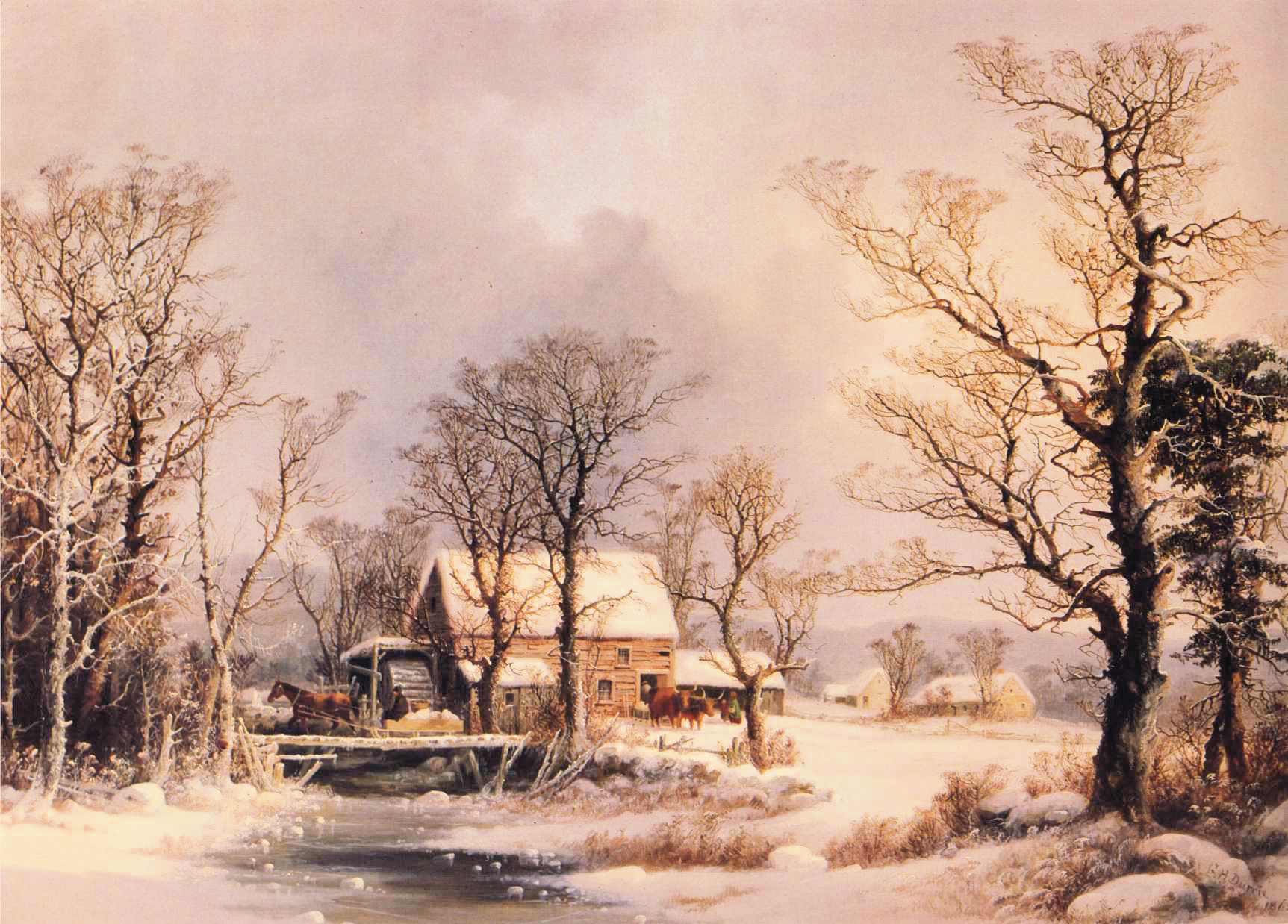
 Artist: George Henry Durrie (1820–1863)
Painting: Oil on canvas, 26 x 36 in
Date: 1862
What I love about this painting:
George Henry Durrie is one of my favorite American artists. In this painting, he shows us a winter’s day in New England in 1862. Snow covers the ground, but the sun is shining, lending a rosy glow to the day.
The stream bears a light skim of ice, but though the millwheel is covered in snow, the mill is not idle. This late (or early) in the year there is no wheat to grind, but the grain from the previous autumn’s harvest has been turned to flour and shoveled into bags and barrels and stored for sale as needed.
A horse-drawn sled crosses the log bridge, loaded with white cotton bags of flour. Perhaps the driver intends to take advantage of the good weather and deliver them to the local General Store or Mercantile.
Durrie’s horses and cattle are as true to life as his landscapes are. One can almost see the muscles moving beneath the glossy coat as our horse pull the sleigh.
If you are writing a story set in an era of lower technology, I strongly suggest you go to the art of Durrie and his contemporaries to find inspiration for worldbuilding.
About the artist, via Wikipedia:
George Henry Durrie (June 6, 1820 – October 15, 1863) was an American landscape artist noted especially for his rural winter snow scenes, which became very popular after they were reproduced as lithographic prints by Currier and Ives.
In Durrie’s time, winter landscapes were not popular with most curators and critics, but nevertheless, by the time of his death, Durrie had acquired a national reputation as a snowscape painter. Durrie died in 1863, at age 43, probably from typhoid fever, not long after Currier and Ives began reproducing his paintings as prints.
Durrie’s paintings, depicting idyllic rural life, a world of stability and home comforts, held great appeal for the middle class and the working class, as an visual antidote for the growing industrialization of America, and the uncertainties of a boom-and-bust economy. The American ideal of a land of self-sufficient farmers, captured by Durrie’s paintings, was being replaced with factories belching smoke, along with a rise in urban populations, foreign immigration, and crime brought about by crowded conditions and poverty. The American descendants of the early English settlers felt that their values and way of life were threatened by these new developments and turned to nostalgic images such as Durrie’s for comfort. [1]
Credits and Attributions:
IMAGE: Wikimedia Commons contributors, “File:George Henry Durrie – Winter in the Country, The Old Grist Mill.JPG,” Wikimedia Commons, https://commons.wikimedia.org/w/index.php?title=File:George_Henry_Durrie_-_Winter_in_the_Country,_The_Old_Grist_Mill.JPG&oldid=995260526 (accessed February 10, 2025).
[1] Wikipedia contributors, “George Henry Durrie,” Wikipedia, The Free Encyclopedia, https://en.wikipedia.org/w/index.php?title=George_Henry_Durrie&oldid=1244671369 (accessed February 10, 2025).


 Life in the Realm of Fantasy