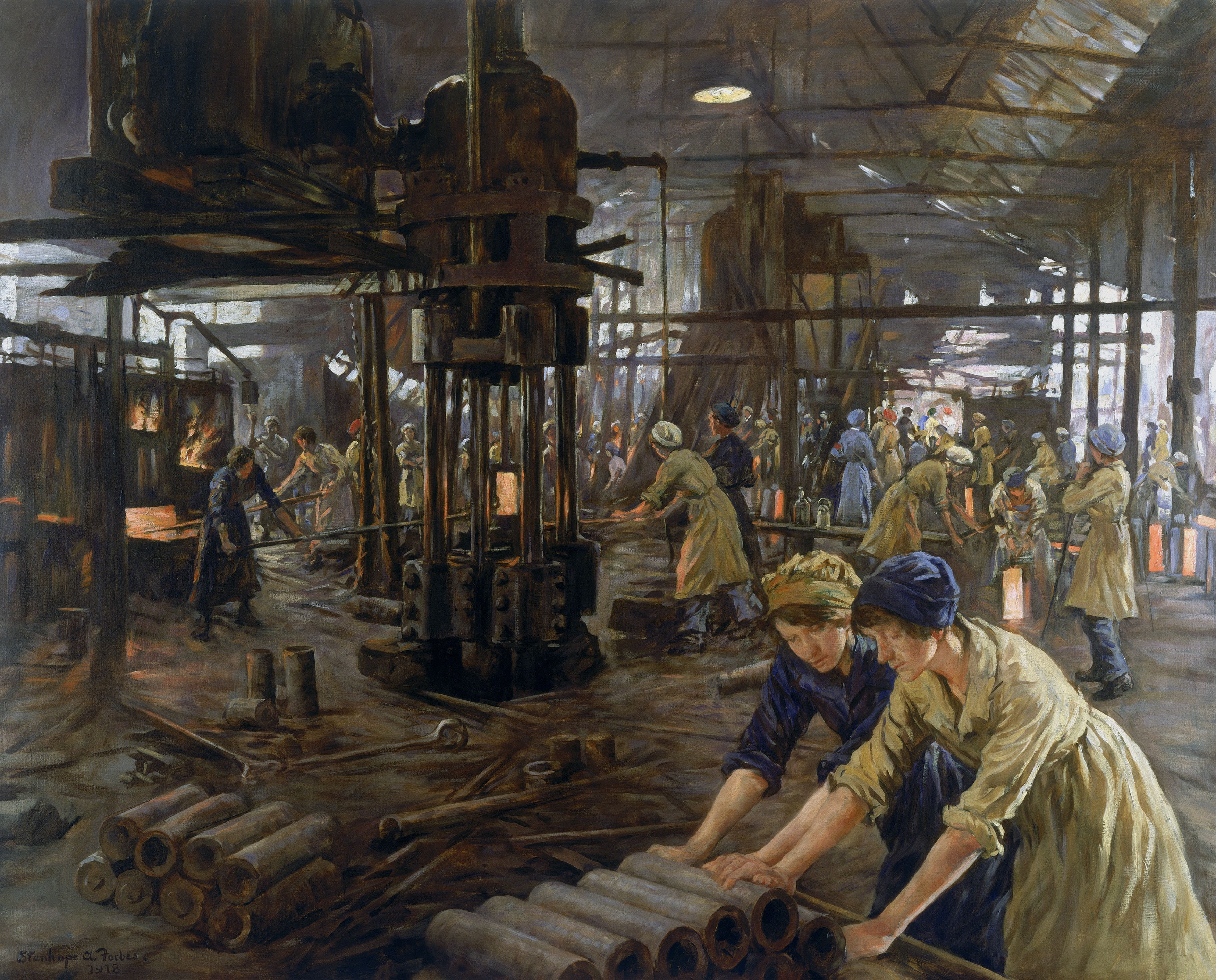
Artist: Stanhope Forbes (1857–1947)
Title: The Munitions Girls
Date: 1918
Medium: oil on canvas
Dimensions: height: 103 cm (40.5 in); width: 127 cm (50 in)
Collection: Science Museum
About this Image, via Wikimedia Commons:
Commissioned by John Baker & Co, this famous oil painting, The Munitions Girls, shows women working at Kilnhurst Steelworks during the First World War. The artist was Alexander Stanhope Forbes (1857-1947). Like many other steelworks during the war, John Baker & Co’s Kilnhurst site was converted to make shells and ammunition. As men volunteered or were conscripted to fight in the British Army, women became the main work force in industry and farming. Munitions workers could often be picked out in a crowd because of the distinctive yellow coloring of their hair and skin caused by the sulfur used in production. They were nicknamed canaries. [1]
My Usual Fine Art Rant Goes in a Different Direction:
The women in this picture are shown doing dangerous, dirty work. They stepped up and did what they had to do to make sure their husbands and lovers had the weapons they needed to defend their country.
And they are doing it for very little money, less than men would have earned. While that is slowly changing, some things remain the same. It’s difficult to find people who want to do the “ordinary work,” jobs considered blue-collar, or manual labor.
Here in the US, it is Labor Day weekend, the last hurrah of summer, but more importantly, a day dedicated to appreciation of those who make up our labor force, the people who do the unglamorous work that keeps our world turning smoothly.
I’ve always been a writer, but I like to eat. I always held two and three part-time jobs just to keep the roof over my children’s heads and food on their table. I could make the food budget stretch like a politician’s idea of truth.
- 1970s-80s – a field hand for a multi-national Christmas tree company, bookkeeper, photo lab tech, waitress in a bakery and also worked in a deli.
- 1980s-90s – a hotel maid, a dark-room technician, a bookkeeper, and an office manager
- 2000-13 – a bookkeeper, tax-preparer, data entry.
None of my work was glamorous but I always found something to enjoy in each job. By going to work every day I was able to pay my bills, which I did enjoy. Sometimes, especially during the Reagan years and into the 90s, wages were low, and jobs were scarce.
I worked every weekend and every holiday and yes it was not easy, but it was what it was. My kids knew I was doing my best for them, and they appreciated it.
During the late 70s and early 80s I was a field hand for the J. Hofert Company (Christmas trees) and absolutely loved the work. It was outdoors, paid $3.25 an hour and it was seasonal, but I was able to work a lot of overtime, as field hands were as hard to get then as they are now.
My favorite job was as a hotel maid at a large hotel in Olympia–the work was hard, but I enjoyed it for 12 years. For most of the 1990s it was my weekend job that I kept along with my bookkeeping job, because the hotel was a union shop.
As a bookkeeper/office manager for a charter bus company, I made $7.50 an hour (two dollars over minimum at the time). I worked four seven-hour shifts a week, Monday through Thursday, arriving at 06:00 AM to open the shop, ate lunch at my desk, and went home at 1:00 PM (13:00 military time). That job had no benefits whatsoever. However, I was home when my kids got off the school bus and could make sure they got to their after-school activities.
At my second job, 3 eight-hour shifts Friday through Sunday, I worked as a hotel housekeeper in a union shop. I made $8.50 an hour (three dollars over minimum).
I kept those two jobs all through the 1990s because I was home every night and earned enough to live decently and provide for my children.
No matter what other job I had, I kept my weekend job at the hotel, because it paid well and left my mind free to think about what I was writing. When other jobs went away, I always had that one to fall back on.
Because of the union, we who did the dirty work earned a little more than other women in that line of work, and had a few benefits, such as health insurance and a 401k. Without the union, we hotel maids would have had nothing more than minimum wage.
Not every union is good, and not every union is reasonable. But while I don’t agree with everything every union does and stands for, I do feel gratitude that I and my family was protected by a good, reasonable organization during those years of struggle.
I’m retired now and have the time to write all I want. The world is a different place in many ways, and workers are in short supply. Every place is short-staffed because there are more job openings than workers to fill them.
Someone must do the dirty jobs, the work that no one else wants. I have nothing but respect for those who work long hard hours in all areas of the service industry, struggling to support their families. Look around you, and see the people who make your life easier, by being there every day doing their job.
Every one of them is a person just like you, a living, caring human being with hopes, ambitions, triumphs, and tragedies. Every one of them has a story and a reason to be where they are, doing the task they have been given.
Say a little thank you to all those who take your unintentional abuse when you are stressed out and “don’t have time to wait,” or are upset by things you have no control over and need to vent at someone who can’t or won’t fight back.
The women in Stanhope Forbes’ painting are all gone now, memories of a moment in history. But what they did was important. Give a little thanks to those who do the dirty work and enable you to live a little easier.
About the Artist, via Wikipedia:
Forbes was born in Dublin, the son of Juliette de Guise Forbes, a French woman, and William Forbes, an English railway manager, who was later transferred to London. He had an older brother, Sir William Forbes, who was a railway manager for the London, Brighton, and South Coast Railway.
He was married in the summer of 1889 to fellow painter Elizabeth Armstrong at Newlyn’s St Peter’s Church. Their first home was at the “Cliffs Castle” cottage, which overlooked the sea. They had a son named Alexander (Alec). The couple had a home built for the family in Higher Faughan, Penzance. Elizabeth died in 1912.
Forbes generally painted genre scenes and landscapes en plein air.
Beyond his plein air painting, he also made interior scenes and was adept at capturing the “warm and charming” effects of lighting on a room and the people in it, such as The Lantern, made in 1897. More poignantly, Mrs. Lionel Birch writes of his style and particularly the painting The Health of the Bride: “[The painting depicts the] dominant note of his life’s message, his sense of sympathetic humanity. These people in their humble little parlour, are real and living. Intolerant of all shams and false sentiment, the painter has made himself one with the people he depicts; he has understood the humour which lies so close to tears.”
Of Forbes’s works, Norman Garstin said: “he is a good unsentimental painter, his work has a sense of sincerity that appeals to everyone”. [2]
Credits and Attributions:
[1] Wikimedia Commons contributors, “File:’The Munitions Girls’ oil painting, England, 1918 Wellcome L0059548.jpg,” Wikimedia Commons, the free media repository, https://commons.wikimedia.org/w/index.php?title=File:%27The_Munitions_Girls%27_oil_painting,_England,_1918_Wellcome_L0059548.jpg&oldid=667352991 (accessed September 1, 2022).
[2] Wikipedia contributors, “Stanhope Forbes,” Wikipedia, The Free Encyclopedia, https://en.wikipedia.org/w/index.php?title=Stanhope_Forbes&oldid=1089060843 (accessed September 1, 2022).

 About this painting, via Wikipedia:


 Life in the Realm of Fantasy