
I write for at least two hours first thing every morning. Then ordinary life kicks in with cooking, housekeeping, appointments, lunches with friends—the days are full. I write in the evening too, as most TV shows don’t interest me.
 However, this year, I am experiencing something I haven’t before—the post-NaNoWriMo slump. My creativity levels are low, and my words seem reluctant to join the party. I know many authors who suffer through this, but since I began this journey in 2010, I have never experienced it.
The way I am dealing with this is to keep a notepad handy for writing down ideas that need to be included in the second-half outline for the current novel.
My analytical mind is operating at full force, so this is an excellent time to make revisions. Instead of forcing myself to write scenes I’m not interested in, I go to my files and pull out short stories that need revising. This way, I am moving forward despite my creative levels being a bit low.
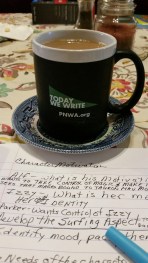 My first drafts tend to be ugly. The story emerges from my imagination and falls onto the paper (or keyboard), warts and all. Each first draft I can write “the end” on is a hot mess of repetitions, awkward phrasing, and cut-and-paste errors. I set them aside when they’re complete and often forget I’ve written them.
So now I have plenty of time to look at these stories analytically. Does the story arc flatline? Is the narrative rife with inadvertent repetition of ideas and reliance on crutch words? What is the boredom factor, and how can it be eliminated?
Those who regularly read my blog know I frequently repeat an idea phrased a bit differently further down the post. We all do this in our first drafts, and very few things are more “first draft” than a blog post.
I print out the story or chapter and read it aloud. I use a yellow highlighter to mark each place where I stumble. By reading it aloud myself (instead of using the narrator app), I find passages that need rewording because they don’t make sense.
I find many other things that need addressing as well:
- run-on sentences,
- spell-check errors,
- numerous small mistakes you don’t notice when reading through it on the computer screen,
- Did I mention inadvertent repetitions?
 Then, I turn to the last paragraph on the story’s final page and cover the rest of the page with a sheet of paper. I begin reading again, starting with the ending paragraph, working my way forward, and making notes in the margins.
You see things from a different angle when you start reading the chapter from the end and work your way toward the beginning. When I read it aloud the first time, I was going in the direction I always go, the way I know so well. The mind has its own version of autocorrect, so even though we try not to, we read what should be there instead of what is.
This admittedly involved process works for me because we don’t notice wonky grammar and mechanics as much when we see them on a computer screen.
I put the hand-corrected copy on a recipe stand (cheap to buy at Amazon) and set it beside my computer. Then, I open the manuscript and save it with a new file name labeled with the date. The date in the file label tells me which is the most recent version of a manuscript. That is the file I use for all my revisions.
 It works the same way for novels. I print out each chapter and go through the steps I described above. Then, I make the revisions in a new file labeled with the date and the word “revised.”
I keep the old files in a folder marked “outtakes” because a story might come along where I can reuse something I’ve already written.
A few things will be embarrassingly conspicuous when I read from the bottom to the top. The second version of repeated ideas are often phrased better than the first, and I go with the one that works best.
Accidental shifts in the spelling of names for people and places will be more visible. I keep a style sheet of how invented names and created words are spelled. I check to see if the word or name is listed and do a global search for each instance, changing it to the one I prefer.
What else do I find when reading forward from the end to the opening?
- Places where I have contradicted myself, such as a town being north of the main character’s location, but they travel south to get there.
- Punctuation errors and missing quotation marks also stand out when I see them printed.
I sometimes forget to make a note of made-up words and usages when I am really into writing. The list can take several forms, but even a simple handwritten page will do. I work in MS Word which makes it easy to copy and paste every invented name, hyphenated word, or placename to a separate document the first time they appear in my manuscript. I use an Excel spreadsheet for this list (called a style sheet) because I was a bookkeeper for a lot of years and like the program.
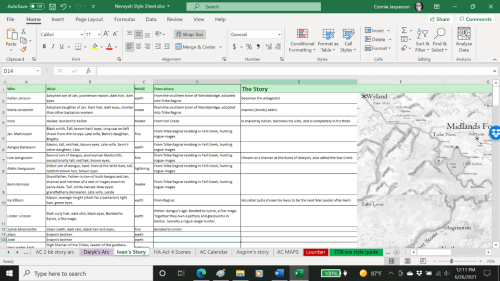 You can get fancy and use a dedicated writer’s program like Scrivener (too complicated for my squirrel brain) or a simple sheet of paper. The internet is full of software for writers, and here is an article to tell you all about them: Book Writing Software (2023): Top 10 Pieces of Software for Writers (thewritepractice.com)
All that’s needed is a list of how you want invented words spelled so that you can ensure they are consistent.
So, if you’re experiencing a little bit of the doldrums, take a look at work you might have shelved. You might find that it needs some sprucing up to make it ready to submit somewhere, but it will be worth it. January and February will see a surge of open calls for contests and anthologies, and you may have something worth submitting.
If you don’t try, you’ll never know.


 Life in the Realm of Fantasy