Tag Archives: writing

#Preptober: Names as a part of worldbuilding #writing

October has arrived, or as many writers will tell you, Preptober. This is the month when November Writers begin preparing for November’s annual writing rumble, the event formerly known as NaNoWriMo. They may create a list of characters and their respective roles.

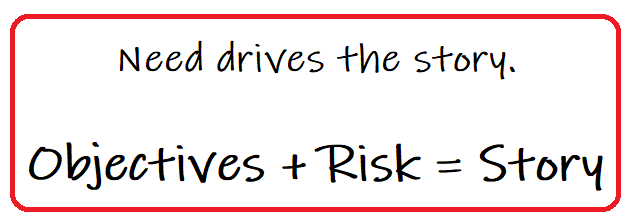
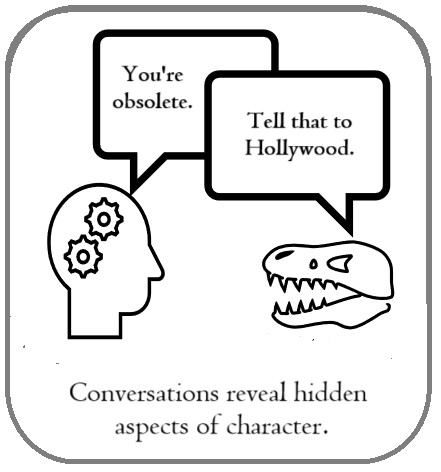
Text only: NaNo Prep, character creation, names and the people who have them.Some, like me, will begin with worldbuilding, drawing a map of where the story will take place and thinking about the people who will bring that world to life.

Creating characters and maps means devising names for people and places. If you are setting your story in a real-world environment, half of the work is done for you. All you have to do is download a few Google Maps, and you have your world.

However, you still need to give your people names. You may also need to invent a town or county that doesn’t exist, but which will fit seamlessly into the real world.

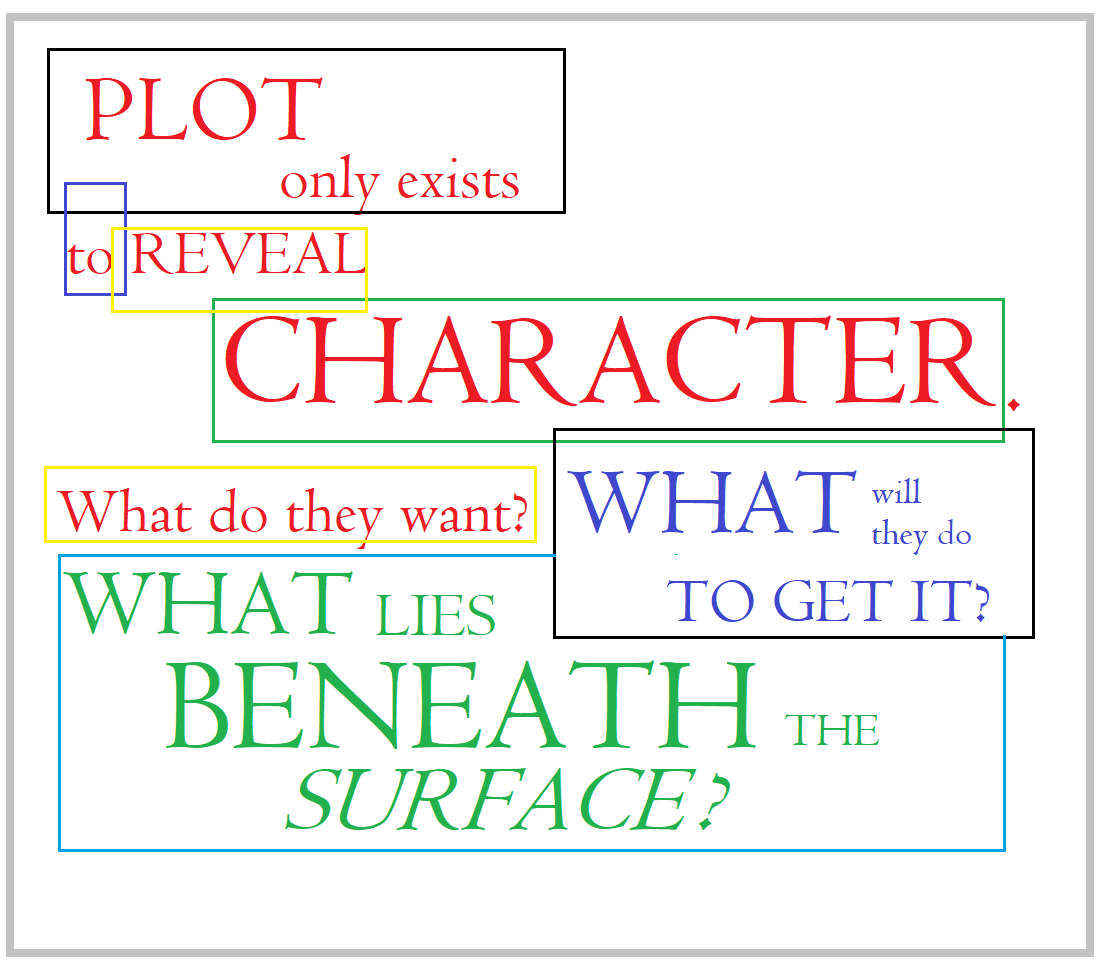
Text only: Fantasy names are a minefield. Keep it simple and think about ease of pronunciation when it comes to how you spell them. Names are a part of the subtext, an aspect that adds to the reader’s mental view but usually goes unnoticed. The names you assign people and places are a part of worldbuilding. If you give your characters names that don’t fit the time, society, and geographical area, readers will find them jarring.

Although I usually start with an outline, my first drafts are often a mess. My stream of consciousness takes over, and I give every walk-on a name, right down to the dog.

This happens because when I am in the creative zone, I forget to look at the outline.

During the first stage of revisions, I whittle down my cast of thousands to a reasonable level.

Here are three rules for deciding who should be named and who should not. Don’t worry about these rules when you are laying down the first draft. Think about them when the story is finished and you are making revisions, as that is when you are making the story flow better.

  1. Is this character someone the reader should remember?
  2. Does the person return later in the story?
  3. Only give names to characters who advance the plot.

These suggestions are true of a novel, a screenplay, or a short story. Names alert us, telling us a character will play an important role in the story.

In my experience as a reader, the pacing an author is trying to establish comes to a halt when a character who is only included for the ambiance has too much time devoted to them.

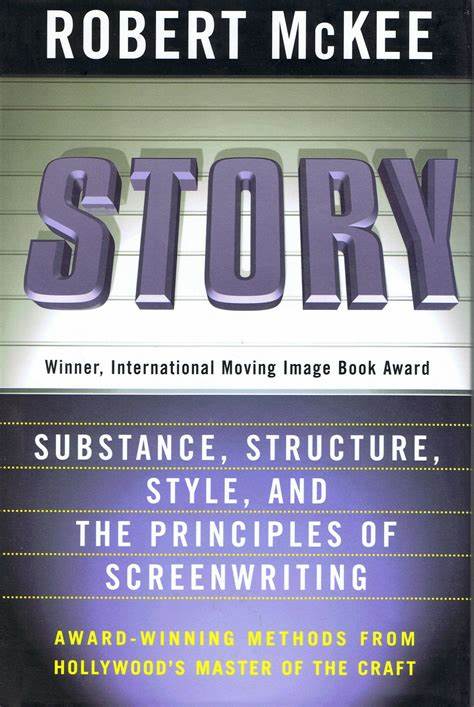
Book Cover image “Story” by Robert McKee.

Novelists can learn a lot about writing a good, concise scene from screenwriters. An excellent book on craft is an older one, but it’s still relevant. Story by Robert McKee.

We want the reader to stay focused on the protagonist(s) and their story. Having too many named characters in a scene is easy to fix. Consider removing characters from the scene if they have nothing to contribute. An example of this is one I’ve used before. It is a transition scene between two characters involved in solving a mystery. One has learned something crucial and needs to meet with the other before he stumbles into trouble.

Julie entered the café at 3:30. All the seats were taken, except for one at the counter, between a man in paint-stained coveralls and a woman with a briefcase at her feet. She caught Nathan’s eye, and he brought her a coffee. “We need to talk,” she whispered. “I’ll wait until you’re free.”

Nathen raised an eyebrow. “I get off at four. See you then.” He refilled several coffees at the counter, then carried the pot to the tables.

This scene depicts Nathan in his job, serving as both worldbuilding and character development. Julie doesn’t need to talk to the people on either side of her onscreen, as idle chit-chat is not necessary and fluffs up the wordcount. The scene can skip forward, and the conversation with Nathan will pick up outside the café after he is off work.

Transition scenes between action scenes are dangerous because the tendency to make every random character memorable is one we can’t indulge. The reader will become confused and irritated if too many characters are named. If a character is set dressing, they should be like the furniture, included solely to lend atmosphere to the scene.

So what about the names we give our people? I’ve mentioned before that I learned a lesson the hard way about naming characters. I have a main character named Marya in one of my early novels, and she’s central to that series. Also, in the first book, a side character was important enough to have a name, but my mind must have been in a rut when I thought that one up.

For some reason, I named her Marta. Marya … Marta … the two names are nearly identical.

To make that faux pas worse, halfway through the first draft of the second book in the series, Marta suddenly became a protagonist with a significant storyline. She actually becomes Marya’s mother-in-law in the next book.

Fortunately, I was in the final stages of editing Book One for publication. I immediately realized I had to make a major correction, and Marta was renamed Halee.

An author should introduce as many characters as necessary to tell the story but should also use common sense.

Inset with text only: Names matter. Keep them simple, keep them separate, and make them count.One last thing to consider is how that name will be pronounced when read aloud. Something that looks good on paper might be impossible to pronounce. Audiobooks have become a big thing, so you may not want to get too fancy with the spelling. That way, a narrator can easily read that name aloud.

In conclusion, don’t confuse your readers by giving unimportant walk-on characters names, and never give two characters names that are nearly identical.

Consider making your spellings of names and places pronounceable, just in case you decide to have your novel made into an audiobook. Your narrator will thank you!

5 Comments

Filed under writing

Notes on Managing Submissions #writing

Do you have a backlog of short stories? One of the best ways to build a reputation as an author is to submit your work to magazines and anthologies.

At first, finding places to submit your work can be challenging, but it’s not impossible. Here are links to two Facebook groups where publishers post open calls for short stories. I have posted these before, and they are still relevant.

Open Submission Calls for Short Story Writers (All genres, including poetry)

Open Call: Science Fiction, Fantasy & Pulp Market (speculative fiction only)

  • You must answer some questions to prove you are legitimately seeking places to submit your work if you apply to be accepted into these groups.
  • Once you are in, you must follow the rules of good conduct for a happy coexistence. Troublemakers and trolls are unceremoniously ejected.

A word of warning: some open calls will be for charity anthologies and are not paid. Do your due diligence. Some “charity” anthology mills have fancy websites featuring “glowing” reviews designed to trick you into publishing with them. Be wary and carefully research the unpaid ones to ensure that the publisher is reputable and that there is a good reason why you are being asked to donate your work for no compensation.

When an author is new to the mean streets of publishing, a vanity anthology mill can seem like a miracle. After all, your work will definitely be published by these predators, no matter how poorly edited it is. Worse, they sometimes offer that service for a steep fee (a BIG red flag). The only volumes they sell are the ones that the individual authors can pressure their friends and families to purchase.

Legitimate publishers do not charge for editing or any other aspect of the publishing process.

Before you sign a contract, remember this: your author name will be listed on the cover and forever associated with that book.

However, legitimate publishers are out there, and they are worth your time and effort. These publishers will pay industry-standard royalties and will offer reasonable contracts.

And on that note, be sure any contracts you sign limit the use of your story to that volume only, and you retain all other rights.

  • You should retain the right to republish that story after a finite amount of time has passed, usually 90 days after the anthology publication date.

SFWA maintains a list of predatory publishers to avoid doing business with. They also provide useful information on potential red flags in predatory contracts. You don’t need to be a member to access these. https://www.sfwa.org/

There are legitimate calls for extremely short fiction by highly reputable publishers. Flash fiction, works of 1000 words or less, is easier to sell to online magazines. Royalties will be paid by the word and might be small as the work they are contracting for isn’t long, but it is payment.

Reputable publishers often have open calls for charity anthologies, which are worth submitting to. These anthologies typically feature one or two well-known authors donating a short story, with work by up-and-coming writers comprising the rest of the book.

You could be one of those up-and-coming authors. But in order to achieve that goal, you must write something worthy of submission.

If a publisher is looking for work that explores a particular theme, such as “escape,” you must think creatively. Consider an original angle that will play well to that theme and then write it.

When you submit your work to various places, you should keep a record of it. Most publishers won’t accept simultaneous submissions. To avoid that, you should list:

  • what was submitted,
  • links or email addresses of where it was sent to,
  • when submissions close.

To that end, consider creating a database for your work. I use an Excel spreadsheet that lists the title, word count, completion date, where and when I submitted the work, how much I earned for it, etc.

Below is a screenshot of what my list of submitted work looks like. I started this file in 2015 and continue to use it to track my submissions.

In extremely short fiction such as drabbles and other flash fiction, you must include only the most essential elements of a story. This kind of constraint teaches us to write concisely and still show an engaging story.

As a poet, I find it far easier to tell a story in 100 words than in 1,000. That 100-word story is called a drabble and is an art form in its own right.

You can find publications with open calls at Submittable. Unfortunately, that site is no longer as useful for speculative fiction as it was several years ago. However, I have seen anthology calls for spec fic there. Still, poetry collections, literary anthologies, and contests use Submittable, so that is an option. https://www.submittable.com/

Some social media platforms are useful, as you may hear about open calls that way. I know many people are avoiding social media these days, but you don’t have to go nuts. Use it just for business (and yes, writing is a business). Follow editors on LinkedIn, Facebook, Instagram, and their Twitter feeds, if you are still using that platform. (I no longer use Twitter, but I do use Bluesky.) Consider following the magazines you submit to (or would like to send work to) on each social media platform you use.

A fellow author keeps a networking notebook. It includes the names of people in the industry she has spoken to, their affiliations (if they work for an agent or editor), their emails and/or business cards, and other relevant details. This information comes in handy when she has to write cover letters to go with submissions to these editors, as she can reintroduce herself as having met them at a specific seminar or conference.

This list of suggestions is meant for authors who intend to write professionally. It’s a business, so these habits help keep me focused and on track.

1 Comment

Filed under writing

The Zen of #writing

Every writer is different, with a unique approach to getting their work on paper. There is no one-size-fits-all method for taking a story from an idea, a “what if” moment, to a finished piece. Each of us has to find our own way.

As an indie, my deadlines are self-imposed, so my production timelines aren’t as finite as a writer who is under contract. If I find myself at a real stopping point, a place where the plot isn’t moving forward, I stop forcing it.

I choose to stop forcing myself to write when the ideas have dried up. I set aside what isn’t working and relax by writing flash fiction and short stories. I have no deadlines, so I can return to a piece that is stuck when I’ve figured out how to get it back on track.

 My goals are for me, not for anyone else. I choose to embrace a Zen writing life.

I’ll admit there is one drawback to this approach, but it’s not the end of the world. One book I began ten years ago feels as if it will never be finished, because I became stalled at the halfway point. Despite my best intentions in 2022, I never got back to it. I know how it has to end, because it is history and is canon in the Tower of Bones series. At this point, I haven’t decided the best way to arrive at that conclusion.

So, one goal for that novel during the rest of this year (2025) is:

First, I will go back to the outline and begin the next phase. Looking at the original plan will help me get the book back on track again. Once I have the plot firmly in mind, I’ll finish writing the pivotal scenes, then tie them together with good transitions. That will complete the manuscript which should top out at 170,000 words.

After that, I will send it to my beta readers. Once I receive their recommendation, I can embark on my favorite part: revising the manuscript. It could take months, but this really is the stage of the process I enjoy most.

Once all that is done to my satisfaction, I will send the manuscript to Irene and have it professionally edited.

The last stage is a two-step process:

  • I make the corrections Irene wants.
  • Then, I hang on to a manuscript and let it sit unread for a while. A month or so later, I print out each chapter and go back through it with a yellow highlighter. At this point, I am proofreading it, looking for typos and cut/paste errors, and making corrections.

Then, if I am happy with it, I will have it professionally formatted for publication. I will also hire the cover out, as I no longer have the patience to deal with cover design.

The first hard-earned piece of wisdom that I have to share with you today is this: you must develop perseverance. You can write the greatest novel ever, but it won’t satisfy every reader. So write your stories for yourself and don’t stop trying.

The second bit is a little more challenging but is a continuation of the first point: Write something new every day, even if it is only one line. You develop better skills when you practice writing a few new words every day. Even if you only have ten minutes free, use them to write whatever enters your head, stream-of-consciousness. Maybe you should write a journal entry.

The third suggestion is fun and easy: learn the meaning of a new word every day. You don’t have to use it, but it never hurts to know new things. Authors should have a wide vocabulary.

The fourth thing: don’t sweat the small stuff when you are just laying down a first draft. I know it’s a cliché, but it is true. Lay the words down, passive phrasing and all, because the important thing is to get the story finished. Don’t share that first draft with anyone you can’t unconditionally trust, as it is yours and still in its infant stage.

The fifth thing to remember is this: every author begins as someone who wants to write but feels like an imposter. The authors who succeed in finishing a poem, a short story, or a novel are those who are brave enough to just do it.

Every author I know has struggled in their personal life. During the years I was raising my children, I had three failed marriages, worked three part-time jobs, and struggled to find time to write. Just when life was getting better financially, two of my children developed adult-onset epilepsy. However, that bad year was when I reconnected with the love of my life. That was the year life became better than good despite the hiccups and the dreaded “E” word.

Now, twenty-two years later, my spouse is suffering from late-stage Parkinson’s, and I am no longer physically able to properly care for him. Still, I visit him every morning without fail, the high point of my day. And even though he is unable to reliably communicate his thoughts, he tells me he loves me. Things are different, but we are still who we always were.

The good things in life are still good, and I choose to focus on those. As time has gone on, I have learned not to panic when I get the dreaded phone call letting me know something bad has happened. Our five children are strong and have stepped into the roles Greg and I have had to step back from. We pull through the rough times as a family.

Everyone needs a creative outlet, whether it is painting, music, or gardening. Writing is how I make sense of the twists and turns of life. It helps me process the complications in a non-threatening way. My Zen approach to writing means I have the choice to write what I can and not feel guilty for the goals I don’t achieve.

  • The story is the goal. Everything else is a bonus.

In real life, nothing is certain. Adversity in life forges strength and understanding of other people’s challenges. It enables us to create characters who aren’t perfect, but with secret backstories that make them more human, more relatable.

Storytelling is my art form, my creative outlet, the one thing I do for myself. I write the stories I want to read, and that is what every writer should do.

So, take ten minutes, and write as many new words as possible. Write a scene, write a 100-word microfiction, or write a haiku. Write these words just for you, a piece you don’t have to share with anyone unless you choose to.

Let go of the guilt. Enjoy the freedom of writing for the joy of it.


7 Comments

Filed under writing

English, the ever-disintegrating language, and why punctuation is important #writing

Every now and then, one of the forums I visit will have a group of people engaged in a little gripe session, sparking a series of comments on how English seems to be sliding in a new and degenerate direction.

I’ve said it before, and I will say it again: English is the ever-disintegrating language. The very roots of English encourage its continual evolution, and the advent of smartphones and the internet have this rollercoaster hurtling downhill.

Unfortunately, I love how each generation of the last three hundred years has twisted common words and used them in “wrong” ways. (I know, I’m naughty.)

The problem many writers have is not with the words they choose and use. It is the lack of knowledge where grammar and sentence structure are concerned.

English grammar, and punctuation in particular, is designed to meet a reader’s expectations. This means that punctuation isn’t flexible, but many other aspects of grammar are.

What makes grammar confusing to the inexperienced author is the fact that the rules are bursting at the seams with exceptions.

This is because, a long time ago in a university far, far away, a bunch of smart guys in Victorian England decided to codify the slippery eel that is English.

They applied the rules of a dead language, Latin, to an evolving language with completely different roots, Frisian smushed together with Old French, and added a bunch of mish-mash words and usages invented by William Shakespeare, calling it “Grammar.”

Some writers are grumpier than others. They do make me laugh, though, with their diatribes declaring that certain newer word usages either signify lazy speech habits or a shift in the language.

A long time ago, I came up with a short list of text-message words that have bled into daily usage. These magical morsels of madness are only the tip of the pox-ridden iceberg:

Supposably … one of my personal favorite crutch words. You may ask if I meant supposedly, and I will look at you with a blank stare.

Liberry … unfortunately, you must go to the library for those books. The liberry will give you hives.

Feberry ... I hope you mean it will happen in February, because Feberry will never come.

Honestness...  honestly, I’m not sure what to make of that one.

But my particular favorite is prolly, which my granddaughters think means probably, but in all honestness, doesn’t. Although in fifty years, it may be the preferred form in the dictionary, and the word probably will be cited as the archaic form.

It’s not a new problem. Jonathan Swiftwriter and dean of St. Patrick’s Cathedral in Dublin, went so far as to say, “In many Instances, it offends against every Part of Grammar.”

Well, that is prolly a little harsh.

English shifts a little with every passing year. It seeks out and pools up in the lowest places. It steals what it wants from every other language it comes across.

That is what makes it so fun to play with. And it’s also what makes English so difficult to work with.

The real problem with some novels, as I see it, isn’t mangled words. It’s this: proper punctuation is vital for the reader to understand and enjoy what you have written.

Punctuation acts as traffic signals, regulating the flow of words in such a way that the reader doesn’t realize it’s there. Instead, they are completely involved in the book.

You don’t have to invest in a library of books on style and writing (even though I can’t pass them up). I have done the work for you by condensing basic punctuation into seven painless rules in this article from last May. It should get you on the right path, punctuation-wise. https://conniejjasperson.com/2025/05/26/self-editing-part-one-7-easy-to-remember-rules-of-punctuation-writing/

An author’s personal voice and style affect the overall readability of their finished product. Good readability is achieved by authors who have developed three traits: understanding of the craft, a touch of rebellion, and wordcraft.

  1. Understanding of the craft: Readers expect certain things of prose, things that go beyond the author’s voice and style. I suggest keeping to generally accepted grammatical practices when constructing sentences. Consider purchasing and using a style guide. This is handy to have when questions arise.
  2. Rebellion: We love it when authors successfully choose to break the accepted rules. They are successful because they do so in a consistent manner, and the reader becomes used to it.
  3. Wordcraft: The way the author phrases things, and the words he/she chooses, combined with his/her knowledge of the language and accepted usage. Perhaps they aren’t afraid to use invented word combinations, such as wordcraft (word+craft). They deliberately choose the context in which their words are placed.

Simply having a unique style does not make your work fun to read. You must meet the reader’s expectations regarding sentence construction, or they will become confused and put the book down. If they review it, they won’t be kind. “Did not finish” is not a good review.

As you are developing your style, remember: we want to challenge our readers, but not so much that they put our work down out of frustration.

Most Indies can’t rely on their names to sell books. That requires marketing, a can of worms I am not qualified to open. But I do know this: there is no point in spending the time and money trying to market a book rife with errors and garbled sentences.

What you choose to write and how you write it is like a fingerprint. It will change and mature as you grow in your craft, but it will always be recognizably yours.

5 Comments

Filed under writing

Walking the path to becoming an author #writing

This last week I was asked what it takes for an ordinary person to be an author. My first thought was, no one is more ordinary than an author.

But I didn’t say that.

Authors are crafts folk, people who work at the craft of writing and take the time to turn out a finished product that is as good as we can make it. You wouldn’t enter a half-finished quilt at the county fair. You would go through all the steps to finish the job and take pride in your creation.

A serious writer takes the book through all the steps needed to make it readable, salable, and enjoyable because we love what we do, and we take pride in it.

It’s a lot of work.

Some writers are better than others, not unlike those crafters who work with wood. A good author is like a carpenter who makes a piece of furniture that will be handed down for generations.

Today seems a good day to revisit an article from February of 2020 on this very subject. Nothing has changed since I wrote this article, so here it is, a rerun that I hope you enjoy.


People often say they want to write a book. I used to say that too.

In 1985 I came across my first stumbling block on my path to becoming a writer. I didn’t know it, but to go from dreamer to storyteller is easy. Anyone can do it.

But if we choose to become an author, we’re taking a walk through an unknown landscape.

And the place where we go from dreamer to storyteller to author is the hardest part.

At first the path is gentle and easy to walk. As children, we invent stories and tell them to ourselves. As adults, we daydream about the stories we want to read, and we tell them to ourselves.

That part of the walk is easy. At some point, we become brave enough to sit down and put the story on paper.

The blank screen or paper is like an empty pond. All we have to do is add words, and the story will tell itself.

The first impedance that would-be authors come to on their way to filling the word-pond with words is a wide, deep river. It’s running high and fast with a flood of “what ifs” and partially visualized ideas.

If you truly want to become a writer, you must cross this river. If you don’t, the path ends here. While this river flows into the word-pond, the real path that takes us to a finished story is on the other side of this stream.

Fortunately, the river has several widely spaced steppingstones. Landing squarely on each one requires effort and a leap of faith, but the determined writer can do it.

The last thing you do before you step off the bank and begin crossing that river is this: visualize what your story is about.

The first stone you must leap to is the most difficult to reach. It is the one most writers who remain only dreamers falter at:

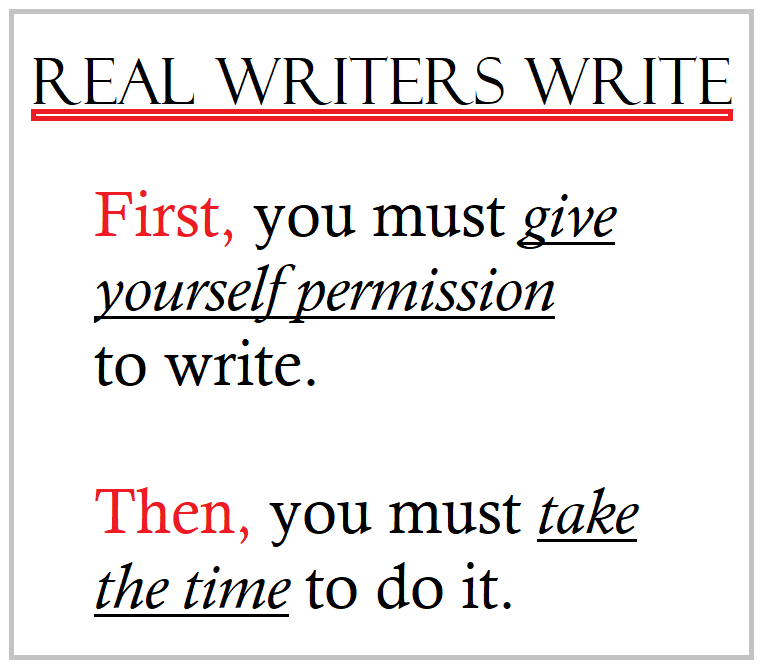
  • You must give yourself permission to write.

We have this perception that it is selfish to spend a portion of our free time writing. It is not self-indulgent. We all must earn a living because very few writers are able to live on their royalties. If writing is your true craft, you must carve the time around your day job to do it. All you need is one undisturbed hour a day.

The second stone is an easy leap:

  • Become literate. Educate yourself.

Buy books on the craft of writing. Buy and use the Chicago Manual of Style. You can usually find used copies on Amazon for around $10 – $15, passed on by those who couldn’t quite make the first leap.

I freely admit to using the internet for research, often on a daily basis, and I buy eBooks. However, my office bookshelves are filled with reference books on the craft of writing. I buy them as paper books because I am always looking things up. The Chicago Manual of Style is one of the most well-worn there.

Most professional editors rely on the CMOS because it’s the most comprehensive style guide—it has the answer for whatever your grammar question is. Best of all, it’s geared for writers of all streaks: essays, novels, all varieties of fiction, and nonfiction.

The third stone is the reason we decided to write in the first place:

  • Good writers never stop reading for pleasure.

We begin as avid readers. A book resonates with us, makes us buy the whole series, and we never want to leave that world.

We soon learn that books like that are few and far between.

The fourth stone is an easy leap from that:

  • We realize that we must write the book we want to read.

As we reach the far bank, we climb up and across the final hurdle:

  • We finish the work, whether it’s a novel or short story.

Over the years since I first began writing, I’ve labored under many misconceptions. It was a shock to me when I discovered that we who write aren’t really special.

Who knew?

We’re extremely common, as ordinary as programmers and software engineers. Everyone either wants to be a writer, is a writer, has a writer in the the family, or knows one.

Even my literary idols aren’t superhuman.

Because there are so many of us, it’s difficult to stand out. We must be highly professional, easy to work with, and literate.

Filling the pond with words and creating a story that hooks a reader is as easy as daydreaming and as difficult as giving birth.

Because writers are so numerous, every idea has been done. Popular tropes soon become stale and fall out of fashion.

A study by the University of Vermont says there are “six core trajectories which form the building blocks of complex narratives.” These are:

  1. Rags to riches (protagonist starts low and rises in happiness)
  2. Tragedy, or riches to rags (protagonist starts high and falls in happiness)
  3. Man in a hole (fall–rise)
  4. Icarus (rise–fall)
  5. Cinderella (rise–fall–rise)
  6. Oedipus” (fall–rise–fall)

No stale idea has ever been done your way.

We give that idea some thought. We apply a thick layer of our own brand of “what if.”

It’s our different approaches to these stories that make us each unique.

Sure, we’re writing an old story. But with a fresh angle, perseverance, and sheer hard work, we might be able to sell it.

And that is what makes the effort and agony of getting that book published and into the hands of prospective readers worthwhile.

2 Comments

Filed under writing

The second draft – a deeper dive into the emotional side of subtext #writing

Last week, in Monday’s post, ‘The Second Draft – Subtext,‘ we barely skimmed the surface of that aspect of our story. We discussed how it can be conveyed as part of world-building. But subtext is so much more. Subtext is emotion. It’s the hidden story, the hints, allegations, and secret reasoning.

  • Subtext is the content that supports both the dialogue and the personal events experienced by the characters.

These are implicit ideas and emotions. These thoughts and feelings may or may not be verbalized, as subtext is often conveyed through the unspoken thoughts and motives of characters. It emerges gradually as what a character really thinks and believes.

It also shows the larger picture. It can imply controversial subjects, or it can be a simple, direct depiction of motives. Metaphors and allegories are excellent tools for conveying ideas.

Subtext can be a conscious thought or a gut reaction on the part of the characters. It is imagery as conveyed by the author. A good story is far more than a recounting of ‘he said’ and ‘she said. ‘It’s more than the action and events that form the arc of the story. A good story is all that, but without good subtext, the story never achieves its true potential.

Within our characters, underneath their dialogue, lurks conflict, anger, rivalry, desire, or pride. Joy, pleasure, fear … as the author, we know those emotions are there, but conveying them without beating the reader over the head is where artistry comes into play.

When it’s done right, the subtext conveys backstory with a deft hand. When layered with symbolism and atmosphere, the reader absorbs the subtext on a subliminal level because it is unobtrusive.

An excellent book on this subject is Writing Subtext: What Lies Beneath by Dr. Linda Seger. On the back of this book, subtext is described as “a silent force bubbling up from below the surface of any screenplay or novel.” This book is a valuable resource for discovering and conveying the deeper story that underlies the action.

Some writers assume that heavy-handed information dumping is subtext because it is often conveyed through internal dialogue,

It’s not. Descriptions, opinions, gestures, imagery, and yes – subtext – can be conveyed in dialogue, but dialogue itself is just people talking.

When characters constantly verbalize their every thought, you run into several problems. First, verbalizing thoughts can become an opportunity for an info dump. Second, in genre fiction, the accepted method of conveying internal dialogue (thought) is through the use of italics.

The main problem I have with italics is that when a writer expresses a character’s thoughts, a wall of leaning letters is difficult to decipher.

Nevertheless, thoughts (internal dialogue) have their place in the narrative and can be part of the subtext. However, I recommend going lightly with them. There are other ways to convey thoughts. In the years since I first began writing seriously, I’ve evolved in my writing habits. Nowadays, I am increasingly drawn to using the various forms of free indirect speech to show who my characters think they are and how they see their world. I rarely use italics.

most of our random thoughts involve obsessing on what we could have done better.A character’s backstory is the subtext of their memories and the events that led them to the situation in which they find themselves. We use interior monologues to represent a character’s thoughts in real time, as they actually think them in their head, using the precise words they use. For that reason, italicized thoughts are always written in first-person present tense I’m the queen! We don’t think about ourselves in the third person, even if we really are the queen.

We think in the first-person present tense because we are in the middle of events as they happen. Our lives unfold in the “now,” so they are written as the character experiences them.

Memories are subtext and reflect a moment in the past. They should be written in the past tense to reflect that. If it was a moment that changed their life, consider rewriting it as a scene and have the character relive it.

We can combine memories and emotions in the form of free indirect speech:

Jeanne paused. The sight of that dark entrance brought a wave of memories, all of them dark and painful.

Chris, on his knees sobbing … their mother’s bloody form ….

She was too young to understand then, but now she knew why Chris seemed so emotionless at times.

Resolutely, she followed him inside.

Subtext expressed as thoughts must fit as smoothly into the narrative as conversations. My recommendation is to express only the most important thoughts through an internal monologue, which will help you retain the reader’s interest. The rest can be presented in images that build the world around the characters.

image of a question mark, asking "what was I thinking?"Information is a component of subtext. We have provided the reader with a lot of information in only a few sentences. They might think they know who a character is, and they have a clue about his aspirations.

But a good story keeps us hanging. Knowledge must emerge via subtext and through descriptions of the environment, conversations, interior monologues, and a character’s general impressions of the world around them.

Odors and ambient sounds, objects placed in a scene, sensations of wind, or the feeling of heat when the sun shines through a window. These bits of background are subtext.

I like books where the scenery is shown in brief impressions, and the reader sees exactly what needs to be there. We don’t want to distract our readers by including unimportant things, such as the exact number of ferns in a forest clearing. The ferns are there, the lost hiker thinks eating their tips is better than starving, and that is all the reader wants to know.

Subtext, metaphor, and allegory are impressions and images that build the world around and within the characters. They are as fundamental to the story as the plot and the arc of the story. As a reader, I’m always thrilled to read a novel that is a voyage of discovery, and good subtext makes that happen.

2 Comments

Filed under writing

The second draft – subtext #writing

Subtext is a complex but essential aspect of storytelling. As the word implies, subtext lies below the surface (sub) and supports the plot and the conversations (text).

It is the hidden story, an unstated knowledge embedded within the narrative.

Subtext can be inserted into the story through the layers of worldbuilding. It is conveyed by the images we place in the environment and how the setting influences our perception of the mood and atmosphere.

We all know good worldbuilding is more than simply detailing the setting. It starts there, but without the addition of mood and atmosphere, a coffee shop is just a room with a few tables and chairs. A reader’s perception of a gripping narrative’s reality is influenced by aspects of the setting that they may not consciously notice at the time.

How does good worldbuilding contribute to good subtext? The clues about mood and atmosphere combine on a subliminal level. This undercurrent shapes a reader’s emotional impressions of the story.

A brief mention of décor can convey atmosphere: Tess stood in line, looking around while Evan secured a table. Country-style furnishings lent a coziness to the room, a warm contrast to the rain pounding on the windows. Soon it was her turn to order. “Two large mochas, please.”

A view of the world from the characters’ point of view is essential, as it conveys mood.

“Why did they bother putting a sign on the dining hall? No matter what Temple you visit, every building is made of white sandstone and you always know where you are and what you are looking at.” Bryson’s scathing tones floated to the instructor, who glared at us all.

Afterward, while readers may not consciously remember details, they will remember what they felt as they read that novel. When asked who their favorite writer is, they will mention that author.

When we experience emotion, we are feeling the effect of contrasts, of transitioning from the positive (good) to the negative (bad) and back to the positive. Moodatmosphere, and emotion form the inferential layer of a story, part of the subtext. When an author has done their job well, those transitions feel personal to the reader.

Atmosphere has two aspects: overall and personal. The overall atmosphere of a story is long-term, an element of mood that is conveyed by the setting as well as by the actions and reactions of the characters.

The overall mood of a story is also long-term. It resides in the background, going almost unnoticed. Mood shapes (and is shaped by) the emotions evoked within the story.

The inferential layer of a story has another component, one we must look at in the second draft. This is where another aspect of worldbuilding, scene framing, comes into play. This component has two aspects: first, it involves the order in which we stage people and visual objects, as well as the sequence of events along the plot arc. It shapes the overall mood and atmosphere, contributing to the subtext.

The second aspect of scene framing involves the plot arc and how we place the scenes and their transitions. We want them in a logical, sequential order.

Good worldbuilding can help us give backstory without an info dump, and symbolism is a key tool for this. Environmental symbols are subliminal landmarks for the reader. Thinking about and planning symbolism in an environment is crucial to developing the general atmosphere and affecting the overall mood.

For example, the word gothic in a novel’s description tells me it will be a dark, moody piece set in a stark, desolate environment. A cold, barren landscape, constant dampness, and continually gray skies set a somber tone to the background of the scene.

A setting like that underscores each of the main characters’ personal problems and evokes a general atmosphere of gloom.

Our characters’ emotions affect their attitudes toward each other and influence how they view their quest. This, in turn, shapes the overall mood of the characters as they move through the arc of the plot. And the visual atmosphere of a particular environment may affect our protagonist’s personal mood.

What tools in our writer’s toolbox are effective in conveying an atmosphere and a specific mood? Allegory and symbolism are two devices that are similar but different. The difference between them is how they are presented.

  • Allegoryis a moral lesson in the form of a story, heavy with symbolism.
  • Symbolismis a literary device that uses one thing throughout the narrative (perhaps shadows) to represent something else (grief).

How can we use allegory and symbolism in modern genre fiction? Cyberpunk, as a subgenre of science fiction, is exceedingly atmosphere-driven. It is heavily symbolic in worldbuilding and often allegorical in the narrative. We see many features of the classic 18th and 19th-century Sturm und Drang literary themes but set in a dystopian society. The deities that humankind must battle are technology and industry. Corporate uber-giants are the gods whose knowledge mere mortals desire and whom they seek to replace.

The setting and worldbuilding in cyberpunk work together to convey a gothic atmosphere. This overall feeling is dark and disturbing. That aspect of subtext is reinforced by the dark nature of interpersonal relationships and the often criminal behaviors our characters engage in for survival.

No matter what genre we write in, the second draft is where we expand on our ideas and fill in the gaps of the rough first draft manuscript. We find words to show the setting more clearly and use visuals to hint at what is to come. We create an immersive atmosphere by including colors, scents, and ambient sounds.

We choose our words carefully as they determine how the visuals are shown. When we have no words and feel stuck, we go to the thesaurus and find them.

Authors are painters, creating worlds out of words. We strive to create an atmosphere and mood that underscores our themes and highlights plot points without resorting to info dumps. Each word is a brushstroke that can lighten the mood as easily as it can darken it.

  • When we create a setting, intense color brightens the visuals, and gray depresses them. Those tones affect the atmosphere and mood of the scene.

In the real world, sunshine, green foliage, blue skies, and birdsong go a long way toward lifting my spirits. When I read a scene set in that kind of environment, the mood of the narrative feels lighter to me.

Worldbuilding is complex. It can feel too difficult when we are trying to convey subtext, mood, and atmosphere, using slimmed down prose and power words rather than flowery. But keep at it because the reader won’t be aware of the complexities involved.

All they will know is how strongly the protagonist and her story affected them and how much they loved that novel.

3 Comments

Filed under writing

Riding in the Rattlebones and wearing the Cone of Shame #writing

At the sweet young age of seventy-two, I make all sorts of calculations as I go through the day. I attempt to cut recipes down to serve only one person but usually fail.

Then I give up and buy single-serve microwave meals. There is less waste, and it’s cheaper. I look for small loaves of bread in the bakery, quarts of oat milk rather than gallons, that sort of thing. That is the usual sort of math people my age do, other than managing the bills. It’s the ordinary trimming down of a once larger food-prep empire.

However, on Friday, as I sat in the emergency room at the local trauma center, I found my bookkeeper brain doing a different sort of math. I had taken my car to be serviced at the Olympia Kia dealership. While walking from the ladies’ room, which was in a separate building, back to the service center, I tripped on a curb.

I suddenly found myself face down on the concrete, in incredible pain. For a few moments, I couldn’t move, but I finally managed to roll onto my back and then sit up.

Then I couldn’t see for the blood that flowed, obscuring my vision.

The fall smashed my glasses and opened a large gash, rearranging my right eyebrow and ringing my head like a bell. I also had several other not-so-good injuries. The people in the sales office rushed to my aid, staunching the gushing wound and calling 911.

I experienced a huge sense of mortality, feeling suddenly very old as I was placed on a gurney with the right half of my face bandaged. Wearing the cervical collar/neck brace felt like the human equivalent of wearing the canine cone of shame.

This experience will lend a bit more understanding as to how I approach writing my characters’ experiences of traumatic injuries.

I did, however, gain a deep understanding of why some folks call the Medic One wagon a “Rattlebones.” The streets here are a bit rough and travelling down the main drag while lying on your back rattles you, the gurney, and the wagon like maracas in a mariachi band.

The EMTs were both kind and supportive. When we arrived at the hospital, they stayed with me until I was booked into triage. After numerous tests, it was determined that I didn’t have a concussion, for which I am grateful.

Via Wikipedia: An emergency medical technician (often, more simply, EMT) is a medical professional who provides emergency medical services. EMTs are most commonly found serving on ambulances and in fire departments in the US and Canada, as full-time and some part-time departments require their firefighters to at least be EMT certified. [1]

I now have a lovely black eye, partly shielded by a white bandage protecting the stitches for a few more days, and a splint that supports my wrist but inhibits movement and makes typing a challenge.

Fortunately, I still had my old glasses. I can still see well enough to read if I use a magnifier, and the distance part of my bifocal lens is still good for driving. I will go to Costco and get another pair of glasses with my new prescription.

So, what sort of math was my confused brain doing in the ER?

  • 1 slight misstep for womankind = 1 ride on a gurney in the Thurston County Medic One van, aka the Rattlebones.
  • 1 cervical collar whether you need it or not.
  • 7 stitches in the right eyebrow, and
  • 1 sprained wrist in a splint (possibly fractured, won’t know for a week).

Add in the black eye, numerous bruises and contusions, eight hours in the ER, and the sum total is:

  • 1 completely deflated ego.

the author taking a picture of herself in a mirror, with bandage over eye and splint on right hand.Yes, technically, I am a senior citizen. But I’m only 72, which, given that most women in my family live well into their 90s, is middle-aged. Mama’s admonitions in my early childhood ring in my ears: “Pick up your feet when you walk and be careful to step up at curbs!”

I should know better.

I DO know better.

But all is not lost. The words are flowing, sort of, and I’m getting them down. I have plenty of microwavable meals and DoorDash to keep me fed.  Everything else that requires mobility/flexibility is doable with a bit of figuring it out.

I suspect I will be healed before I have it completely figured out. That’s the way it is when fate sends us on another spin the Blender of Life.


Credits and Attributions:

Image: Wikimedia Commons contributors, “File:EMTs loading a patient.jpg,” Wikimedia Commons, https://commons.wikimedia.org/w/index.php?title=File:EMTs_loading_a_patient.jpg&oldid=702262046 (accessed August 10, 2025).

[1]  Wikipedia contributors, “Emergency medical technician,” Wikipedia, The Free Encyclopedia, https://en.wikipedia.org/w/index.php?title=Emergency_medical_technician&oldid=1304690357 (accessed August 9, 2025).

8 Comments

Filed under writing

#Writing in the Blender of Life

Technically, I am a full-time writer. For about ten years after I retired from corporate America, I had regular office hours for writing, and very little interfered with it. Nothing lasts forever, and once again, I am drawing on the habits I developed during my years as a hobbyist.

While I’m rarely in the right headspace to do a long stint of writing new words, I manage to fit short bursts of writing into my day, no matter what is on the calendar.

When I was still working, I sometimes wrote during breaks or at lunch. Other days, I was able to dedicate a block of time for writing by rising two hours before I had to depart for work. But waking up that early was tough, so I frequently wrote after the dishes were done and the house was clean. If I skipped watching TV, I could get a whole scene on paper.

Nowadays,  I arrange my writing time around whatever the calendar says is scheduled. I usually have all afternoon to devote to it, but some days are less productive than I wish. However, I always manage to get something done. Even though the advancement is slow, I’m creeping toward the finish line.

A happy life is all about balance, which is sometimes hard to find.

blended margarita drinkI’ve mentioned before that sometimes life is like a blended margarita. It’s a slurry of everything all at once, and here at Casa del Jasperson, things are usually in a whirl or at a dead halt. Sometimes finding my creative muse among the chaos is difficult, and other times it won’t be silent.

If you are a regular here at Life in the Realm of Fantasy, you know my husband is in the late stages of Parkinson’s. He is now in an Adult Family Home, and every morning I go to visit him. That is the one thing that happens every day without fail. All my appointments are scheduled around that morning visit.

Setting him up in a care facility was a difficult decision, as I felt caring for him was my job, my responsibility. But his decline has been exceedingly rapid. He is unable to stand without two people assisting him as he can’t transfer himself from wheelchair to bed, and is unable to reliably communicate his needs. He can no longer write, use his cellphone, or use the computer.

In May, I had to face the reality I had put off for as long as I could: my husband was no longer safe in our home. He had fallen twice and developed a blood clot in his left leg.

I had help from a Senior Living professional in finding the right place for him. We found a lovely home fifteen minutes away from my apartment, just down the road from the house I grew up in.

The home is owned and operated by two registered nurses, with two licensed CNAs (certified nursing assistants) on duty around the clock. He has his own room, the kind of food he likes, and company. Currently, there are only three residents, but the maximum capacity is six, with each resident having a private room.

They have daily activities, games, and physical therapy. Best of all is the lovely, peaceful deck where residents can take their wheelchairs to sit. He and I often sit out there absorbing the serenity of the back garden. The ongoing squabbles and dramas among the squirrels and many birds keep us both entertained.

So, things have settled into a routine here. I have more free time, which allows me to participate in my writing group and engage in write-ins with the larger writing community. I have time to mentor new authors and can enjoy the occasional lunch with friends.

walla walla onionsWriting posts for this blog and the community of friends I have found here has been the one constant during a stretch of time when everything felt out of control. The plot in our community garden has been a surprisingly relaxing hobby. I have harvested strawberries, tomatoes, and onions. In the next few days, celery will be on the menu.

The lone pumpkin plant is taking over the world, and I will get six or seven pumpkins when all is said and done. They should be small, as they are the sugar pie variety, but when I planted it, I had no idea how big a single pumpkin plant would get.

I am so grateful for the blessings, the good things that stand out sharply against the not-so-good in life. I can still be with my husband for part of the day, and I have the freedom to do a few things that I was unable to do before.

Life is different, but it’s still good.

6 Comments

Filed under writing

Constructing the short story – the Narrative Essay #writing

I talk a lot about the craft of writing, from novels to short stories, poems, and microfiction. Some might think that outside of journalism and blogging, there isn’t much left for an author to focus on. However, there is another area of writing that we’ve all heard of but don’t often think about. They are essays.

Narrative essays most frequently appear in magazines, so that is where to look for the best contemporary work by today’s authors of mainstream fiction.

  • And much of it is sitting around in waiting rooms the world over, so take a more critical look at the magazines the next time you go to the dentist.

Essays offer an author the opportunity to express ideas and values. Michel de Montaigne (1533–1592) was the first author to describe his work as essays, by which he meant attempts. He used the term to characterize these short pieces as “attempts” to put his thoughts into writing.

Narrative essays are drawn directly from real life, but they are fictionalized accounts. They detail an incident or event and talk about how the experience affected the author on a personal level.

One of my favorite narrative essays is 1994’s Ticket to the Fair (now titled “Getting Away from Already Being Pretty Much Away from It All“) by David Foster Wallace, published in Harper’s. I’ve talked about this particular piece before. It’s a humorous, eye-opening story of a naïve, slightly arrogant young journalist’s assignment to cover the 1993 Iowa State Fair, told in the first person.

Wallace assumed it would be a boring event featuring farm animals, which might be beneath him. But it was his first official assignment for Harpers, and he didn’t want to screw it up. What he found there, the people he met, their various crafts, and how they loved their lives profoundly altered his view of himself and his values.

As we find in Wallace’s piece, the primary purpose of an essay is thought-provoking content. The narrative essay conveys our ideas in a palatable form, so writing this kind of piece requires authors to think.

Some magazines are still available in print and can be found at many grocery stores and bookstores. However, don’t hesitate to submit to online publications, as many magazines have transitioned to publishing online rather than on paper nowadays. Legitimate online publishers pay the same royalties to their authors as those still publishing via paper do.

A narrative essay is just like any other form of short fiction. It has content and structure:

  • Introductory paragraphs that hook the reader.
  • An intriguing plot that keeps the reader interested.
  • Engaging characters.
  • An immersive setting.
  • An ending that satisfies the reader, but leaves them thinking about the story and what might have happened next..

Choose your words for impact because writing with intentional prose is critical. A good narrative essay expresses far more than mere opinion, more than simply relating an experience. Essays sometimes convey deep, uncomfortable views. The trick is to offer them in a way that the reader feels connected to the story. Once readers have that connection, they will see the merit of the opinions and viewpoints.

So, now we know that narrative essays are a way of sharing our personal views of the world, the places we visit, and the people we meet along the way.

  • Names should be changed, of course.

Literary magazines want well-written essays on a wide range of topics and life experiences presented with a fresh point of view. Authors can make their names by being published in a reputable magazine. You must pay strict attention to grammar and editing to have any chance of acceptance.

After you have finished the piece, set it aside for a week or two. Then, return to it with a yellow highlighter and a fresh eye. Print it out and read it out loud, checking for dropped and missing words. Read it aloud yourself, because in this case, I do NOT recommend the narrator function of your word processing program.

In the process of reading aloud, you will highlight the following bloopers:

  • Misspelled words, autocorrect errors, and homophones (words that sound the same but are spelled differently). These words are insidious because they are actual words and don’t immediately appear out of place.
  • Repeated words and cut-and-paste errors. These are sneaky and dreadfully difficult to spot. Spell-checker won’t always find them. When you read them silently, they make sense to you because you see what you think you wrote. For the reader, they appear as unusually garbled sentences, and you will stumble over them as you read aloud.
  • Missing punctuation and closed quotes. These things happen to the best of us.
  • Digits/Numbers: Miskeyed numbers are difficult to spot when they are wrong, unless they are spelled out.

Don’t be afraid to write with a wide vocabulary and use power words. Readers of these publications have a broad command of language. While they won’t want excessively flowery prose, they also don’t want to read a dumbed-down narrative.

  • However, we never use jargon or technical terms that are only known to people in certain professions, unless it is a piece for a publication catering to that segment of readers.

Above all, be a little bold. I enjoy works by authors who are adventurous in their work.

And finally, we must be realistic. Not everything you write will resonate with everyone you submit it to. Put two people in a room, hand them the most exciting thing you’ve ever read, and you’ll get two different opinions. They probably won’t agree with you.

Don’t be discouraged by rejection. I follow several well-known authors via social media because what they have to say about the industry is intriguing. They’re journalists who submit at least one piece weekly, hoping they will sell one or two a year. One says she aims for one hundred rejections a year because two or three stories or essays are bound to strike a chord with the right editor during that time.

Rejection happens far more frequently than acceptance, so don’t let fear of rejection keep you from writing pieces you’re emotionally invested in.

This is where you have the opportunity to cross the invisible line between amateur and professional. Always take the high ground—if an editor has sent you a detailed rejection, respond with a simple “thank you for your time.” If it’s a form letter rejection, don’t reply.

What should you do if your work is accepted but the editor wants a few revisions?

If the editor wants changes, they will make their requests clear. Editors know what their intended audience wants. Trust that the editor knows their business.

Make whatever changes they request.

Never be less than gracious to any of the people at a publication when you communicate with them, whether they are the senior editor or the newest intern. Be a team player and work with them.

And when you receive that email of acceptance, crack open the Bubbly (in my case, Sparkling Cider). Give yourself permission to celebrate having sold your work.

Comments Off on Constructing the short story – the Narrative Essay #writing

Filed under writing