Monthly Archives: April 2015

Conventions: Hawking your books vs attending the convention

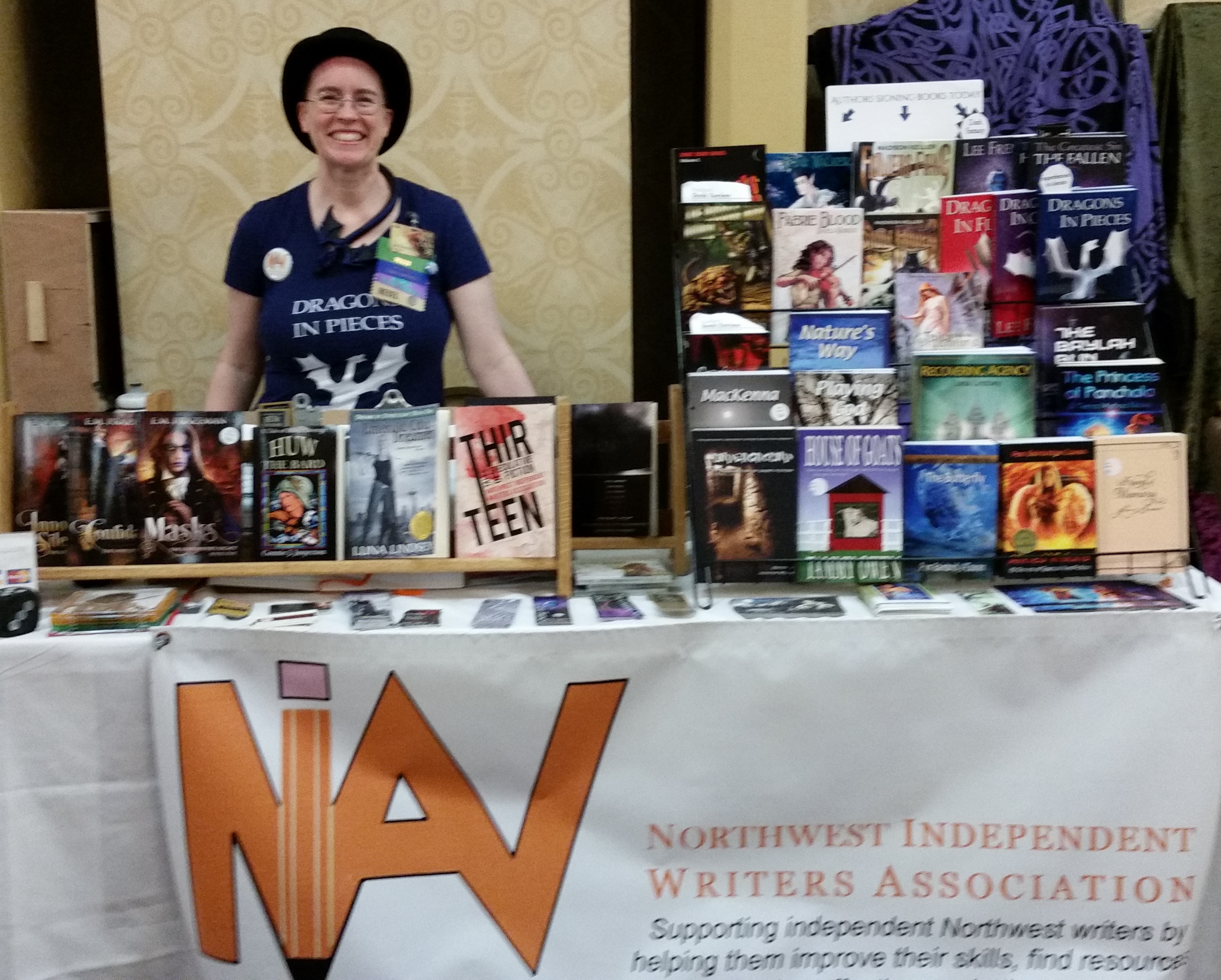
Lee French at Norwescon 2015 in NIWA Booth

Lee French at Norwescon 2015 in NIWA Booth

Going Indie means going it alone, and doing it the hard way. However–there are now small bands of indies coming together to help each other, and in the process, help themselves.

One such organization is Northwest Independent Writers Association, an organization of indie and small-press authors based in Western Oregon and Western Washington. We seem to be situated along the I-5 corridor from south of the Portland area north through the Seattle area.

This last week I attended Norwescon, carpooling the first day with fellow Myrddin Publishing Group author, Lee French. She is an awesome person, as well as a wonderful, creative author.

My book, Huw the Bard, was in the rack at the NIWA table, and I met some of the most wonderful people: Angela Korra’ti, Madison Keller, Jake Elliot, and Luna Lindsey were all there, manning the table and helping each person who stopped to find a book that fit them, regardless of if it was their own book or not–we were selling each others’ books as well as our own.

I ran into my good friend, fellow NIWA  member, Thomas Gondolfi , who was working his own booth.

Saturday night, Lee, Jake, Angela and I had dinner with fellow NIWA member, steampunk author, Jeffrey Cook.

Huw the Bard at NorwesconMy feet are killing me–today, I am not sure I will do it again, but I am glad I did this time.  My view will likely change as I begin to feel rested again.

Huw the Bard was not a good fit for that venue–they were more into fairies and steampunk, which Huw is obviously not. However, I think he would do well at a ren-fair, as the people who were interested in him were all ren-fair people.  Most likely my best books for a gaming venue will be my World of Neveyah series, as it is RPG game-based, and gaming of all varieties is what Norwescon is all about.

Standing in the booth for most of 4 days did me in, I do confess.  I also was somewhat of a 5th wheel, in that the booth was too small for the number of authors who were there and willing to contribute their time and energy to the project. There was only room for 1 chair, and so we stood. I felt a bit unnecessary, at times, which is not a good way to feel, but they very kindly tolerated me.

Angela Korra’ti has a knack for selling her books, and I tried to learn as much as I could from her. Jake Elliot and Lee French seemed to know what they were doing too–there is definitely a learning curve to pitching your book live and in person.

norwesconBeing an indie author, or being published by a small press means you are on your own as far as getting the word out about your books.  This means if you want your books seen at a convention, you have to pay for the table, buy your stock, and get the word out, because no one else will.

It also means you must spend the convention in the dealers’ room at your booth, pitching your product to strangers, rather than taking in the panels and hearing speakers like George R. R.  Martin. But I did see him in the lobby while I was getting coffee, and I saw many, many people who really love his work, far more than I do–and they stood for hours to get to see him.

I would have loved to hear George speak, but I had books of my own to hawk. I never thought I would live long enough to be able to say that.

This is where you discover that going indie means honing an elevator pitch that will sell your book in thirty seconds. That will be my next trick.

cashbox 3This is also where you discover that the Sparco cash-box you bought, and  that was not cheap, is nearly impossible to unlock, but it makes an awesome weapon if you are ever mugged on the way back to your hotel. Which I wasn’t, but I’m an author, and that’s how I think.

It’s also where you discover that your target audience was not at that convention.

Most importantly, this is where you realize that your poor old feet are  just not up to you spending 10 hours a day standing on them.

I understand there is some controversy regarding the Hugo award nominations–but I didn’t hear them announced, as I was trying to sell books. I suppose a shakeup is inevitable, and I will have to do some reading to find out for myself what the problem is, in the eyes of the reading world.  That will be interesting–accusations of blocks of special interest groups gaming the outcome and such intrigue me, and I will definitely want to get to the bottom of that!

14 Comments

Filed under Adventure, Books, Fantasy, Humor, Publishing, Uncategorized, writer, writing

Norwescon 2015

NorWesCon 2015 - 1This weekend I am at Norwescon in Seattle, Washington, along with fellow Myrddin Publishing Group author, Lee French. This is where I get to do both the work and the fun stuff that goes along with being an author–AND Huw the Bard will be offered on the NIWA table!  How cool is that?

Norwescon is a gamer-scifi-fantasy addict’s paradise.  The guests of honor are George R. R. Martin (Author), Julie Dillon (Artist), Amy Mainzer (Science), and Random House (Spotlight Publisher) represented by Anne Groell and Tricia Narwani.

Plus, there will be a large number number of seminars and special events: Thursday, Friday, and Saturday night each feature a DJ’d dance in the grand ballrooms, and Lazer Tag and many other games. Friday features an 18-and-over special event. And, don’t forget the Masquerade, complete with Children’s Masquerade. Holy cosplay!

Michael Tinker Pearce came by our booth on Thursday,  and I have to say I loved his work, Diaries of a Dwarven Rifleman. I really enjoyed meeting him–he’s a charming man.

000510Of course, food is tricky–the vegan must provide for herself while on the road. One can only hope that the room she ordered at her hotel that is within walking distance of the event will have the kitchenette as she had requested. Otherwise she will be downstairs at the breakfast area using the microwave at all hours.

Feeding myself at these events is always a challenge, even at conventions where they claim to provide for “special” dietary needs.  How hard is it to bake a damned potato and garnish it with a little guacamole, and some veggies sauteed in olive oil?  Apparently impossible, as proven by my annual PNWA conference dietary fiasco at the Hilton. I look forward to seeing how they manage to screw up “special” needs every year. Last year I was literally the last person to be served at the banquet, and the food arrived cold and inedible–and my table mates had long since finished theirs when mine was delivered.

Being glared at by the servers for wistfully hoping to eventually see a plate of food was also to be expected–after all, “special dietary needs” are a selfish fad designed to draw attention to ones self, don’t you know.

But Norwescon will be different. It’s far less expensive to attend, less than 1/5 the cost of PNWA (indies pay their own way, you know) and they proved snacks but you aren’t tied to their menu.

The difference is this: PNWA is a writer-focused event with seminars, agent, and editors attending and presenting seminars. I’ve found the writers who give the seminars there to be really entertaining and THAT is why I attend. It is an awesome, inspiring conference that recharges me.

Julie Dillon will be speaking at Norwescon, and as a wannabe artist myself, I’m quite intrigued by her work. The covers art she does for mainstream fantasy authors is just as high a quality as that of the legendary Michael Whelan.

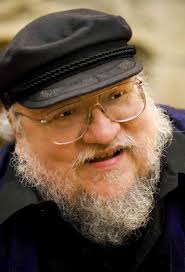
George R. R. Martin photoSo I get to hang out in the dealers area with my friends from NIWA, buy a new T shirt or two designed by some crazy-gifted people, and I will get to hear George R.R. Martin speak on Sunday morning. Don’t love his work, but I adore him as a man and as a speaker.

If I am really crafty, I can get my pristine, barely-been-read first edition of A Game of Thrones signed during one of George’s 3 scheduled signing events–wowsers.

During the hippie era, of which I was a late entry to, most hippies did not refer to themselves as hippies as that was really term used when our parents were complaining about us. Mostly we referred to ourselves as freaks, since the mainstream society considered our willful desire for world peace to be aberrant. But out of that culture grew some of the best scifi and fantasy authors and artists of all time.

And so I say, it’s good to be a freak in a land where freaks really know how to freak! Norwescon will be an adventure for sure!

8 Comments

Filed under Fantasy, Humor, Literature, Publishing, Uncategorized, writer, writing

Creating Conversations

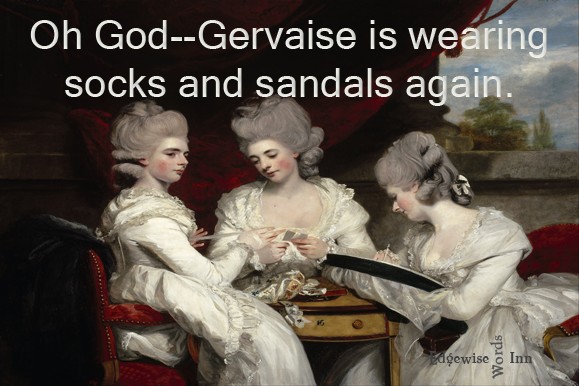
Socks and Sandals MemeConversations are easy to write…badly.

Unless the author thinks about it carefully, they can be stilted, stiff, and an unnatural wall of blah-blah-blah. Good writing involves learning the craft, and nowhere is that more apparent than in a conversation.

So how does the intrepid author write this phenomenon in such a way that it sounds natural? I always think of a conversation as having an arc: It begins, rises to a peak, and ebbs, an integral part of the scene, propelling the story forward to the next scene.

We might jabber about nothing, but in writing,  a good conversation is about something and builds toward something. J.R.R. Tolkien said that good dialogue must have a premise and moves toward a conclusion of some sort. If nothing comes of it, the dialogue is a waste of the reader’s time.

First, when we write about conversations between our characters, we want to ensure they don’t all sound like the same person. Imagine you are at a party. If you look around you, observing the conversations going on in small clusters, you will notice that every person has different mannerisms. The same is true of your characters when you see them in your head. With that image in mind,  you want to include those differences in their gestures, and their manner of speech.

When people talk, they rarely follow grammatical rules. Any English class you’ve taken will have stressed the importance of using proper grammar and punctuation in your writing, and believe me, those rules are important. However, when we attempt to write dialogue, those same rules should be thrown out of the window. People speak in broken sentences, with pauses, and even use incorrect words.

Now we get to the part where my editor and I have our own little conversation—the one where I stick random bits of punctuation in at odd places and she puts them where they belong or removes them entirely:

She: “I agree with the grammar part. I take exception to the punctuation. Punctuation rules MUST be followed especially in dialogue so that the reader reads the dialogue in the same manner the writer intended it to be read.”

Me: “Yes, ma’am.” (Muttering as I find ways to insert action where I want the pauses to go.)

Leonard_Nimoy_William_Shatner_Spock's_Brain_Star_Trek_1968We all take breaths at different places. Some people speak quickly and off the cuff, with short bursts. Others consider their words before they say them and speak more slowly. Every person in a given room speaks with their own unique style and pattern.

What are the roots of these patterns?  Speech habits are born in the environment the speaker grows up in, but they become identifiable mannerisms acquired throughout our lives.

Consider how the conversation fits into the arc of the scene.

We’ve talked about this before, but it bears repeating: first we must identify what must be conveyed in our conversation.

  1. Who needs to know what?
  2. Why must they know it?
  3. And how many paragraphs do you intend to devote to it?

My rule of thumb is, keep the conversations short and intersperse them with scenes of actions that advance the plot. Walls of meaningless conversation don’t keep the action moving and will lose readers, so  the conversations you include in your narrative must be important—and intriguing.

Author James Scott Bell says dialogue has five functions:

  1. To reveal story information
  2. To reveal character
  3. To set the tone
  4. To set the scene
  5. To reveal theme

SHotel California Memeome people will have the characters discuss the back-story, and this can be good if done the right way, in small snippets at critical points, and only when that information is needed. But this can be bad, especially when used as away to dump history in long, bloated paragraphs of dialogue.

Don’t give your characters long paragraphs with lines and lines and lines of uninterrupted dialogue. Those are sometimes seen as a wall of words by the reader. When asked how to write a good book, Elmore Leonard said, “Try to leave out the part that readers tend to skip.”

That goes double for dialogue. When I think of the novels I’ve enjoyed the most, the important information in their conversations is dealt with up front, and the minor details emerge later as they become important.

We don’t want our characters to be just a bunch of talking heads, sitting around, yammering on. It’s unnatural and doesn’t happen in real life except on the nightly news.

I’ve mentioned this before, but your characters should pause in their conversations, and sometimes miss a few beats. Beats are what screenwriters call the little bits of physical action that are inserted into dialogue and which in a novel can serve to indicate who said what without a dialogue tag interfering with it. Actions serve to punctuate the dialogue, to give the scene movement, and to maintain a strong mental picture, especially when an author is trying to balance the use of dialogue tags.

e3-2013-trailer-final-fantasy-x-x-2-hd-remasterRemember, actions are best placed where there’s a natural break in the dialogue. They show the mood and personality of your characters and allow the reader to experience the same pause in the dialogue as the characters do, and increase the sense of immediacy, making the scene real in the reader’s mind. It’s through the small habits we give our characters that we convey a little bit of their back-story, without having to resort to an info dump.


3 Comments

Filed under Books, Fantasy, Humor, Literature, Publishing, Self Publishing, Uncategorized, writer, writing