 Being an author is a business. It is a retail business, and you must look at it from that point of view, even if your work isn’t selling like hotcakes at the local diner. Big, fat books that are full of bloated exposition and conversations to nowhere are more expensive to publish and are unlikely to sell once the prospective reader has leafed through them.
Once you have a book published, you have a business, whether you are an Indie or traditionally published, and you must think about it from that angle. Wouldn’t you like to see some money from your work? Your best chance of this is at trade shows and book signing events. However,
- In the real world, authors must pay for each book that is stocked on their table.
“This won’t apply to me,” you say. “I’m going the traditional route. Once I sell my book to that Big Publisher in the Sky, he will provide me with all the copies of my books that I will ever need when I do signings, at no cost to me.”
Not so, my deluded friend.
A traditional publisher who is really excited about your book might arrange for you to have a table at a convention and will advance you copies of the books for you to sell and sign, but the cost of those books will come out of your earned royalties. You will see no money from your publisher until your book has out-earned all the advances they have paid you. So, just like an Indie, you pay for the books for your table at trade shows, conventions, and at most book-signings. The fact is, many traditionally published authors never out-earn their advances. Retail sales at shows are where they stand the most chance of bringing home money from book sales.
Consider how many copies of each book you can afford to take to the book signing event. You must weigh this cost against what you think the demand will be. Books that cost YOU more than $5.99 each are not a good thing for an Indie, because you must pony-up the cash at the time you order them. If you buy too many and they don’t sell, you have a lot of cash tied up in stock-on-hand that is earning you nothing.
For an indie who writes epic fantasy, it’s most cost-effective to keep your work to between 90,000 and 120,000 words if you intend to print through CreateSpace, which prints my paper books. If you have written a 300,000-word epic fantasy, consider dividing it into three volumes of 100,000 words each. Otherwise, you will be required to charge $17.99 to $20.00 per book just to make a minimal profit through Amazon.
How do we keep this cost down? We get a grip on the fluff that has worked its way into our work, and trust me, I didn’t understand this when I first began writing full time.
In the first draft, we have created a large amount of backstory. This is because we needed it to get a grip on the characters, their world, and the situation in order to write it. This is work the reader does not need to know the minuscule details of. To avoid info dumps and yet deploy the background as it is needed, we write conversations.
We need to exercise restraint. In the second draft, we decide what is crucial to the advancement of the plot and what could be done without. In recent years, I have begun cutting entire chapters that, when I looked at them realistically, were only background. In some cases, it was my favorite work, but when looked at with an independent eye, it didn’t do anything but stall the forward momentum of my book.
So how do we convey a sense of naturalness and avoid the pitfalls of the dreaded info dump and stilted dialogue? First, we must consider how the conversation fits into the arc of the scene.
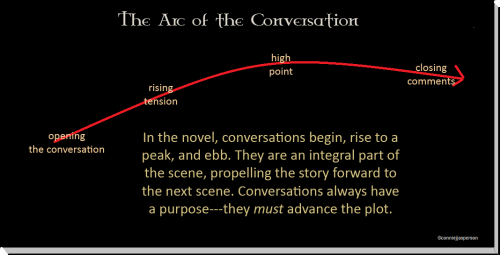
It begins, rises to a peak, and ebbs, an integral part of the scene, propelling the story forward to the launching point for the next scene. A good conversation is about something and builds toward something. J.R.R. Tolkien said, “Dialogue has a premise or premises and moves toward a conclusion of some sort. If nothing comes of it, the dialogue is a waste of the reader’s time.”
First, we must identify what must be conveyed in our conversation.
- Who needs to know what?
- Why must they know it?
- How many paragraphs do you intend to devote to it?
My rule of thumb is, keep the conversations short and intersperse them with scenes of actions that advance the plot. Think like a screenwriter–visualize the conversation as if you are viewing it on a stage. Does the thought of two heads yammering about the weather for half an hour really interest you? No. Show the weather and spend your conversations on the important things. Walls of conversation don’t keep the action moving and will lose readers.
Author James Scott Bell says dialogue has five functions:
- To reveal story information
- To reveal character
- To set the tone
- To set the scene
- To reveal theme
So now that we know what must be conveyed and why, we arrive in the minefield of the manuscript:
- Delivering the backstory.
 Don’t give your characters long paragraphs with lines and lines and lines of uninterrupted dialogue. Those can become info dumps laced with useless fluff and are sometimes seen as a wall of words by the reader.
When the dialogue is trying to tell the reader too much, characters end up saying a lot of unnatural and awkward things. Characters go back and forth explaining precisely what they are feeling or thinking, and it doesn’t seem remotely real.
- Background information must be deployed on a “need to know” basis. If it is not important at that moment, the reader does not need to know it.
- The only time exposition works is when both the reader and the character being spoken to do not know the information being artfully dumped.
When reading, even dedicated readers will skip over large, unbroken blocks of words. Elmore Leonard famously said, “Try to leave out the part that readers tend to skip.”
I feel this goes double for dialogue.




 Life in the Realm of Fantasy