Today’s guest post concludes my two part series on two exhibits of the 2017 Biennale in Venice: the Glasstress exhibit, and the Mark Bradford Exhibit. Today’s post is by Dr. Colleen Getz, and digs deep into the mysteries of American artist Mark Bradford’s creative genius. Enjoy!
“Tomorrow is Another Day”: Mark Bradford, American Artist at the 2017 Biennale
By Colleen Getz
The works of Mark Bradford, Los Angeles-based African-American artist command the American Pavilion at the 2017 Biennale in Venice. All but one of the works were created for the Biennale. When Bradford spoke at the opening of the exhibit, his remarks focused on his role as an artist and citizen. Thus, it is not only appropriate, but rather essential that any review of his Biennale installation focus first on Bradford’s view of himself and his role in the world.
Bradford spoke compellingly about his interest in politics, social policies and community. “Being an artist doesn’t mean I lost my passport to my citizenship. We need to expand the definition of artist,” he stated. For Bradford art and social engagement are parts of a whole, and both begin with community.
In Los Angeles he founded Art + Practice an organization that supports children in foster care (children who are in government care) and provides the local community opportunities to experience contemporary art. Similarly, in Venice he founded Process Collecttivo, which works in partnership with a local organization that works with prisoners to support their transition back into society by developing skills that will allow them to be self-sufficient. Both are long-term projects, in keeping with Bradford’s commitment to economic sustainability, to give people a solid foundation in life. He declared he is “obsessed by sustainability.” He gets involved, he explained, by talking to people outside of the art world, by listening to what they need and determining what he can do to help them sustain themselves.
So it is no surprise that the physical material and content of his work come from his engagement with the world. He says he pulls information—the people, the stories—as well as the physical material he uses from the world into his studio. There he adds his perspective to it all—the urgency he finds, the hope he feels. The resulting work is a project created not just of material taken from the outside world, nor something created in a hermetically-sealed art studio. Rather it is something in between, artistic creations he calls a little bit elegant and a little rough. He declares he’s a “big process person, a big ‘I don’t know’ person.” He feels most comfortable when people tell him they’re trying to figure something out, working through something. Similarly, he doesn’t mind letting people into his thinking process. He doesn’t need to be “Instagram perfect.” He believes perfection can alienate.
And, alienation is clearly an anathema to Bradford. His life and art together—are determinedly an ongoing masterwork against alienation and marginalization. He said firmly while he may have problems with aspects of the world, he has never had a problem being in the world. His response to contemporary events is to engage and encourage others to engage as well. Similarly, he asserted that he has no problem being black, but does have a problem with being reduced to what some people mean by that. He proclaimed what’s exciting about the situation in the United States now is “we’re having conversations about what it is to be North American that are not just about race. We’re beginning to have conversations about nationhood that are about more than black and white.” He is encouraged that a lot more young people are getting involved in the political machinery of the country. He declares it “super healthy” that his nieces and nephews want to discuss how the U.S. Congress operates. He says recent events in American politics are like “when the ground moves and certain gases escape.” As a result, people are becoming interested in the North American political structure. “I see possibility in that, I’m always looking for possibility, no matter what happens. Whatever I get thrown I can work with it. For me it’s always about navigation, not crying about roadblocks, it’s always about trying to find a way to navigate. Navigate and negotiate.”
When asked how to bring marginalized voices into the national discussion Bradford said you can’t disappear because you’re nervous and scared, and referencing his Biennale exhibition avows, “though my exhibition begins with a collapse and a push to the center, we have to push back into it even if it’s a bit problematic; we can’t allow ourselves to accept marginalization, that’s something we can never allow. Progressives belong at the table. My whole life people told me, Mark you know you don’t belong at that table and I said, yeah, I do. We have to demand that we push into the center as close as we can get and I’m going to do this as an artist. The center needs to see me more than I need to see them. People In the center don’t know what an artist looks like any more. They have some romantic notion of what we do, but they don’t see what we do.”
So what has Mark Bradford done in his Biennale exhibit? He has created a journey through works that that both encapsulate the artist’s personal vision and provides the opportunity for viewers to find their own vision within.
The first notable aspect of the exhibition is its title, which is the closing line of Gone with the Wind, both book and movie. It is Scarlett O’Hara’s declaration of hope and faith in her power to move forward and shape her future in the face of great loss. Given the racism in Margaret Mitchell’s work, it is not an obvious choice for an exhibition by an African-American artist. When asked, Bradford said that he had chosen it two years before, with an entirely different theme for the Biennale in mind. But, although his ideas for the exhibition changed, he found the words still relevant, given what is currently occurring in the United States. So these few words both encapsulate both Bradford’s attitude towards American life and guide visual and philosophical journey on which Bradford takes the viewer.
 The visual experience begins with the interplay between his works and the architecture of the American pavilion itself. It is an example, in miniature, of a classic American government building, found not just throughout Washington D.C., but in cities and towns across America. The structure, with its columned façade and central rotunda is the physical embodiment of “the center” of power and authority in American society to which Bradford referred in his remarks. You enter it, and the exhibition, from the left wing and immediately are confronted by that power and authority in the shape of a massive bulb of paper that hangs from the ceiling, filling the room and forcing you to edge your way around it. As Bradford described it, this tumorous mass represents a kind of collapse of the structure of “the center”. With its scabby surface of rough spots of black, orange, red and white (layers of paper that have been blasted with a pressure hose) it intimidates and marginalizes the viewer. There is no way to view it comfortably. And to get past it, we have to use
  Bradford’s approach to life, we have to navigate and negotiate our way around it to the next room.
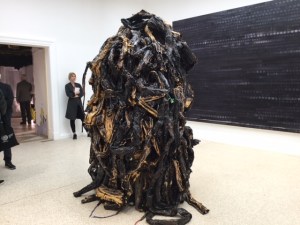
There we find in the center of the room a tall sculpture of twisted ropes of black paper partially bleached yellow. The viewer does not need to be told that the artist named it “Medusa.” It’s powerful, seething mass, is both complemented and counterbalanced by the works that surround it on the walls. In these pieces Bradford has returned to a form he explored earlier in his artistic career. Endpapers—used in styling women’s hair, and here dyed shimmering shades of purplish-black, create compositions of subtle color gradations that invite the eye to explore their nuances. The use of endpapers is inspired by Bradford’s early life. His mother is a hairdresser and owned a beauty salon in which he worked for years. When asked why he had returned to this medium, he replied simply that he “hadn’t finished with it, there were still some paintings I wanted to do”. He added that he had stopped doing them because he felt they had led people to reduce his life down to a rap video—a “black hairdresser from south central Los Angeles.” But, “black people’s stories are as diverse and messy as everybody else’s. I just want diversity.”
And diversity is what he has created in this room. In substance it is an homage to the black women, including his mother, of whose inspiring, supporting role in his life he speaks frequently. In style it exemplifies “elegant and rough” in Bradford’s work and demonstrates how they can work together to convey a coherent and compelling vision.
 What then to make of the next installation in the pavilion? One steps from the expanse of this room into the confines of the small space under the rotunda at the center of the pavilion and is immediately overwhelmed by an encrustation of the same black and bleached paper as the Medusa sculpture, which coats the dome and pours down the sides of the room. He explained how it came about—originally he had planned an entirely different work for this space but decided shortly before the start of the Biennale that it “wasn’t working” for him. He terms the work in the rotunda “a lot of process”, and thus a prime example of how Bradford does not mind letting people into his creative process.
It is physically intimidating and visually striking, but what does it mean? The artist himself called the rotunda “monstrous but beautiful.” In his remarks Bradford said he is more comfortable when people tell him that they are trying to figure something out, or are working through something. The rotunda certainly provides them with such an opportunity. The work lends itself to several interpretations, all in keeping with Bradford’s keen sense of himself as an 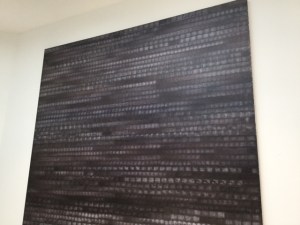 American citizen. First, there is the obvious inference to American history and slavery, since the rotunda as an architectural form in America is often associated with Thomas Jefferson. Jefferson developed a love of Palladian architecture while serving as a diplomat in France, and designed a rotunda for both his home, Monticello, and the main building of the University of Virginia, whose original campus he designed. It is easy to interpret the dark mass covering the rotunda as a metaphor for the monstrous enslavement of Africans whose labor sustained Jefferson’s elegant intellectual life. The contrast between the smooth neo-classical form and Bradford’s seething work addresses an ongoing question in American history: how to understand the contradiction within the man who could write the Declaration of Independence yet enslave others his entire life? One can take even a broader view of the contrast of form and surface in the rotunda. Since the rotunda is at the center of a building that is the physical embodiment of the centers of social and political power in the United States, the viewer can also see Bradford the citizen at work here. He has demonstrated how the realities of American life have encrusted the elegant, beautiful and inspiring ideals on which the country was founded. But, because the encrustation appears dynamic, he also has demonstrated that there exists opportunity for movement and change.
That change is manifest in the following room. Here form and color of the compositions become lighter, and dynamic in a way that lifts the spirit and brightly engages the eye. Bradford has dyed, bleached and molded the paper with his hands to create complex compositions of diverse surfaces, shapes and colors. Red is startlingly present in some, suggesting violence and drama. Examine the compositions up close and the multiplicity of round shapes suggests the molecules that make up life; step back and the compositions taken as whole suggest an ever-expanding, ever-progressing universe. Above all, they engage in a way that is entirely in keeping with Bradford’s approach to current American life—the ability to see possibility and opportunity, to navigate and negotiate our way forward.
 We then arrive at the final work in Bradford’s exhibition. The only one which was not created for the Biennale. It is a 2005 film of a young, strong African-American man striding down a city street, seen only from the back, walking away from the camera. It is not a staged walk, it is real—the man used to walk by Bradford’s studio every day—intriguing the artist so much that he asked to film him. And one can see why. He symbolizes the apotheosis of the ideal of citizenship Bradford spoke about. He does not need to navigate or negotiate his way. He has made his place at the table, he is seen; he belongs. He walks forward with assurance. The viewer sees him, confident in his place in the world, striding into his future. And thus, the ultimate message of Bradford as American artist and contemporary American citizen is conveyed—that always, “Tomorrow is Another Day.”
>>><<< >>><<< >>><<<
About the author, Dr. Colleen Getz
Dr. Colleen Getz studied art history at Smith College. She has published op-eds in the New York Times and Wall St. Journal as the official speechwriter for a senior government official and in the Washington Times under her own name. She has previously served as an editorial consultant to the art journal gallery.spb; this is her first article for it, which will be published in its online version later this year.
Credits and Attributions:
“Tomorrow is Another Day”: Mark Bradford, American Artist at the 2017 Biennale, by Colleen Getz, ©2018 Colleen Getz, All Rights Reserved. Printed by Permission.
All images used in this article are ©2018 by Colleen Getz, and are intended solely to illustrate this post. Used by permission.

 I try to approach writing each dialogue scene as it would be portrayed in a movie. I think of each conversation as an event that must advance the story, so dialogue must do at least one (if not all) of these things:
 We began with the same words and a notebook, and used the same names. But with different relationships, we ended up with different characters. They have a different quest, and their story is written for a different genre. However, the layers in this fantasy do the same work as in the contemporary piece. The layers that form this scene are:


 Life in the Realm of Fantasy